
Nothing to see here, only another book promoting the medicalisation of youth.

The blurby bit
Join YouTube star Jamie Raines for tea! Jamie will be discussing and answering your questions about his new book, The T in LGBT. Sharing advice, tips and personal stories and answering questions about starting hormones and considering surgery, The T in LGBT is an indispensable guide to the trans experience and gender identity.
Whether you’re questioning your own identity or whether you want to learn about the trans experience to support someone or understand allyship, everyone is welcome.
Jamie Raines is a 29-year-old trans man from the UK. Known as Jammidodger online, Jamie is a content creator and LGBT+ advocate with an online following of more than one million people. Jamie also has a PhD in Psychology, focusing on transgender development and wellbeing.
This event will be hosted by YouTuber, podcaster and author, Hannah Witton. Doors will open from 1:45pm.
Your ticket includes a cup of tea!
From Eventbrite
About Jamie Raines
Jamie Raines aka Jammidodger has over a million subscribers on YouTube. At the time of writing her latest post, uploaded three days ago, had already received 77 thousand views. It’s normal for her to get over one hundred thousand hits, or even millions of hits, for her posts.
Her current pinned post is ‘Bad Women’s Anatomy is Getting WORSE’. She’s natural and chatty on camera, including clips of herself tripping up over the phrase ‘trans inclusive’, this could easily be edited out, but clearly kept in to add to the aesthetic of her affable persona. In the video she makes simplistic links between women’s bodies and misogyny. Hence, we have a ‘man’ who wants to lecture her teen girl audience about how awful men are, whilst showcasing her ability to empathise with women (all too understandable when she is one). This is who her audience is then, girls who are unsure about their changing bodies.
Her videos are mainly about transgenderism but also its offshoots, like asexuality. Perhaps her main topic though is her ‘transition’. Jamie has had bilateral mastectomy, ‘bottom surgery’ in the form of a metoidioplasty (where a hormonally enlarged clitoris is surgically freed to look more penis-like and a sac created to house a pair of prosthetic balls, and is, in my opinion, far worse than phalloplasty on an aesthetic level). She has been on testosterone for 12 years. She does pass, it has to be said, and is good looking, so I understand her appeal.
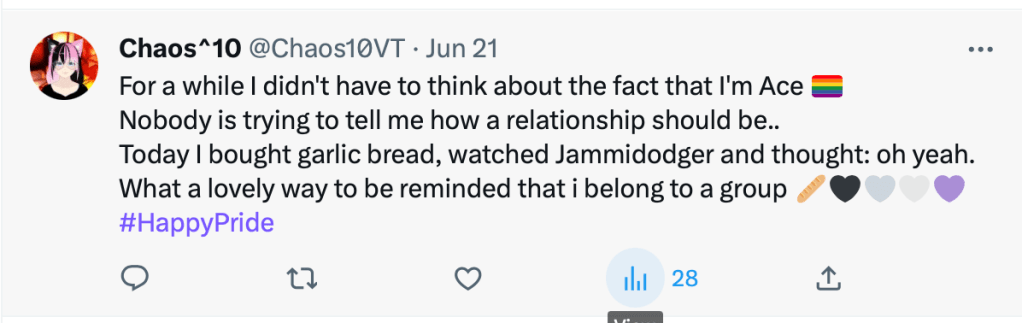
About Shaaba
An unexpected extra was the appearance of Jamie’s partner, Shaaba. In this piece from the Daily Mail in 2018, we are told that Shaaba has ‘always identified as a heterosexual and had previously dated boys’ and that she and Jamie have been together since they were both 16 years old. Jamie began her ‘transition’ shortly after aged 17. Shaaba is a regular contributor to Jamie’s videos. As the friend who accompanied observed, there are some things you can’t control off screen, Shaaba’s domination of Jamie being one.
About the host
Hannah Witton is also a YouTube star who educates on ‘sex, relationships and pleasure’, including age restricted content, e.g. rope bondage, but it is hard to believe she would appeal to an 18 plus audience given her conspicuous immaturity. Talking about sex toys is something she is interested in quite a bit (not age restricted) and asks ‘deep’ questions like ‘Is death erotic?‘. Like Raines she is popular, easily reaching thousands of views per video and no doubt her youthful appearance (and immaturity) helps.
About the audience
The audience was mainly teen girls, no surprises there, some of whom looked palpably conflicted. There were only two males that we noted, both adult, but there were a number of adult women, some were mums with kids in tow, or else older trans-identified females. There were at least two adult women who had support cuddly toys on display, their heads proudly poking out of tops of bags. About fifty people attended.
The weird dynamic
Although this was Jamie’s book launch and her interview, both Hannah and Shaaba dominated the conversation, with Jamie taking a backseat and deferring to her missus whenever Shaaba indicated she wanted to speak (which was all the time). Indeed Jamie seemed reticent to voice her own thoughts and experiences, often being prompted by Shaaba, and quite forgetful too. Hannah too could talk the hind legs off a donkey and took far too long to ask such simple questions.
It begins with a joke about a T party
So we were promised a cup of tea with the price of the ticket, and indeed refreshments were put out. Hannah began by telling us she didn’t drink tea. Neither does Jamie as it turns out. Knowing laughs from some in the audience followed – T being slang for testosterone – Hannah laughed but the double meaning went clear over her head.
What was the process of writing the book like?
Jamie immediately defaulted to inarticulating her thoughts about what it was like to transition, recalling that writing about stuff made her remember stuff, like the first time her voice dropped. No emotional or intellectual reflections were offered, even though she described it as ‘cathartic’.
Did you have a person in your head who you were writing the book to?
Jamie told us that she wrote the book that she wanted to write when she was 16 (I’ve heard this answer given so many times now by trans authors of self-help books). Jamie wanted to be able to provide a checklist of ‘what are the different surgery options’.
What advice do you have for someone who wants to talk to their parents about gender?
Jamie had no solid advice to give, explaining ‘it kind of depends on the parent’ and that her mum was the first person she spoke to, she had shown her Tumblr and YouTube videos. Hannah has a toddler and reflected that the child ‘may not end up being cis’ and was open to having that conversation (very soon by the sounds of things). She told Jamie that the conversation Jamie had had with her mother ‘wouldn’t have just happened’ if the foundations for openness hadn’t been laid down years before (that was for the mums in the room).
Then Shaaba, who talked in a voice that was so hard to hear, gave a very long irrelevant anecdote about being behind someone in a queue – ‘Do you remember this? she asked of Jamie, who dutifully responded in the affirmative – a mumsy-looking woman said she wasn’t going to buy Lego for her daughter because she was a girl.
Does transphobia fill you with rage? Or, does it fill you with hope because you’re seeing all the progress that is being made?
Jamie told us that it was very disheartening but didn’t sound like she meant it at all. She had started her transition twelve years ago and whilst there was a lot of information out there now (about how to do that) there was also a corresponding increase in ‘hate’. Jamie however did feel there was hope and that there was a lot progress being made in the background. Transphobia was nothing more than recycled homophobia.
When do you give up on people?
Jamie hated the phrase ‘time will heal’ because you could give up on somebody and then suddenly they might have an epiphany. The tipping point though was if she felt she needed to protect herself, that’s when she removes herself from the situation, and leaves it to the other person bring the olive branch.
Shaaba launched into answering an entirely different question, saying that there should be no pressure for someone to decide on new pronouns or a new name. She was answering the question as a ‘cis person’, having gone through what she had gone through being in a relationship with a ‘trans person’. At the start of their relationship her parents had been a very ‘negative force’. An aunt had finally told her that you can’t change someone’s core values, for example, Shaaba can’t just suddenly become transphobic or racist at a drop of a hat! There is nothing you can do to help a shift, except provide information when they’re willing to listen. Then Hannah basically repeated a version of what Shaaba said. Jamie sat in the middle of the two obediently looking from one to the other as she was spoken over. Shaaba continued after Hannah’s interlude to inform us that it was a much healthier mindset to tell people: ‘I’m demanding you accept my existence.’
Hannah reported that some of her friends, although they were like LGBT Allies and everything, had started to pick up some of the stories about trans people in the media (thank you Lia Thomas and Isla Bryson). Apropos of nothing Hannah then gave out such a stupid little giggle. These friends had this blind spot because they weren’t close to a trans person in real life. Hannah’s final complaint was that these criticisms often came from well educated people who sounded like they were being even-handed.
Have you had any conversations, like that?
Jamie couldn’t recall anything but a quick nudge from Shaaba prompted her to recall that her PhD supervisor and his senior academic colleague had both known about autogynephilia. This was a number of years ago. Hannah wanted Jamie to explain what autogynephilia was, ‘it’s complicated’ said Jamie, realising perhaps that there was no easy way to whitewash an explanation, but Hannah said ‘isn’t it when you’re sexually attracted to yourself?’ and that ‘it very much leans into transphobic belief’. Jamie agreed.
When Jamie told her supervisor she wanted to research trans people she had been given a book on autogynephilia. Initially this academic thought that Jamie was a ‘pre-transition trans woman’. Over time, apparently, the supervisor became more receptive to using the language that Jamie wanted around these issues. As ever, ‘famous celebrities’ were rounded upon (i.e. invoking the spectre of JK Rowling) who had no right to talk about trans people because they weren’t trans themselves. According to Jamie we should only form our views on trans people in line with what trans people say about themselves.
Shaaba talked at least three times as long as Jamie, talking about her own personal brand of ‘cis allyship’. Hannah rivalled her, asking Jamie a question, before wandering off again into her own verbal diarrhoea, including expressing disbelief that a friend had watched Gender Wars, the utterly benign documentary starring Kathleen Stock and loathsome Katy Jon Went. Hannah herself had watched the first ten minutes (from behind the sofa, I bet).
How do you deal with intrusive questions about your transition?
A ridiculous question since anything you could possibly want to know is in Jamie’s videos. Jamie reflected that these questions weren’t asked in the spirit of being open minded and that she had found what Shaaba and Hannah had said really interesting.
What makes you feel gender euphoria?
Hannah reflected that ‘cis’ people also have a gender and thus are also subject to gender euphoria. Jamie couldn’t think of anything. Shaaba gently reminded her ‘that’s the whole last chapter of your book,’ and Jamie thanked her for not only being an emotional support but also a memory support. How do you forget a whole chapter in a book?
Shaaba dived into answering the question for herself. ‘Boobs’ (her own) are what gives Shaaba gender euphoria. Shaaba assured us that she knew that ‘boobs do not mean woman’ but it still sounded a little transphobic to me. Shaaba likes to give herself a little thumbs up in the morning when she sees her boobs in the mirror. Tee-hee. Jamie dutifully responded that she found it very distracting too, giving Shaaba the opportunity to chide ‘typical man’. Lots of giggles from the teenage audience, as you’d expect.
Jamie finally remembered an instance of gender euphoria, one that had happened very recently. It had taken about four years for facial hair to grow properly and even longer for her chest hair. Recently she discovered that a friend (Shaaba prompted her to reveal that it was fellow YouTuber Alex Bertie*) was shaving her chest hair off. Jamie wondered if she should try it too. And she did. And then like it grew back and everything. Jamie realised this was normal.
* By the by, in Alex Bertie’s most recent post, her first in two years, she reveals she is now having to wear a wig. She also has a new book out – a trans romcom.
Hannah’s gender euphoria was breastfeeding, commenting that it made her ‘feel like a woman’. Shaaba then claimed that gender was unimportant to her everyday euphoria, it was just a feeling that arose once you were comfortable with yourself.
Jamie has a code word she uses with Shaaba
Don’t worry, it’s for when Jamie needs to indicate to the ever-present-Shaaba that she’s feeling gender dysphoria. Instead of asking a question, Hannah fully explained the situation to us, that it was a handy tip and ensured the trans person had a place to go to safety. She also informed us all that there was a useful checklist in the book to help people change their legal paperwork.
When Jamie was finally allowed a chance to speak, she came out with a load of guff about having ‘open conversations and mutual boundaries’ and to ‘go at a pace you’re both comfortable with’, i.e. the way that no one really communicates in intimate relationships. Jamie added that you didn’t need to tell someone on the first date that you were trans, just to tell them when you felt comfortable, but added you should really tell them before you get intimate. Erm, good idea.
Shaaba had a lot of over confident words too for the mainly teenage audience, who had probably never even kissed someone yet.
Hands up who has a question for Jamie (or Shaaba)?
– the Q&A
How do you protect your mental health when dealing with the awful press coverage?
Asked by middle aged woman.
Jamie gave a pat answer, it’s clear that she hasn’t had to think about this issue. I’m guessing that’s because she doesn’t actually read any of the articles about the controversies, like prisons or the medical malpractice. Shaaba said you didn’t need to be kind to people who are being unkind to you, but what she really meant were people who disagree with you. Shaaba claims that she is often asked how she and Jamie have sex with each other, clearly a lie since the likelihood of getting a word in edgeways with her is close to zero. We did finally get a tip though (remember the event was billed as tip-fest), if someone says something you don’t like just look at them for three seconds and move the conversation on. (She forgot to add what to do when the person simply repeats their original question.)
Hannah’s tip was to ask ‘What do you mean by that?’ and then you could deliciously enjoy watching them tripping over themselves to over-explain exactly what they meant. Hannah added she hadn’t the chance to use that yet. Doh!
I’m in a relationship with a trans woman for the last six months, these are challenging times.
Comment made by middle aged woman, teen sat next to her.
What are your highlights of transition?
Asked by teenage girl.
Something had sprung to mind but Jamie didn’t know if it was appropriate. ‘You set the tone,’ Saaba almost reprimanded. It wasn’t T, it was the moment when Jamie ran upstairs and felt her prosthetic balls jiggling about. The other was when her voice broke on T.
Will you accept my gift?
Asked by the child of the woman dating the trans-identified male.
The gift was a packet of Jammie Dodgers and the kid had even gone to the trouble of deleting the E off Jammie, so that it correctly read Jammi. Chronic.
How did you prepare yourself for your changes on T?
Asked by teenage girl.
Jamie focussed on preparing other people, which neatly excused her from talking about anything medical or any research she may have done on side effects. She advised her parents on what was going to change. Shaaba revealingly recalled that Jamie getting on ‘HRT’ felt like a deadline and alleged that it had taken so long to get it, and, ‘it shouldn’t, hashtag reform the NHS’. There were so many milestones to reach after starting testosterone too.
Hannah suggested that people record themselves so that they had a permanent record of the changes their bodies had gone through (as if this generation aren’t already routinely doing this). Jamie agreed, and claimed she hadn’t noticed the deepening of her voice because it dropped slowly.
The thing that worries me more than out and out transphobes are those people who are allies to your face but not when you’re not around. Is that something you have dealt with?
Asked by young woman.
This had had happened to Jamie and Saaba recently. People who were accepting to their faces but didn’t want to come to their wedding. Jamie doesn’t speak to these (non-specified) people anymore. Simple as. ‘You don’t respect me all the time, I don’t want to know you any of the time,’ said Jamie.
Should schools be doing more for trans people?
Asked by middle aged woman.
Jamie, who only started identifying as trans after she met her girlfriend Shaaba by the look of things, says all she ever wanted at school was to be ‘being trans is okay’ and that it would have meant so much to her to have heard this and made a big difference.
Hannah said a lot of scaremongering going on at the moment and that schools were the place where kids could try out new names and new pronouns. It was horrifying that such children might need their parents permission to change their pronouns at school. It was important that parents who were allies to the LGBT cause were listened to over those who were not and that these parents should really put pressure on schools to protect trans kids, this included allowing them whatever name, pronoun or uniform they wanted.
Shaaba said that although it was this young generation most affected by these things right now, they were also the coolest generation. She learns things from 12 year olds. The week before, in a family group chat, one had expressed delight that Jamie had been able to make a presentation to their school assembly sharing ‘a bunch of different trans resources’. If legislation* did come in which stopped children being secretly transitioned at school, find another way of getting these materials delivered to the students.
* The Bill, bought by Reclaim Party MP Andrew Bridgen, was discussed in Parliament several days later and did not pass – see here for article.
Were there any changes on T that you didn’t want to happen/were afraid of? If so, how deal you deal with these?
Asked by teenage girl
Jamie said that taking testosterone had made her smell (like cat piss I’ve heard). The audience giggled. She’d also been worried by hair loss (luckily she is blessed with naturally thick abundant hair, so has avoided that so far). Jamie then rather dodged the question, stating it wasn’t about one individual change, it was about the multitude of changes, and she had thought at the time ‘if I lose my hair, so what?’. Which is funny isn’t it, since most men are rarely so blithe about the balding process. The girl questioner was relieved to hear this there’s-nothing-to-fear answer.
That was the end of the Q&A but Jamie was then to do a signing, so there was an opportunity to ask a question one-to-one and most of the teenage audience formed an orderly queue.
Conclusion
It’s something few have understood yet, the power of the YouTube star. Some stars have audiences most could only dream, yet the mainstream media remain aware of their influence. And Jamie’s moniker, Jammidodger, is particularly interesting in that it evokes the wheeler-dealer, so beloved by the British, of a guy gaming the system. The system the Jammidodger is gaming is sex, avoiding the pitfalls of a female body. The ‘jam’, so to speak.
This is just my hunch, but it appears to be me that Jamie has been very much lead by her girlfriend in her journey down transition. Not only did she constantly look at Shaaba for prompts and actual memory nudges, but the history of their relationship as per the Daily Mail article suggests that the idea for being trans may have arisen in an attempt to convince Shaaba’s family this was a heterosexual partnership. Jamie’s behaviour during the event was completely submissive. Happy to let the two other women talk more and over her. How many male authors can you think of who would be happy with that?
Moreover though it was clear that the teen audience was most definitely there because they had an interest in the practicalities of so-called transition. Note that there were three teenage girls questioners who all wanted to know the same thing, albeit differently worded to the question I am about to pose; ‘Will testosterone devastate my body?’ On this subject Jamie marvellously dissembled, although given her circle of friends she must know first- and secondhand of the serious side effects. Indeed many of her videos have documented such things and the complications of surgery. One suspects the book is similarly coy about such things.
The book is published by Vermilion, the Canadian arm of the Penguin/Random House group.
Thank you for reading! Sign up to my blog by going to the bottom of the page.
Please share on other forums if you liked it, as I only do Twitter.
 The Lies They Tell
Thank you for the possessive pronoun. A proper application of ‘gender’.
LikeLike