
Session covered:
WHAT DOES A GENDERQUEER MUSEUM LOOK LIKE?
The session was called WHAT DOES A GENDERQUEER MUSEUM LOOK LIKE? and part of a day-long festival called Queer and Now held at the Tate Britain. For the very full programme see here. You will note that themes of transness and intersex dominate and the acronym honoured is LGBTQIA+. ‘Tate members of staff wearing Vibe Checker lanyards will be on hand to help you enjoy the day,’ we were told. There were also wildly inappropriate workshops for children and the man who poured piss over himself outside the EHRC head office back in September 2022, as reported in Vice, also took part in an open session celebrating a new magazine called oestrogeneration.
The blurby bit

Queering the archives
It must be the umpteenth time I have written about the ‘queering’ of museums and history. One thing trans activism has innately understood is the control of history and cultural spaces and thus we have the Tate Britain art gallery hosting this explicitly political diatribe demanding space. It’s not the first time either.
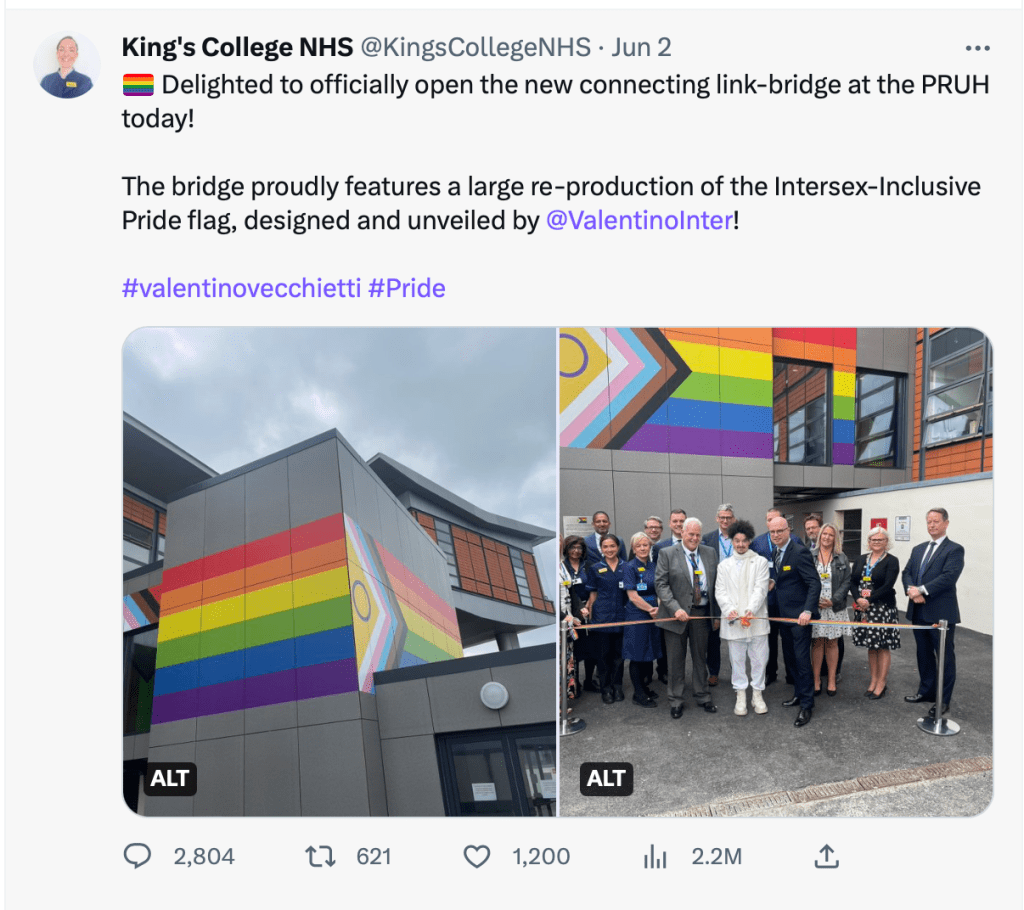
At the helm were two women who have enormous sway, E-J Scott, a trans-identified female, and Valentino Vecchietti, who is an intersex-identified lesbian. As far as I am aware Vecchietti has never disclosed which Disorder of Sexual Development she is affected by, but has successfully added ‘Intersex’ to the Pride flag, on trains, and now on a hospital.
It begins
E-J Scott began by saying it wasn’t the first time this discussion had been held (you’re not kidding) but was the first time it included the IA+ communities (I don’t think so). It was an ‘urgent’ discussion said E-J, rather unconvincingly in her contrived drawn out voice, putting spaces between words way beyond natural pauses. Effective though, as I found myself literally hanging onto every word. E-J told us the panel was going to consider whether or not the museum space could play a role in healing divisions among genderqueer people.
First the panel would introduce themselves and then there would be ‘a conversation’ because E-J doesn’t like ‘top down teaching’. She wanted us to ‘pause for a moment’ in ‘soft time’ because it was a ‘very noisy world out there’ for the Alphabet Bag and we all needed a moment of ‘queer contemplation’ (cue loud snort from me). On our chairs were blank pieces of paper in which we could write questions down as they come to you (mine was ‘When we will reach the point that ‘prick’ is finally understood as a misogynistic term?’). There would be a break and then the panel would answer the questions submitted by the audience. We won’t get through them all, E-J reminded us, since they were only going to choose the two questions they wanted to discuss in the first place. ‘Does that sound good?’ E-J asked the room, and despite no one saying ‘yes’, she quickly moved on, – to lecture about how the room needed to be a safe space, a space where we cared about each other.
The interminable introductions
Winn Austin
First up was the trans-identified male on the panel. Winn Austin is famous for being in the Channel 4 series Gender Bender in the 1990s (of which I could find no record) and more recently running up some stairs in Hampton Court.
E-J Scott waxed lyrical about the clip she’d seen of Winn navigating these stairs, noting that he had done ‘a massive twirl’ yet had looked ‘entirely at home’, this made E-J wonder where Winn got his confidence from? Winn told us that his family had always allowed him to be himself ‘without barriers’. He came to the UK as a teen from Ghana.
It was Richard Sandell, sat in the front row, who’d given Winn his opportunity to run up and down in Hampton Court Palace. Sandell is an academic/activist who has invested rather a lot of time in ‘queering the museum’ and even a book called Museum Activism.
Winn generously described himself as a very kind person, but that we probably wouldn’t believe it because he was so gorgeous. E.J. wanted to know if he wanted to give his energy back to museum spaces. Winn wasn’t particularly in love with the museum sector because when he was growing up there was no representation of ‘my culture’. At school he had been forced to learn about British history. This was only his second time inside the Tate Britain.
Predictably E.J. was very sympathetic, agreeing that there was be no reason for Winn to come to a museum unless he was able to see himself in it.
Janine Francois
Janine Francois identifies as a black feminist killjoy who wanted to destroy ‘the binary industrial complex’. She is an academic responsible for setting up ‘hip hop culture modules’.
With Janine, E.J. took a different tack, speaking about how ‘trans people are not allowed to say people are trans in the past’ (you are dear, just don’t pick on women, like George Eliot, who clearly weren’t). ‘There’s sis-sis-silencing going on,’ said E.J. in her contrived drawl. She invited Janine to talk about the ‘cis-heteronormative gaze’. Janine talked about colonialism, imperialism and capitalism, or rather she just mentioned those words and whinged about her lack of power. She encouraged us to look around the room at the paintings on display, claiming that the people depicted in those painting were all ‘cisgendered, heterosexual and white’. I’ll give her the last one, but how can you tell gender identity or sexuality by looking at a painting? Lack of blue hair?
What would happen, asked Janine, if we put black and brown LGBTQI+ people as the central focus of culture and everyone sat around that? It would radically shift research for a start, she said, ignoring that this shift has actually taken place a number of years ago and is the bandwagon she’d hopped on at that time.
Janine said she didn’t have time to talk to ‘cis white straight people about systems of power’ adding that she ‘didn’t care actually [what they thought]’ and got a huge round of applause and went on to claim people like her were subject to institutional abuse.
E.J. wanted to get onto the ‘gender binary being a colonial project’ and Janine was able to talk with authority that the binary wasn’t a bad thing in an of itself (especially since most trans people seem to want to replicate that). What was bad was the idea that the gender binary was the only way. Other diversities had existed previously.
The pied piper moment
There was then a terrible din from somewhere behind. Mr Menno recorded it from his perspective at the back of the room, however, this footage doesn’t quite do justice to how the audience, especially those sat near the front, experienced it, the almighty hullabaloo shrieking up through the space. The adult women playing pied pipers (all of whom make sexually charged artworks), banged drums, chanted ‘we’re so queer’ and ‘we embody’, parading some very scared and confused children amongst us adults, whilst we gawped at them, mostly perplexed by the sudden intrusion. The interruption lasted approximately two minutes with the final small bewildered child being coaxed to complete their journey through what must have looked to them a sea of hostile faces.
E.J. effortlessly moved onto the next panellist, as if nothing strange had happened, asking another convoluted question about diversity and the museum space.
Valentino Vecchietti
Valentino Vecchietti is an ‘awarding winning intersex equality campaigner’. Also a writer, artist, diversity speaker and an EDI consultant. In 2019 she founded Intersex Equality Rights UK, four years later this still doesn’t have its own website. In 2021 Vecchietti created the intersex inclusive Pride flag (downloadable for free).
Valentino began by giving us the full breakdown of her identity crises; she’s a lesbian but also ‘intersex’, her father is from the ‘global south’ (pre-George Floyd dad was simply Italian, post- an afro now seems to be sprouting on Valentino’s head). She also claimed, in a plummy tone, that’s she was working class and from Manchester (if Manchester was a district in Islington I could well believe it). Valentino also has dyslexia and had been helped by a disability assistant that day so that she could take part in the event. She was also homeless as a child.
After the long spiel about herself, she apparently hadn’t forgotten E.J.’s interminable question about diverse museums, but instead of answering that returned reliably to her schtick about being intersex, claiming that sex was more than binary and that she had different sex characteristics to other women, bamboozling the audience with terms like primary sex characteristics (more commonly known as genitalia) and secondary sex characteristics, i.e. her likely entirely unnatural beard growth. I was counting down the moment until she mentioned genital operations being done on innocent babies but amazingly she was able to keep that back for later.
Scottee
Scottee is a self-taught artist who makes works which are political or ‘confronting’. Scottee has appeared at the Barbican in the past, and his principal claim to fame is that he is, apparently, a bona fide working class person.
With Scottee, E.J. wanted to talk about the UK protests against Drag Queen Story Hour and the man behind it, whose stage name is ‘Aida H Dee’. How wrong was this? she wanted to know. E.J. framed this as protesters wanting to ‘close down conversations with children in museum spaces’, comparing it to Section 28.
Scottee agreed that the backlash was very dangerous and that it had been ‘very clever and strategic’ but hated admitting that. Scottee was living proof of how damaging Section 28 had been, as his whole education had occurred under the legislation and he had been riddled with guilt and shame because of it (the legislation forbade any discussion of homosexuality in sex education). He claimed that in ten years’ time there would be another generation of ‘the community’ who would be traumatised. Could we imagine what it would be like to have one generation who was free of this oppression?
Scottee had thought about the problem and come up with an ingenious solution; to do violence.
As a council kid I wanted to be violent. My response to it [the backlash] is violence. That is the articulation I grew up around. As an artist I feel frightened and as a person I feel frightened.
Scottee, who thinks all people do on council estates do is throw punches
He went onto claim that he was having to rethink what kinds of artwork he might want to do in future, hinting that he might face similar opposition to his performances. (His latest work is called The Faggots & Their Friends, an appreciation of a slur rarely used in the UK.) Scottee complained that a pseudo academic argument was being used against the LGBTQ backed up by a lot of white working class men, this made him feel ‘slightly responsible’ for the fear that trans and and intersex people were experiencing.
Could museums create a safe space to allow trans people to be creative in a safe environment? asked E.J. in what must have been the umpteenth reiteration of the same question. Scottee told the audience that a lot of queer artists die before they get any recognition. From a class perspective, Scottee was lucky to even get his foot through the door (which seems ridiculous when history is littered with starving artists) but I guess when you are the lone white gay man, not yet prepared to take on the mantle of a trans identity, you have to say something.
The conversation
After more than 30 minutes of the panellists being introduced to us, it appears that the panel discussion started. This involved a quick whipround of the panel testifying to their oppressions. E.J. didn’t want to do the work anymore, but rather just go to Duckies and dance. Winn reflected on the double oppression of being black and trans and that we all should be more determined to be ourselves. ‘You can bend me but you won’t break me,’ said Winn, to a round of applause and cheering. Janine thought it was also important to have spaces outside of institutions, for the alphabet sick bag, as culture could exist outside of institutions too.
Valentino wanted access to funding streams for intersex-identified people, however she’d found this very difficult because she is dyslexic. She designed and released the new Pride Flag without any funding! Or help. She contradicted this a moment later by admitting that the LGBT Consortium had helped and Stonewall UK did too, so there you go. Was this easy for Valentino to do though? No, she’s a second generation immigrant and was educated in a school which wouldn’t even teach her how to spell her own surname. Valentino isn’t someone who can ask for things and expect to receive them. Like the others, she was on the outside of the outside, face smashed up against the window, not being allowed in.
How could Scottee possibly top this? Only having a history of being a working class queer kid (though that seems questionable). He couldn’t really. Winn returned to the brave and stunning moment that he ran through Hampton Court Palace and how liberating it was to sit in the palace rooms as a ‘black queer trans person’, claiming that he wasn’t allowed to be there (any paying member of the public can visit the Palace, the real barrier is actually money). This earned Winn another round of applause and whistles.
Then it was a time for a five minute break before the Q&A.
The Q&A
E.J. read out a question along the lines about imagining a future in which everything queer was central to everything.
Winn told us that he was trans and a person of colour, again. We had to remember that these two things were different. More inexplicable applause. Our diversity is real, said Valentino, including diversity of sexual characteristics. It was also a climate change issue and diversity in nature. There was still time to save it. Scottee reminded us there were people who wanted to take LGBTQ+ human rights away. Janine, I believe, may have talked about the notion of the ‘trans child’ though it was difficult to hear.
Valentino grasped the opportunity to talk about the notion that sex was assigned at birth, arguing that the current discussion about this, although it included gender identity, excluded intersex people, because it didn’t recognise the diversity of sex characteristics. She wanted parents to be offered the opportunity to register their baby as having a third gender due to this supposed diversity. It was fine for people to change their sex characteristics, Valentino reassured us, but there were intersex infants and babies having their genitalia changed without their ever being told. Intersex people were harmed by the narrative that trans people don’t exist. When people insisted that only the male and female sexes existed this put direct pressure on doctors to change the bodies of intersex infants to fit the binary. Valentino failed to state what a third gender body actually looked like.
If it was true that our bodies inform our gender identity every single person who had bodies like mine, the intersex body that we were born with, would be non-binary and it absolutely isn’t true.
Valentino Vecchietti
Valentino then went into quite a rant, making clear that really she is a trans activist and trans-identified, explaining that we are all cultural beings. She was like a train that couldn’t be stopped, blathering on finally on some pseudo intellectual point regarding artificial intelligence.
The genderqueer museum as a battleground in the culture war and how do we defend that?
Scottee was tired of being resilient but agreed it was going to be a key battleground. Winn thought we had just to keep going and someone, probably Sandell, the bloke who had filmed him at Hampton Court Palace, clapped. But then Winn made a faux pas saying he thought that asking people their pronouns was a waste of time. Trying to back peddle, he explained to the audience that he accepted people for who they were, but that only made it worse, since accepting people for who they were isn’t really part of the pronoun package. E.J. let him off, telling him that he was ‘inspirational’ but I think I detected a degree of animosity. Winn returned to a subject he knew was unchallengeable (especially since he was almost the only black person in the room) that he had to protect himself as a child because he was black.
Valentino however wasn’t prepared to let the blasphemy go so quickly. She is an intersex woman who uses she/they pronouns. The beard on her face should not be taken a signifier that she is happy with being called sir or he/him. Valentino wasn’t protected by the Equality Act so when people abuse her (either thinking she’s a woman with a beard, a trans man or lesbian) and she reports it to the police she can’t report it as intersex phobia. That means these crimes against her can’t be prosecuted in law (because she isn’t prepared to record them as homophobic, etc).
E.J. reflected that having had just two questions answered by panel from the audience it was time to wrap things up, which was fair enough as it had taken them twenty minutes. She also reported that there had been around thirty ‘trans kids’ at a session she had run earlier who had wanted to archive. E.J. Scott finished with a prepared speech congratulating everyone for their good behaviour, but also said this, in relation to the children at her workshop:
What’s going on here? And what’s going on is that they want to meet each other, they want to tell each other their stories, they want to be seen and they want to share in the future and to know that their people count. And we all count.
E.J. Scott on ‘trans kids’
These activists always return to their desire for the children.
Thank you for reading! Sign up to my blog by going to the bottom of the page.
Please share on other forums if you liked it, as I only do Twitter.
 The Lies They Tell
You must be logged in to post a comment.