
Willoughby, Webberley and Whittle!

The blurby bit
Translucent.Org.UK are a trans-led advocacy organisation for the transgender, non-binary and gender-diverse community, winner of the LGBT Organisation of the Year (National Diversity Awards 2022) and has been described by the EHRC as a “key stakeholder” for trans human rights. Within the last two years, we have made three human rights submissions to the UN.
On the morning of November 16th, we will hold our first London Conference and launch our “Why” campaign.
The expert range of speakers/panellists includes Jayne Ozanne (Ozanne Foundation), Dr Helen Webberley (GenderGP), Nancy Kelley (Former CEO Stonewall), Robin Moira White (Barrister), Paul Giannasi (National Police Advisor for Hate Crime), India Willoughby (TV Presenter), Supt Naomi Edwards (Essex Police), David Burton-Sampson (Basildon Pride), Prof Stephen Whittle (Manchester Uni) and Caroline Litman (who sadly lost her trans daughter to suicide) + VIP Surprise Guest Speakers.
Email from Translucent Organisers
Imagine my excitement when I saw the guest list! Willoughby, Webberley and Whittle! And White of course. He’d turn up to an opening of an envelope. Worth going just to see massive egos collide. Would Susie Green be lurking somewhere in the shadows? Helen Belcher? I’d finally get to see Steph’s Place geezer in person. And who would be the VIP Surprise Guest Speaker, when Himdia was already announced? (He won’t have liked that.) I’m guessing it was going to be Munroe Bergdorf (it usually is) but strangely all the gay TIMs dodged the event. They never announced who the VIP guest was but Susie Green, Annie Wallace, Roz Kaveney and Peter Tatchell all turned up, so take your pick.
From what I could see, Webberley and Green did not speak to each other, however Kelley and Green hugged. Throughout the conference the TIMs who make up TransLucent walked constantly up and down the conference hall, having important whispered conversations and much nodding of heads. Many of the participants found it hard to stay focussed during the talks, looking at videos on their Twitter feeds instead.
Why?
Why in 2023 was it necessary for trans people to meet up to discuss their rights? Well, because there is a culture war led by the media in which trans people are stigmatised. Like, for example, Steph being criticised for being made chief executive of an endometriosis charity the week before (timely planning I would say). The words ‘truth’, ‘clarity’ and ‘justice’ were important. There hadn’t been a sudden explosion in numbers. They weren’t here to take away the hard won rights of women. Trans people had always existed. Why, in ancient Egypt there had even been a female priest called Hatshepsut who took on the male role of the pharaoh (she was actually a wife and only regent). Richards claimed that she had been depicted as wearing male clothes, and as a man in paintings. He generously suggested that she probably wasn’t trans. This, he said, was an example of ‘gender-bending’, despite the facts proving the exact opposite.
Let’s also not forget James Barry, the ‘trans man’ surgeon who performed the first successful caesarian section. That Barry stayed in role as a man after her retirement was proof that she did really identify as a man, said Richards.
Moving on to the 1930s, Richards compared the rise of fascism in Germany to the culture war we were now seeing. ‘Once again’ it was trans people who were the victims, being marked out as ‘degenerate and disposable’. It wasn’t clear how many trans people died in the Holocaust but he said it was between five and 15,000. This led nicely into a reference about Robert Cowell, flying a Spitfire, who later became Roberta, after having ‘gender confirming surgery’. And who could forget the wonderful April Ashley? In 2023 we could be thankful to the likes of Sophie Wilson, a man who had something to do with engineering your smart phone.
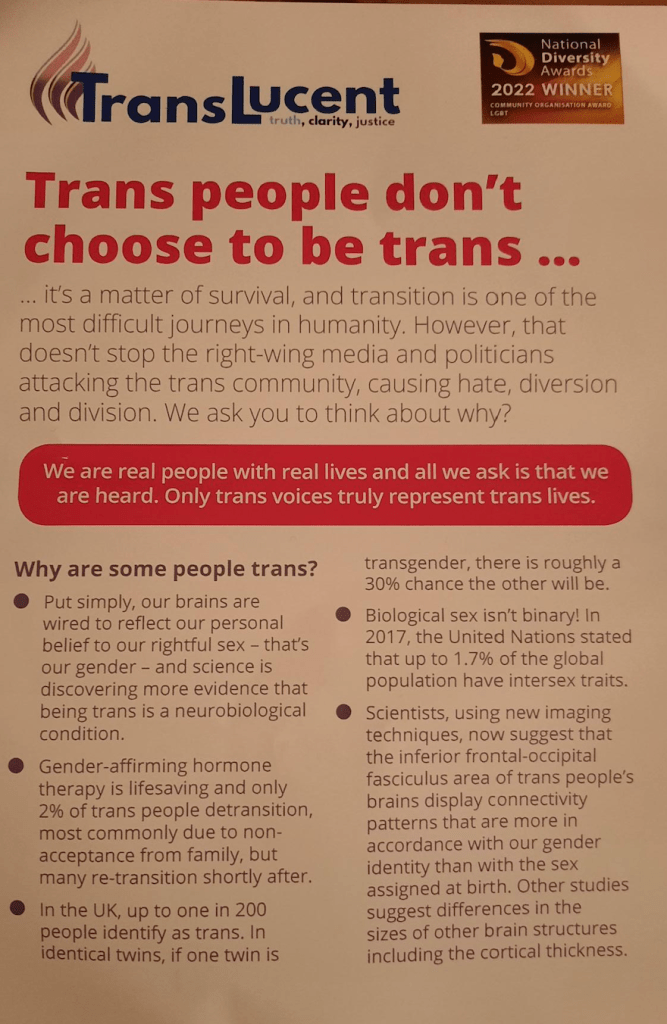

Why is a community of less than half a million people treated so appallingly? Why is trans hate crime going through the roof? Unlike JK Rowling, Richards’ death threats weren’t going to make the front page of the Daily Mail (though I note he did get a piece in the Daily Mirror). Why was the Equality Act under threat? Richards was grateful that later in the day we would be joined by Melanie Field, formerly of the EHRC and who helped draft the Equality Act. Why are the LGBTQIA+ community still not protected from conversion therapy?
The biggest issue of all though – predictably – was why trans healthcare is vital.
Why Trans Hate Crime is a Catalyst
With Paul Giannasi (National Police Advisor for Hate Crime), India Willoughby (TV Presenter), David Burton-Sampson (Basildon Pride), Julie Miller (Transgender Consultant and Speaker), Moderated by Claire Prosho (Director, TransLucent)
Opening remarks
Claire Prosho, a director at TransLucent, opened the session. Why is hate crime going up? Why trans people? Why the last few years? The answer was a media hate campaign. In 2022 the UK media had published about 7,500 media articles on the trans issues, ‘almost all of which were exclusively negative’. This equated to 21 articles per day, full of lies and misinformation.
Hate crime against trans people had risen by 1,411 percent in England and Wales over the last ten years. Not only that but Stonewall had done research which showed that 76 percent of trans hate crime went unreported! Prosho blamed white middle class people. What are we are going to do about it? Carry on resisting. We’re not going anywhere.
Julie Miller
Jullie Miller introduced himself. Alongside his training consultancy work in the education sector, he also claims he has a role in the NHS. On his website https://juliemiller.me.uk/about-me/ he admits that he just a common garden crossdresser and previously an engineer (many in the Beaumont Society were).
Beneath my clothed exterior and thin veneer of femininity I still exhibit a fully intact, finely chiseled, fully functioning male body….no viagra needed! For lifestyle, relationship and health reasons I do not want to undertake any medical processes to change my body, for example hormones or surgical interventions. I am naturally an extremely feminine person and I present myself as femininely as possible all the time….my mental health is important to me and this is how I look after it.
From Julie Miller’s ‘About Me’ page
For contrast, see the evidence Miller submitted to the Parliamentary committee which considered the reform of the Gender Recognition Act.
Miller had just become a member of the National Independent Advisory Group for Hate Crime (of which Paul Giannasi is secretary). He was also a consultant to a UK prison (I think he said HMP Berwyn) and gives support to the transgender sex offenders held there. He didn’t quite explain what his experience of hate crime was but apparently Posie Parker had used a photo of him the previous week in one of her live broadcasts.
David Burton-Sampson
Basildon Pride had been founded as a positive response to the hate crime towards the LGBT community, David Burton-Sampson told us. He was part of an advisory group on hate crime for Essex Police.
Paul Giannasi
Paul Giannasi had worked in policing since the times of the miners’ strike, however in 2007 he gained a secondment to run the government’s hate crime programme following the Stephen Lawrence Inquiry, which had found that there needed to be a ‘holistic response to hate crime across the whole of government’. Giannasi’s first task was to define what was meant by hate crime and which strands of characteristics should be included. The National Independent Advisory Group for Hate Crime (that Julie Miller had just joined) had initially helped define those terms which ultimately boiled down to five strands, four of which went onto be included in the enhanced sentencing legislation (now known as the Sentencing Act 2020).
At that time hate crime towards LGB was included but transgender wasn’t (i.e. before the T got added to the acronym). Giannasi said they ‘set about trying to work why that was the case because we believed the evidence was compelling’ – that evidence being someone who was ‘visibly trans’ (e.g. a fat bloke in an ill-fitting frock) was likely to be at high risk of attack. Conversations with the predecessor department to the Ministry of Justice revealed that civil servants felt if blokes wore frocks this was a choice they made and could not be of the same order as an integral characteristic such as race, religion or sexual orientation. In other words, they hadn’t been introduced to the Genderbread Person yet.
Giannasi and his team created two data systems, one was the recorded crime data and the other was the crime survey which goes out to 45,000 households – questions about hate crime were added to the survey on the (now five) monitored strands. In the first year of data collection in 2008/9, 375 trans hate crimes were recorded. In the last year (2022/3) the figure had gone up to 4,732 – Giannasi described the increase as ‘momentous progress’. Apparently the Metropolitan Police record more hate crime than the entirety of the United States, Giannasi bewailed that this showed how bad things were across the pond.
In the last segment of the talk he protested that his involvement in the collection of the data was not political at all, yet here he was at an explicitly political conference talking about protecting the ‘human rights’ of transgender people and explaining how he had intervened to get transgender identity added to the legislation.
India Willoughby
India Willoughby arrived fashionably late, too late, in fact, to have his own introductory section, but was given instead the opportunity to answer the first loaded question: Is hate crime being allowed and empowered by the UK government causing it to thrive across social media? Willoughby agreed and opined that because the transgender population was so small – just 0.5 percent of the population – there weren’t really the numbers for an effective fightback. The community literally did not have a voice in news media. In typical Himdia testeria this was termed a ‘blanket ban’, trans people in the arts, however, fared better. A few years ago there had been transgender personages on TV but they had all now been squeezed out (in other words, Willoughby’s work had slowed down). Trans people were needed on the news media so that they could educate the general public. A thousand articles a month had been written about trans people but not a single one had been written by a trans person (obviously he doesn’t consider Pink News a worthy news site). A few years ago he would go out and about and not worry about his safety but now he does. A comparison was made to Butch Cassidy and the Sundance Kid, the two notorious outlaws being analogous to trans people, with the mob which murdered them the baying mob on social media.
Willoughby has a friend who works at ITN and volunteers for Mermaids, who had recently reflected that the newsrooms of recent history didn’t even have any journalists from certain ethnic minorities (I wonder which ones, given Trevor McDonald started his career at ITN in 1973). The friend hadn’t the courage to challenge more senior colleagues on their use of language regarding certain ethnic groups, however when the newsroom finally gained a member of staff from this mysterious ethnic group, attitudes magically changed.
Miller intervenes
Managing to cut through Willoughby’s verbal diarrhoea, Miller reported that when he does trans awareness training with young people, often more than half the room will put their hand up when he asks if anyone knows any one who is trans or non-binary. Young people ‘get it’ and were the future, they would be the future bureaucrats (who said admin was boring?). There was zero proof that ‘trans women’ posed any danger to women and girls in sex segregated spaces – you could look back a hundred years or, alternatively, you could look at the United Nations website. There was no evidence whatsoever. ‘We will actually come through this,’ said Willoughby derailing Miller, continuing on his previous train of thought.
The Basildon Pride man described the Sunak government as the most ‘far right government’ we had ever had. Mention of Suella Braverman’s sacking earned applause. In the 80s he recalled that the binman disappeared to reappear as the binwoman. There hadn’t been an ounce of hatred though – Willoughby interrupted to describe this as ‘gender non-binnery’ (I may have been the only person who laughed). Nowadays, however, that person would get an outrageous amount of hate. Inclusion and diversity education was the way to resolve the societal problem of discrimination.
What can be done to improve things?
Asked Prosho, urging the panellists to give a short snappy answer. Basildon Pride said ‘allyship’. Miller wibbled about freedom of expression and that phrases like ‘adult human female’ and ‘trans women are men’ were hate phrases and should be recognised as such and prosecuted by police. Giannasi talked about context and that people should have the confidence to report something if it ‘felt wrong’. Willoughby had a death threat earlier in the year and had the terror unit visit him as it had come from a neo-nazi. The gender critical movement were all single issue and weren’t interested in women’s rights.
Question and Answer
A trans-identified female, who was so softly spoken, asked a question which I’m sure most of the room did not hear. Apparently the panel did hear it and and Basildon Pride said that a trans person had been seriously violently attacked, the offender eventually being identified through DNA. However, the victim was only prepared to give evidence if no mention would be made of their previous gender identity, citing the relevant clause in the Gender Recognition Act (i.e. making a crime, likely enacted by a male on male, now a crime of male on female).
A trans identified male reported that he had a member of staff, a technician, who had been repeatedly purposely misgendered whilst visiting a customer’s premises, resulting in the staff member losing all confidence. What would the panel advise him to do in his role of a director of a business? Should he address the customer himself or report them for a hate crime? Basildon Pride said he needed to decide whether he wanted the customer’s business and perhaps he should discuss it with the customer direct. Willoughby said he should behave in the same way as if the customer had used a racial or antisemitic slur. Bigotry was bigotry. Contact TransLucent for help said Prosho. Miller said the way to make inroads was through EDI policies, which had been successful in the armed forces (he is ex-army).
Why We Need the Equality Act
With Nancy Kelley (Former CEO Stonewall), Robin Moira White (Barrister), Melanie Field (formerly EHRC) and Stephen Whittle (Manchester Uni).
Steph Richards announced that Stephen Whittle would be late due to her train. ‘Ooh, I don’t know anything about trains,’ remarked Robin White. There was some laughter. Nancy Kelley helpfully explained that White was ‘completely obsessed with trains’, thereby signalling her cosiness with White, the barrister who represented Stonewall in the Allison Bailey case.
Opening remarks from Robin White
White explained that the Equality Act had been ‘squaged’ together by amalgamating other discrimination acts, like the Sex Discrimination Act and Race Relation Acts. Other characteristics, like sexual orientation and religion were then added in. The Equality Act 2010 was the gold standard (though he referred to it as 2020, without being corrected). White said we were coming to the end of the ‘worst administration’ he had ever lived through.
White claimed claimed that sex meant different things in different parts of the Act and he described principles like ‘reasonableness’ and ‘proportionality’, as awful. We were blessed to have it, but there were still some problems, like it didn’t recognise non-binary people.
Melanie Field
Richards asked Field a question about the Act, she responded that she lead the team which drafted the act and obviously thought it was a good piece of legislation but admitted that the principle of proportionality lacked clarity and that this was a human rights issue.
White jumped in to talk, blathering on about the fact that women weren’t allowed the vote in the 1830s and that Jewish people had to pay a fine for not going to church (apparently repealed in 1780s). The lawyer in him got excited at the prospect at more business. The answer was, however, easy: How would we like to be treated? (Access to guaranteed single sex spaces please.) Field agreed, saying the basis of the Act was that people should not be treated badly for who they are but the balance was that they should be treated ‘appropriately’. As with all these conferences, actual examples were non-existent.
An audience member asked a question about protections for trans and non-binary people and Field responded she thought the Act should include protection for non-binary and asexual-identified people, the latter particularly showing that she was in line with Stonewall’s policy objectives. She felt could be achieved through case law. Trans and non-binary people needed freedom to access ‘healthcare’. (Interestingly, Field once wrote a blog, hosted by the EHRC, in which she argued against the commodification of gender, I wonder what she thinks goes on in cosmetic surgery clinics then?) Field then had a little tizzy about her tiny orange designer handbag not being within her field of vision and was distracted until it was retrieved. She admitted that it would be difficult to incorporate the characteristic of non-binary into the Act and referred to the Jaguar/Landrover case as ‘binding’ (which it wasn’t). She praised the Scottish judiciary which had defended a decision to refer to ‘people who are pregnant’ and that maternity was no longer about sex.
Nancy Kelley gets her turn
The current Tory government was intent on rolling back LGBTQ rights. The media churned out ‘unbelievable amounts of guff’ about the Act which undermined, what she jokingly referred to as, ‘Stonewall Law’. Kelley felt that undermining an ‘anti-discrimination act was a pretty low bar’. Trans people, Kelly said, should be able to ‘puddle around’ (sweetly inventing her own word, like White had) to their hearts’ content, e.g. they should be able to go to the gym and not be terrified of getting changed, but, as per usual, was unable to explore the conflict of rights. All people should have basic safety and comfort, said Kelley, the Equality Act was a shield for when things go badly wrong.
White tells his awful SLAGG anecdote
Replete with the impersonation of Little Granny popping out the shop back room, thirsty for salacious details about White’s surgical transition.
Questions and answers
A trans-identified male, who I think identified himself as being linked in an official capacity to Stonewall, asked why trans discrimination in UK law wasn’t linked to sex, like it had been in the US (I think he was referring to the Aimee Stephens case). Why weren’t trans people protected by the Equality Act under the protected characteristic of sex? Field answered, saying it was and it wasn’t, for example gender reassignment was one of the characteristics. It all came back to what ‘sex’ meant in law and how a GRC modified that. It was all about ‘the reason for the treatment’. Field defended the decision to treat them separately because they were ‘different things’. White cited the Cornwall case and said that it was about ‘change of sex’. Kelley said misogyny, homophobia and transphobia all shared in common that they were about the ‘policing of gender’, which she clarified she thought was different to sex.
Richards said that a lot of money was spent on mental health and a lot of money could be saved if only the government would recognise non-binary identities. He didn’t explain his workings out on how these ‘billions’ could be saved but presumably it involves throwing cross sex hormones at anyone who wants them.
Kelley recommended people hook up with Stop Funding Hate and then they can put pressure on companies to stop advertising with media outlets.
White said that you don’t need to have a GRC in order to have your death recorded in the opposite sex and recently had a conversation with the chief registrar. It was mainly about making that wish known and having supportive relatives. Whittle (having arrived fashionably late) said that the ‘registrar will take the information that is given’ and that pathologists could also falsify the paperwork. Just last week, someone had been in contact with her, who had had fertility treatment prior to transition and also held a GRC. This person was denied the right to be registered as the father of her child. ‘The Gender Recognition Act is clear that the recognition is for all purposes,’ said Whittle.
Whittle also claimed that whilst the Equality Act was being drafted, full consideration was given to how it would interact with the Gender Recognition Act.
An intervention from Natacha Kennedy
Natacha Kennedy, a trans-identified male academic at Goldsmiths University, is running a study called ‘Non-linear transitions’ and was looking to interview people who have transitioned more than once and were still not the gender they were ‘assigned at birth’ (i.e. avoiding contact with any one who might consider themselves victim of medical malpractice). Kennedy, clearly keeping an open mind, said the data suggested that most people who ‘detransitioned’ went back to transition again anyway. He also wanted to hear from people who were or had been ‘non-binary’.
A Superintendent from Essex Police
Superintendent Naomi Edwards, who had been too late to attend the panel discussing hate crime, wanted to urge people at the meeting to contact her with any hate-related incidents they may have experienced, even though the attendees were drawn from across the country, not Essex, she was still interested in hearing the views of the community. Edwards said that she had looked at the stats for crimes against transgender people and could clearly see that there was ‘under reporting’.
She added she had heard something yesterday ‘that actually scared me, I’m a police officer, and it actually scared me’. What scared her was that she had heard someone (not identified) say that the Equality Act and the Human Rights Act weren’t relevant any more. She urged attendees again to contact her with suggestions on how she could improve things for the Essex transgender community. She then brought up the ‘atrocity’ of George Floyd’s ‘murder’ (he died under police restraint whilst high on fentanyl and resisting arrest, more than 4,500 miles away from where we were sitting) which had revealed that there were many allies to the Black Lives Matter political movement. She said that since 2020 people had been ’empowered’ to report race hate crime and at the current time race hate crime made up 60 percent of all reported hate crime. She wanted the trans community to stand up and say ‘Enough is enough’ and again urged people to contact her via a form she distributed.
She couldn’t stay any longer because she had just been given a new job related to the ‘Gaza and Israel conflict’ (presumably managing the weekly unruly protests of the pro-Hamas mob).
Following a question from an audience member, Edwards confirmed that anonymous reports of hate crime were very welcomed, it was important to protect the victim’s identity.
‘Please email me, please!’ Edwards begged as she finished her announcement.
Why Conversion Therapy is Harmful, not Helpful
Panel led by Jayne Ozanne (Ozanne Foundation) with Igi Moon (Chair of the MoU Coalition Against Conversion Therapy), Susie Green (formerly Mermaids Gender and Gender GP) and Annie Wallace (actor in Hollyoaks)
There was also a man on the panel, there because he had a ‘trans child’. I didn’t catch the name but have seen him around before, a regular on the circuit. I have no idea what Annie Wallace was doing on the panel, the others I can sort of understand.
Ozanne’s presentation
Jayne Ozanne gave a presentation. She said she had just come from the General Synod, which felt like a sin (bad-dum-tish) and then, to labour the point, told us that syn and sin were spelt differently. Most of the hate that trans people face was fuelled by religion and apologised for this. She was doing her best within the Synod to change these views. A while back she had got a bunch of human rights lawyers together, the meeting was chaired by Helena Kennedy KC (Doughty Street Chambers), some of the lawyers had to be ‘silent partners’ because of the ‘positions they held at the UN’. This resulted in the Cooper Report being published. The definition which was settled on was ‘any action which has a pre-determined purpose which seeks to change or suppress either sexual orientation or gender identity’. Conversion therapy could be practiced by religious leaders, counsellors and even parents. Ozanne, trying her best to sound measured, did talk about therapy helping people to ‘come to a point of peace’ and said that therapists could challenge but ultimately want she wanted was ‘affirmative care’, which negates the principle of challenge. According to Ozanne, receiving verbal abuse from one’s parents counts as conversion therapy.
There were three phases to conversion therapy, particularly in a religious context, the first was you carried a secret, the second stage was coming out and talking to people about it. Often in the religious context, this would mean you were exposed to a lot of prayer, mostly well-meaning prayer but ‘abuse’ nonetheless. The third stage was when you sought help from a therapist or a religious leader. Ozanne wanted the legislation to allow for organisations to be sued if they tried to get people to buy into ‘something which is false’. Whistleblowing protections should also be in place.
Susie Green
With no mention by anyone of Mermaids, Susie Green was on this panel. She didn’t really claim to know much about the subject but did get in early that she had become a target ‘because I spoke up for trans youth’. She referred to Mumsnet as ‘the prosecco stormfront’ (which, to be fair, is quite funny), a place where mums talked about restricting their children’s access to social media because of concerns about their children becoming trans trenders.
General discussion
Lip service was paid to the idea that parents were truly allowed to question their trans-identified child as to whether they were making the right decision. ‘That’s not conversion therapy,’ said the dad. Green talked about allowing families to explore without any expectation of what should be happening. She also said that the ‘media onslaught’ against trans people was stopping parents from stepping back and listening to their children. ‘We genuinely don’t want kids to make the wrong decision,’ said the dad. ‘Oh, I know,’ said Green, ‘I’ve got a trans daughter, so I appreciate that entirely.’
Igi Moon said that the ban would come about, she might not be around when it happened, but it would definitely happen. It was almost the hundredth year since the Convention of the Rights of the Child, she claimed. Moon was pissed off that there were therapy organisations which did not agree with the MoU’s aims and wanted to provide therapy to young people. Gender critical beliefs were now protected but people undergoing gender reassignment should also be protected (which they are already under the GRA, but I suspect she meant children). The group most vulnerable to conversion therapy, according by an LGBT survey, were 16 to 24 year olds. The MoU weren’t partisan and would work with anyone who wanted to bring about a ban.
The power of TV
Cue Annie Wallace’s moment in the sun. Wallace retold the story that most in the room would already be aware of, that he advised Coronation Street on how to handle the Hayley Cropper storyline and that some of details related back to his own personal life. He worked with Stephen Whittle/Press 4 Change on this.
Critics of the MoU ‘twisted’ things by saying that gender affirmative care was the real conversion therapy. ‘It’s bullshit!’ Wallace shrieked. All he wanted was for young trans people to have the conversations they needed to find out who they were. The narrative being pushed was that we should cut down on the number of trans people.
Hollyoaks was the ‘most LGBTQ+ friendly soap’ on TV, except it wasn’t on TV anymore because it had been relegated by C4 to stream-only. In other words, it is flagging and probably now terminal. There are two trans characters at the current time and next year there would be a young trans storyline next year which was really going to ‘shake the tree’. On stream.
Currently Hollyoaks has a conversion therapy storyline, of which he relayed the finer details to us, which are simply far too dull to bear repeating. For some reason Wallace talked for longer than any other panellist. Even Green’s face was set in a grimace.
What happened to darling Steph the week before
Before Helen Webberly took to the stage to do her Dragons Den presentation, filmed by a private film production company, Steph bravely took to the stage to discuss what had happened to him the week before. Richards told us how much he cared about women’s health and that he was determined to do something about the treatment of women with endometriosis. Prosho rushed to the stage to give Richards a hug, such was the raw emotion.
Why Trans Healthcare is Vital
With Helen Webberley (GenderGP), Claire Prosho (TransLucent), the Litmans (parents), Unknown TIM (TransLucent)

Webberley’s presentation
Weaponising suicide
‘Being transgender is not, and should not be, a life-threatening condition,’ Webberley began. So many people had told her the work she was doing had saved their lives and she knew many who had lost their ‘lives to death’.* This had to stop. In 2015, Webberley met her first transgender patient. Life was very tough for this older trans-identified male living in the Welsh valleys. Webberley didn’t know how to help him, but was determined to. Webberley explained to the man that he would have to get on a train and visit a clinic quite far away, but as she explained she saw a veil coming down and realised that she would write him a prescription for oestrogen instead. The transformation on the pills was dramatic, his skin became softer, breasts developed, etc. At the same time she developed a website by putting together information for those who wanted to transition. People started to contact her asking for help, i.e. prescription help. Webberley started to help them, but it wasn’t really what she set out to do. This was basically how Gender GP started.
* A reminder that her husband, Dr Michael Webberley, was struck off for a range of failings, including prescribing puberty blockers to a child of 9 and cross sex hormones to a teenager, who later committed suicide.
Gets emotional
Webberley had created her slide talking points using ChatGPT, she’d put in her own name, and it generated four bullet points, describing her crooked services as an ‘innovative patient-centred approach’. She loved the transgender community to death but didn’t want to cry all over again, so instead left it at loving them with all of her heart. Aah. Funnily enough, all her patients loved her ‘innovate patient-centred approach’ but all her critics hated it. Why might that be? Well naturally she didn’t want to say but she did mention that she had ‘gone through hell’ with the General Medical Council, who had a special focus on three young patients, including a 12 year old girl that she had prescribed testosterone to. She did, however, win the appeal (the room applauded).
On the lack of education
So what was the solution then? There was an 82 percent suicide ideation rate. She didn’t want to talk too much about the Cass Review (obviously) but WPATH, and all the other PATHs, had said Cass’s recommendations were likely to cause ‘enormous harm’. That’s a very big word, Webberley warned. We wouldn’t accept accept our GP telling us they knew nothing about elbows, so why would we accept them knowing nothing about prescribing cross sex hormones for cosmetic purposes? If you had a slightly tricky patient, then they could be sent for secondary care and an über difficult patient could be sent to tertiary care for the really rare stuff (what she meant was genital removal and the experimental reconstructions).
In the case of children services, these were regarded as even more highly specialised. The caseload was normally no more than around 500 children. That’s how rare it was. We didn’t know how big the trans-population was because too many people had to hide. Webberley believes that 1-2% of the population are trans. That meant the incidence of trans people was roughly equivalent to the number of people suffering from angina and we’ve all met someone who suffers from angina, haven’t we? There were no clinical guidelines on how to prescribe hormones. That’s shocking, she said. We all had to work together to normalise this ‘care’ being given.
Webberley berated the General Medical Council for not taking a lead in this matter and joked about their being her ‘good friends’, met approvingly by bloke-ish guffaws from a lovely laydee. (Don’t worry Helen, it won’t be too long before you are back before them.) No specialist training existed and this needed to change. A curriculum needed to be set out and approved by the GMC. Even in the endocrinology curriculum there were a few guidelines which dealt with the prescribing of cross sex hormones. Rather than reflect that the guidelines don’t exist because the area is too fraught with medical malpractice issues, Webberley thinks the real malpractice is that no one has put it into writing (which is true too, if you think about it).
Three principles of care
So what was this ‘innovative and patient-centred’ model she had created then? There were three principles. The first being that we are all expert on ourselves. People shouldn’t have to go to appointment after appointment, just to get their gender identity validated. People were forced into telling lies in order to get access to hormones.
Who is the expert in gender identity? Because it ain’t me. I’m an expert in my own gender identity.
Helen Webberley on the issue of the expertness in gender dysphoria
Thus her innovation was ‘believe people when they say they are trans’. The first question the doctor should ask should be: How can I help you? What would you like me to do? Basically this was the ‘informed consent’ used in every other mode of care.
What was the third secret source of her innovative model? Celebrating gender diversity around the world?! Sorry, that wasn’t a joke but actually the answer. Just to clarify, the third principle of Dr Helen Webberley’s care was literally ‘celebrating gender diversity around the world’. And she wonders why there are no standard clinical guidelines in place. Before she received her applause for her speech, she endorsed the fight for self-identification of gender in law.
The incredible team at TransLucent
Richards was still choked up from his emotion packed speech but paid tribute to the 11 or so members of TransLucent. They were always looking for help from any allies, so please do reach out. Richards invited Prosho to comment on the content of Webberley’s talk. Of course, Prosho had agreed with every word and had been doing his own research into this area, which he wasn’t able to divulge at the present time. However, he was able to reveal that the only way reducing waiting list would be by moving the responsibility to primary care providers (i.e. GPs). Referral rates in England had only increased by 2.2 percent in five years, said Prosho, yet the waiting list was growing at 9 times the rate of referral. Forty thousand people were on the waiting list, despite GIC staff numbers doubling. The waiting list in Sheffield was 54 years, Prosho tried his best to sound scandalised but there wasn’t a person in the room who believed it. Then to undermine this shocking statistic, Prosho told us about his own experience, originally referred in 2020, he had his first appointment in 2021 and had had a couple of subsequent appointments since, which had included assessments for surgery. Prosho was also on cross sex hormones and a testosterone blocker. He had never felt better, yet he felt very guilty having easy access to care which should be available to everybody.
Prosho sits on the LGBT Foundation NHS sounding board and just this month they had had meetings with the head of clinical commissioning groups. Prosho had argued that providing hormone prescriptions for medical needs meant that GPs already had the skillset to provide the same for cosmetic purposes.
The Litmans
Alice Litman was a 20 year old young man who committed suicide, his parents allege this was due to a long wait for treatment for his gender dysphoria – see Guardian article. The mother talked a great deal, the father said almost nothing. The mother described the build up and denouement in a detached monotone voice. Alice’s GP was sharply criticised for giving out a Mermaids leaflet and advising him ‘to go away and think about it’, rather than providing ‘affirming care’. Interestingly Mrs Litman had been a psychiatrist by profession and had a chance to ask GPs what they needed in order to treat patients with gender dysphoria. One had responded that no amount of training would make them feel confident treating this cohort.
General discussion
People generally bemoaned GPs lack of enthusiasm in providing cross sex hormones. Igi Moon wanted to add a positive note; GLADD (the gay and lesbian association for doctors and dentists) had worked with Michael Brady to put together a charter which 43 training institutions for doctors had signed up to. One person claimed that one gender identity clinic imposed genital inspections onto all patients seeking hormone treatment and said the reason the clinic gave was to ensure everything was okay before so-called ‘bottom surgery’. Another wanted to point out that if your GP had taken on the collaborative care of another patient/group of patients, but not for trans people, then you had a clear case to establish ‘transphobia’.
Closing speech from Stephen Whittle
Whittle whittle whittle. Things had gotten better. Go to your GP and demand care. Whittle has walked around with pain in her shoulder for 40 years, because she is trans the pain was considered psychological. She was still providing free advice on how people can change their names and gender. The community should knowledge share and provide support to one another on these practical elements.
Post-conference
After the conference there was an opportunity to meet with the UK’s first trans-identified MP, ‘Dr’ Jamie Wallis (he has a fake PhD), the MP from Bridgend & Porthcawl, who has found notoriety in a variety of unfortunate incidents. One was crashing into a lamppost whilst crossdressed, he fled the scene, possibly to avoid a breathalyzer test. Wallis was also director of a sugar daddy website but denied this on questioning, despite being listed as its director at Companies House. When things went wrong for him he belatedly came out as trans, which appears to be limited to growing his out hair.

Thank you for reading! Sign up to my blog by going to the bottom of the page.

Please share on other forums if you liked it, as I only do Twitter.
 The Lies They Tell
You must be logged in to post a comment.