
Quite simply, a terrible film. No stars. No redeeming features.
The blurby bit
Preview: Orlando, My Political Biography (15*) + Conversation with Paul B. Preciado and Erika Balsom
In partnership with Fitzcarraldo Editions, we present a preview of the highly anticipated film by writer Paul B. Preciado based on the novel Orlando.
The film is a reimagining of Virginia Woolf’s famed Orlando, centring around a young man who grows up to become a 36-year-old woman.
In his response to Woolf’s text, Paul B. Preciado reflects on how the fictional character has transcended literature to become a tangible reality. Preciado explores the transformation of Orlando’s body as a symbol that resonates with non-binary individuals worldwide.
Through the voices of young people undergoing similar journeys, Preciado narrates his own transformation in a poetic odyssey where life, literature, theory, and imagery blend in the pursuit of truth. He emphasizes that individuals like Orlando, who identify as transgender, face daily challenges navigating norms, legal systems, historical contexts, psychiatric perspectives, familial expectations, and the influence of pharmaceutical corporations.
From the Barbican website
Introduction
It was packed in the Barbican’s biggest screen, filled with lots of trans-identified females of all ages (but mostly younger) eager to see, who I guess must be a hero to them, Paul B. Preciado. Preciado is now 53 years of age but is blessed with youthful looks and an even more youthful mind (some might say adolescent, but I’ll get onto that). According to the Wikipedia entry, Paul was previously Beatriz and transitioned in 2014, i.e. aged forty-four years. An internet search for Beatriz bought up this article from 2013, from when she was on the brink of her ‘transition’, being interviewed for the book she is most famous for – Testo Junkie : Sex, Drugs and Biopolitics in the Pharmacopornographic Era.
B. toggles between a personal account of using topical testosterone, Testogel, as a kind of performative homage to a fallen queer friend, and a cultural analysis that investigates how pharmaceutical companies politicize the body– down to the molecule.
From The Paris Review: Pharmacopornography: An Interview with Beatriz Preciado, 4 December 2013
Preciado has had a long term relationship with the author Virginie Despentes (who also sounds a like a fucking nightmare) and who also briefly appears in Orlando (as the judge at the end).
The film was simply terrible and I could barely keep my eyes open. I estimate I saw about half the movie I was dozing so much. The man sitting next to me managed about twenty minutes. I even walked out of Preciado’s Q&A halfway through. It turns out I do have my limits after all.
The film
Beginnings
Preciado begins with the claim that Virginia Woolf was writing about trans lives, however, she didn’t get it right. Woolf had assumed that transition was a doddle. And it’s not. It’s very very tough, people. I think that might have been the point my unconscious mind bid me sleep.
I’m not familiar with Virginia Woolf’s Orlando (though I may have tried to read it once as a precocious teenager) but I’m confident in stating that Preciado’s interpretation was piss poor.
The film is mainly in French, with some Spanish, and a tiny bit of English. It turns out French- and Spanish-speaking trans people are as big as knob-heads as the English-speaking sort. None of the cast are professional actors.
Bits I watched through half-closed eyes and head nodding
We had all the tropes:
- Hormones set you free and the only way to liberation and revolution. Someone gets injected with T and then techno music starts. Naturally Preciado penned the lyrics, which went something along the lines of ‘yeah, we hate the krypto-fascist heteronormative cis state, fuck yeah, taking T is really really cooool, yeah’.
- Transphobia kills, as told by trans-identified male prostitutes.
- Close up shots of mastectomy scars revealed as brave and stunning.
- Trans kids exist. With three small children who obviously have no idea who Woolf is.
- Personal testimonies extolling the use of exogenous hormones and how these drugs helped them become their true authentic selves, even though some of the talking heads aren’t fully grown yet.
- Evil-looking drag queens being ultra sassy and clever.
- Footage (available on YouTube) of Silvia Rivera and Martha P. Johnson, in which it is clear they are talking about gay issues.
- Christine Jorgensen was the trailblazer, cue the same footage we always see of Jorgensen alighting from the aircraft. Truly, what an original idea.
Too much time was spent on ensuring that each and every talking head got the chance to look into the camera and say with seriousness: ‘In this film I’ll be Orlando by Virginia Woolf’. Especially since it didn’t make any sense, since none of them played at being Orlando, even if they did wear silly ruffs around their necks.
The scene with the three young children was underscored by them watching a video of a ‘trans girl’ giving an address (I think to the Spanish senate, but was unable to find the video). We had a scene where an older man, who now plays at being a woman and has zero acting ability, gets refused a booking at a hotel because his passport didn’t match the name he booked in.
There were several mentions of the affair that Woolf had with Vita Sackville-West but it wasn’t explored at all, in fact, I don’t think we even saw a photo of Woolf or heard anything about her background.
The end
The closing scene involved all the talking heads gathering together in a ‘courtroom’ and it was Virginie Despentes, Preciado’s ex-, handing out passports, to finally validate the identities of the assembled motley crew. I wondered if Despentes’ gravelly voice was a result of testosterone? That, or whiskey and cigarettes (which is more probable).
The passport scene met a new level of pathetic, as we had to watch each and every person be called up to receive their passport. Tedious. It also highlighted how young the cast were in comparison to 53 year old Preciado.
For Preciado, filming that final scene was “unforgettable,” he says. As he was developing the material with his Orlandos, he realized that having papers was a key issue for many of them. It affected everything from whether they could have bank accounts to whether they could even attend school.
From the Los Angeles Times review – ‘How a first-time filmmaker turned a Virginia Woolf novel into a ‘survival’ strategy’
Final comments
For all the personal testimonies, not one person uttered a true thing about themselves. Everyone was doing that Judith Butler thing, not only performing their gender, but performing themselves performing their gender. We didn’t learn a single thing about any of them, unless this all happened in the spaces in which I was dozing, which I doubt.
The film won the Special Jury Prize at the Berlinale Film Festival, for:
For the in depth and unmediated account of affirmation of self identity, for the innovative and multi-layered, politically rigorous yet formally playful, approach, the Special Jury award ex aequo goes to Orlando, ma biographie politique by Paul B. Preciado.
https://www.berlinale.de/en/archive/awards-juries/awards.html/o=desc/p=1/rp=40
It’s staggering but the film has got a UK distributor with the Picturehouse cinema group listing it as ‘coming soon’. I wonder if any mainstream media review will be honest about how terrible it is?
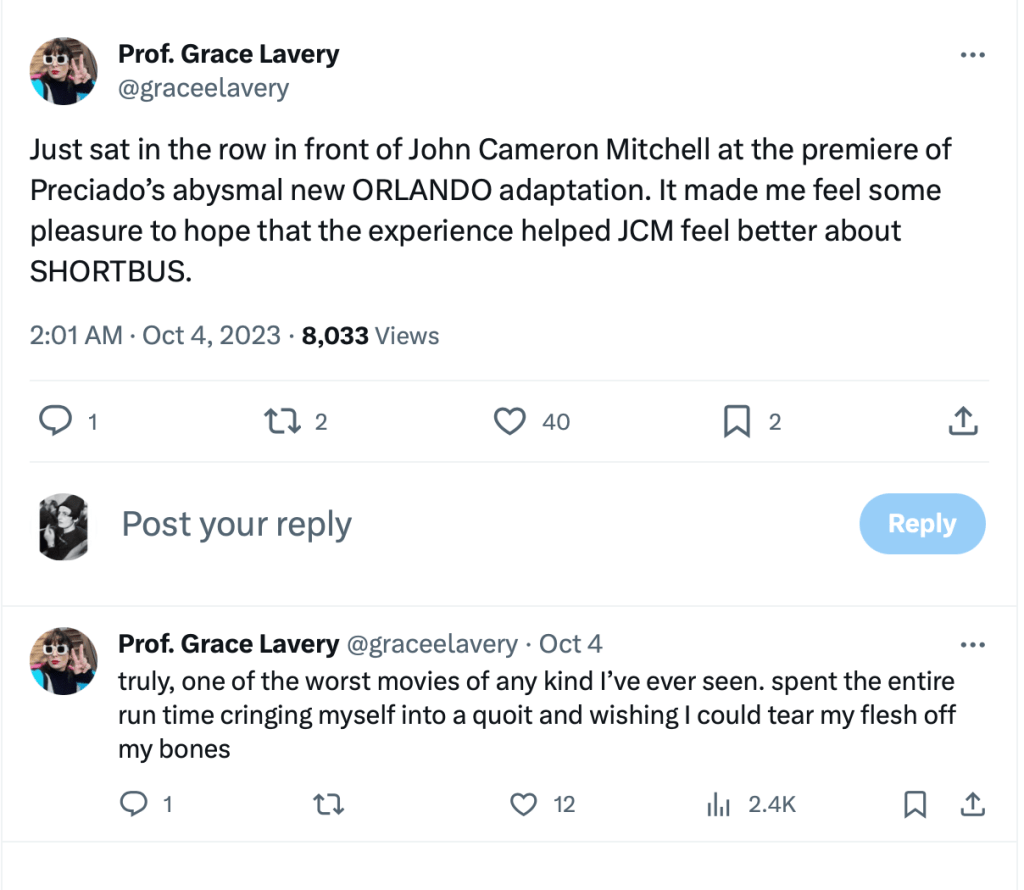
The Conversation
Preciado descended the stairs to a very long and fulsome round of applause. Her interviewer was Erika Balsom, a Reader in Film Studies at King’s College. (I think originally Juliet Jacques was scheduled, I wonder why he pulled out? I like to think he saw the film.)
Balsom asked one question – ‘How did you come to make this wonderful film? – and Preciado talked at length for several minutes. Twelve to be exact.
In summary, some producers from ARTE approached her to make a film of her life so far. She knew that meant they would go back to her roots as ‘an assigned female at birth’. Clearly uncomfortable with the idea of coming to terms with her history, instead she joked that ‘Orlando is my biography’ and thought that would be the end of the conversation. Instead the producers thought it was an amazing idea. Her phone was ringing off the hook being bothered by calls asking her to make the film herself.
Preciado believes she is trans because she always likes learning something new.
Thus, she set about finding the ‘real Orlandos of today’ to tell her life story (even though she lived her life off exogenous hormones for more than 40 years and most of her turns were under the age of 25, some of whom had received puberty blockers). The producers warned her against using non-actors. There wasn’t much money for costumes or locations.
She originally read the book aged 14 at school in an advanced English literature class. She realised that she needed fiction and believes this is essential to all people who belong to ‘political minorities’. She isn’t, however, a Virginia Woolf expert and had to re-read many of her works as background. Preciado described Woolf as ‘misogynist, homophobic, lesbophobic and transphobic’ and had a ‘hypercolonial mind in many senses’.
Balsom got to ask a second question, which was full of word salad (I think she just wanted an opportunity to speak, as so far she just had to smile sweetly and may as well have not been present). Her question amounted to a comment that Preciado didn’t really appear that much in the film.
Preciado maintained that the film was her biography. However, there were many things important to her story, things that happened before she was born. Initially one hundred people responded to the casting call. All the auditionees claimed to be Orlando and that they didn’t need to look for anyone else. The cast all met together, including the sex workers, the kids (and their parents), and they would all discuss Virginia Woolf. They would also tell the story of their lives together. The film took three years to make, so Preciado had known some of the teenagers quite a substantial time. One of the cast, Ruben, she had known since Ruben was 12. Ruben shared the story of his first love with 53 year old Preciado.
“My penis is simply female”
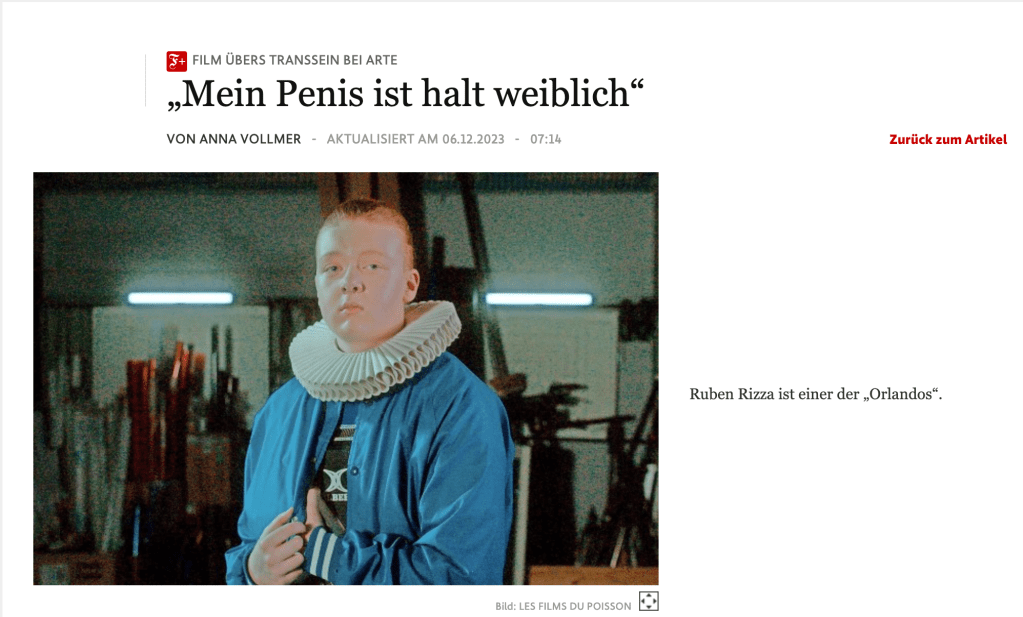
Preciado started talked about how joyful it was to make the film and returned again to the idea of ‘political minorities’. I decided I’d had enough, as had others, and left the screening a bit sorry I’d gone.
Thank you for reading! Sign up to my blog by going to the bottom of the page.
Please share on other forums if you liked it, as I only do Twitter.
 The Lies They Tell
You must be logged in to post a comment.