
Transport for London provided this training free of charge, but of course it’s ultimately paid for by us.
It could have been really useful and grappled with the realities of travelling on a packed tube, – like how to protect yourself against pickpockets, – dealing with aggressive beggars, and so on. Instead the focus was the nebulous topic of ‘identity-based violence’.

The blurby bit
Transport for London (TfL) is funding hundreds of places on free training sessions to empower people to take action to prevent or reduce harm when they encounter hate crime.
This free 3 hours interactive course is led by identity-based violence prevention charity, Protection Approaches and has been developed in partnership with Britain`’s East and Southeast Asian Network (besea.n).
The expert-led sessions see participants guided through a series of discussions to explore how they can play a role in safely tackling identity-based harms in their community, school, or place of work.
You will learn:
What it means to be an active bystander: trough group discussion the participants explore what being an active bystander means to them
Standing up for victims safely: working through a series of scenarios, participants consider and learn what they can do when they encounter identity-based harms such as harassment on public transport, a racist attack in a supermarket, or a prejudiced comment from a colleague
Proactive prevention: returning to the scenarios participants reflect on the root causes of prejudice and discrimination before discussing ways they could contribute to dismantling those root causes and to building safer, more inclusive, and just communities.
Find out more information here.
From the Eventbrite event
About Protection Approaches
Protection Approaches (PA) is a registered charity with four supposed programme areas: communities, schools, training and atrocity prevention. Yep, you read that correctly. Atrocity prevention. Thankfully they define ‘atrocity’ as genocide, ethnic cleansing, crimes against humanity and war crimes, rather than misgendering. However, it is not explained why they, a lowly diversity, equity and inclusion (DEI) training provider, would have any influence over international politics.
Protection Approaches works to change how the world views identity-based violence – and by so doing, change the way we respond to and prevent it.
Mission statement – https://protectionapproaches.org/about-us
Do you want to see an example of Protection Approaches’ active bystanding?
Okay then. Following the Hamas attack of Israel on 7 October, it took Protection Approaches four working days to release a statement condemning the acts of kidnap, torture, rape and murder of Israeli citizens. They curiously state ‘we also consider it likely the attack by Hamas constitutes crimes against humanity’ (my italics), meaning they must be unsure whether beheadings and rape are really that bad after all. There then follows four paragraphs strongly condemning Israel’s response to the terror attack and, again, that phrase ‘we also consider it likely’, etc, is trotted out, this time against the Israeli Defence Forces. In other words, it is the ultimate ‘both sides’ but with bells on. More waffle, more blaming of Israel, and suggestions of how the UK government should intervene, follow. Hamas, of course, receives no blame for any wrong doing against its citizens or for causing the war.
Queering Atrocity Prevention
Yes, really. Protection Approaches employ someone in the role of ‘Queering Atrocity Prevention Co-ordinator‘ and another as ‘Queering Atrocity Prevention Research Fellow’. What the fuck they do all day, I don’t know. One thing they did do though is publish a 42 page report on ‘Queering Atrocity Prevention‘ back in March 2022. Several paragraphs cover the rise of the Nazis in 1930s Germany but there is no mention anywhere of the Nuremberg Laws, instead we have this:
[W]hen Hitler became Chancellor in January 1933, the Nazi party began a systemic campaign to eradicate Germany’s gay, lesbian, bisexual, trans, intersex and queer communities as a means to gain support for the Nazi’s populist political project.
page 9, Queering Atrocity Prevention
In other words, these are simply not serious people.
On more recent wars we have this:
While the Russian invasion of Ukraine has not been explicitly justified on grounds
page 12 of Queering Atrocity Prevention
of sexual moralism, …
Or, how about not at all? Don’t think the Kaliningrad-obsessed Putin mentioned that one. Or anyone else, for that matter.
On page 13 it is claimed that restricting the use puberty blockers (i.e. GnRH agonists) to children is ‘transphobia’ and makes a direct correlation to self-harm and suicide. Such things are taken as evidence that the UK is developing into a fascist state.
Our travelcard money has funded this outfit. Urghh!
About besea.n
Britain’s East and Southeast Asian Network (besea.n) by comparison is a more benign organisation. besea.n is presumably a pun on be-seen, but there is still a random full stop in an acronym made up of lower caps.
besea.n appears to be made up of a group of female friends (except one) doing a sideline in Diversity, Equity & Inclusion training alongside their professional careers. In their promotional video there are endless shots of them mid-laugh looking into the middle distance. Best of all though are the facts about the team. For example, one was ‘head of Hufflepuff in her university’s Harry Potter Society’. Another is ‘constantly looking for his glasses’. Seriously, how can anyone say with a straight face that daydreaming is a pastime? Or that you like cuddling your dog? I wouldn’t fucking trust them to tie their own shoelaces. I’d like to think, in any other situation, that besea.n’s CV would go straight in the trashcan, but the times, they are a-changin’, folx.
How much did it cost?
God knows, but TfL admit in an FOI response that they have contributed £4,550 towards the cost of running the sessions (all held online, from what I can gather). Note also that TfL did not commission the work, rather ‘partnered’ with Protection Approaches, therefore there was no tendering process. Odd, no?

The response also explains that TfL wants everyone to feel confident travelling on the network. A shame then, as I said upfront, that the training did not focus solely on common situations faced by commuters, like navigating the onslaught of drunken football fans, challenging inappropriate use of priority seat areas, or the recent phenomenon of pro-Hamas protestors using the tube to chant ‘From the river to the sea’ with the tube driver joining in.
I suspect the final fee Protection Approaches received for providing this training is likely to be far greater than the £4,550 TfL provided. Its most recent financial statement shows it has received nearly half a million pounds of taxpayer money from the government’s Department for Levelling Up and nearly £60,000 from the Cabinet Office’s Conflict, Stability and Security Fund (that’ll be the Atrocity Prevention box ticked).
The participants
It was a quite a mixed bag with a few having pronouns next to their names, all of whom later revealed themselves to be LGBTQ. A handful of participants appeared to be retired and doing the course for fun. We weren’t asked why we had signed up for this free training, if we needed it or where we worked, so it was a real mystery why we were all there.
The training
What does ‘identity-based violence’ mean?
Like all training consultancies, Protection Approaches (PA) are keen to reinvent the wheel, because although there is a perfectly workable and legal definition of hate crime, PA explained to us that ‘identity-based harm or violence’ meant any act which was influenced by hate from the perspective of the attacker, including if someone took wrongly to your eye colour (which is not actually covered by the legislation).
What is an Active Bystander?
We were sent into breakout rooms to fumble over this question for ten minutes while PA went off and had the first of several (metaphorical at least) fag breaks. People had strictly straightforward responses to this, as you would imagine, including the glaringly obvious point that ‘bystander’ strongly suggested passivity. PA agreed and felt that we should really be talking about ‘active upstanders’ instead. Doh!
We also learnt that an active bystander didn’t need to do something in the moment, it could be an hour or even a week later, rendering the term even more meaningless. My favourite suggestion though was that being aware of your surroundings and other people helped foster a sense of community. Put those phones away peeps, and start noticing the beauty of those around you, that office worker chomping -mouth agape- on a Big Mac, that child just picking its nose, the whimsical hawking of the paint-spattered workman. Nah, I’ll stick to my phone, thanks.
PA explained to us that it was our responsibility to be Active Bystanders and to challenge – where it was safe to do so. However, you didn’t have to do this every single time you came across an injustice because that would get a bit exhausting. Quite. Safety was a separate discussion, as what might be safe for PA, might not be safe for us. No, PA was much more interested in tackling ‘systemic injustices’.
Prejudice and division in communities can be overcome through long-term, meaningful interaction between different members of community. Meaningful interactions go beyond surface-level conversations, delving into shared interests, hopes, concerns, or even each other’s differences.
From the handout circulated post-session, most of which was totally incompatible with the issue of dealing with stranger conflict on a public transport network
The scenarios
All four scenarios discussed were uniquely challenging in that all failed to be specific, making it difficult to say anything concrete about how one should act. Only one was a public transport scenario. Also baked-in was the implication that the victim in each case was a helpless individual, with no agency, just waiting for a social justice warrior to come riding-in on a white horse. Because the material is likely copyrighted, I won’t reproduce the utterly ridiculous hypotheticals posted on screen, but I suspect they were written by the dreamy spectacle-seeking dog-cuddlers at besea.n.
SCENARIO 1
Chinese girl on train racially abused. Someone challenges the man abusing the girl but this enrages him.
Suggested responses included sensible things, like reporting to the police and capturing evidence. Not so sensible advice included using distraction techniques and sitting next to the girl to provide reassurance, endorsed by PA (such advice is also plastered all over TfL posters on the network). I would like to know what research has been done to make PA and TfL so confident to promote such a tactic? PA’s anecdotal example of an aggressor melting after a simple question was frankly unbelievable.
PA also advised that people not film incidents, nor post them online, even though it is perfectly legal to record people in public in the UK and to publish the pictures. PA explained that this would be cruel to the victim and that we should instead try recording the audio of the attack, which means any physical attack could be plausibly denied and is also possibly incongruent with the law on covert recording.
Third party reporting centres
The real message PA wanted to impart to us though was that third party reporting centres could and should be used to report hate crimes. The following were recommended:
- StopHateUK for any aspect of an individual’s identity,
- On Your Side for anybody in the UK who identifies as part of an East or Southeast Asian community (run by PA itself – it seems they have more than just an incidental connection to besea.n),
- True Vision which focuses on monitored strands but includes additional non-monitored strands (funded and run by the police itself),
- Tell Mama UK which monitors anti-Muslim attacks,
- and last, but not least, Galop which supports LGBT+ people.
Interestingly, despite the recent rise of antisemitic attacks since 7 October, PA did not mention the Community Security Trust. Just an oversight, I’m sure.
PA wanted to know how we felt about reporting things to the police, rather than giving us practical advice on how we could. Predictably people commented that it was time consuming but asserted it was surely the most correct route to use? In response, PA highlighted the benefit of reporting via the third party route, as you could do it online and anonymously and was also a good route to choose if a victim was unlikely to report an incident themselves.
The real message PA wanted to impart to us though was reporting all and any incidences of hate crime or content via third party reporting centres.
SCENARIO 2
Someone you know tangentially makes a social media post about his engagement to another man. Other posters respond with abusive homophobic comments.
Yet again, because there is so much hysteria around language nowadays, the scenario was stripped of any real meaning because we weren’t allowed to know what the abusive and threatening words were.
People felt that the abusive social media poster should be reported to the social media site for violation of its terms and conditions. The conversation over whether the gay man should be comforted was fraught with tension. What if he hadn’t seen the nasty posts and you drawing it to his attention traumatised him? No one suggested that the user could simply block the person(s) being abusive. PA felt it would be more productive to respond by posting lots of supportive comments under ‘the beautiful post’.
Such an incident would also be appropriate for reporting to the third party reporting centres and you did not need to be one hundred percent sure that it met the criteria of a hate crime.
SCENARIO 3
You are in a DEI meeting and someone uses outdated language about disabled people. Someone at the meeting identifies as disabled.
A most challenging scenario. First of all, the term ‘disabled’ is already a contested term (even the UK government website says so) – so who are PA to decide that it is the correct language? Secondly, you either are disabled (e.g. registered blind, paralysed from the waist down, diagnosed with cystic fibrosis, etc) or you are not. There is no such thing as identifying as disabled in law. The fact that all this happens at a DEI meeting in the workplace is the final sick twist.
It was felt that the person, who was not intending to cause any offence, needed to be challenged. Challenged because of the non-specified outdated language they had used about disabled people. Ways of challenging them including rephrasing their question to the whole group with the correct language – which isn’t shaming at all, is it? So much for safe spaces.
It was agreed that it was not at all important whether the person who ‘identified as disabled’ was offended by the outdated language, and for once I’m inclined to agree.
Such a scenario presented the perfect opportunity to contact your HR department to ask for further training in the area.
SCENARIO 4
A friend introduces you to their new partner whilst on a car journey. That person makes racist comments about immigrants, which makes your friend look unsettled.
The consensus was that the new partner should be challenged. However, one participant felt that it would mark the end of a friendship, if the friend did not also join in and challenge the unspecified racist remarks, while also calmly asserting that if the imaginary threesome were in an Uber, the driver was going to be offended.
A few felt that this was possibly an abusive relationship, since the friend was apparently already scared, an idea which was endorsed by PA who said it was a clear example of boundary testing, rather than a person awkwardly expressing an opinion you didn’t like (again, what has been said is rather up to your own imagination).
In summary
Predictably participants on the whole were averse to conflict, wanted not to offend anyone, and for everybody to be happy. Notably the one person who was extremely intolerant of intolerance, so to speak, had pronouns. The promotion of the third party reporting centres was frankly quite dodgy and demonstrated that one hand always washes the other in the DEI industry.
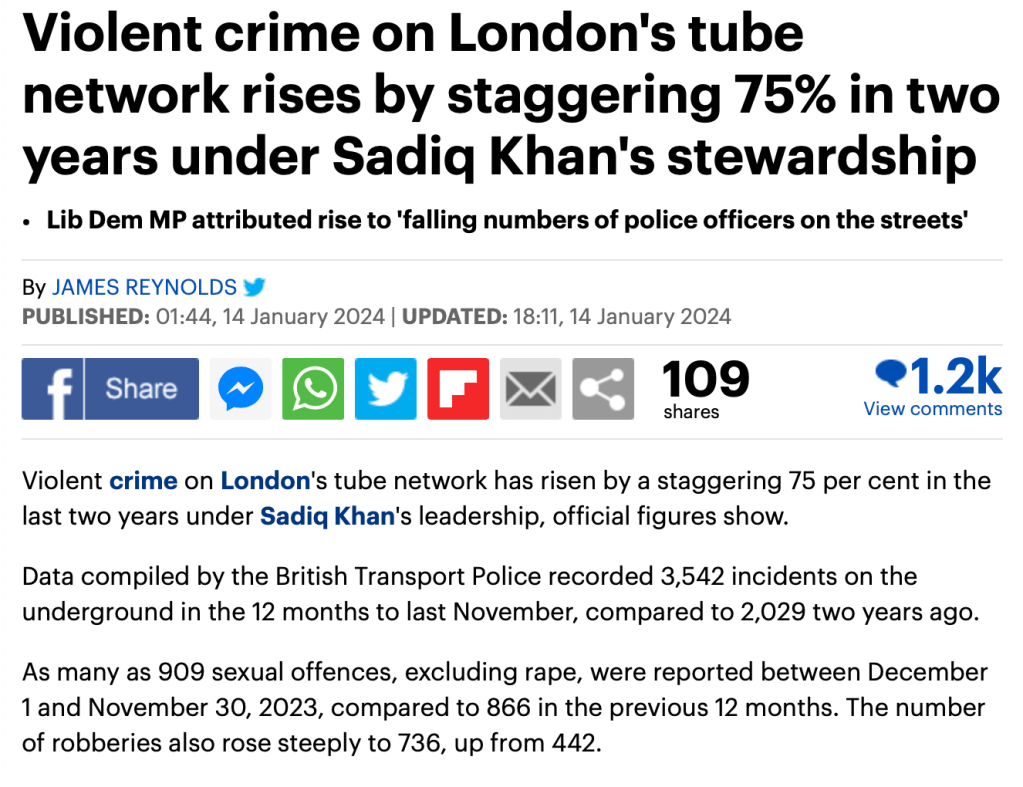
The main fault of the training though, was that there was no mention of any serious violent crimes committed on the transport network, nor that these are quite often perpetrated by drug addicts. In the official handout emailed round after the session there was also no mention of this, even in the ‘critical thinking’ section. Surely they deserved one mention?
Transport for London has more than its fair share of knife-wielding drug-crazed maniacs using its services to sleep and keep warm. Such people are highly volatile and best left unchallenged. Unless you’re wearing a stab vest. It is like PA, and their ilk, operate in a parallel universe, where everyone is just one DEI session away from being a fully rounded human being. Dangerous stuff.
Postscript
Following further FOIs to TfL, we have learnt that just 219 received the training offered over the course of eight (or ten, there appears to be confusion on the number) sessions, working out at a cost of about approximately £500 per session. When you consider that everything was on Zoom, PA must be laughing all the way to the bank. When pushed as to why PA were the chosen training supplier, TfL revealed that it wasn’t a partnership at all, rather:
Protection Approaches and Britain’s East and South East Asian Network (besea.n) were chosen to deliver the training, as they are a leading organisation in delivering hate crime active bystander training and have been funded by the Mayor’s Office for Policing and Crime (MOPAC), another member of the GLA Group. The one-off partnership was undertaken as part of business as usual activity during National Hate Crime Awareness Week and therefore subject to TfL’s usual internal approval process for amounts under £5,000. Protection Approaches provided an invoice for the training – the agreement was to deliver 8 active bystander sessions at a total cost of £4,550. This was to cover the cost of six sessions, in addition to two free of charge sessions funded under Protection Approaches’ Stronger Communities projects.
Source: https://tfl.gov.uk/corporate/transparency/freedom-of-information/foi-request-detail?referenceId=FOI-3827-2324
Thank you for reading! Sign up to my blog by going to the bottom of the page.
Please share on other forums if you liked it, as I only do Twitter.
 The Lies They Tell
Thanks for the caption abt those horrible, 1970s-style cartoons. And I thank the Good Lord I don’t live in Londonistan. Rampant unreality about how the criminal or lunatic minority can behave.
LikeLiked by 1 person