
How to write a whole book and still say nothing. Okay, not nothing. But nothing we haven’t all heard before.

Introduction
It was only a matter of time before Debbie (previously David) Hayton was offered a book deal to tell the story of his transition. Having read a fair few of them, despite the claim this one would be an unorthodox one, it is still the same self-important bullshit one expects from the genre and indeed, from trans-identified males. Hayton manages to say very little whenever it is badly needed, otherwise he gabbles away at us, in that irritating know-it-all sing-songy voice he has, stating axiomatic facts over and over again.
The first trans memoir I ever read was Paper Genders: Pulling the Mask Off the Transgender Phenomenon by Walt Heyer, published in 2011. I read it probably in 2016, before I started blogging about gender identity ideology. In Paper Genders Heyer simply explains why he underwent surgery and of his subsequent sudden regret when he realised one day that he was female on paper only and that even that paper told a lie.
Regrettably, I learned to dislike the boy who was fondled by an uncle, cross-dressed by a grandmother and propositioned by a homosexual clergyman. I was never a homosexual or felt the desire for men. My rejection of my birth gender was the result of abuse I suffered from several adults.
Loc 1538, Paper Genders by Walt Heyer
It’s a rallying cry against the dangers of castration/vaginoplasty surgery, including detailed information about the history of the affirmative model and stories from trans-identified males who have emailed Heyer their regrets over the years. Heyer explains that the underlying emotional distress has to be addressed. Interestingly Heyer does not discuss autogynephilia (AGP) as a cause, it isn’t even mentioned, nor is Ray Blanchard. Anyway, what I wanted to say, if you want to read about a supposed ‘transsexual apostate’ read that book.
On with Dobbie’s book
Prologue – Gender Reassignment
If everything goes to plan, the surgeon can create an aesthetic and functional facsimile of female genitalia.

Loc 16, Transsexual Apostate
We get the lowdown on Hayton’s vaginoplasty surgery. Nominally he talks openly about how badly surgeries can go, mentioning it can cause permanent incontinence, for example. He even hints that he may regret his. Yet for all that, we can’t shake the feeling that he is also hinting to potential applicants: It’s not too bad, really (and finally, at the end of the book, he makes clear his position). For example, we learn that he could feel sexual sensation in his old anatomy in its new configuration (Loc 34) just a few days after surgery, though later in the book, he makes a counter claim that ‘sensation returned after about six months’ (Loc 555).
He had one significant post-op side effect of retained urine, distending his bladder, which resolved uneventfully following emergency treatment a few weeks later. Another example: On dilation we learn ‘that has become a weekly activity’ (Loc 60), so when he tells us, a page later, that immediately after op he found it so excruciatingly painful he had to take the dilator out along with a mucky mess (Loc 78), the horror has already been cancelled out by the preceding statement.
Growing Up
We learn that Hayton grew up in a loving family with two younger brothers (Loc 120). This is about as much information he gives on family dynamics. To be fair to Hayton, he may have been denied permission by family members to spill the family beans, in which case there seems little point in writing a memoir. In any case, if such a denial had been given it would suit him down to the ground, since it very much allows him to peddle the political narrative about ‘autogynephilia’ being innate. '[I]nstinct is pre-installed within’ our brains, following ‘a billion years of evolution’ (Loc 123), he tells us. Of course, this instinct involves three year old Hayton getting excited over the word ‘eighty’ because it sounds like ‘tights’ (Loc 136) (which it doesn’t, but lets just play along). Mother would throw her laddered tights in the bin and little Dobbie would retrieve them, covered in potato peelings, ‘or worse’ (Loc 142) and wear them. He was aged five. There is no additional information about how a pair of tights, stretched out to an adult woman’s dimensions, fitted over a five year old boy’s legs and torso and I would suggest that would be because it never happened.
Aged eight (Loc 148) he was caught crossdressing in the family bathroom by his grandmother. His parents were called to inspect and all three adults gawped at him, saying nothing. Was Hayton in his mother’s discarded laddered tights? We aren’t told. Curiously the adults mention nothing about it to him afterwards either.
Primary school offered just two opportunities for public cross-dressing.

Loc 166
Ever the opportunist, eh? One was dressing up as a ladybird aged six, which meant he got to dress up in a tight black jumper and tights. He says that the adrenaline rush he experienced was ‘palpable’ (Loc 166) though he doesn’t clarify if anyone commented on it, so perhaps it was just palpable to his own mind? The other opportunity came with a Christmas play, but this time he turned down the opportunity to wear tights and insisted on wearing trousers instead and then experienced the same for being the odd one out for being be-trousered (Loc 172).
Hayton voices nags of his authority on these matters, and on himself, claiming that:
[T]he hormone that drove me was not testosterone, but adrenaline. The mere thought of being a girl gave me the rush; writing it down in a diary focused it.

Loc 178
Aged fourteen he bought a pair of tights from a shop, he obviously doesn’t admit as much, but it appears that involving other people in his secret was exciting for him. Hayton refers to masturbation as ‘sexual release’ and it appears he was doing that in the women’s clothes he would buy and then purge throughout his teenage years.
Other than that, his experiences of growing up sound utterly unremarkable, but as I say, we are given remarkably little information about how he was bought up and almost no information about his parents, other than that he had them.
Hayton would go to the library and read up on the lives of transsexuals and transvestites, never taking out the books, so that it didn’t appear on his lending record (Loc 234). Hayton believes that transvestites were ‘objects of ridicule’ (Loc 240) and cites the comedians of the time; apparently the target of Dick Emery’s and the Two Ronnies’s comedy efforts were to offend cross-dressers.
On his wife, he is always complimentary and says he is understands that things were difficult for her, without ever demonstrating he understands the reasons why. He claims that he told her early on about his crossdressing, but admits she denies ever remembering him saying that he had a thing for women’s clothes (Loc 247). But it’s an interesting contradiction, is Hayton’s desire for women clothes? Or it is for having a female body (i.e. being AGP)? It is never quite clear and he swaps and switches his arguments according to his own benefit.
The activities of transvestite groups (by which he must mean the Beaumont Society but fails to mention this influential group) looked ‘sordid and distasteful’ (Loc 252). Shortly after his marriage he learnt that a ‘friend of a friend’ had ‘transitioned’ (Loc 259), beyond that we aren’t told of the connection. Was this a transvestite friend of another transvestite friend? You might think Hayton would want to clarify the matter, but when it matters most Hayton is sure to provide scant information. Following this revelation Hayton’s mind turned back to the idea of revealing his secret compulsion and he told a member of his church’s pastoral team all about his crossdressing and potential interest in castrating himself. The upshot of the conversation was that this was not something he should pursue. Hayton frames this:
Was that conversion therapy? How ever that meeting might be described three decades later, it was what I need at the time.

Loc 271
Hayton’s compulsion to crossdress continued into his marriage, raising a young family and his career as a schoolteacher.
Trans Orthodoxy
Naturally the advent of the internet boosted Hayton’s interest in his obsession and would visit transvestite message boards. He admits transvestite porn was often one click away from these message boards but claims to have not been interested (Loc 326). There was a hierarchy – those who had had surgery were better and Hayton knew which group he most aligned with. He came to believe that he was a ‘transwoman’ and that his brain had been affected in utero by sex hormones; ergo he had a female brain (Loc 338).
Compatriots reassured him that there was nothing wrong with him psychologically and he had simply been born with the wrong genitals. He found it ‘delicious’ that the impetus was on society to affirm his gender identity (Loc 344) and that he didn’t need to do any work on himself.
Hayton was well aware of the post-surgical problems with castration/vaginoplasty, as men would post about them on the message boards, nevertheless he became consumed by the idea that he should pursue the same. Meanwhile, he was enjoying the rush he would get every time he came out to someone new (Loc 417). A counsellor affirmed his desires and he made the decision to go ahead in July 2011 – so Hayton transitioned around the same time as Ritchie did (see above), so must have been similarly aware of the concept of AGP. Shortly after he and his counsellor agreed it was the right path for him, he met with a man who had recently had castration/vaginoplasty surgery. The man bought a ‘doughnut cushion’ (Loc 435) with him to sit down on. Hayton says he experienced a spike of jealousy when the man was called ‘madam’ but one suspects the cushion was also objectified by Hayton.
He also told his employer of his decision and they facilitated his desire by bringing in a consultant who advised on how the whole thing could be managed (Loc 440) (one suspects Hayton was able to make such a recommendation). Hayton reflects that there was no help for his wife Stephanie and that when they told the children and wider family they ‘were shocked, hurt and upset’ (Loc 447).
“What really upset me was Debbie only listened to her online friends, who told Debbie repeatedly I had no say in our marriage,” says Stephanie, “and my only role was to go shopping with her for women’s clothes.”
Stephanie Hayton from Times article: Debbie Hayton: the trans woman taking on the trans activists
Hayton does not comment on the individual children or other family members and again this could be because they did not give permission for their private responses to be shared publicly. Hayton makes no attempt to ameliorate for this by using other means to communicate how such a decision can destroy a family and given there are dozens of publicly available examples, you wonder why he didn’t make use of them. (We learn much later that Hayton’s daughter was 15 when he began his transition (Loc 2518)).
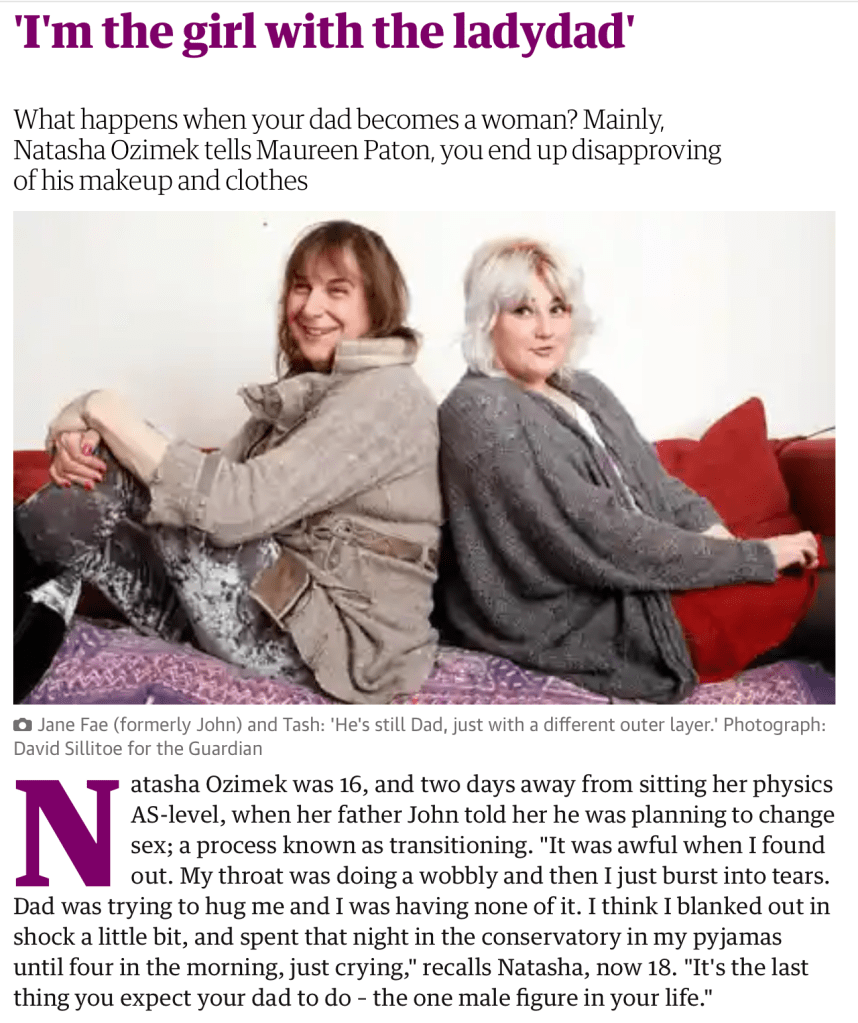
Hayton says that family life returned to normal and that the kids requested that they still call him dad and referred to him by male pronouns. Hayton failed to share this detail with the GIC (Loc 459) presumably because it proved that his distress around his sex didn’t extend to being reminded that he had sired children.
Hayton spends an inordinate amount of time trying to convince that he passes as a woman, which he tends to tell us by way of anecdote. For example, he once got a friend to walk twenty paces behind him to check the look on peoples’ faces, the fact that few people gave him a second glance was proof that he was passing (Loc 477).
Hayton gives an overly long pedantic account of his activism as a trade union represent for the teachers’ union NASUWT. Now that Hayton was officially trans, he could be a member of the TUC LGBT+ committee – a role he clearly relished. Committee places had been reserved just for trans-identified people, like himself (Loc 489). Meanwhile Hayton changed his passport, driving licence and other documents to declare himself as female (Loc 533), but of course – famously – has never bothered to get a Gender Identity Certificate because ‘there seemed to be no reason to lie about the past to live in the present’ (Loc 539).
Awakening
Hayton’s supposed gender critical awakening came when Dr Julia Long questioned another woman panellist at a seminar about ‘policy priorities for transgender equality’ (Loc 558) held on 15 June 2016*. Hayton notes that Long pointedly ignored him, whilst making the case that such policies had serious implications for women and women’s safety. Hayton claims he had a sudden epiphany that self-declaration of gender identity was the problem and indeed what was gender identity anyway (Loc 572)? In fact, he uses a very interesting turn of phrase:
Inside my head, I felt the discomfort personally.

Loc 572
*The NASUWT ‘Trans Equality in Schools and Colleges’ he authored, in which he recommended that trans-identified persons could use which ever toilet they wanted, was published in 2017 – document linked further down and in tweet below.
Long’s talking point lead him to investigate a hashtag on Twitter and thus another arm of his activism came to life (Loc 585) and he began following the likes of Stephanie Davies-Arai and claims to have been worried: ‘What dreadful things were we doing to children?’ (Loc 607). To me the whole episode reads to me of a man bloodthirsty to get involved in politics and he lurches from one unbelievable claim to the other. It was Miranda Yardley who ‘first attempted to explain autogynephilia to me’ (Loc 619). I’m simply not buying that, given Hayton had been on message boards for years at this point, not to mention time spent researching in libraries.
Hayton’s repeats again and again phrases like ‘rendered women’s boundaries meaningless’ (Loc 645) but his real concern was that if official gatekeeping disappeared ‘women may well introduce informal gatekeeping’ which might be ‘far less welcoming of transsexuals’ (Loc 652). (To date, no one has explained how a woman might tell a transsexual from transvestite.) Hayton also regularly reminds us that the official gender recognition process is ‘hardly intensive’ and again that he had never bothered with it (Loc 652). Regardless of his inconsistent arguments about his supposed rejection of self-declaration, he at pains to convince us that men who have had surgery is something that can be ‘observed and recorded’ (Loc 658), which when many go abroad to have surgery, and no gender recognition panel is required to check, is a clear fallacy.
Hayton says that sending trans-identified males to women’s prisons presents a ‘massive safeguarding loophole’ (Loc 725) and claims to have had this heartfelt concern during a Commons debate he followed on 1 December 2016. For context, here are some of Hayton’s statements on the issue of prison accommodation made after that date:
Should that [being sent to prison] happen, I would prefer to be accommodated within the female estate. I identify with women, my hormone levels are in the female range and my sex characteristics look female.
Are transgender prison wings the answer? by Debbie Hayton, Wednesday, 27 March 2019
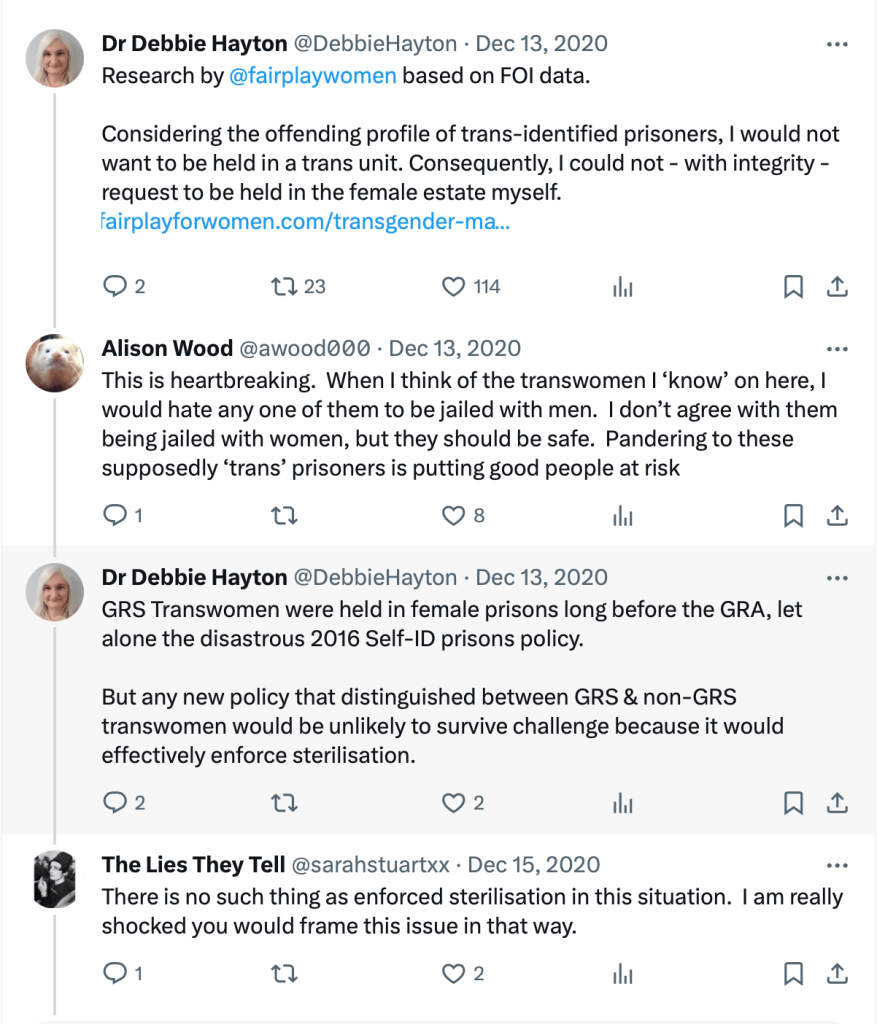
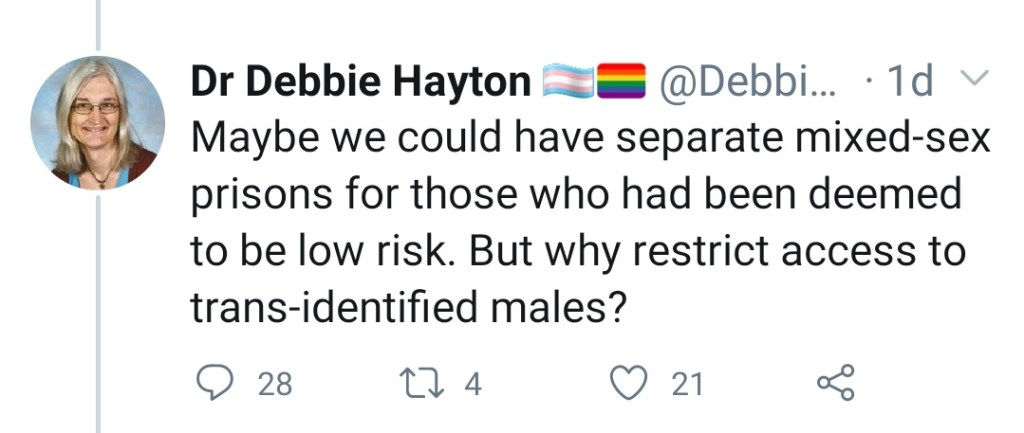
Soon Hayton’s foray into gender critical discourse on Twitter earned him a career in journalism (Loc 752). His first piece described the debate as ‘polarised and toxic’ (Loc 760), but of course he did, Hayton is just a common garden TRA after all. He became the go-to trans person to speak out against self-ID, so you can imagine he was able to easily monopolise a huge range of people, just from holding that position alone. When someone describes someone like Lily (Liam) Madigan as a ‘transgender woman’ (Loc 790) you know they are simply not a serious person. Not only that, but his subsequent article in The Times prevaricated on the issue of whether or not Madigan should be a women’s officer; nowhere does he clearly state that he should not. He quotes two whole paragraphs out of the article to virtue signal his GC credentials, but there’s one paragraph which I think is far more relevant:
My dictionary tells me that a woman is an adult human female, but that does not fit well with the claim that “transgender women are women”. This is painful territory for transgender people, and it is tempting to shut down debate and dismiss concerns as transphobia. But concerns don’t go away, they fester, and we risk transgender-acceptance being replaced by transgender-suspicion.
We transgender women cannot self identify our sex by Debbie Hayton, The Times, 29 November 2017
Autogynephilia
When Hayton argues for his rights, he does so using the argument that he is a ‘transsexual’ and quotes the relevant bits of the Gender Recognition Act and 2010 Equality Act which protect men like him. He argues that there are different causes for transsexualism (Loc 827) and his is AGP. This means he is nominally against AGPs having access to women’s spaces, unless, like himself, they have taken their fetish full throttle and have had their sex organs removed. It’s amazing really that some in the gender critical movement cannot see the absolute brass neck of this position.
Every now and then Hayton’s mask slips and we catch a glimpse of the panting pervert. For example, Hayton gives a little biology lesson, using bullet points, i.e. humans are mammals in which the young feed on milk, we are sexually dimorphic, sexual characteristics are clearly delineated. The final bullet is:
Some human beings appear to have an insatiable urge to present as - and be perceived as - the other sex.

Loc 840
Descending into psychobabble, we are told this is to do with ‘the legacy of human evolution’ (Loc 866) and that ‘we are constantly signalling our own sexual attractiveness’ (Loc 887). He admits that the drive to get himself castrated and have a cosmetically created neo-vagina was purely sexual and was because he was ‘signalling to myself’ (Loc 906) due to an erotic target location error.
In discussing AGP, Hayton fails to consider any other causes which lead to men identifying as trans. The nefarious men who self-declare their gender really aren’t like him at all! Exhibitionism, narcissism, and voyeurism don’t get a look in. Instead we have the supposed four types of AGP mind explained to us, these are: transvestic (clothes), behavioural (getting turned on by typical behaviours of a woman, i.e. sexist tropes), anatomic (wanting a female body) and physiological (‘arousal by the fantasy of having female body functions’, which sounds exactly the same thing as anatomic) (Loc 925). Why should any man, who displays this behaviour, need any special protection by society?
We all laughed when Stonewall said they were going to protect the rights of asexual people and that’s where Hayton goes next – ‘nobody should be called to account for their sexual orientation’ (Loc 963) and that’s because Dobby also believes that his AGP is a bona fide sexual orientation. If being without sexual attraction is a sexual orientation, then I don’t see why being AGP can’t be one too, right? Being AGP is akin to a ‘variety of romantic love’ (Loc 1001) and the ‘intimacy of the relationship’ (Loc 1008). These are simply mad statements, we are all in relationships with ourselves, we all have an internal monologue. None of his arguments withstand any scrutiny.
Porn doesn't cause unusual sexualities, rather, it reveals them.

Loc 1047
Of course, Hayton has no data to back up this fantastic claim, and very keen to persuade the reader of his complete disinterest in porn. In fact, transvestic porn, also known as sissy hypno porn, has been described by Steve Hassan, an expert in cults and on the effects of hypnosis, as ‘weaponized mind control‘. This was after he interviewed a bunch of detransitioners. There’s no doubt Hayton is aware of all this, it obviously just doesn’t fit his honest-to-God narrative to mention it. No, Hayton wants us to believe that being AGP is ‘appears to be hardwired’ (Loc 1053), thereby removing the need for anyone to ask any difficult questions about childhood abuse, use of pornography or any other social factors.
Lip service is paid to Stephanie, his wife, for having to deal with the second trauma of his announcement that he is AGP, rather than a woman, (Loc 1072) and excuses himself from considering how this must have impacted her by saying ‘that is her story rather than mine’. Hayton claims that he wouldn’t have transitioned had he known in 2012 what he knows now (Loc 1072) but this falls flat. I don’t believe for one minute he had not heard of autogynephilia before he transitioned.
“What you are seeing [in an AGP] is an embodiment of how that person would like the ideal woman to dress. Autogynephilia is a rare window into male heterosexuality, because men usually keep their feelings and porn fantasies strictly under wraps.”
Debbie Hayton quoted from Times article: Debbie Hayton: the trans woman taking on the trans activists, by Janice Turner
Perception and reality
In which Hayton harps on ad nauseum that men and women are biologically different and I would argue it has a hypnotic effect. He does this because he is working his way up to making this fatuous and contradictory statement:
Hard-wiring the words 'men' and 'women' to 'male' and 'female' is also unhelpful when describing some people with 'differences of sexual development'.

Loc 1120
Proving to us that he is no more than a common garden trans right activist, he uses the example of people affected by CAIS to prove his point. The prevalence of CAIS in the general population is estimated at between one in 20,000 and one in 60,000 live births, so we are talking about an extremely rare chromosomal abnormality, which can’t be passed on by those who have CAIS, since it renders them infertile.
Are transwomen women after all, then? Clearly, we are the opposite sex to women. [...] But we could say that someone perceived to be an adult human female can be usefully referred to as a woman.

Loc 1139
Hayton cites the case of Goodwin v. United Kingdom, and says ‘the court held that if someone is perceived to be a woman, it is perverse for the law to them as a man’ (Loc 1205) – see the video posted by Maya Forstater – Christine Goodwin was instantly identifiable as male.
Announcing pronouns, according to Hayton, is harmful to trans people, not only might they be outed but what about ‘trans people who are still in the closet’? (Loc 1273). As it turns out, when a new colleague apparently did not realise he was a trans-identified male, lecturing him on the importance of sharing pronouns, Hayton had a rather different reaction:
The irony was delicious, and the temptation to say more was almost unbearable.

Loc 1287
Gender Identity to Gender Apostasy
Hayton was elected to the NASUWT National Executive and eventually found himself subject to a disciplinary investigation by the TUC for his gender critical stance. It sounds an unpleasant episode, but the verve with which he recalls the episode (‘the atmosphere was electric,’ boasting that he retained his male voice, etc (Loc 1427)) makes clear he enjoyed the attention. He claims that it was his ‘transsexualism that opened doors’ (Loc 1389) yet how would anyone know, unless they were to do a genital check, that Hayton was anything other than a transvestite?
Although he admits previously supporting motions such as ”all women’ included transwomen’ (Loc 1465), he fails to mention the episode where he authored NASUWT’s ‘Trans Equality in Schools and Colleges’ in 2017 (remember, this was written one year after the alleged gender critical epiphany). The full policy document is still available, though appears to have been removed from NASUWT’s site. Hayton has yet to disavow the document publicly nor ask for its retraction, though I’m told he is keen to distance himself if asked about it one-to-one.
Supporting Dual-role People
For example, a male teacher might want to attend a staff party as a woman. In that case they would probably prefer to use a female name and feminine pronouns, and they should be allowed to use the toilets appropriate to the gender in which they are presenting.
page 14/15, of the policy document authored by Debbie Hayton
Hayton claims that mostly his pupils are oblivious to his activities as an activist or his trans-identified status (Loc 1495) and that parents occasionally contact the school to commend the stance he has taken (Loc 1501).
Apostasy and Exclusion & Terf Island: Britain Against the World
Two whole chapters which breathlessly explain his views on the trade union movement and gender critical politics.
Children and Technology
As is typical for Hayton, he delivers an already accepted idea about the impact of social media on society, comparing it to the invention of the printing press, delivered as if it were his own (Loc 2119). He points out that children are now growing up in a world where images can be manipulated and we can’t know who it is we are talking to online. To illustrate this, he tells us of the fun he has playing online chess, where he is allegedly bothered by men who respond to his real photo by asking “Hello gorgeous, you look stunning today” (Loc 2131) and its for us to reflect that only a sad old pervert would feel complimented by such a droll line. For Hayton it is proof they think him female. He is also titillated when it is assumed that he is receiving chess tips from his boyfriend (Loc 2137).
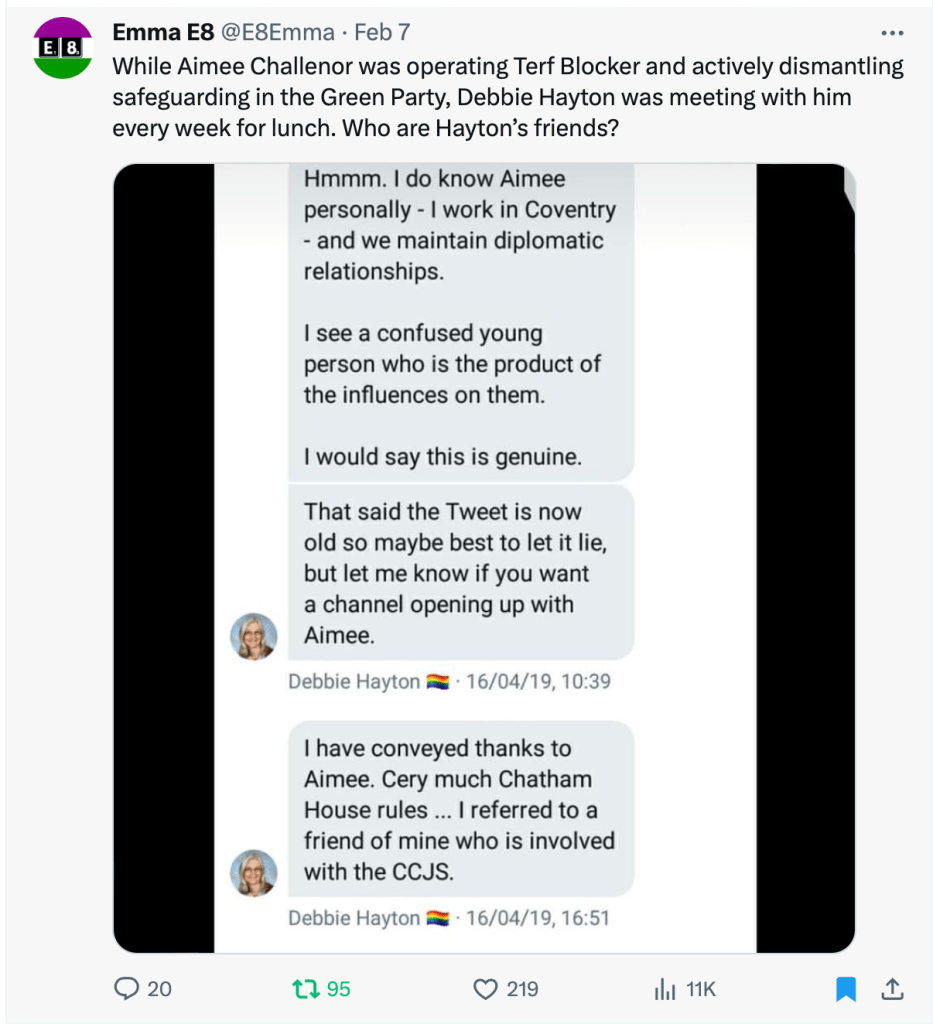
When COVID came in and classrooms moved into an online space, he describes the school’s initial decision to blank out the children’s cameras as a ‘hastily instigated safeguarding polic[y]’ (Loc 2216). Hayton goes to pains to persuade us of his concern of the impact of COVID on the developing minds of children and then rapidly moves onto his concerns about the availability of puberty blockers.
Nobody needs a gender identity - we simply need to be ourselves.

Loc 2307
Unless, of course, you’re an AGP – that ‘identity’ is perfectly fine!
He reveals that he has been approached twice by pupils who wanted to discuss sex and gender with him, ‘one child transitioned soon after leaving school’, while the other ‘experimented with a non-binary identity’ (Loc 2325). Again, Hayton views his existence in their lives as purely incidental and assures us he followed normal school policy on disclosures.
‘Senior teachers sometimes ask me to advise on trans policies,’ of course. Hayton’s new position, since writing the NASUWT policy document, is that ‘transgender-identified children must not be accommodated with the other sex’ (Loc 2332). Again he has a chance to disclose that he has previously petitioned for the reverse but there is no honesty here, only rhetoric. The chapter ends on a note that the ‘future is uncertain’ for ‘transsexual’ (rather than AGP) adults such as himself (Loc 2357) – and you thought it was going to be all about the children?
Eventually, her NASUWT opponents tabled a position statement saying, “Trans women are women,” which was passed. Unable to support it and refusing to stay silent, Hayton resigned, forfeiting the chance to lead Britain’s seventh biggest union and, ironically, be the first trans person to lead any union.
From Times article: Debbie Hayton: the trans woman taking on the trans activists, by Janice Turner
The Transsexual Future
Hayton reminds us that he had to transition ‘as a means to and end – to protect my sanity’ (Loc 2364) again contradicting his earlier claim to now be regretful. He would prefer if law and policy referred to perception of sex and ‘defined a transsexual person as one routinely perceived to be the other sex’ (Loc 2400). Hayton says this because he is trolling us, he knows that he in no way passes as a woman, so any such policy would be to his own detriment.
On the issue of toilets, he claims he now understands and respects women’s boundaries but this does not mean that heterosexual AGP men, like himself, who may be turned on by the physiological attributes of a female body, should have to use men’s facilities. Why? The sight of TIMs might cause ‘discomfort and embarrassment’ to other men (Loc 2432), whereas as Hayton naturally sees no problems for women with the proliferation of single-use facilities.
Finally, to clear up any confusion the reader may have had, Hayton makes it patently clear that he does not regret transition, as he ‘prefers my body as it is now’ and tries to persuade us that his breasts are the result of exogenous oestrogen (Loc 2469). To further underline this he tells us that he does not plan to ‘detransition’ because it would entail him having to make a decision to wear a ‘chest binder’ or wear ‘baggy clothes’ to hide his breast implants (Loc 2475). In fact, abandoning his gender identity might cause ‘a mental health catastrophe’ (Loc 2481).
Epilogue: Another Perspective
In which Hayton’s wife, gets to speak. We learn that she was unconvinced by Hayton’s arguments that wearing female clothes was evidence he was born in the wrong body (Loc 2512), that she found him unmanageable when he began to transition and put pressure on her not to exercise her right to divorce (Loc 2518). Stephanie points out that trans-identified males rarely pass, are on the whole taller than average for men, yet still wear high heels (Loc 2530) and use their natural deeper voices to dominate women (Loc 2536). She has been mortified to be regarded as in a same sex relationship and once felt the urge to shout out ‘I’m not gay!’ but didn’t because she didn’t want to ‘out’ Hayton (Loc 2548). It appears Stephanie stays in the relationship because she is led by her faith in God and despite her protestations of being satisfied with the arrangements, she is clearly performing mind over matter to get herself through it.
Conclusion
The book in no way makes the case for autogynephilia as a sexuality or identity, because beyond a few weak personal anecdotes, there is no hard evidence or cogent arguments presented here that persuade it would be either beneficial to the individual or society at large to mainstream it. There is no acknowledgement that it is regarded by many as a particularly nasty fetish which feeds on the emotions of women. Especially concerning are the repeated denials that pornography is in any way the cause of the same, despite the abundant video and photographic evidence that it is. Like I say, it’s absolutely staggering that Hayton has anyone’s ear, absolutely staggering.
Thank you for reading! Sign up to my blog by going to the bottom of the page.
Please share on other forums if you liked it, as I only do Twitter.
 The Lies They Tell
Heterosexual male, pornography-induced self-importance. Thank you for revealing his dishonesty. He has received much attention – e.g., from ‘The Speccie’ – and some of us never believed he deserved it.
LikeLiked by 2 people
This is an excellent piece and dovetails magnificently with the 2 videos on DebbieDavid Hayton up on my channel, Trans Widow Ute Heggen. You deserve a wider following and I will do what I can on that end. Thanks for reading the book so that I and my subscribers don’t have to! I could have predicted the illogic and inconsistencies based on my life as the ex-wife of a dude like him, and as a keeper of records of trans widows’ experiences. The reality I’m discovering is that so many of these dudes are violent to the wife before she gets out. Of 56, 23 were sexually assaulted and 16 were physically assaulted. A few women reported to law enforcement, especially in the cases where attempted strangulation was the assault. None prosecuted. Thanks so much for what you are doing!
Ute Heggen, author, In the Curated Woods, True Tails from a Grass Widow (iuniverse, 2022)
LikeLiked by 3 people
Thank you for this. A question that’s been on my mind — if paraphilias, including AGP, tend to escalate — is this book (and Hayton’s copious essays, interviews, op-eds, and social media posts over the years) not an arc of performative escalation? I’m not convinced this is any kind of exercise in self-awareness. It’s more like a savvy GC-adjacent version of AGP confessionalism.
LikeLike