
An evening with the playdoh people.

The blurby bit
Please join us for a panel discussion and the launch of our recently published report from our survey of non-binary students and staff in UK high education. The event is part of our larger Non-Binary Genders in Higher Education: Lived Experiences, Imagined Futures project.
We will present the report’s main findings as well as our recommendations. We will also be joined by a panel of non-binary students and staff to discuss current situation and future possibilities for non-binary people in higher education.
Our report sets our findings from the first large-scale survey of non-binary people in UK higher education. The survey was carried out to find out about current levels of institutional inclusion or recognition of non-binary staff and students and how they navigate institutional structures. Through the survey we were able to identify areas of good practice and where institutions can do further work.
This event is supported by the *Centre for Social Justice Research and the *Centre for Education and Teaching Innovation.
From the Eventbrite information
* Both departments at the University of Westminster.
Introduction
Back in June 2019 we attended the Non-Binary in Higher Education’s (NBinHE) roundtable discussion, a hilarious affair in which a non-binary panel discussed their everyday non-binaryness. We thought a couple of them were clearly taking the piss but we also saw one of the same students at this event. Our props to them, it must take real stamina to keep up a non-binary identity that long. The session included the now legendary playdoh interpretations of non-binary curricula we all ROLFED at, we learnt that Jennifer Fraser still has the models lovingly preserved in their office. The aim back then was to create data to prove that non-binary was a separate category and force universities to recognise that category through surveys and research projects, and affect wider society data collection. They now, apparently, have the data …
The event was recorded.
The team
The hackdemic team are Jennifer Fraser (lecturer at the University of Westminster), Raf Benato (senior lecturer, City, University of London) and Francis Ray (reader at the University of Westminster). They are three grown-ass women and utterly pathetic, having put their twitter account into protected mode at the time of writing, despite precisely no one (with the exception of us) showing any interest in them whatsoever.
Welcome from Jennifer
Jennifer Fraser began the evening, thanking everyone who had helped in the project. The team had come at this project from being three non-binary hackademics musing what felt wrong or off about the lives they were living in higher education and giving a listening ear to the complaints they were receiving from their whiny non-binary students. In particular, there was a lack of non-binary specific data, always being ‘subsumed’ with the data about trans or just LGBTQIA+ people instead. They also saw the project as part of the larger ‘decolonisation’ project in hackademia. On the other hand there was the ‘outright transphobia’ and right wing machinations. Cope.
How the government consultation on ‘gender diverse children’ would affect the future generations of non binary people coming into higher education, was one current issue. It was the first time these hackdemics had ever done a survey before, so needed a lot of help designing and analysing the results from outside the team.
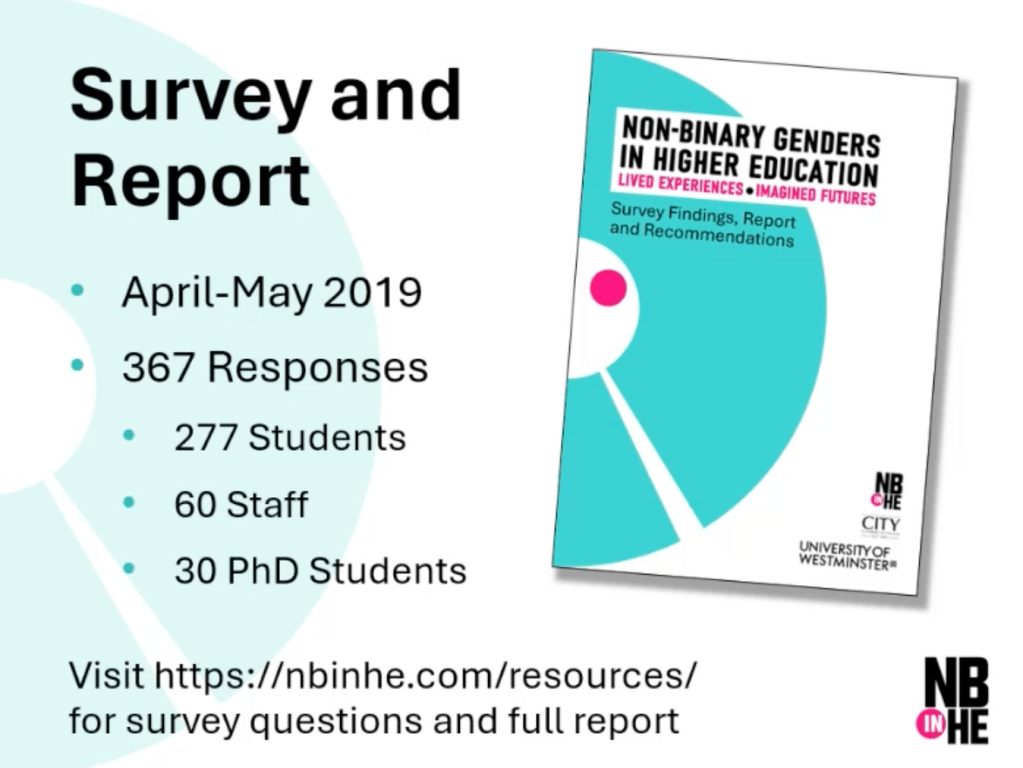
We personally think this is a most revealing result. Despite students helping spread the news of the survey across university campuses and non-binary hackdemics and allies also pitching in, they managed to get just a paltry 367 responses. About a third of all respondents were staff, or PhD students (likely interested in becoming hackdemics themselves, since many were also teaching). Fraser lied, saying they would have been happy with just 100 responses.
Included in the survey was a section called ‘navigating your gender in your studies and work’. However, Fraser told us, voice-a-quiver, they deliberately chose not to ask people about traumatic experiences because they didn’t want people to ‘relive that pain’. Though, guess what, people had been very generous and had shared their painful things anyway. The survey was designed so that people could ignore any questions they didn’t want to answer, apart from the consent question. The survey was run for six weeks starting in April 2019, thus it had taken more than four years to analyse the results and publish this report. FOUR YEARS! A worldwide pandemic has come and gone in between, which we’re pretty sure saw most hackademics twiddling their thumbs for about 18 months, so what the fuck have they been doing?
Two peer reviewed articles were also due to appear arising from the survey data, we guess they are just battling now to get those through, because when you see what was uncovered, your brains are literally going to shrink. It was hoped the results would inform universities on how to make non-binary people ‘feel welcomed – [but] perhaps not at home,’ so that they could study in peace and not worry about finding the gender neutral toilet (now available almost everywhere on universities campuses, certainly Westminster has had them since 2020).
Francis presents the key findings
There were five key findings:
- Ego-narcissistic wish fulfilment not being met.
- There are about a squillion words which mean non-binary.
- Just so happens that university is the most non-binary-phobic places in known universe.
- Most non-binaries have a side order of other made-up stuff.
- We managed to get enough responses to claim ubiquity.
Okay, okay, these are the actual key findings, but I think you’ll agree, ours are much more accurate.

Francis Ray thought it very significant that 41 percent of respondents felt unable to be open with their teachers about why they had died their hair blue.


Francis Ray also spent most of their sabbatical producing the above pie charts.
There were 93 different permutations of announcing you didn’t have a personality. Above left are the 20 most popular single word responses, above right are the respondents who used more than one term to describe themselves, because, just like the recent sadistic cat killer, Scarlet Blake, there are now people who identify as multiple units. You will note it includes words which recognise the binary of the sexes. Such evidence meant universities could not simply create a third category to include non-binary people, because it was so much more complicated than that – we need to ‘explode the idea of gender categorisibility,’ [sic] said Ray and we do agree with at least one bit of that, it is risible.
One of the major themes the survey had bought out was that people were tired and exhausted all the time from the effort of telling people they were a they/them or else being overlooked (i.e. ignored, because it isn’t really that interesting).
Then there was the intersectional nature of being non-binary. Eleven percent of respondents identified as coming from a minority ethnic background, meaning the vast majority are white British. Of course, this was spun as if there were a significant number, when in actual fact it more or less fits with the census data collected for England and Wales on race, though we suspect that ethnic minority was probably enthusiastically interpreted by the blue hairs.
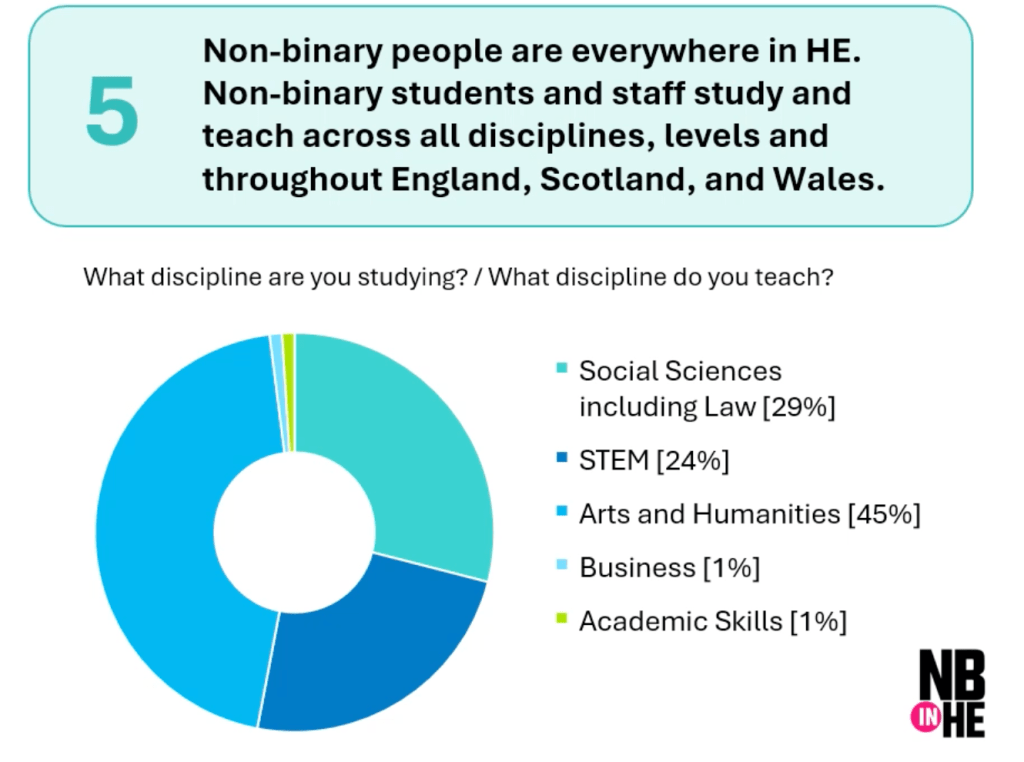
Unsurprisingly almost half of the non-binary students/staff are linked to arts and humanities. You really didn’t need to do a survey to find this out. However, again this was styled out as if non-binary identities were pretty common. Big LOL from us that only 1 percent of them are in ‘academic skills’. Ray described the fact that only 1 percent were in business studies as ‘fewer’ rather than the ‘hardly any’ it clearly is.
Interestingly, Ray reflected that it probably wasn’t possible to be non-binary and heterosexual, implying that being non-binary is really just a new way of announcing you were same-sex attracted to some degree, or at least not bothered by being perceived as such.
Recommendations
Don’t assume that the needs of non-binary people will be met by a trans inclusion policy. Include non-binary people in policy design. Ensure databases are flexible enough for students to change their names (currently lot of systems were unlinked and therefore didn’t update automatically, the team appear to have no idea that the cost in linking such systems could run into the millions). ‘This is why non-binary people are exhausted because this is what they have to do all the time,’ said Ray of the difficulties of name change. Imagine if married women made the same claim though?
Demands on other teaching staff included remembering to use the right pronouns and new name changes. They should also avoid unnecessary gendering of students. Staff who are ‘coming out’ as non-binary should be given extra support.
Another survey was to be rolled out in April 2024 and the team were awaiting an ethics committee approval for it. Hilarious, we know. Imagine, it will be 2029 before we write another blog about it.
Panel discussion
Always our favourite bit. The panel were:
- Mat, they/them (male), just finished a PhD in Brighton looking at trans and non-binary experiences of town planning (bogs, basically- what else could it mean?).
- Raf Benato, they/them (female), the third NBinHE team member, was there to do their bit representing non-binary staff.
- Jo, they/them (female) but also she/her (if they/she doesn’t want a confrontation), also a PhD student. Her PhD was on why sex workers in India felt like there weren’t part of the queer movement – touching on class and caste struggles.
- Alan, he/him (female), undergraduate politics student.
- S, they/them (male), doing a doctorate in clinical psychology. Thesis was on ‘trans and non-binary sexualities affected by transition’.
- Matty, they/them (female), undergraduate student.
The panel was tasked with answering the following wishy-washy questions:
- What are the conditions that make it possible to be (openly) non-binary in higher education?
- What would a non-binary inclusive curriculum look like in your discipline?
- If you had unlimited resources, what would a fully non-binary inclusive university look or feel like?
Brighton had a special unit which looked at queer stuff and were on hand to back up students who identified with gender. An admin person was tasked with actioning name and gender changes ASAP. In response to this news another student found this ‘beautiful’. The love-in and serious nodding of heads had begun! Toilets, of course, were an issue. Do you know how difficult it is to put your make-up on when you are a man in a dress in a male toilet?
The major block in people understanding non-binary identity was that medical and surgical alternations weren’t necessarily needed. We are all in constant transition anyway, as our bodies age. It would be helpful if in Fresher’s week everyone could be put through a mandatory experiential exercise.
Staff had gone out of their way to make sure wishes were met. This female student also would like the university to get rid of gendered changing rooms in the gym and to play more gay music. The burden was on them to inform fellow students of the alternative political narratives available during lectures.
In the last few years there had been an increase in terf groups and hate speech, thus it was increasingly scarier by the day to be trans or non-binary. Nevertheless, they appeared to have no fear in sharing their news with Chinese students, who naturally asked questions, but this was a bit too much, they’re not here to educate. ‘Please use Google,’ was the advice.
Benato, the hackdemic panel member, talked about how ‘unbelievably boring’ and ‘soul destroying’ it was to design a curriculum. We wonder why they are in hackedemia then, when there are tons of jobs out there which require no creative input whatsoever? For Benato, it would be improved if the students could do this essential work instead, so on top of being stupid, it turns out they (Benato) are lazy too.
Trans and non-binary people should be included in the curriculum because they’ve been making videos and stuff and posting them on youtube. Any class being taught by the same, automatically makes it a trans or non-binary class (the implication being just the presence of such a person will impart knowledge to the learner).
Another wanted to say they wished there was more criticism of gender in the foundation texts but struggled with this because they didn’t want to make it sound like they were being ‘gender critical’. What would a non-binary perspective bring? (And, what is that anyway?)
The website Pink Therapy should be promoted on psychotherapy courses.

Normally LGBTQ people only got one chapter in the book, at the end, as an add-on. Such books should be thrown away and we should only use ones in which LGBTQ are omnipresent.
Having openly non-binary vice chancellors wasn’t the answer, for example, the University of Brighton had an openly lesbian VC and it had ‘not gone well’ (on checking, Debra Humphris has appeared not to say anything slightly terfy and the thumbs-down likely to do with redundancies). Get rid of VCs and Executive Boards, we don’t need hierarchy. Give us the resources to do what we want, in particular make resources available to those staff and students exposed to the ‘culture wars’. Provide mental health support.
Another panel member agreed, it wasn’t fair that students didn’t get a say in how the budget was spent. Not only that, the gender neutral toilets in the building was on the lower ground, which meant if they were on the sixth floor it would take the entirety of their break to use the loo. They admitted that they were happy to use the ladies though didn’t feel they could use the men’s because they would be ‘questioned’ (I think they meant to say they would feel ‘threatened’). Wearing pronoun badges is very helpful. Make it common practice to ask each others pronouns.
Benato agreed things should be student-led, although there was still a space for people like theirself to be role models. Language does change, why when they were younger, people use to say chairman all the time and now people say chair. It’s our delight to point out to them that words like ‘manager’ and ‘chief’ haven’t gone away at all. Benato claimed that some of the data and quotes that they read in the survey were so very traumatising, they had sat on their doorstep wondering how such toxic information could be presented without re-traumatising others or themselves. Such is the sacrifice they have given.
A properly inclusive university would be unabashedly anti-colonial and understanding of the gender identities that already existed pre-colonisation. You also shouldn’t have to chose what sort of violence you’d be on the receiving on; so it was a quandary, do you risk coming out as ‘anxious’? University wasn’t able to deal with multi-dimensional identities, it seemed. More money to trans and non-binary staff for having to provide pastoral care to trans and non-binary students, since this was also ‘exhausting’.
Question and Answer session
A female member of staff (she/they) wanted advice on how to come out as non-binary.
A student responded that the registry didn’t have anything in place that changed their name for all their classes, so they had to keep turning up to be greeted by their dead name. This was ‘terrifying’ and they experienced trauma in that first year. Now when they get misgendered they are ready to make people feel uncomfortable. ‘I’m not going to make myself small for you,’ they said.
Email signatures do a lot of work for you. And non-binary lanyards for when you teach.
Coming out was an endless process over a lifetime, said Benato. They always come out to students. Except when they don’t.
Changing your name is a technique for coming out, said Ray, but at the time they did it, there wasn’t a gender box they could tick. How many people do you tell across the university? Decisions, decisions.
Is there a curriculum which takes non-binary fully into consideration which had been completely peer reviewed.
Yes, there is some stuff. Benato had written advice for radiographers and students.
Ray said a lot of stuff is made up in universities anyway. New textbooks were being written for sociology which was trying to incorporate the gender stuff. Their advice was being sought on that but they would only contribute if they were paid.
Research can influence policy. We are all answering the government education consultation.
We non-binary people think very deeply about things, but if you weren’t going to be polite and gentle, what would your most radical take be?
Humble, as ever. One panelist imagined the building blowing up and a world where no one had to work and everyone could spend as much time as they wished learning. It wasn’t fair some people could be educated at university and others couldn’t (no tears this side of the grass). Pride was being sponsored by those complicit in Palestinian ‘genocide’.
Centre trans and non-binary experience as a springboard to more progress.
One student was unapologetically communist [snort]. We don’t live in a vacuum and we have horrible experiences. They also have a horrible landlord. We need to get organised and fight against the ‘one percent’.
Francis wanted to not be in a building ‘built on sugar’ and help build the decolonised space. They suspected it wouldn’t happen in their lifetime.
My identity is my weapon to use and I’m going to use it against you.
Non-binary student
We eagerly await the next instalment …
Thank you for reading! Sign up to my blog by going to the bottom of the page.
Please share on other forums if you liked it, as I only do Twitter.
 The Lies They Tell
You must be logged in to post a comment.