
Chelsea Manning claims that ‘copying data is the most natural thing in the world’, so he won’t mind then, the abridged version of his memoir being posted here.

Before the lies start
We have some blurb – ‘about the author’ – (unlikely to be just Chelsea Manning himself) describing him as an ‘American transparency activist’, a dedication to the ‘brave trans kids who struggle to live as themselves in a hostile world’ (just think of little Bradley). However, more importantly there is a disclaimer. A disclaimer which is pretty funny and worth bearing in mind for everything which comes after.
The public release clearance of this publication by the Department of Defense does not imply Department of Defense endorsement or factual accuracy of the material.

Loc 32
Then there’s an ‘author’s note’, which pretty much says the same. On with the show …
CHAPTER 1, BARNES & NOBLE, ROCKVILLE, MARYLAND, FEBRUARY 8, 2010
The sabotage
It begins with Bradley Manning’s act of sabotage. Manning claims intimate knowledge of what was in the files, ultimately to be shared publicly by Julian Assange via Wikileaks:
This was every single incident report the United States Army ever filed about Iraq or Afghanistan.

Loc 46
Given over 700,000 documents were illegally shared, it would have been impossible for Manning to have known exactly what he was uploading. We are told of the urgency he felt to do this, that he was responding to an inner unstoppable probity, of futile attempts to make contact with responsible established media, like the Washington Post. Ultimately though he wants us to think he chose an unstable internet connection in a chain bookstore and that if the upload hadn’t completed, he would have abandoned the attempt once and for all (Loc 56). A claim he learnt of Wikileaks from an army instructor, who advised him not to visit it, is quickly followed by a clarification the instructor denied this (Loc 109). (Yep, there’s a lot careful wording and lawyering going on this book.)
The intellectual rationale for sharing highly confidential military reports, which risked the lives of US personnel and Iraqi collaborators, Manning has only this:
More and more, I began to question the rationale for keeping so much information classified. Why are we keeping so many secrets? There seemed to be no consistent internal logic to classification decisions.

Loc 163
Post-sabotage
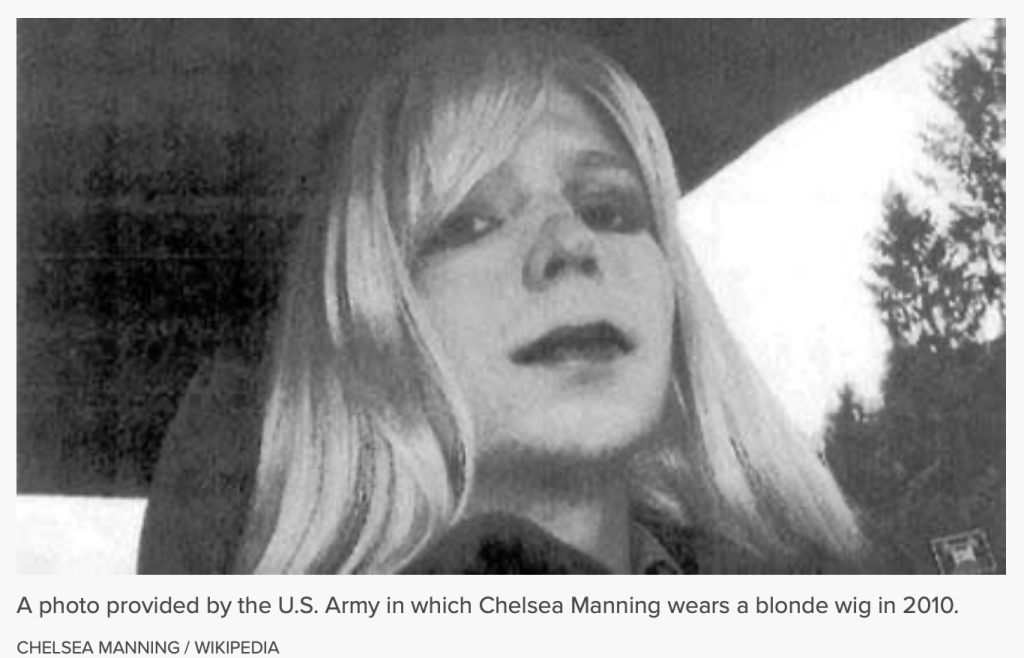
After allegedly sealing his fate in the bookshop, Manning says he took himself off to a shopping mall, where he purchased a purple coat, make-up, a business casual outfit, and ate fast food before returning home. Once home, he put on the women’s clothes he had purchased, a long blonde wig and went back out again, spending the rest of the day wandering around bookstores and coffee shops. In other words, he had a relaxing and pleasurable day, crossdressing in public.
Despite an earlier insinuation Manning understood the gravity of the situation, that he was leaking the information for the greater good and had chosen the platform of Wikileaks very carefully, we have the utterly eye-popping claim that Manning didn’t understand that his crimes would result in a life-long prison sentence, believing instead:
I figured at most I was going to be discharged or lose my security clearance.

Loc 126
And thus the tale begins.
It is well written. I did initially believe it was a ghostwriter but now think it is mostly Manning, albeit heavily edited because not everything adds up as a personal memoir. Manning, of course, is presented as hero, but we can’t help also seeing glimpses of the extreme fecklessness and stupidity. A literary flourish on the first page makes clear it is to be a work of fiction, describing the file upload as ‘a pointillist picture of wars that wouldn’t end’ (Loc 46) (such flourishes I doubt are Manning’s, as he speaks so plainly in interviews).
The prosecutors claim Manning, 24, used the online alias of ‘Nobody’ while talking to ‘Nathanial Frank’ which they claim was an alias for Mr Assange.
In one chat, the young intelligence analyst asked ‘Frank’ for help cracking the password on his classified computer so he could log on anonymously.
He asked if he had experience breaking such ‘hash’ codes. ‘Frank’ allegdly replied yes they had ‘rainbow tables’ for doing that.
Assange may face spy charges after lawyers claim he ‘coached’ U.S. whistleblower on breaking military computer passwords, Mail Online, 24 December 2011
Gender dysphoria
As his gender dysphoria was the crux of the legal campaign to overturn his sentencing, we get quite a lot of information about this in the first chapter. We learn that he had watched a lot of YouTube videos of men detailing their transitions, so is likely to have come across a fair bit of sissy porn. Also, he was aware that people like him weren’t allowed to ‘serve openly’ (Loc 63). He says that he doesn’t feel like a woman trapped in man’s body but rather there is an ‘innate incoherence’ (Loc 74) between who he wanted to be, as opposed to who he was.
CHAPTER 2, CENTRAL OKLAHOMA, 1987
This chapter builds on the template as Manning as victim, not only of hard drinking, uncaring parents, but also of the culture. The year in the chapter denotes Manning’s year of birth; 1987 (at the time of writing, Manning is 36 years old). Manning claims to have been deeply affected by the Waco siege of 1993, when he would have been just six years old, and also the Oklahoma City bombing, carried out by Timothy McVeigh two years later, without really explaining why, so one can only assume that this is padding.
Manning relates an incident in which he was bullied by his peers and adults alike. He says that aged 10 he kissed another boy, a kiss that was witnessed by another and a rumour spread which reached the ears of the school bus driver. The school bus driver then told the school (?). Manning was threatened with suspension during a meeting at the school at which the bus driver, the principal, the boy he kissed, the boy’s father and his own father were all present. Manning promised not to do it again, so the school decided not to enforce the suspension (Loc 260). Why would the school invite or even need the bus driver to be present for such a meeting, given he had no direct knowledge of the kiss? Did the publisher attempted to verify any of these stories?
There are inconsistencies also in the description of his parents being abusive and drunk. Alternately dad helps little Bradley to learn how computer code but also, on both parents, he makes this extraordinary claim:
Sometimes they could barely get dressed or feed themselves without huge difficulty.

Loc 358
Despite this, Manning was a high academic achiever, winning the science fair and was the first person from his school to win ‘the academic-bowl squad’ (Loc 355). He also says that his mum drank during her pregnancy with him (Loc 212). (At trial, Manning’s team claimed he suffered from foetal alcohol syndrome, a claim the book wisely avoids repeating, though I think it is well established that his mother was an alcoholic.)
In a violent incident involving his father, aged 11, he claims he was stripped half naked and whipped with a belt on his buttocks by his father. Manning overpowered his father (Loc 304) by getting him in a double nelson. All little Bradley had wanted to do was to get on with his homework. Because he was so bruised after the incident, a school teacher noticed and reported it to social services, but Manning told the social worker, who visited him at school, that he made it up (Loc 314) and the authorities desisted further investigation. Just like that.
There is more revealing detail about his crossdressing, and, as so often the case, he started by sneaking in to his sister’s room to wear her clothes. In response, his sister put a lock on her room, which he still tried to pick so he could ‘play with her things’ (Loc 232). Once he was old enough, he would go into town to shoplift clothes and make-up but then would throw it all away and promise himself he would never do it again (Loc 320). A familiar enough story from a crossdresser – but is it his?
A more believable detail is his foray into gay chat rooms aged 12/13 and the possibility his father shared his propensity for fantasy, e.g. his father told him he wore a Royal Navy uniform ‘to blend in with and confuse spies’ (Loc 197) (his father was in the US Navy, his mother a British citizen).
We also have Manning’s trademark intellectual curiosity:
Copying data seemed like the most natural, normal thing in the world.

Loc 348
Manning was a lowly private in his early twenties with a record of emotional instability. He was almost discharged six weeks after enlisting. Yet the army gave him the keys to its secret kingdom: top security clearance and access to material that ranged from half a million military field reports (including a chilling video of a military helicopter shooting civilians) to a quarter of a million diplomatic cables. He eventually sent 700,000 documents to WikiLeaks and thereby to the world’s press. That incompetence has been continued with his imprisonment. With the world watching and America’s reputation sullied by Abu Ghraib, the US army kept Manning locked up for three years, much of it in solitary confinement, sometimes stripped naked.
Spooks are too vital to be given this much power and funding, The Sunday Times, August 2013
CHAPTER 3, WALES, 2001
In a typical piece of revisionist history, Manning claims that after 9/11 he became concerned ‘about the consequences of our new heightened fear of Islamic terrorism’, nevertheless after the Islamic terrorist attack he put an American flag on his locker door but ‘certainly wasn’t the only student who did that’ (Loc 394).
His parents divorced with his father remarrying at speed, Manning was not invited to the wedding (Loc 405) and he moved with his mother, back to Wales. This must have been a big shift for him to have dealt with culturally. Manning says they were poor, having barely any furniture in a small flat and his mother had the first in a series of strokes, which he puts down to her heavy-drinking/smoking.
He told a girl, who showed some interest in him sexually, that he was gay (Loc 438) and he had some confusion about whether he fancied both a boy and his girlfriend, or whether he just wanted to be the girlfriend of the boy he fancied (Loc 427).
His interest in the internet continued to grow but apparently porn websites held no interest for him (Loc 443), preferring instead coding and hacking chatrooms, particularly chats about illegal music downloading, and liked to ‘sabotage the web servers of organisations in the recording industry’ (Loc 475). He claims to have broken into the office of someone that his friend didn’t like (Loc 491), picking the lock and copying a hard drive.
Of note, Manning claims to have been in London on the day of the 7/7 attacks in London of 2005 because he had an appointment to visit the US Embassy to get his passport reissued (Loc 448) and stayed the night in a Bloomsbury hotel to do so. He claims that he entered Kings Cross tube station just when ‘all hell broke lose’ (i.e. at 8.50am, when the bombs went off). We then learn a few paragraphs later that he returned to the US aged 17, after successfully completing four AS* levels. These dates sit beside each other extremely uncomfortably and we wonder why he would need to get his passport reissued? The US Embassy website currently stipulates that applicants aged between 16-17 should be accompanied by a parent or legal guardian, unless there are extenuating circumstances, yet Manning tells us he was on his own.
*The first half an A level. A levels are equivalent to AP courses.
CHAPTER 4, CHICAGO, 2006
So by 2006, when he was 18, Manning was back in the US and quickly found Chicago’s ‘gaybourhood’ (Loc 593). He started to use cocaine and ecstasy and have one night stands (Loc 609), claiming to have fallen into a breezy prostitution-type situation, where the guys would give him ‘gas money’ (Loc 615) in the morning. Although he wasn’t presenting himself as for sale, rather relying on the generosity of the men he slept with to voluntarily cough up in the morning, he claims to have worried about being found out by undercover cops.
Manning got himself a job and would sleep in his truck at night in the carpark (Loc 631). He also found time to set up a fraudulent tech service, called Homeless Hacker*:
I'd meet someone, chat them up, and promise websites and databases I had no intention of delivering [...] I'd just ask for a small downpayment, say a hundred dollars or so, for the work I swore I would do fast and cheap. And then I'd disappear.

Loc 647
*He seems not to realise that no one in their right mind would use a service called Homeless Hacker, but there again the US Army employed him, so who knows, right?
Unlike the alleged prostitution, Manning seems to have had no fear about the police busting his ass for fraud and theft, indeed now asserting the thought of jail (i.e. ‘three hots and a cot’ (Loc 652)) would have been a relief.
At the time of his alleged homelessness, Manning says he thought his parents didn’t care where he was, but finally realised they were concerned when he was contacted by his Aunt Debbie, his father’s sister, at the behest of his mother. He lived with Debbie in the ‘upper middle class’ area of Potomac, Maryland. His plan was to get a degree in physics at the University of Maryland but in the meantime he had to work as a barista at Starbucks to cover college tuition fees, work which he says he found ‘exhausting’, ’emotionally taxing’ and the schedule ‘grueling’ (Loc 679).
Manning continued to frequent gay nightclubs and use ecstasy, the quality of which was vastly better (Loc 679) but found his ‘debilitating gender dysphoria was getting more acute’ (Loc 690), buying more clothes and make-up but also secretly wearing the clothes of his female cousin. He also started to research cross sex hormone therapy, which he first learnt about from a flyer in a gay night club (Loc 701). In the same club, he was apparently ‘clocked’ as an ‘egg’ by a trans-identified male, a moment he turned over in his mind ‘obsessively’ and led him to seeking therapy, although ultimately never bought up the issue with the therapist (Loc 706). The main reason he gives for avoiding bringing up the topic was because he was ‘passed over, twice, for an assistant manager position I’d been promised at Starbucks’ (Loc 723). This apparently crushed him, even though he was only there part-time to help himself through college. In any case, he crashed out of college, because he didn’t really know what he wanted to do with his life, and got a job in tech in Virginia via a man he had met on the gay scene.
As the chapter closes we have Manning wonder whether he should jump in front of train whilst mesmerised by a photoshopped image of a woman in a make up ad. Whilst he reflected that it represented ‘total, unattainable perfection’ a train came in and he casually wondered: ’Should I just jump in front of it right now?’ (Loc 739). Adrian Mole, anyone?
No doubt Lamo experienced some disbelief himself. If what Manning said was true, he had just admitted to the largest leak of confidential material in American history, to a total stranger, on an unencrypted chat service. […] Why had Lamo been singled out? At the time of these chats he was 29 years old, and a well-known operator in hacking circles. Nicknamed “the Homeless Hacker” for his habit of couch-surfing his way through life, he initially worked for online companies detailing gaps in their security, without taking payment.
The whistleblower who blew the house down, by Ed Caesar, The Sunday Times, 19 December 2010
CHAPTER 5, MARYLAND, SUMMER 2007 (JUNE TO SEPTEMBER)
Manning had now apparently reconnected with his father, who he spoke to regularly on the phone. His father encouraged him to join the military because it offered ‘stability, tuition money down the line, a career’ and it would ‘man’ him up (Loc 747).
“[Bradley Manning] was, believe it or not, kind of Republican in his outlook. Very pro-America, pro-army. Fiscally, rather than socially, conservative. I remember him writing a story when he was in third grade [about eight years old] about how a dictator had got his hands on all the oil in the Middle East — and the US had to go and free up all this oil. It was kind of a Gulf war story.” – Quote from a friend.
The whistleblower who blew the house down, by Ed Caesar, The Sunday Times, 19 December
The Iraq War, which had begun in 2003, nominally to destroy Saddam Hussein’s alleged weapons of mass destruction and his government’s purported links to al-Qaeda. Manning admits his views on the invasion were not only unformed but also uninformed (Loc 747), in other words, we won’t find anybody who will testify that he didn’t parrot the narrative being pushed. He spent a lot of his time playing combat video games, like Call of Duty and was only interested in ‘technical aspects of fighting’ (Loc 752).
In other words, in September 2007, when he signed up to the army, he was clearly on the right of the political spectrum, as you would expect, and unlikely to have been wracked by libertarian concerns. Indeed, he claims he was more interested in the possibility that wearing a uniform might stop the desire to wear women’s clothing and that he wouldn’t ‘have to think about gender presentation at all’ (Loc 758). Plus, he ‘wanted to go to Iraq’, to experience war firsthand. It also meant that he ‘wouldn’t die of the targeted violence so many queer people like me fear and experience’ (Loc 763). Hmm.
Whatever his reasons for enlisting, he is eager to convince us it was done too hastily, which is a fair conclusion. The recruiters apparently advised him not to mention his drug use (Loc 790), nor that he had sought help for panic attacks (Loc 795) on his application. The paperwork also reminded applicants that they would not be asked if they were homosexual, but also that they could not disclose it. Although other areas of the recruitment are described as rushed, he was sent to the doctor to have a mole on his back checked out by biopsy (Loc 801). He didn’t tell his family he had joined until after he had been accepted. His father was happy but his sister noted that he had a problem with authority figures (Loc 806).
Once in training, Manning appears to have been surprised that the drill sergeant wasn’t as accommodating as the lads at the recruitment unit (Loc 811). He describes that the recruits all had their heads shaven and were taken in large groups to the medical room for vaccinations, where they were instructed to pull down their underpants so that they became a row of exposed buttocks in one long line (Loc 827). You would have thought that vaccinations would have been ascertained at recruitment, wouldn’t you? Manning did not say which vaccination shots were given, just that:
Nurses walked around with giant needles.

Loc 827
Manning found the intense physical training hard, but moreover, because of his short stature and his homosexuality, he found himself the butt of many a joke and the opportunity to sleep lacking. He now believes the aim of basic army training is ‘to mimic the effects of low level PTSD’ (Loc 861). During training his libido disappeared, as well as his desire to cross-dress (Loc 867).
Just ten days into training he says he experienced complete numbness in his right arm and left foot.
He was sent for neurology investigations, which ‘confirmed there was something real going on, but offered no explanation of why’ (Loc 878). The army began to discharge him but Manning asked for a lawyer when he was given the form to out-process him (Loc 884). He claims that the other soldiers called him Thumper because of the numb foot he had to hobble on (Loc 889). Finally an EMG test showed that he had sustained nerve damage and two months later he went back to restart basic training again (though an ABC News article claims the 6 weeks training course took 6 months to complete). This time he was better prepared and fitter, and all round tolerated it much better (Loc 895), boasting that he particularly excelled at ‘small-unit combat maneuvers’ due to his height, was able to shoot with accuracy and could ‘think clearly, and tactically- even with others yelling and screaming in panic’ (Loc 900). What a difference a few weeks made!
She performed well on the Armed Services Aptitude Battery but struggled with Basic Combat Training, at one point injuring both her shoulder and foot. At one point, Manning was told she was in danger of being “out-processed” or dismissed from training, but she returned after recovering from her injuries. Ultimately, Manning needed six months to finish the training that typically takes six weeks.
Everything you need to know about Chelsea Manning, ABC News, 16 May 2017
Meanwhile Manning was visited by his aunt and a past boyfriend, who was now working for the Human Rights Campaign in Washington D.C. (Loc 905) and Hilary Clinton’s 2008 presidential primary campaign (the one which saw her trounced by Barack Obama). He and the ex-boyfriend spent a day together with his father and aunt, before he flew out to Fort Huachuca.
Life at Fort Huachua was much more relaxed and Manning started to get back into the online world, in particular 4chan, a place where he says there ‘were no moderates’ (Loc 959). His ‘personal creed’ was atheism, the thing which shaped the rest of his views, which up until now has not been mentioned. Apparently he tried to sound like the ‘four horsemen of atheism‘ (Loc 964), a reference to, I believe, a popular YouTube video with Richard Dawkins, Christopher Hitchens, Daniel Dennett and Sam Harris. Manning now finds the four men ‘misogynistic, classist, and often xenophobic’ but fails to mention why.
Manning saw a lot of anti-Muslim diatribes he ‘recognised from Hitchens and Dawkins’ on 4chan but claims he ‘didn’t have that kind of anger’ (Loc 970), carefully protecting the hero status he now has on The Left. On the other hand, despite claiming to detest any hatred or ignorance shown towards Muslims, he admits going full throttle after Christians, going as far as integrating himself into Christian chat rooms. Once he was in, often after he had got moderator status, he would then propose that ‘evolution was legit’ (Loc 977) and delight in the fall out. He decided it was worth him risking his army career to engage in trolling because:
Trolling gives you a human connection.

Loc 981
And there it is again, that shining Manning intellect.
CHAPTER 6, FORT DRUM, NEW YORK, WINTER 2008-2009
Whilst at Fort Drum, Manning built an online relationship with Zinnia Jones, a trans-identified male, a YouTube ‘militant atheist star’ who impressed Manning. Now that, I can believe. At the time Jones was known as [snort] the Queen of Atheism.
As an aside, Zinnia Jones has found notoriety amongst terfs for allegedly having inserted a stapler into his anus. Jones since clarified that this was actually eight Sharpies. I mention that because it’s funny, but also instructive of the type of person Manning was drawn to and still looks up to.

Manning found Jones attractive and sent him an instant message, intrigued by the fact Jones was ‘openly trans’ (Loc 1006). He told Jones that he wanted to get credentials that conservatives would find difficult to attack and then ‘jump into politics’ (Loc 1011). Manning shared details about his deployment with Jones (Loc 1022), who provided tea and sympathy (of sorts).
He also didn’t fit in at Fort Drum either, alternatively claiming this was due to him being ‘military intelligence’ but also that he didn’t fit in with the wider team. Another contradiction: rank mattered less in intelligence (Loc 1043) and that he was able to ‘treat officers like peers’, they apparently were eager to think of him that way too, to ‘trust’ his advice (Loc 1049), etc.
The description of the kind of intelligence work he alleges he was tasked with, is strikingly similar to the detail you might expect to find in the blurb of a tactical role player game:
The video feeds were [...] information that I loved to fit together: the price of bread in a village, which crops were diseased or burned.

Loc 1059
He claims that he had had access to how specific targets’ ‘strengths, flaws, lies and hopes’. Unsurprisingly this is not backed up by any examples, even made-up ones, and we have more rhetoric on how he was depended upon to provide ‘clinical evaluation’ (Loc 1064).
Meanwhile the internet was changing and he was spending time in Internet Relay Chat (IRC) spaces, which were sometimes populated by hundreds of users at a time, but you could also now direct message others. At this time he was part of Anonymous, the online hacker group, being allowed in after he proved that he could hack a specific target, an event he describes as ‘absolutely harmless’ (Loc 1118).
He was also still on the gay scene, still leaking information about his army life. This time he befriended a journalist, who he says worked for the Washington Blade, and Manning shared with him what it was like to live under Don’t Ask, Don’t Tell and believes he was a background source for his reporting, including leaking an internal draft policy document which he found on military servers. Manning recalls his upset that the policy document had taken into consideration the possibility of increased HIV care, if policy was changed, and describes it as ‘too potentially harmful to keep bottled up’ and rationalises that it was an ‘unclassified document’ (Loc 1145). Predictably Manning was extremely flattered when the journalist, who had been flirting with him, told him how useful a source he had been.
He was bullied in the army, too; for, as a fellow soldier told the Guardian, ‘The kid was barely five foot…He was a runt, so pick on him. He’s crazy, pick on him. He’s a faggot, pick on him. The guy took it from every side. He couldn’t please anyone.’
Alexander Chancellor: Why was Bradley Manning ever allowed to join the army? – The Spectator, 31 August 2013
Manning would have love to have developed relationships with national reporters but reflects that – alas – they weren’t interested in talking to a ‘junior enlisted person’. Instead he developed a relationship with a female local journalist that – again – he had gotten to know through the gay scene. He would leak information to her that he got from a press officer he had befriended (Loc 1150). He would use both the journalist and the press officer, playing them off against each other, and using the information extracted from both as leverage to get more information. However, this was mainly tidbits and gossipy stuff.
He claims that it was part of his job to make sure safes containing armories and classified information had the right physical security measures in place, which doesn’t sound like a job given to a junior enlisted person. Manning claims such safes still had their locks set to ‘factory default settings’ (Loc 1161). He also claims that digital security was similarly lacking and that he earned a ‘modest reputation’ for being good with computers (Loc 1166) after he built a private file server for the unit. He also says he hacked a training software package the unit had to complete, so that the team could have an ‘edge going into the next stage’ and that the password to get administrator privileges was ‘admin’ (Loc 1182). (My recollection is that such passwords were disabled well before 2008.)
As Manning exported the training database, a typo meant that he ‘fucked up’ the router (Loc 1192) and, instead of getting in trouble, he was rewarded by transfer to a new unit dealing with cybersecurity. Despite the chance to remain desk-based, he still wanted to be deployed into a war zone (Loc 1215). Remember, this is someone who claims to have always been concerned about US attitudes towards the fear of Islamic terrorism.
CHAPTER 7, UPSTATE NEW YORK, NOVEMBER 2008
Manning’s alleged preoccupation with gay politics is ramped up, as we hear of the massive impact that Proposition 8 supposedly had on him. Proposition 8 was a California state bill which sought to reverse the state ruling on same sex marriage, which succeeded by the narrowest of margins. He tells us he had sat on his bed, devastated, reflecting:
It was a personal rejection of me, and millions of other queer people, as human beings.

Loc 1242
And goes on to describe the kind of response you would expect of someone experiencing extreme trauma (e.g. a soldier returning from war, or the type of solitary confinement he was going to eventually face) with limb shaking, he found himself sat in the shower for two hours, weeping.
It was his ‘first inking that the moral arc of the universe doesn’t necessarily bend toward justice’ (Loc 1258) and that it marked an intellectual and political life turning point. He began reading about the lives of Sylvia Rivera, Marsha P. Johnson (both mentally ill drug addicts), the supposed Compton Cafeteria uprising and Transgender History by Susan Stryker (a trans-identified male academic). He got involved with an anarchist queer collective called Bash Back! and rued the fact that he was not allowed to attend direct street actions, as it meant discharge or worse. This is at odds with his plea that he had no idea that uploading files to Wikileaks was an offence, and as it turned out he doxxed the Family Research Council for Bash Back! without worrying too much if he got found out.
Pride was not the only Bash Back! target. Chapters attacked the homes of heterosexist murderers, organized dance parties in the streets, beautified cop cars with glitter and paint, engaged in public sex and orgies, “glamdalized” Army recruiting centers, disrupted transphobic politicians’ speeches, discussed theory, and wheat-pasted images of fisting onto bank windows.
From ‘When the Bashed Bash Back‘ by Ella Fassler, Slate
In terms of dating, Manning didn’t go to gay clubs as he felt that scene in New York was lame (Loc 1297) and made do with online dating instead, having a relationship with an 18 year old, in which he felt powerful and worldly in comparison, as he was now 21, while the boy was still in school.
Meanwhile of Manning’s professional career, we are expected to believe this:
I studied Wardak-Logar down to each village, learning about intra-Pashtun political dynamics and Tajik society.

Loc 1334
As with all Manning’s blusters, nothing is offered as evidence of this deep understanding and appears to have no understanding how incongruent this boast is, to his involvement with Bash Back!.
Another traumatic event happens; he is raped by an older more senior man in the military, who he hooked up with in public. In comparison to the meltdown he describes in response to the success of Proposition 8, we are told he took the ‘longest hottest shower of his life’ (Loc 1382), so presumably even longer than two hours! The following day he bumps up against a female officer, above him in rank, who he refers to as ‘Admin’ (I’m thinking this refers to the female soldier he punched in face). All of his anger at the previous night’s incident is focused on Admin, who he describes as a ‘ridiculous person’ (Loc 1393), obsessed with ‘surface-level hierarchies of the military’ (Loc 1399). Suddenly the real Bradley bursts through again:
She was easy to irritate and undermine, so I made her life miserable.

Loc 1404
More truths: Despite Admin knowing that Manning was gay, he wasn’t worried about her grassing him up because his unit had an unofficial policy of avoiding investigations, invalidating his previous claims that he had to be out on the gay scene with extreme caution. We also learn that at work he ‘felt like a robot, acting in a prescribed role’ (Loc 1415), again contradicting his story about being involved in intricate cyber investigations.
It was in these days of long boredom and frustration that he began to dress in women’s clothes and watching video after video of transition stories on YouTube. However, he didn’t want to transition yet, because of the ‘expertise, deep knowledge’ (Loc 1439) he could share in the army and transitioning meant quitting and he hadn’t yet gotten to Iraq.
CHAPTER 8, FORWARD OPERATING BASE HAMMER, IRAQ, OCTOBER 2009
Beginning with a lovely literary flourish; a comparison between the plains of Iraq and those of Oklahoma. We are supposed to believe that Manning wondered about the daily lives of Iraqis, parents sending their children off to school whilst under military occupation, and such like. A friend back home wanted to know if they should encrypt their conversations because of Don’t Ask, Don’t Tell but Manning told him not to bother as the army didn’t have the capacity to monitor the communications, which contradicts, I think, the claims about knowing the innermost details of the citizens of Iraq, right down to their hopes and dreams.
I was supposed to spend two weeks in Kuwait, acclimating, but less than a week in, I woke up ready to spend another day playing real-time strategy games on my personal MacBook.

Loc 1465
He was promoted from private to a specialist (which in effect, just meant he was still a private) which failed to have any impact on how those above him, viewed him. The move also apparently meant that he was exposed to constant live feed footage of endless combat, from helmet level, which made him feel as if he were living in a simulation (Loc 1524). But as with all these recollections, we realise Manning is probably mixing up his penchant for computers games for real life.
Manning, long time hacker and doxxer, claims that he began to be troubled by the ‘human right to privacy’ (Loc 1535) because of the spying in on Iraqi citizens. There was also a lot of ‘fear-driven interoffice sex’ (Loc 1563). Everyone knew he was gay because he kept ‘a fairy wand on my desk, for one thing’ (Loc 1568). Increasingly we get the impression that Don’t Ask, Don’t Tell, a central pillar of his alienation story, was more or less inconsequential, not only to him and his peers, but also those more senior. Work also left him with enough time on his hands, he admits, to ‘pry around’. However, he claims that such ‘exploration was sanctioned’ (Loc 1596) and tells us an eye-stretching story about his being given the responsibility of monitoring a specific Shia group.
I used Bayesian statistical analysis to look for patterns in their behaviour, but this particular target group often defied my priors and predictions.

Loc 1607
Around this time, command referred him to see a therapist. Manning complains that he couldn’t tell the therapist much because the therapist ‘didn’t have a high-enough security clearance’ (Loc 1617) to discuss his work. He wasn’t prepare to talk about his gender dysphoria yet and he couldn’t talk about his sexuality either.
CHAPTER 9, IRAQ, DECEMBER 2009 TO JANUARY 2010
Begins with an interesting admission about his time in the army, absent from his reflections on his leaking activities:
I live with the fact that people died because of my team's work.

Loc 1634
Manning claims that he was involved in tracking a high-value target, knowing intimate details of the man’s life, where he ate lunch, his lovers and how he obtained alcohol. The US Army was to assassinate the target but they didn’t use the updated target package Manning had put together, thus the target was missed and the wrong people died instead – ‘even the fucking dog’ (Loc 1643), claims Manning. Despite this evident lack of utilising his advice, Manning is keen to persuade us, as always, that his opinions were highly valued and that hierarchy in his section was ‘relatively flat’ (Loc 1660).
Manning admits that one night he arrived to his post 45 minutes late because he had been playing video games. When it happened again during the same week, the master sergeant was tasked with escorting him from his digs to ensure that he arrived before time. This sent him into a blind rage, flipping over a table closest by. He was restrained by two men whilst Admin looked on. However, a more senior officer was prepared to overlook these transgressions because wee Manning’s work was so valuable (I suspect it was more about bums on seats).
Again, Manning relates a critical instance, in which he had the right intelligence, which everyone around him ignored and lives were lost, leading to him feeling powerless (Loc 1736). Manning was still in touch with one of the journalists he had befriended on the gay scene, and wrote to him about the types of files he had access to in the databases. Again, there is another long quote in the text, no doubt lifted from evidence submitted to trial, in which Manning expresses a wish to share these reports in the public domain (Loc 1752). He finished the message to the journalist with a smiley emoji and notes that the ‘censors let everything sail on through’ (Loc 1758).
Within a week, he decided to act, downloading vast numbers of files, which came to be known as the Iraq War logs, onto a (rewritable) DVD-RW, which he claims he labelled, had on full display (presumably his desk), stressing that it was used as a back-up in case he encountered slow internet connectivity (Loc 1763) for when he did the upload (which – remember – he claims to have done in a chain bookstore).
As a low-level intelligence analyst, he had security clearance to view databases such as SIPRNet, on which most of the information he is alleged to have leaked was stored. He claims to have uploaded classified documents on to CDs while pretending to listen to Lady Gaga, and then transferred that information to WikiLeaks. While he may have leaked some of the documents over the internet, it seems unlikely that he uploaded the biggest files from Iraq, because his base in the desert would have had a slow satellite internet connection. So what was the process?
“The belief is that, in the case of the larger files, they [the CDs] were hand-delivered back to the United States to someone who then made a physical hand-off to WikiLeaks,” says Lamo. One “hand-off” is believed to have taken place in Boston, in January 2010, where US military investigators are now looking for his fellow conspirators.
The whistleblower who blew the house down, by Ed Caesar, The Sunday Times, 19 December
A week before he returned home to do the deed, he posted from Iraq on his Facebook that he felt hopeless and alone (Loc 1785), and one has to wonder if this was caused by the promises he had given to Julian Assange (as yet unmentioned) and the full knowledge that he was staring down the rest of his life in jail, regardless if he did the dirty deed or not. Indeed, he seemed to be thinking along those lines when he wrote a friend:
"I can't seem to wriggle out, even just to breathe."

Loc 1790
Manning repeats his claim that he believed sharing the classified material would garner no more heat than attending a disciplinary board and told his friend as much, clearly building a case in advance for plausible denial. The following day he had a change of heart, as a commander suggested that he could become an officer, and told the friend things were much better, bragging of his intelligence: ‘[He] is not bright like me, I’m beyond sinister” (Loc 1818). The friend meanwhile urged caution about talking over an insecure channel.
CHAPTER 10, POTOMAC, MARYLAND, JANUARY 2010
Manning returned to his aunt’s house in Potomac, desperate to unburden himself of his plans to share state secrets. He ‘tried to tell’ his boyfriend (I expect he was simply playing the role of the man burdened with a terrible secret to impress the teen) but when the boyfriend asked too many questions, he had to back down, likely not wanting to incriminate himself.
After a few days after the alleged uploading of the material to Wikipedia in a bookstore (giving the discs to Assange is more likely), he returned to Iraq on 11 February 2010. He tells us that the act bought him ‘relief’ as he waited for Wikileaks to ‘find’ the files (Loc 1832).
He admits that his online life since the beginning of the year had included being in an open internet chat room, which he ‘suspected’ was associated with Wikileaks. Manning knew of Wikileaks prior the sharing of half a million pager messages gathered on the day of the September 11 attacks (including civilian communications) and wanted to know more about the hackers behind it. Ever the bragger, he claims that whilst researching Wikileaks he found a document about weapons trafficking which he ‘integrated into my work product’ (Loc 1837).
To put it another way, WikiLeaks would be nothing without Manning. Without his vast leaks, Assange would not have his scoops; nor would he be enjoying the attentions of the world’s media and intelligence services;
The whistleblower who blew the house down, by Ed Caesar, The Sunday Times, 19 December
Manning says that he fretted over whether Wikileaks had failed to notice his submission – was no one looking? Was there a snag?
In late 2009, Manning shared a cable, 10REYKJAVIK13, he had found, in which Iceland apparently expressed it felt bullied by the UK and the Netherlands. Assange was based in Iceland at that time. Manning claims he did it because he was upset that ‘the Icelandic people were getting screwed’ (Loc 1853), but it seems more likely that Assange and he were already in communication and Assange testing his mark for compliance. He sent the message as a text file, so it would be immediately legible and a few hours later it was published and made the news, which gave Manning a satisfying feeling (Loc 1858).
Other leaks followed, including on 21 February 2010, the leaking of what came to be known as the ‘Collateral Murder‘ tape. Manning claims that his unit enjoyed watching the tape as ‘war porn’ (Loc 1864) and indeed admits that ‘it was entertaining’ (Loc 1869). In reality, it feels as if Assange was directing him and was looking for a big media splash before Wikileaks went full throttle publishing further materials. The existence of the tape was already known of but it is plausible Assange asked for it. Little Bradley was dismayed to learn that the US military used the video in training, as it was an example of a military action which met the legal requirements set out in the Geneva Convention (Loc 1896). Despite several hand-wringing paragraphs about ‘complex asymmetric warfare’, we can’t shake the suspicion that Manning really just thought it was a cool video. Wikileaks published the video in April 2010.
Manning claims that it was after this that he started to have an encrypted chat with an account called ‘preassociation’, which Manning saved in his contacts as “Nathaniel Frank” (it was suspected by the prosecution that this was Assange). He admits that he was soon talking with the account every day, sometimes for an hour. On reflection he is able to see that it meant more to him, than it did to Assange, a faltering admission that he had been Wikileaks’ fall guy (Loc 1929). Understandably Manning harbours a certain degree of resentment towards Assange, expressed through the opinion that ‘Assange was beginning to position himself as the figurehead, rather than a comrade among equals’ and that he had the temerity to appear at a press conference wearing a tie (Loc 1950) but Manning is also distancing himself too.
CHAPTER 11, IRAQ, MARCH 2010
As Manning moves inexorably to court martial, his behaviour understandably deteriorated. The pressures on him at that time must have been sky high. Release came in the form of anger when a soldier he worked with was killed by insurgents and admits he wanted to take revenge on the enemy but rationalises this supposed out-of-character behaviour by saying this was the ‘reptile part’ of his brain (Loc 2049). He admits that whilst in Iraq he would have such episodes 4-5 times per week. When the insurgents who killed the soldier were caught they were apparently handed over to the Iraqi government, no names are given, but as we have learnt, Manning has no great interest in details and there are no reports I could find that the grenade throwers were found.
Moreover though, Admin’s hatred of him had ‘calcified’. He claims she regularly called him a ‘faggot’ and fixed a notice above his workstation calling him a retard and one above her own saying she was planning on targeting ‘shitbags and sissies’ (Loc 2065). He also alleges that there was racism towards an female Asian recruit and that he cared about that person’s wellbeing. He tried to make an informal complaint but nothing changed and Admin (who was above in him the pecking order) praised his work, he felt, in mocking tones (Loc 2077).
On his official file it was recorded that Manning would often give blank stares in response to questions (Loc 2082) but he says he was ‘preoccupied with worry that my leaks weren’t making the impact I wanted’ (Loc 2088). More likely he was in a deep and blind panic knowing that the train was going to hit at some point but not brave or honest enough to admit as much, lest there be the slimmest of all chances that he could get away with it.
He sent an email to Master Sergeant Adkins of the photo of himself in the blonde wig and lipstick that he had taken on the day that he had visited Barnes & Noble, informing Adkins that ‘this is my problem’ (Loc 2104). According to the excerpt that Manning shares with us from the email, he does not use the word transgender or phrases like trapped in the wrong body. He claims that the email was ignored by his superiors but surely the hunt for the leaker must have already been underway?
During this intervening period, Manning craved attention and notoriety, trying to strike up an online conversation with the novelist Jonathan Odell, informing him that he had helped expose Don’t Ask, Don’t Tell. Odell acknowledged his reaching out but didn’t take up the offer to start a conversation.
Manning says he was unable to cry because he had ‘so much testosterone in my system’ and instead got angry (Loc 2121) and would often go the storage room to punch things. One day he went too long and was found curled up on the floor; Adkins wrote a report.
Things came to a head between he and Admin, who had apparently gone through his phone and discovered that he identified as trans. It seems unlikely that Manning would have left his phone unguarded, given the shit he was in. He claims that she ‘bodyslammed’ him, so he thumped her back, ‘inflicting real pain’ which made him feel good (Loc 2133). He was immediately demoted from specialist back to private first class and Adkins had the bolt removed from his weapon (Loc 2138). Finally his superiors were recognising the danger he posed and Manning also finally admits he was worried about what retribution might look like.
In order to hasten his own unavoidable fate, he contacted the infamous hacker Adrian Lamo, likely in the hope that the conversation would be intercepted by federal agents. He chose Lamo, not just for his hacking credentials, but avowed bisexuality and having had a previous trans-identified male partner (Loc 2144). The date the conversation began was 21 May 2010.

In fact, it was Lamo who contacted security services a few days later, likely to avoid being implicated as an accessory. Less than a week later, agents came for Manning. He knew they were coming, not because he hacked that information from the access clearance he is so keen on bragging about, but because he found out a VIP flight was scheduled to land (Loc 2155), remembering the agents’ ‘fresh-shined shoes in the dusty desert’ (Loc 2160) and from thereon his 7-year spell in custody began.
CHAPTER 12, ALI AL SALEM AIR BASE, KUWAIT, MAY 2010
Finally, the hunted man is captured and Manning revels in showing how composed he was, with the plastic flex cuffs feeling ‘cosmetic’ (Loc 2167) and the boast that ‘even my crime was classified’ (Loc 2170) which meant the men who initially detained him, had no idea what the crime was. This meant Manning was able to still keep the performance of the accused man going simultaneously alongside the (now captured) freedom fighter.
During the official intake as a military prisoner, ever obsessed with rank, Manning notes that the Velcro patches denoting his rank were taken away and during the mental health assessment he failed to mention that he had gender dysphoria that had been ‘so acute just a few days ago’ (Loc 2186). This he puts down to being in a haze of confusion, but he still remembered those Velcro patches though, huh?
Manning was assigned a military lawyer and claims it was at this point he realised that prison may be a prospect (Loc 2197). While it is utterly implausible that Manning could not have known that his crimes were treasonous, he probably didn’t bank on being put in a metal cage ‘sized for a large animal’ (Loc 2202) for fifty-nine straight days. It was the hottest season in Iraq, although he did have air conditioners and given three meals a day. The light was artificial and on 24 hours a day. The cage also had a bed, toilet and shelf. He did drills to exercise. He missed reading and communicating with people on the internet. Eventually they gave him novels to read. Nonetheless it clearly was a brutal experience and Manning must have been very toughened to withstand it. I expect he had spent time in advance, not only thinking about how he might deal with this situation. He reports that at one point he had a complete breakdown where he babbled and screamed but there is little evidence of this in his recollections, so I feel sceptical whilst not wanting to discount it entirely.
He claims he was haunted by regrets, not treating his semi-serious open relationship boyfriend right, neglecting his relationship with his sister and not having had the chance to transition. He wanted to die and complains of being ‘deadnamed’ in media stories (Loc 2246), despite at that point still being plain old Bradley. One day he tried to make a noose from his bedsheets but was soon picked up because he was being looked in on every 15 minutes (Loc 2251). From thereon he was on suicide watch and diagnosed with depression, anxiety and – finally – gender dysphoria.
At the end of July 2010, Wikileaks went ahead and published some the classified documents Manning had provided.
CHAPTER 13, QUANTICO, VIRGINIA, JULY-AUGUST 2010
The publication of the disclosures changed the government's calculus on how to treat me.

Loc 2292
Shackled Manning was transported to a new location by helicopter. He claims that a convoy of vehicles turned up to move him, a five foot two inch man detained alone, who had had no way of communicating to his co-conspirators (one of whom was already under house arrest in the Ecuadorian Embassy in London) his new location. He was given a Coke and a meatball Sub whilst he waited to aboard the flight which would take him the final leg back to the US. Again, Manning was placed in solitary confinement.
Despite the suicidal type behaviour, in August he was cleared by a psychiatrist to be taken off suicide watch and he believes that the officer in charge had to run all decisions about his treatment up the chain of command, which meant ‘the Pentagon was paying close attention’ (Loc 2238). Later a United Nations report condemned his incarceration as being against ‘“article 15 of the convention of torture”’. Despite that, he admits to having access to television outside of his cell for one hour a day and every night he got two and half hours of correspondence time so that he could write to friends and supporters (Loc 2344).
Whilst at Quantico, Assange continued to publish files, meaning that pressure on Manning continued at time which now probably felt very inopportune to him, he, however, claims that he was barely aware of such developments. Instead his attention was taken up with how he had now become the darling of the libertarian right and the far left but hated by the national right (Loc 2366). Unfortunately for him, the Obama administration were not fans and the then Secretary of State, Hillary Clinton, officially condemned the leaks (Loc 2387). A page later, Manning claims that she had spent many hours on the phone telling diplomats all over the world that no one was in fact in danger because of the disclosures (Loc 2397), if true, this simply sounds like damage limitation to me. Manning provides no citations for this claim.
Manning accrued a number of powerful supporters, including the Germany’s parliamentary human rights commission and legal academics. In building his case with his lawyer, Manning ‘cared about the way history would portray my actions’ (Loc 2440) and that he was fighting the government who had been ‘seeding the media’ with stories that portrayed him as a traitor (Loc 2445) (though it seems to me that as least as many regarded him as a whistleblower).
He disclosed, in a gigantic document dump, more than a million pages of classified information, including information about American military operations, American diplomacy, and American allies. The Obama administration was forced to rush to safety foreign friends whom Manning had outed as helping Americans.
Transgenderism Doesn’t Excuse Treason, National Review, 10 August 2017
Ridiculously, in 2013, Manning was awarded the Seán MacBride Peace Prize for his ‘“outstanding work for peace”” (Loc 2461). (For comparison, other winners include Black Lives Matter in 2020 and Jeremy Corbyn in 2017.) Antiwar activist Ann Wright, formerly colonel, accepted the award on his behalf. Manning was moved to release a statement to the Guardian explaining that:
“It’s not terribly clear to me that my actions were explicitly done for ‘peace’… I feel that the public cannot decide what actions and policies are or are not justified if they don’t even know the most rudimentary details about them and their effects.”
https://www.theguardian.com/world/2013/oct/09/chelsea-manning-not-a-pacifist
This was the first statement he had released since receiving the 35 year sentence in military custody. He cleared up that he was not a pacifist, rather saw himself as a transparency advocate (Loc 2467). This apparently burned a lot of bridges with the anti-war lobby.
CHAPTER 14, FORT LEAVENWORTH, KANSAS, APRIL 2011
Manning was moved again, this time to Fort Leavenworth, where he was assigned a psychologist, Dr Galloway, who stayed with him until his release. Again, it was confirmed by a mental health professional that he was not suicidal (Loc 2532), a key point in Manning’s legal team’s argument to be taken out of solitary confinement. Additionally, Dr Galloway argued that solitary confinement would be harmful. Meanwhile seven hundred files on Guantánamo were about to be released and therefore Manning believes that the government became sensitive on how his detainment might be viewed in comparison (Loc 2543), so he was finally out of solitary confinement.
He claims that on arrival to the new facility none of his fellow prisoners knew who he was (Loc 2554), which seems unlikely given the press generated. Soon, however, he started to receive a deluge of mail from supporters on the outside. He says he read them all but advised by his lawyer to put nothing in writing (Loc 2559). Manning’s distaste for his fellow soldier arises again, describing the prison guards as ‘children’ (they were a few years younger than him), sniffily complaining that they had never had deployment, yet had been given this ‘badge of authority’ (Loc 2570).
Despite being a full grown adult at this time, aged 24, he complains that his body ‘grew ever more masculine’ (Loc 2576) in response to exercise, which he loved to do and helped him feel alert. This lead to him working out his ‘own conceptual lexicon around gender and identity with care’ (Loc 2581) because, yes, there is almost nothing in this memoir in which he reflects that he was really female on this inside. He obviously made a decision early on that he couldn’t pull off that narrative, so settled one which emphasised personal autonomy instead.
Since Manning had nothing else to occupy him, he spent most of his time preparing for his court martial (Loc 2597). Again, comparisons of it being a ‘tactical battle’ and ‘logic puzzle’ are made. We wonder how this could really be possible in jail cell in which personal belongings are strictly limited, in particular, a huge amount of paper would be viewed as an arson risk.
The investigation, still underway, involved complex coordination between the military and civilian agencies.

Loc 2586
On potential prison sentences (remember Manning’s alternate world weary/wide-eyed persona is dependent on how it helps his defence), Manning now tells us that he ‘wasn’t comfortable with any number above a twenty-year sentence’ (Loc 2629). And then this damning admission:
The prosecution's timeline was based on what its investigators had found on my Macbook.

Loc 2634
But the prosecution made one big mistake in forming its case, it accused Manning of uploading a video, which had been – according to Manning – leaked by a systems administrator at the Department of Energy (Loc 2634). It seems as if prosecution made many smaller mistakes like this, all too predictable arising from such a huge information dump. His case was also now clashing with that of Assange’s, his lawyer requested that an investigating officer needed to recuse himself but this was denied (Loc 2645).
Manning began to see himself in relation to his public – he was ‘simply a symbol, a silent-film actor onto whom people projected their love and their hate’ (Loc 2650) and he was clearly concerned that they hadn’t hear him speak yet.
He explains to us that he pleaded guilty ‘without admitting a broader wrongdoing’ (Loc 2655) because, as we now know, Manning is the fount of all knowledge when it suits and a doe-eyed fool when it doesn’t, so he told the judge it was ‘beyond his pay grade’ (Loc 2661) to understand the decision-making. Undoubtedly his poor treatment at Quantico ultimately played in his favour, as his team were easily able to establish he had been treated poorly. The army however argued that they had to keep him safe because of his potential to self-harm due to his gender dysphoria (Loc 2666).
When other prisoners asked about what he had done, he brushed them off, telling them he didn’t talk about the case and there were a mix of those who thought he was cool and those who hated him (Loc 2671). He made some friends and one relationship which he describes as ‘intense’ (Loc 2671) but not sexual. He also made friends with a ‘charming and amoral man’ (Loc 2671) who used to test his limits by shouting loudly. Manning lost control and ‘punched him four times in a row, as fast and as hard as I could’ which also served to show others that he ‘couldn’t be fucked with’ (Loc 2677). Another reason, I guess, why Manning didn’t want the label pacifist put on him.
In order for my sentence to be reduced, I would have to plead guilty to the "aiding the enemy" violation.

Loc 2704
Manning didn’t want to do that, however.
CHAPTER 15, FORT MEADE, MARYLAND, SUMMER 2011
Instead he and his team decided to pursue a legal strategy of mitigation, which meant ‘showing I was a good person put into unusual circumstances’ and that the army had ignored all the red flags that he was not fit for service but had ‘desperately needed my skill set’. Manning claims he hated this approach as it felt like conceding, because of course he is claiming in this memoir that he was motivated by a sense of ‘ethical obligation’ (Loc 2721), whereas in reality his legal team were arguing that his gender dysphoria had pushed him to breaking point (Loc 2727). He claims that he resisted his legal team making this argument (Loc 2732) which brings up the interesting possibility that they lied during trial, if he was vigorously denying this behind the scenes.
An article by Steve Fishman published by the New York magazine on 1 July 2011 gets a special mention. Manning alleges that it was Fishman who broke the news of Manning’s gender dysphoria and that this was how his family had found out he was trans, he also says that it had taken his agency away (Loc 2748). However, it seems to me that Manning might have been more peeved about the interview Fishman got with his father Brian, who claims it was him to persuaded him to join the army and the in depth detail of Zinnia Jones’s influence over him in the 12 month lead up to the ultimate information dump.
Manning was an atheist himself—“I’m godless,” he told an acquaintance. But even more, he identified with ZJ’s self-invented life. “I saw your more personal stuff and figured you were on the same page … as me,” Manning wrote. “You remind me of … well … me.”
Bradley Manning’s Army of One by Steve Fishman
Also:
On March 29, 2006, tensions boiled over. His stepmother said something about him getting a job. In anger, Bradley grabbed a butcher’s knife and threatened her. His father, who was recovering from prostate surgery at the time, tried to get involved but slipped and fell. Bradley’s stepmother called the police. “Get away from him,” she can be heard yelling at Bradley on a 911 call, though in the background, Bradley seemed calm. “Are you okay, Dad?” he asked plaintively.
Bradley Manning’s Army of One by Steve Fishman
Also in the article, in conflict with the claims made in the memoir (namely chapter 8), Fisher claims that Manning did speak to a counsellor about his gender dysphoria in November 2009 and had also divulged some details about military actions which had affected him.
“I feel like a monster,” he typed to his gender counselor, who said, “He was very, very distressed.”
Bradley Manning’s Army of One by Steve Fishman
Fisher also puts November 2009 as the date when Manning found Assange.
Soon the Chelsea Manning Support Network was set up, a non-profit organisation which helped raised funds for his legal defence (Loc 2758). Outside the courthouse they would get traffic to honk horns, whilst Manning sat inside cringing every time the hullaboo impeded the trial. Since the nature of the trial was about classified information, much of the press was kept out of its proceedings, however Manning strongly agrees that his work as an analyst be kept secret:
Most of the evidence in the early stages was less about the content of my work as an analyst - much of which is classified, and justly so -

Loc 2796
That boasting goes on, by the way, for another page or so. Yes, Manning might have been involved in the biggest information dump in human history but his personal involvement in warfare was ‘broader, deeper, more specialised knowledge than people farther up the chain’ (Loc 2801) and laughably claims that the 700,000 plus information dump was ‘selective disclosure’ (Loc 2806).
On day three of his trial, the story about Edward Snowden broke. Manning noted that it ‘sucked all the air out of my defense’ (Loc 2812) and media interest instantly shifted onto to its new darling and one who, unlike Manning, appeared to have all his ducks in a row (even if he did have to go and live in Russia).
Manning says that he was desperate to testify but that his legal team advised him against it, believing, I suspect, that he would have not have withstood cross-examination. Witnesses, however, were, and the detested female soldier known as ‘Admin’ got destroyed on the stand (Loc 2856). Interestingly Manning claimed that his religion to be humanism (Loc 2905). It was all to no avail though as he was found guilty of 17 out of 22 charges all of which fell under the Espionage Act.
One of Manning’s witnesses, showcasing his good character, was given by Zinnia Jones (aka Lauren McNamara/ Zadok Anatoly) who read out the messages they’d sent each other and testified that Manning had been concerned about saving lives. In response, the prosecution had tried to prove Manning’s involvement in activism had been malign, showing that he had admitted to Jones that activism was ‘fun’ and that: ‘It doesn’t do much good unless you get hurt, however,’ (Loc 2921). The court was told that the ‘hyper-masculine’ environment had made his gender affirmation impossible (Loc 2927).
But McNamara [aka Zinnia Jones] also suggested that Manning had been aware that his actions were illegal. She wrote: “I believe he was aware that what he was doing violated numerous laws and regulations – I mean, how could he not be?”
In response to another question, McNamara said that it was “irresponsible to release hundreds of thousands of documents, both diplomatic as well as from war zones, without taking the time to make sure they didn’t contain sensitive or dangerous information”.
McNamara defended herself against claims that talking about the case could undermine the defence. “This is probably the dumbest thing a witness in a high profile case can do,” wrote one Reddit user. Another asked: “Is this legal?”
Key witness in Bradley Manning WikiLeaks trial defends Reddit webchat, Guardian, Friday 11 January 2013
The prosecution had attempted to show that Manning was a narcissist with a superiority complex but this backfired when a witness also admitted he referred to soldiers as ‘ignorant rednecks’ too (Loc 2938).
His defence team planned a statement apologising for the damage which had been done. Manning postures that he had argued with his lawyers and had wanted to draft his own dramatic statement but in the end he ‘listened’ to his team and made this spoken statement instead to the judge:
I’m sorry that my actions hurt people.  I’m sorry that I hurt the United States.  I look back at my decision and wonder how on earth could I, a junior analyst, possibly believe I could change the world for the better over the decision of those with the proper authority.

Loc 2964
It must have killed him to have to say those words out loud because there it is, an admittance that he was just junior. Notwithstanding he was handed down a thirty-five year sentence, which was ‘impossibly cruel and unusual, because I would be forced to live as a man’ (Loc 2970).
CHAPTER 16, FORT LEAVENWORTH, KANSAS, AUGUST 2013
It was at this point then, that Manning decided to ‘liberate’ himself from his gender ‘constraints’ (Loc 2978). Immediately after the trial he legally changed his name to Chelsea Elizabeth Manning and had ‘come out’ as trans a couple of weeks before the end of the court martial (Loc 2981). He had experimented with Breanna but chose Chelsea, as he had played online games using that name. His legal team helped spread the news and it was announced on the Today show that he wanted to start ‘hormone therapy as soon as possible’ (Loc 2986). Mailbags full of sympathetic correspondence started to arrive (Loc 2992).
Back at Fort Leavenworth but now housed in the long term section, he introduced himself to others as Chelsea and as trans. He found the long termers more diplomatic and the atmosphere all around more conducive. In order to get cross sex hormones though, he had to first prove that he had a diagnosis of gender dysphoria, some of that work had already been done by the government psychologists he had seen (Loc 3024). Enter Chase Strangio, Manning’s trans-identified female lawyer at the ACLU. Strangio apparently became a ‘role model’ to Manning (Loc 3030). It was Strangio who argued that Manning needed access to hormones and that the military should pay. He also needed to have the ‘freedom to follow female grooming standards’ (Loc 3035) and the case was tried in the federal courts first. Thus it was argued that Manning was being denied ‘medically necessary care’ (Loc 3040).
Meanwhile, in the prison, Manning got a job working in the kitchens (normally the province of the toughest inmates), which he describes as ‘almost as bad as the ones at Starbucks’ (Loc 3061), earning the nickname ‘La Jefa, the boss’ and was addressed with female pronouns (Loc 3072).
It was not lost on me that I was respected as a woman only after I had engaged in some archetypically masculine bullshit.

Loc 3072
Nor us, Bradley.
Manning, who had always worn his hair short, now experienced extreme dysphoria when visiting the prison barbers for a buzzcut (Loc 3078). Eventually the prison allowed him to wear female underwear (Loc 3094) but hormones still weren’t forthcoming.
It appears that he thrived in this new environment and claims responsibility for co-ordinating a group backlash when guards restricted access to food at mealtimes. Manning says that he was able to persuade all eighteen housing units to join in, in asking for a paracetamol pill, as they were allowed this ‘no questions asked’. This meant the line to the medical station was as long as it could be and apparently shook up the guards (Loc 3120). (Surely though, if it was on a no-questions-asked basis, the line would have moved quickly?) Manning worried that they had seen him organising (Loc 3126).
CHAPTER 17, FORT LEAVENWORTH, KANSAS, SUMMER 2015
A week later, the guards got their own back on him and he faced an accusation that he had thrown a ketchup packet at one of them (Loc 3135). Given some of the violence Manning has admitted to thus far, the matter of a ketchup packet seems like something he would be more than capable of. Nevertheless, Manning denies the charge and said that he was punished by having a day of solitary confinement.
In September 2014, Strangio and the ACLU filed a lawsuit against the secretary of defense because Manning had been denied ‘medically necessary treatment’ (Loc 3155). December 2014 he acquired access to cosmetics, though there was apparently some oohing and aahing about whether he would be allowed to use lipstick (Loc 3160). When describing such details, there is never any pause for thought from him as to why it might be that lipstick is inherently female or womanly.
On 16 February 2015, after just a few weeks of medical appointments (Loc 3160), Manning was prescribed oestrogen. His sex drive reduced and his muscle mass shrunk. He also ‘slipped into despair’ (Loc 3170) and would ‘cry for days and days’, but he still got angry too and says he would go to the woodshop, take a mallet and ‘beat the shit out of chunks of wood for an hour at a time’ (Loc 3175). So ladylike.
He wrote to a trans activist called Annie Danger, who gave him advice on transitioning and reassured him that if he stuck with it, he would escape the wild depression in the end (Loc 3186). Of course, Manning claims post- this initial period his world opened up and was able to make better connections with people (Loc 3197) but it is all just pat, not believable. What is believable though was that he began to voraciously read trans activist literature and he tried to get his hands on as many copies of Transgender Studies Quarterly (Loc 3214), as he could.
A public relations firm offered to run his Twitter account for him on a pro bono basis (Loc 3231), an offer he took up and began to devise his own branding, one which would stand up for ‘transparency and against prejudice and government cover-ups’ (Loc 3242). (God knows what the Vogue article was trying to communicate then.) Manning also got a column in the Guardian (Loc 3253), which is nice. He also corresponded with a tech and information security journalist who had recently starting identifying as trans (Janus Rose works for Vice now) and Rose co-ordinated a booth at a hacker festival for people to write letters to Manning (Loc 3265).
The non-binary hacker and cryptographer, Isis Agora Lovecruft, also became a friend after Manning sent him a message and Manning says of Lovecruft: ‘[W]e have become such intimates I think of them as family.’ (Loc 3275)

CHAPTER 18, FORT LEAVENWORTH, KANSAS, JULY 2016
[B]y 2016, six years since I'd first been locked up, it had become increasingly clear that prison was corroding my sense of possibility and connection with the future.

Loc 3284
Thus, on the Fourth of July weekend 2016 a suicide attempt was made (Loc 3284). There is no reflection from Manning that millions of men had gone before him, serving much longer prison sentences, and survived. Instead he ruminates over the fact that the Obama administration was overturning the ban on trans-identified soldiers serving in the military. If only this had happened sooner! Then he wouldn’t have had to carry this terrible secret around, even though, by his own admission, the whole point of the joining the military was supposedly to ‘forget’ all about his gender identity. As we have seen, the secret which really ate him up in the end was committing the crime, knowing that the military would come for him but not knowing when or how bad the punishment might be.
Manning’s transsexualism might not have been apparent to the recruiting officer at the time of his enlistment in 2007, for he was then an openly gay man. He had, however, shared his anxieties about his sexual identity with other people. So what is the point of America’s mass electronic surveillance, as revealed by Edward Snowden, if it doesn’t use it to check the suitability for military service of odd coves like Manning? And if transsexualism is considered incompatible with soldiering, why was Manning allowed to stay in the army after he emailed his sergeant, attaching a picture of himself in a wig and women’s clothes, calling himself ‘Breanna’, and saying that he had hoped that a military career would ‘get rid’ of his gender identity disorder?
Alexander Chancellor: Why was Bradley Manning every allowed to join the army? – The Spectator, 31 August 2013
Hearing about the Pulse nightclub shooting in Orlando had him in bits, since the nightclubs were the only safe spaces he had left in his memory (Loc 3289). He reached out to people on the phone but no one answered. He just wanted to end things there and then. Intriguingly the method of suicide was via ‘a sophisticated device’ he had ‘engineered’ (Loc 3294) which didn’t work as he woke up in the ambulance on the way to the hospital ‘mostly shocked’.
Manning continued to be in a ‘dark place’ and in April 2017 his psychologist gave an official recommendation that he was suitable for ‘bottom surgery’ (i.e. full castration with the creation of a surgically created hole to resemble a vagina). He became hyper focused on getting this and describes it as a ‘punishment’ that he wasn’t automatically allowed it (Loc 3300). This involved hunger strikes, which he says he researched, even getting in touch with the activists who had helped the Pelican Bay hunger strikers (Loc 3306), who were striking against extreme isolation units amongst other things, whereas Manning’s was simply leverage so that his body could be irreversibly mutilated. He also read up on case law, the methods of force feeding and got a Do Not Resuscitate order (Loc 3316).
Manning released a statement announcing his hunger strike, alleging that his father would beat him repeatedly for not being masculine enough (Loc 3322) comparing it to the way the government was then treating him. He announced he wouldn’t consume any food but would take water and his ‘prescribed medications’ (Loc 3332), i.e. his cross sex hormone prescription.
‘Day one was bad’ (Loc 3337) but ‘Day two was even worse’ (Loc 3342). Funny, I would have thought day five would have been about the time when the shit starts to hit the fan, but it turns out that’s how long his hunger strike lasted, as officials arrived to reassure they were going to give him the surgery, they just couldn’t share the date due to security reasons (Loc 3348). As ever, a statement via the ACLU followed bemoaning the ‘steep and unnecessary’ action he had had to take (Loc 3353). I suspect he did know this all along and he and the ACLU devised this plan to extract confirmation in writing.
Shortly after he had another spell in solitary confinement for his earlier suicide attempt and resisting guards (Loc 3359), where yet he again attempted suicide. He also describes an event which sounds like a hallucination:
They talked like people from video games or movies, like bad actors reading a hackneyed scrips.  I heard a pistol firing, and a fight.

Loc 3374
Manning also gained a new criminal defense lawyer, Nancy Hollander (Loc 3380).
On the election of Donald Trump, Manning has this judgement on his fellow inmates:
I wasn't as surprised as everyone one seemed to be.  After living in prison in Kansas with a bunch of conservative leaning white folks, I knew something sinister was happening.

Loc 3400
Of course, a whinge about the rise of fascism follows, in which he expresses concern for ‘immigrants, Muslims, people of color, queer and trans people’ (Loc 3405).
Despite the desolation caused by the most recent suicide attempt, Manning still found the wherewithal to write a personal letter addressed to President Obama (Loc 3416). A contact in the White House had passed on that Obama was thinking hard about his legacy (Loc 3422), though one suspect that feelers must have been put out at the same time. Manning now tells us that he was okay with receiving a commutation, reasoning that Obama would never give a pardon (Loc 3427). I mean, fair enough, but again, it is interesting how quick Manning is prepared to drop his transparency activism schtick when it suits. Lawyers went carefully over the letter he drafted, making only a few small tweaks (Loc 3433) (I suspect really it was the over way round).
The letter also needed to be beefed up by a petition, which was a highly organised affair. It needed over a hundred thousand signatures within thirty days to ensure an official response. Backers included the ACLU (of course), Fight for the Future, and finally Amnesty International got on board (Loc 3454) getting it past the line. Thus Obama would be forced to reckon with how many people wanted him out of jail (I wonder how many signatures arguing the opposite might have attracted?).
Manning was informed on 17 January 2017 that he would be released in mid-May 2017 (Loc 3464). Success. There must have been men in his facility having already served longer sentences, not even midway, yet here Manning was walking free after just seven years for the biggest military information dump ever known. He, however, says he had ‘served a tough prison sentence’ (Loc 3470).
On exit, his lawyer Nancy Hollander was waiting, Chase Strangio and a security team. He had been given civilian clothes to wear, which ‘we had spent weeks negotiating’ (Loc 3476) but had only gotten something that ‘felt gender-neutral’ instead. It was only on board that private flight that he was finally able to slip into ‘women’s clothes for the first time – leggings, a tank top, a red hoodie’ (Loc 3481). Most prisoners exit prison with zero people to greet them and no real place to go – does Manning take a moment to reflect how blessed had had been all things considering? Well:
I was a celebrity, and had been made, without consultation, a symbol of all sort of things, a figurehead for all kinds of ideas.

Loc 3487
The puff piece with Vogue and photoshoot with Annie Leibovitz quickly followed in September 2017 (Loc 3492).
The final page Manning takes the opportunity to remind us again that his crime was not a crime at all but an ‘act of rebellion, of resistance, and of civil disobedience’ (Loc 3497), the last bit especially making no sense, since he committed the crime in the military and was tried by court martial. But as with most of Manning’s recollections, they rely solely on his own benefit.
More than three years after the low-level military analyst was arrested at a base outside of Baghdad, Private Bradley Manning, who copied and leaked millions of pages of classified documents to WikiLeaks, will be brought before a military judge on Monday on charges that could leave him in military prison for life.
WikiLeak soldier’s trial set to begin, The Sunday Times, June 2013
Brief reflection from me
The US military has gone from debarring people who identify as trans, to acceptance and more recently promoting them, regardless of how bizarre they appear. Take, for example, Rachel (previously Richard) Levine, now Assistant Secretary of Health in Biden’s administration. In fact, the military has had its own trans activist group working on the inside for many years, called Sparta. It was President Sue Fulton, a lesbian, who served in the Biden administration until recently, who set the group up in 2013. Sparta’s primary goal was getting the transgender ban lifted.
More recently we have been treated to the wisdom of trans-identified male Lieutenant Colonel Bree Fram (also previous President of Sparta) who was invited to the 2023 FORTUNE Most Powerful Women Summit to argue that ‘trans inclusion is a national security imperative’ and that trans people must ‘feel safe to bring their full selves to work’. I’m mentioning this because Manning failed to mention this influential insider group and I think it is critical that Manning came out as trans around the same time that Sparta was set up.

Thank you for reading! Sign up to my blog by going to the bottom of the page.
Please share on other forums if you liked it, as I only do Twitter.
 The Lies They Tell
You must be logged in to post a comment.