
Another case of one hand washing the other, I’m afraid.

The blurby bit
Just a little one this time, but a big agenda follows …
Allies Coming Out for Trans+ is an Executive Briefing to provide leaders with practical ways to be active allies to Trans+ colleagues.
From the Eventbrite listing
NB: On Trans+: the plus sign now stuck to ‘trans’ is to include intersex-identified people.
Held at Google/YouTube’s headquarters in London, this event had a number of partners: Creative Equals (a global marketing organisation, focusing on DEI through the slant of neurodiversity), Outvertising (LGBT pressure group focussed on marketing), Trans in the City (training provider and advocacy), Trans Solidarity Alliance (national advocacy network), the Unmistakables (corporate DEI provider) and the event was organised by Towards Utopia, a ‘culture change business’, who have worked with global brands, such as Coca Cola and Nestlé. Alison Lomax, head of YouTube in London, had gifted the space that evening and also holds a directorship with Trans in the City.
Creative Equals, Outvertising, Smarty Pants, The Unmistakables and Utopia announce the launch of a new collective, Allies Coming Out for Trans+ (ACT+), which seeks to encourage support of the trans+ community amongst Marketing and Communications leaders. The collective will join forces to provide positivity as well as practical and tangible ways that leaders in the industry can come forward as allies in the election year.
From Outvertising’s website
The day before it started there was a faux pas; a demand for proof of identity on entry because ‘duty of care is paramount in this toxic environment’, with a lame assurance that if the name we booked in didn’t match our legal record, we would be treated discreetly, without clarifying what this actually meant. ‘Not really trans allyship, is it?,’ I thought, and it seems an assortment of pink- and blue-hairs concurred, as 24-hours later, we had another email, more or less saying ‘we didn’t really mean it’. Of course, the fear was that some angry terfs were going to gate crash and liven things up but alas this happens only once in a blue moon. It’s really only our events which get disrupted.
Session 1

Asad Dhunna, founder of the Unmistakables, opened the session by informing us that chill out rooms were available, if things got too stressful for us. His main partner in creating this event was Nadya Powell, co-founder of Towards Utopia. In other words, promoting diversity and inclusion is their bread and butter, so trans inclusion was very much a vested interest. They had met at the Great British Diversity Experiment (co-founded by Powell, according to this YouTube video) which had brainstormed how to make advertising more diverse. Dhunna reflected that progress had been made (progress meaning nearly all adverts now feature extras from an Africa heritage, a new kind of racial tokenism) but felt like it was going backwards in other respects. Trans people were the ones who needed help ‘the most’.
Dhunna recalled his time as Director of Communications for Pride in London and predictably repeated the catechism that trans people were being treated now, how gay men were treated in the eighties. Together, only together, he almost said. The day a handful of lesbians temporarily stopped the London Pride March held in 2018 was ‘honestly the worst thing that has ever happened in my life,’ said Dhunna, hopefully with a hint of irony.
In 2017, a trans-identified female called Stuart Barette, an IT manager working at HSBC, changed some of the processes and systems at HSBC, e.g. people could record themselves as non-binary and choose from a smorgasbord of gender neutral titles. If I understood correctly, Dhunna’s firm was responsible for fielding that story, around TDOV, which received widespread positive coverage. Now he looks back and realises the story could not be replicated today; how and why had that happened? Dhunna answered the question himself; fashion cycles change every seven years.
Powell wanted to emphasise that ‘competitors’ had gotten together on this project and thought this demonstrated how important and urgent action was, rather forgetting that the world of marketing is simply paid for lies. She wanted to thank the collective and, of those contacted, only one had declined involvement. Naturally lots of the people from those organisations were in the room that night. These were Bloom (network for women in advertising), Cannes Lions (global advertising festival), Contagious (marketing consultants), D&AD (association for advertisers), Join Our Table (association for black women in advertising), Pocc (DEI association), SheSays (association for those who identify as women and non-binary in advertising), WACL (ditto, more or less), and WARC (marketing research firm). That’s a lot of associations just for the marketing industry, and not even the full list. What on earth do they all do?
Five companies had made the event possible: Essence Media, Havas and YouTube being three. Powell had wanted to do this event because she had been talking to a friend who had told her that many of her trans friends had taken their own lives. Powell said that as a ‘cis’ person, she wasn’t hearing these stories and reflected that the media ‘certainly isn’t covering these stories’ (probably due to the reporting restrictions around suicide). Powell claimed that coverage on the conflict around trans issues had a direct correlation to suicide. She also claimed the coverage was illegal, but – as always – failed to give a single example of this illegality.
Allyship was a privilege because if you do nothing your life won’t fundamentally change – understand? No, neither do I. She wanted everyone in the room the day after to do one simple action, whether that was looking at company policy or speaking with family, everyone had to help and lean-in. They also needed money, and a plea was made for us to donate to Outvertising, a not for profit company.
Session 2

Jan Gooding and Nishma Patel Robb are ‘two incredible allies,’ said Powell, the latter being instantly dislikable. Your typical bloated Girl Boss Feminist. She’d been a shopkeeper’s daughter but had risen to the heady heights of glorified fish wife for Google itself. Back when the family were living in Watford in the 70s, locals would come to the shop ‘just to see what we looked like’. No doubt racism was rampant back then, but this sounded like a weirdly made-up detail. Fast forward to the recent past and Patel Robb was made President of WACL (Women in Advertising and Communications Leadership) established over a hundred years ago. However, she was unhappy when she heard the rumblings of proto terfs in the club, who may have been opposed to trans-identified males being included. Patel Robb stressed that she spent much time even-handedly researching such ‘prejudices’, prepared to spend time with someone whose opinion was ‘misguided’, despite it being clear that she held that ‘trans women were women’ and never shifted from that position. Allyship was not just a badge of honour or passive tolerance, it was a lifelong commitment. Patel Robb was prepared to throw the ladder down for any TIM which wanted to scramble up it.
Patel Robb then introduced Jan Gooding, who she had known for a few years, Gooding having provided her with career support. Gooding, of course, was previously the Chair of Stonewall UK and had presided over the decision of Stonewall taking on the T in 2015, ‘the proudest thing I have ever been associated with,’ said Gooding of the doomed decision, met with a round of applause. However, this meant she was ‘stalked on social media’ (a quick reccy of her twitter account suggests otherwise).
If she had her time again, she would have made Stonewall intersex inclusive as well and it was her biggest regret it hadn’t been added, though lobbying for this was still going on in the background (hence the plus sign now hanging on like a limpet to the word trans).
Gooding told her trans ally story, which had happened prior to her tenure at Stonewall. In 2008, she had just come out as a lesbian, entering into a senior marketing role at Aviva and became co-chair of Aviva Pride*. She quickly found that there were several other lesbians in the department. One woman in particular was visited by trans-identified male regularly. Gooding wanted to know ‘Who’s that?’ and was told it was a ‘trans woman’ (as they didn’t say back then) working in a different department, but seeking refuge in Gooding’s team’s space as he felt ‘safer’ there. As a senior director she wanted to do something about this and the TIM took her under his wing, without her even realising, taking her on ‘an education’. Said TIM then joined the Aviva Pride Steering Group and took Gooding to her very first trans conference. (That’s how you do it, folks!) Thus, Gooding had had her own personal mentor on the issue. One day Gooding realised that the TIM had disappeared, on questioning colleagues she found that he had relocated due to the bullying, wanting to start all over again with no fuss (or was it that he simply wanted to try living ‘stealth’?).
*Interestingly Emma Cusdin, of Global Butterflies, was appointed HR Director at Aviva in 2016.
Good allyship was not about righting wrongs, e.g. in this case going after the bullying manager, it was about being in service of what the trans individual wanted. Thus, a situation was created in which bullying had gone unaddressed, nicely setting the next victim up. But there you go, that actually is allyship, ignoring problems when it suits.
Session 3
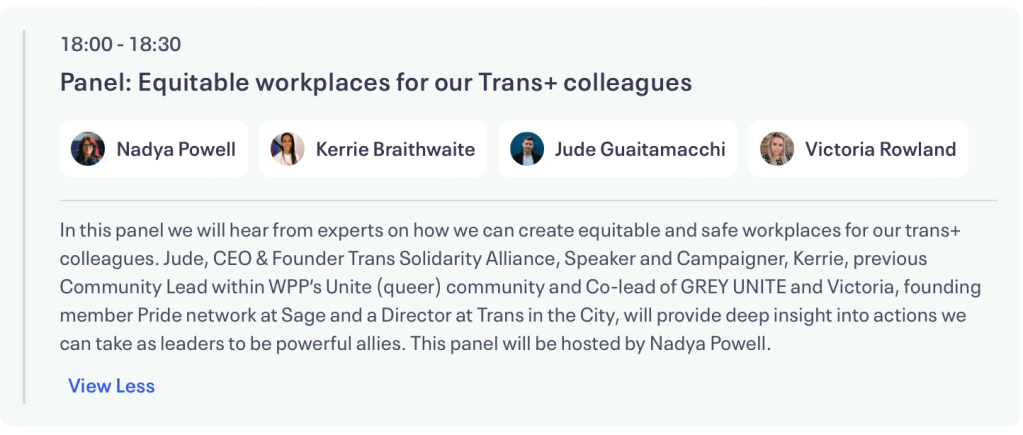
Then an interminable panel discussion, double the length it needed to be. Powell invited them to introduce themselves.
First up was professional trans Jude Guaitamacchi, founder of Trans Solidarity Alliance, a trans awareness trainer and sometime model. She was behind the #LwiththeT hashtag movement, unwittingly revealing that it was trans-initiated, however, lesbians ‘had done a wonderful job of taking it forward’, which surely must have fallen flat to someone else’s ears? Guaitamacchi had been working in UK schools for ten years on LGBT awareness education and also did the same in corporates, including internationally – her most recent gig was Florida. ‘It’s great to work on the inside,’ she said with a hint of glee. She had also held briefings in Parliament and had even stood next to a Labour MP.
Kerrie Braithwaithe (she/they) was up next, who identifies as non-binary. She advocates for disabled queer people via ParaPride (another empty shell organisation, just have a look at the events page). She told us that an intersectional lens was so important.
Finally Victoria Rowland, who works in the corporate world but also helps Trans in the City with its student ambassador programme, the purpose of which was to build the gap between employers and trans/non-binary students. Naturally Rowland is an ally and recited the mantra as required; being an ally was a never-ending journey and she was here to share her insights on that road.
What are organisations doing wrong?
Guaitamacchi, a trans identified female who has taken testosterone, went straight for the low notes – trans people were really struggling at the moment with their mental health, employment, etc. Education was key; not a lot of people knew what ‘trans’ meant. Sex and gender identity was distinctly separate, said Guaitamacchi, in proto terf mode. Continuing to inarticulate what ‘trans’ meant, we were told some people transitioned, while others didn’t, and it meant ‘different things to different people’. Well, I’m glad we’ve cleared that one up.
Braithwaite, had led ERGs (which stands for Employee Resource Groups, they implement DEI inside organisations). Ever the marketing dweeb, she had four key findings she wanted to share: 1) Allyship couldn’t be passive, you needed to think of it as a verb, and be proactively anti-transphobic, 2) Create a safer space for trans talent you want to attract, 3) Don’t then lean on the trans talent to then run your ERGs (McCann take note) and 4) No hot potato mentality!, i.e. don’t worry about saying something wrong, adopt a progression over perfection attitude (rather negated by points 1 and 3). Initially she had not felt safe joining ERGs, because of the fear of saying something wrong, but now she was proactively educating herself as an individual, that had melted away and she realised she was on her own learning journey. How anyone can say that with a straight face, I don’t know.
Rowland saw a lot of tokenism. Working in the early career space she saw some amazing branding from tech companies, but the reality was often very different. Your gender talent will walk, she warned. And then she said something utterly fascinating, if true (though I do believe it). Gen Z talent was mostly interested in diversity and inclusion. Six or seven years ago, interviewees would be mostly interested in knowing what the salary and progression were like, now they wanted to know what the company was doing for the LGBT+ community and other ‘marginalised’ groups, rather than what was in it for them (a sure sign people have given up hope of having a mortgage). They wanted a ‘sense of inclusion which was authentic’ and if companies couldn’t step up to the plate, they would miss out on this Gen Z talent. These were the people who would be AI specialists and machine learning engineers, so there was a real risk that such companies would miss the boat if they didn’t correct, as this was a skills gaps fast approaching.
I think the other way to look at this revelation is that young professionals are now so cowed by the current cultural climate, they feel the need to showcase their compliance up front, though I suspect it is a mix of both.
What was going right?
Lanyards with the proper flags. Rowland knew this because people who were LGBTQ+ had told her they had felt included when they saw people wearing them. She was so moved by such feedback that she persuaded her company to put in a global order and a tranche of allyship training was rolled out, which presumably people had to take in order to earn the privilege of wearing one.
The things Braithwaite liked was that people from the community were being paid to come in and do the training and/or be speakers, which had been on the increase. Agencies were working with brands towards their DEI goals (otherwise known as the Stonewall Equality Index).
Guaitamacchi wanted to be positive but couldn’t because ’employment discrimination was getting worse for trans people’ and they were losing work opportunities, herself included (Florida already a distant memory). Her best friend had just moved in because she had lost her job and home. Trans people were getting each other through it, but she was worried. This was her ‘truth’. There had been a distinct decrease in speaker opportunities. The years 2021/22 had been great for Guaitamacchi, she had done an ad campaign with Harrods, but all that was gone now. She blamed terfs. Brands were no longer working with her and the education work had been slashed. She wasn’t sure what she was going to do. She believed that brands were succumbing to the pressure, ergo the professed allyship was not genuine. Don’t speak for us, but platform us, so we can advocate for ourselves, she told the room.
What should the room do?
Rowland wanted everyone to take whatever they had learnt and take it back to the office, to teach others and learn more. Please get in touch with Trans in the City if you needed more help.
Braithwaite wanted to focus on intersectionality and when you were looking for trans talent, look for a black disabled trans person. She also said that she didn’t know any black trans women or men in her industry but did know a few non-binary brown people, the implication being that the corporate space wasn’t welcoming enough. This was then undermined by statements that she had come out at work, under queer leadership, and had received a lot of support.
Guaitamacchi’s organisation was made up of volunteers and they often put their own money into projects. ‘Our own money went into #LwiththeT,’ she whined. (I wonder who to, a PR company?) Funding their own political projects was unfair, so give us your money. She was watching closely the strategy of the ‘anti-trans movement’ and trying to use it against them. Terfs had been holding briefings in Parliament for years. Sex Matters go in weekly, she claimed. A fightback plan had now been figured out and now it was just a case of getting the right people on board. All very mysterious.
Session 4

The main problem with these things is that they always make them about twice as long as they need to be, so thank God Charlie Craggs was wheeled out midway to inject some energy into the room. Craggs was interviewed by Ali Hanan, CEO of Creative Equals. On introducing Craggs, she went through his resume, which now includes being a victim of a hate crime and setting up self-defence classes for trans people.
Craggs was upset because the government had suggested that trans people would be offered private rooms on hospital wards as a solution for women who want to be assured of a single sex space. He correctly pointed out that there wasn’t really the money to do this and objected to it on the basis that it suggested trans people were disgusting (though I have heard many a trans activist argue for private rooms). Every day it felt like someone was pushing down on your chest.
It was a different world to the one in which he wrote To My Trans Sisters. He had met Nadya Powell in those good times and the term ‘terf’ wasn’t widely used back then, so he didn’t even know it, whereas now there was a terf article every day in The Times. When he transitioned there was none of this discussion. (A moment to point out, that literally no one mentioned the Cass Report during the three hour briefing.) Trans people had gone from being a joke, to being the boogie man. Trans people weren’t bullies, they were the bullied. If you think they’re not coming for the gays and lesbians, you’d be wrong, he said. On the issue of toilets, butch lesbians were going to be hurt just as much as trans women.
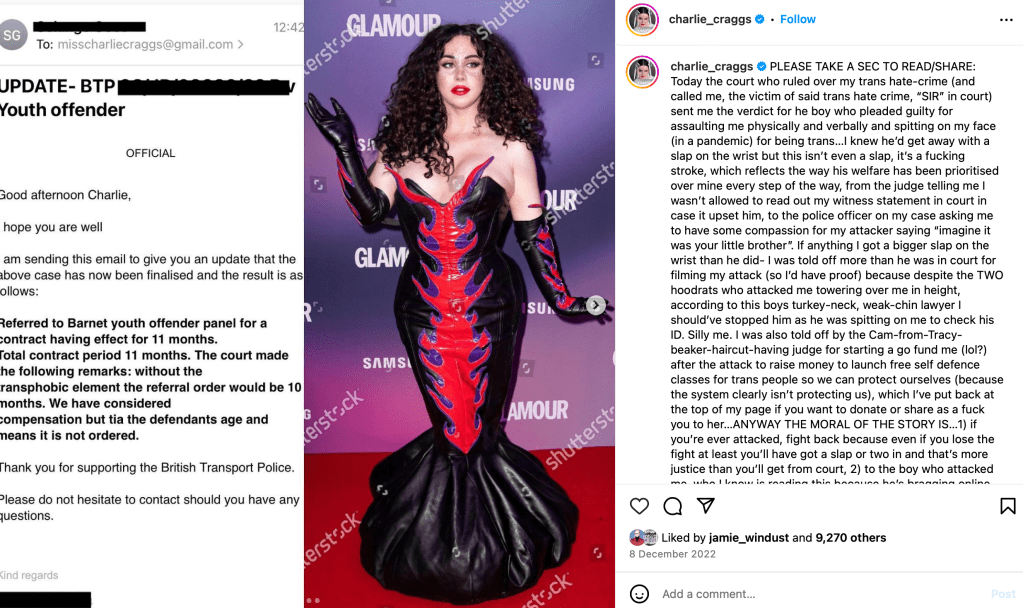
Hanan said that the Tories had a lot of answer for, for engaging in the ‘culture war’, so where was the pushback going to come from? The newspapers were all in it together and all owned by those close to the Tories, said Craggs. On the hate crime he experienced, the boy who had spat on him had only been 14 years old. Craggs had captured the spat on a phone camera and shared it to Instagram (now deleted, though it earned Craggs ten thousand followers). A spit swab was also done.
During the court case, Craggs had been admonished for filming in court (he hadn’t realised this was contempt of court) and alleges that he had been called ‘Sir’. The terfy judge told him off (had a terfy haircut apparently, which is how he knew) as he had filmed the 14 year old without his consent and posted it on the internet. Terfing was a British thing and the 14 year old had grown up in a culture which was terfy, for example, the newspapers were full of it. (Very much doubt anyone under the age of 14 turns to newspapers for their news, or even to news.)
Hanan wanted to talk about brand endorsements and the case of Dylan Mulvaney (whose endorsement managed to tank the established beer brand, Bud Light). Transphobia in the US was very different, there was a lot more violence and murder, whereas in the UK it was political, Cragg explained. For example, a mutual friend was responsible for the LGBTQ+ exhibition at John Lewis (who can forget the lovely Ruby?), which got cancelled (despite pulling the exhibition, John Lewis still donated £50k to an LGBT+ charity, Just Like Us).
On brand work, this had dried up, because a terf was stalking Cragg’s Instagram page and messaging the brands to complain about him. Brands were viewing him as risky now because he was deemed too political, if I understood correctly (Craggs did get rather breathless in his explanation). However, a few days after the event I note he posted a brand endorsement for the company Cheex (‘female-friendly’ porn platform), so it seems the work hasn’t dried up completely …
As an aside, Craggs claimed in a Pink News article, that after leaving YouTube’s premises, he was threatened by a group of men and posted a video one of the alleged ‘roadmen’ to Instagram. Below is that video, in which he pursues and goads a lone man, walking at speed away from him, intercut with stills of himself mocking the supposed aggressor.
Session 5

The panel slightly differed from the above, with Jamie June replaced by trans influencer Darkwah, who dominated things, speaking far too long (see the clip of him speaking on the night, if you want to feel my pain) but as per usual no one dare interrupt the man.
Eleonore Murauer, global brand director for Durex, naturally wanted a bite of the LGBTQ market, which meant getting the Durex house in order as per the reciprocal nature of trans activist endorsement. Murauer strongly believes that the internal DEI work had reaped benefits to the organisation’s understanding of this new customer base and it is probably true. It turns out that when ‘terfs’ post negative comments on adverts, the business was comfortable ignoring these.
Kenny Ethan Jones said that people were now scared of talking about trans-related issues because of the backlash they would receive; managing the comments section could be daunting. Were companies who had such misgivings truly allies? No, it was lazy, said Ethan Jones, to a round of applause.
Dhunna suggested that people were scared of losing their jobs, which seemed contrary to what had been said previously, that Gen Z were now pressuring employers at interview. Darkwah said DEI was a human right and don’t be scared. Dhunna knew a client at HSBC who had said they were prepared to lose their job over the issue. In response Ethan Jones rued that she wasn’t earning as much money as she had in 2020, ergo she was actually losing jobs, as were other trans people and that people positioned themselves as allies but then didn’t come up with the goods.
Darkwah reflected that in 2021 he had gotten a contract which had allowed him to pay his rent for a whole year. This had allowed him to focus on being an artist and get therapy. Things had slowed down since then, he was being asked to come to events but no one was offering to pay, not even his car! Can you imagine?
Ethan Jones talked about his brand relationship with period product company Natracare. She had liked their approach as she hadn’t had to educate them the entire time, indeed, they came to her with a suggested list of associates, who were the ones she would have chosen (i.e. her mates Fox Fisher, et al). Hence, it felt very comfortable, especially as the Natracare person would email and ask Ethan Jones how her birthday weekend had gone. Small moments of connection were important. They had also consulted her over the language to use in describing menstruation.
Darkwah wanted to keep the line of communication open between ambassadors and marketers, to continue to keep things authentic. This was what Gen Z wanted now. The Durex Global Director agreed, stating it was a privilege to be able to help change the world. Ethan Jones wanted to emphasise that the advertisers in the room would learn a lot more if they engaged one-on-one with the ambassadors they were dealing with.
Just a little aside from me …
Current brand endorsements
Darkwah’s recent brand endorsements, in April 2024, include several make up and clothing brands. There is also a reel of him giving a talk in front of a Bank of America poster. In other words, Darkwah is having a good war. Craggs has his Cheex ad.
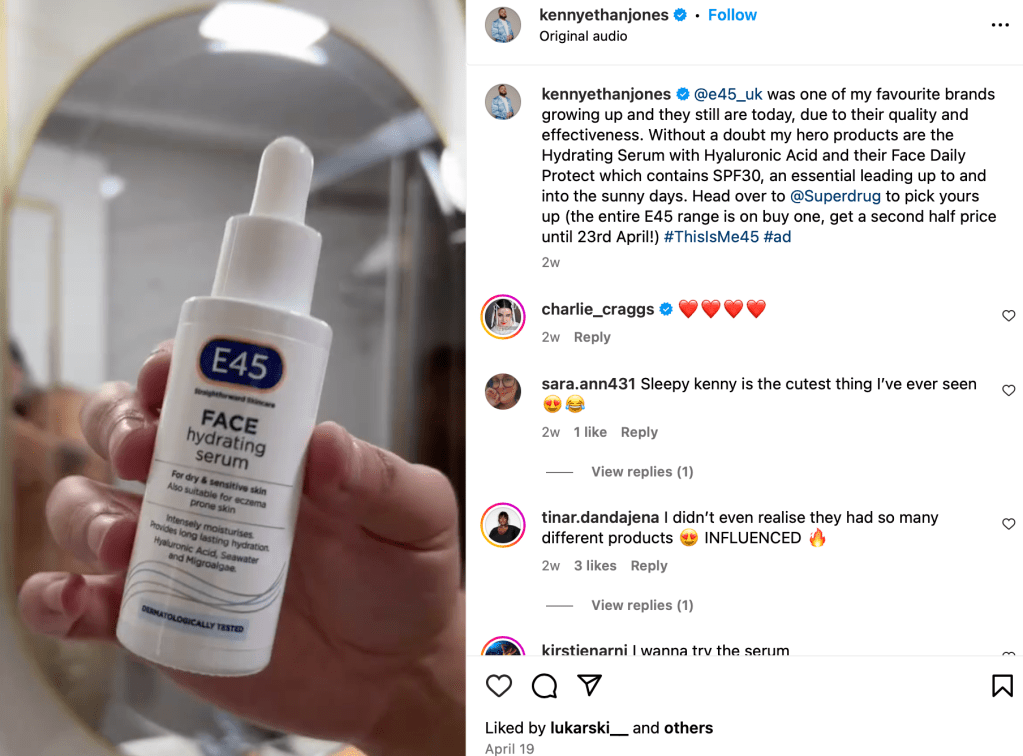
At the time of writing, Ethan Jones’s most recent endorsement was E45 Cream in conjunction with a Superdrug deal, posted on 19 April 2024. In January 2024 she was interviewed by TV star Davina McCall (who likes to style herself as an expert on menopause) which received over 100,000 views (way more than many terrestrial TV shows receive). (According to comments, Ethan Jones’s menopause and subsequent hysterectomy, due to testosterone use, were discussed uncritically.) In 2023, both she and Craggs had a joint gig representing the travel firm Tui in New York. Her book, Dear Cisgender People, has a publication date of 6 June 2024.
On 18 April 2024, Guaitamacchi had a speaker engagement at the headquarters of TikTok.
So, while I can’t speak to as to whether jobs have significantly diminished for these folx, it seems that all four trans-identified influencers have recent engagements, presumably paid, as why else would they do it?
Session 6

Really dropping off by this point, and it felt like Marty Davies (she/they), the joint CEO of Outvertising, was speaking in a deliberately slow manner. Every word felt like an age and he begun by summarising the main points of the evening. A trigger warning was given that particularly distressing ‘transphobic’ and ‘trans-misogynist’ material was going to be discussed and we could remove ourselves if we thought we would be affected by it. Literally no one moved. He too was hearing from trans people that they just weren’t getting booked any more.
Not only that, but the media was driving violence against trans people, which he described as ‘dirty attention’. The blocking of Holyrood’s Gender Bill could have seen trans rights rise to a level commensurate to those in other countries, including Pakistan, he said, with a completely straight face.
Especially risible though, was the moment he got very dry eyed about the murder of Brianna Ghey, though at least he pronounced Ghey correctly. The pieces he had written for Campaign magazine over the last year had laid out the connection between ‘ad spends and hate crime‘. In June 2023, the top ten media agencies committed to divest from companies who spread ‘disinformation‘.
‘I don’t want any more names of murdered trans children in my mouth,’ said Davies, pausing dramatically, looking like he dealing with a bit of flatulence. ‘You need to ask yourselves: “What hate crime, is our next campaign funding?”‘
Happily Lord Michael Grade, Chair of Ofcom, was also calling for this change:
So if you are a marketer with money to spend online; or if you are an agency planning and buying on behalf of clients; my message to you is this. Online safety is happening now, and you have a chance to play your part – by getting ahead of the harm.
Excerpt of Grade’s speech read out by Marty Davies – see full statement here
Research had shown that Queer+ people were a multi-trillion dollar market, Davies said boastfully, and ethically demanding. What could we do to help? Davies handed over to colleague Cassius Naylor to answer.
Naylor said it was difficult to answer. Everyone in the industry had a role to play, big or small. He was going to give some practical operational guidance. People who worked in HR should engage with LGBTQIA+ employees on strategic matters, either through a staff network or via an industry association. The thing was to bring them into leadership spaces in a structured manner. Give them more than a just voice.
Creatives had to deal with the problem of representing the LGBTQIA+ community ‘authentically’. (No mean feat, I’m sure we all agree, not least because no one has a bloody clue what the QIA+ actually is.) Bravery was needed and currently missing. Stand your ground and run the campaign you want to run. Hire queer- and trans-talent. Protect them post-campaign, don’t just leave them out to dry (re: Dylan Mulvaney and Bud Light). Don’t run because LGBTQIA+ people can’t run, so don’t you run either!
Those in media planning and spending, be aware of funding the wrong companies, and carefully audit. Curate for queer-inclusive advertising spaces. Everyone in the advertising supply chain had the capacity to influence some sort of change. Ensure that your ads don’t end up next to a headline which might not be flattering. Outvertising had put together a ‘playbook’ which contained all this information, soon to be available. Don’t shy away, Naylor urged, it our holistic responsibility to create the world we wanted to live in; a fairer world for everyone.
After saying all that, Naylor told us that we should avoid pink- and rainbow-washing at all costs and returned again to the – as yet undefined – topic of authenticity. You could be assured of authenticity if you walked the walk, before you talked the talk. Anyone? Nah, me neither. Outvertising were available for advice to anyone who wished to seek it. You can download their latest guidance here.
Conclusion
It was funny hearing people talking about the media being the enemy, when Google and its subsidiaries (particularly YouTube) are now the major global players and clearly onside with the woke agenda. In fact, YouTube has demonetised several channels on its platform for ‘wrong think’, including gender critical people, such as Matt Walsh for criticising and ‘misgendering’ Dylan Mulvaney. No one can argue that there aren’t very powerful forces batting for the gender mob. You have to wonder to what extent Google, et al, simply want to marginalise legacy media companies, to capture their market share and how useful trans activists are to them in furthering that cause. Once they have complete domination, will they just dump these activists? Probably not.
On the other hand, the upper middle class professionals, who make up marketing and adverting world, really do see themselves as social justice warriors, fighting for a fairer world and it couldn’t be funnier or less true. As for trans activists, well, they realised a long time ago, that real power lies with the corporates.
Thank you for reading! Sign up to my blog by going to the bottom of the page.
Please share on other forums if you liked it, as I only do Twitter.
 The Lies They Tell
You must be logged in to post a comment.