
*’Edutainment’ being a portmanteau of education and entertainment, unfortunate, as Pop’N’Olly is neither.
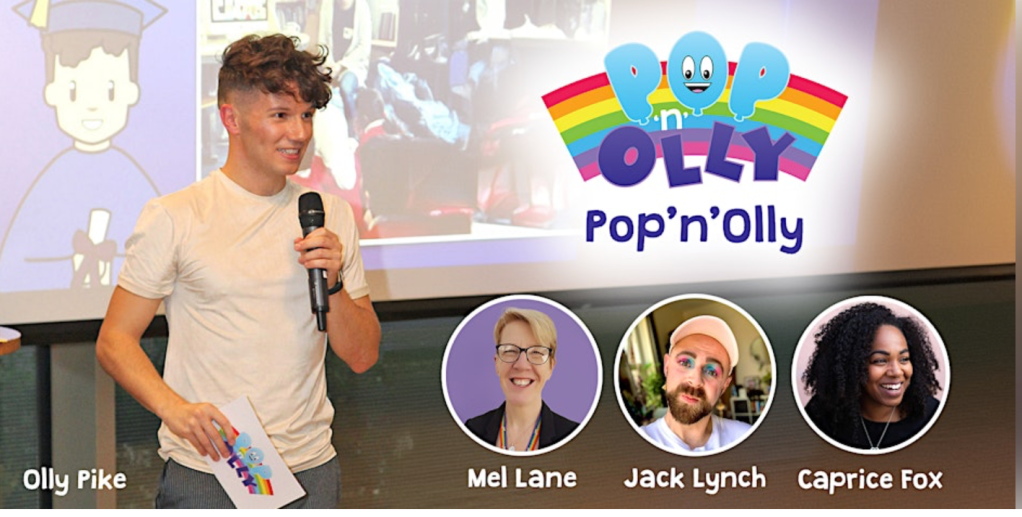
The blurby bit
The Future of LGBT+ Education: Eradicating Shame and Empowering Change, held on 19 September 2024 at Monzo HQ, London

The audience
Mainly Monzo bank employees, as you’d expect, possibly lured by free, but cold, pizza and a chance to network. A number of regulars from the LGBT ally scene attended, making it about 150 people in the room with only a few walkouts. People also watched online.
‘Have You Ever Seen a Normal?’
The evening was also Olly Pike’s new book launch with the exciting opportunity to get a copy of Have You Ever Seen a Normal? This is self-described as ‘a delightful rhyming story designed to spark conversations about diversity and acceptance’. Some of the prose made up the beginning of Pike’s speech. It contains about a hundred uses of the word ‘normal’. Did you know there’s no such thing as normal? For example, there is no such thing as normal food, normal houses, normal families, normal kids, being a normal height, normal love or normal heat. Et cetera. Normal isn’t real. The implication being, of course, is that there is no such thing as abnormal [behaviour] and that everything is relative.
Talking to us as if we were five, Pike told us that he sometimes needed to take a deep breath when he speaks in public. So we had to take a deep breath with him. Good grief. Pike’s pronouns are he/him and he is CEU of Pop’N’Olly. He wanted us to tell him what CEU stood for. Luckily his team were in the audience, so they were able to shout out it stood for Chief Executive Unicorn. Everyone else was miffed. Pike laughed idiotically.
(You might be wondering who Pop is, in the Pop’N’Olly combo? Well, Pop is a balloon. That’s how inventive a storyteller Pike is. Pop has He/Him pronouns and therefore is blue. Pop is ‘Chief Executive Balloon & Head of Inflation’.)
Pound signs glowing in his eyes, Pike told the room full of bank employees that his LGBT+ ‘edutainment resource’ [sic] was multi-award winning. His main focus was to teach ‘equality and diversity’ to primary school kids which would ultimately help combat ‘LGBT+ prejudice’. Multiple studies had proved that children weren’t born prejudiced, said Pike. Which meant they could unlearn it, care of companies like Pike’s.
Audience participation
No one needed to panic, Pike soothed, he wasn’t going to put anyone on the spot. Please put your hand up if you were once a child? Keep your hand up, if you remember liking a story you were told when you were a child. ‘I have to be careful now,’ giggled 38 year old Pike, sporting a crop top and low slung jeans to show off a belly button, ‘some of you might have been a child more than 20 or 30 years ago’. Erm, quite.
I bet you remember how those stories made you feel, cooed Pike. His favourite story is Coraline, the novella by Neil Gaiman, published in 2002, when Pike was 16 years old. Coraline is actually a very scary story, I saw the film version (which somehow achieved a PG rating) with a creeping sense of dread, sat next to an (unrelated) five year old who was practically having an aneurysm. My own recollection was that the child was reacting to the idea that parents could be dangerous imposters. Coraline therefore could be said to fit a queer theory agenda. I wondered also if Pike talks to primary school children about Coraline, or whether this was just for his corporate audience? Anyway, it was all a preamble to telling us that ‘dragons can be beaten’, in case any of us were still worried about monsters under our bed.
Olly Pike ‘My Story’
The Shame Dragon
Pike has a little dragon, which looks just like him! It’s been with him a long time. That dragon’s name is Shame. Cue photos of pre-Shame Olly, i.e. him as a child dressed up as a fairy, etc, with full support from mum and dad. The photos were all pre-school and before he realised what was expected of him being a boy and that he was different.
He was policed by everyone around, friends, family and teachers, and thus the Shame Dragon began to form inside of him and tell him not to play with dolls or pick pink things. This lead to him searching for any crumb of evidence in stories that it was okay to be a feminine boy but he didn’t find any. Why? Section 28. Introduced by Margaret Thatcher’s government in 1988, it made it illegal for anyone funded by local authorities to promote homosexuality. Which meant when he was a kid, there were no stories about two mums or two dads. And there were definitely no stories about trans or non-binary characters! For the life of him, he couldn’t find a story about a boy who was like him. Which is a weird claim, isn’t it, when the theme of being the odd one out is basically the basis of almost all children’s stories?
Anyway, Pike distinctly remembers thinking that he had ‘come out wrong’ and needed fixing. Poor Pike would cry himself to sleep at night asking the Universe the existential question: Why aren’t I normal? Despite Section 28 having been rescinded more than 20 years ago now, LGBT+ kids still felt awful about themselves. In fact, Pike informed us, they probably felt ‘much, much worse’. Cue a trigger warning before he showed slides about self-harming and suicide rates. One in five young LGB people and half of trans young people had attempted suicide, we were unreliably informed.
Pike, however, found a safe space during his own childhood, which protected him from his Shame Dragon. Musical theatre. Which suggests that he very much embraced his campness and was encouraged to do so, contradicting his Shame Dragon claim. ‘Don’t make me sing! Don’t make me sing!,’ joked Pike, knowing full well no one wanted him to.
Even in the theatre world though, Pike claims to have been told to ‘stop dancing like a girl’. He also got rejected for a job once because he wasn’t the kind of boy who would climb a tree. Unfair, cos’ Pike can ‘climb many things’, which apparently was construed as a rude quip by some, though I didn’t get it myself.
I suspect the mundane truth is that once Pike realised that the movie gods, nor theatre, nor TV, were not going to smile on him, he endeavoured instead into making himself into a social media star. He taught himself how to animate and illustrate and started his YouTube channel ten years ago. Viewing figures were low until he started to tell stories about two princes that fell in love. However, when he started telling stories about trans and non-binary characters, the viewing figures rocketed into the thousands, even going viral. He now tells more than just stories, including history lessons, explainer videos and even songs. ‘Don’t make me sing!’ Pike chuckled again, unprovoked.
Initially his target audience were LGBT parents and carers so it was a surprise when schools started to get in touch, reporting that they were already showing the content during lessons and assemblies to teach children about equality and diversity, helping ‘all children to feel proud’. (One wonders how organic this was really, and I suspect the hand of LGBT+ network groups.) Ten years ago he wasn’t the ‘LGBT+ expert you see before you today’. No, back then, he couldn’t believe his luck. Not only that, he assured us, primary schools were allowed to show this type of content, nay, they were expected to. The current relationships guidance for primary schools stated that all children needed to know that LGBT+ families exist by the time they leave primary school. All the other statutory guidance, Pike said, clearly supported an LGBT+ inclusive curriculum and his team had put all of these together in one 19-page document which was free to download from his website (I believe this is the document).
Later in his career as ‘expert LGBT+ eduitator’ [sic] he realised he could turn his videos into books. Pike claims to have distributed thirty thousand books worldwide, of which twelve thousand had been donated to UK primary schools. The audience seemed impressed by these figures, whooping and clapping. Though perhaps it was just his team getting excited, it always pays to have plants.
These donations were made with the help of companies, charities and individuals. In particular, Pop’N’Olly patrons had been instrumental and some were in attendance that night, as volunteers. Pike got them to stand up. The patrons were making a difference ‘every single month’.

Another really cool thing that Pike started to do were ‘Author Visits’ to schools (the price list is available only on direct contact) where he would talk to children about his videos, books and life. (A few weeks after signing up to the website, Pop’N’Olly were offering free visits to schools in the London area.) Kids were completely blasé about same sex relationships, claimed Pike, and more interested in how many TikTok followers one might have (the Pop’N’Olly TikTok account has just 2,594 at the time of writing, which is piss poor).
One thing kids and young people didn’t understand though was injustice and inequality. Pike shares with the children he meets that he is gay and that he and his partner receive abuse on the streets when they hold hands. He also tells them that if he lived in a country where ‘being gay’ was illegal, he could be put in prison or worse. The kids don’t understand why that might be and of course want to help. In turn, Pike claims when faced with these situations, he began to realise that his work wasn’t just about spreading joy, but ’empowering’ children to know that they can make a difference.
After that, the company expanded to provide teacher resources, training and workshops and this was mainly down to the efforts of his two team members; Mel Lane and Jack Lynch.
Fireside Chat with Mel Lane, Jack Lynch and Caprice Fox
Mel’s Journey
Mel Lane had been working with Pop’N’Olly for over five years. Lane is a former primary school teacher and teacher trainer and currently works with a LGBT+ charity in Dorset, the Space Youth Project, as a Training and Education Volunteer. According to Pike’s introduction, Lane has worked with over 80 schools in Dorset and works with UNICEF (an offshoot of the UN) as a Rights Respecting Schools Assessor (which appears to be a Stonewall-type scheme, where schools can win bronze, silver and gold awards). You can read Transgender Trend’s piece on Mel Lane and the Space Youth Project here.
Mel Lane had gone into the DEI business because she wanted ‘kids to feel good about themselves’. People said that ‘teaching trans’ was difficult but Lane had had to teach about the subjunctive clause for years, and that was much harder (I kindly suggest that it isn’t). Lane’s ‘child’ (we never learned from her if they were a son or daughter) had absorbed a strong sense of shame from the homophobia they heard in the school corridors, which meant, despite knowing they were gay since the age of 14, they didn’t come out until the grand old age of eighteen. Lane was supportive but appalled that her sprog had had to wait so long to reveal this secret, despite 18 years being an entirely normal age to become sexually active. Lane became active at the school she taught at, at the time, showing videos, giving talks about LGBT+ lives and trying to get other teachers to join in.
*Her sprog is none other than fellow team member Dr Alex Canning.
All this activity led to one of girls in her primary school class ‘coming out’ to her during lunchtime. The girl apparently whispered, ‘I’m a girl that really likes girls’. Lane thanked her for sharing this secret but didn’t know what to do. So she rang the charity she now volunteers for. Previous to that she had taught in schools when Section 28 was still in force and recalled two boys, aged about 10, asking her to explain what ‘gay’ meant and she had had to tell them she wasn’t allowed to talk about that. She had felt awful about this for a long time.
*Section 28 was repealed in 2000 (Scotland) and 2003 (England & Wales).
Like Pike, Lane also reported that children had no prejudices and wouldn’t allow anti-gay slurs to be used in the classroom against their peers. She never thought she would leave the classroom but this new work was so incredibly inspiring it is now what she does full-time. Lane has clearly been a great boon to Pike, as she uses his books in the training sessions she has organised throughout the schools she has visited in Dorset.
Lane is super super proud that Pop’N’Olly had created the LGBT+ primary school resources that teachers wanted. In particular, she was proud of What does LGBT+ mean? The book was also helping adults too, as someone had given it to an in-law who had it given the rave review of: ‘I finally understand what you’ve been banging on about for the last few years,’ – which doesn’t necessarily sound like a compliment to me.
Another proud moment was the Pop’N’Olly ‘identity pack’ being downloaded three hundred times in the first hour (I couldn’t find it on the website). Looking into the future, Lane is super excited to start producing resources for the new book.
Jack’s Journey
Pike introduced Jack Lynch as being head of training and workshops and that he had so far delivered in person training to over 3,000 children in primary schools and 26,000 virtually. Lynch is also in charge of media and PR and had helped ‘reach new audiences’.
Like Mel Lane, Jack Lynch had also been with the company for five years and identifies as non-binary. He believes that [LGBT+] education can ‘create such positive change’. His career history is in athletic coaching (clearly not a sport he practises himself) for both adults and children, but particularly the latter because he liked seeing ‘the changes which happen so quickly’. He joined Pop’N’Olly at a time when he was reflecting on his own experience of being a ‘queer child’ at school. If only he had had Pop’N’Olly resources back then! His particular skill set means he is able to empower children and spark joy, just by standing in front of the kids ‘being himself’.
Similar to Pike’s and Lane’s testimony, Lynch also said that children today knew themselves so well they barely needed to be informed on LGBT+ topics. Why, once he had been in a class, talking about his own life, and a ten year old girl had put her hand up and said: ‘I feel like you feel’. Feeling like Lynch felt, meant she didn’t like wearing girls’ clothes but did like playing football and playing with boys. For Lynch, this showed the power of storytelling (his own, of course, not the beauty of a simile or metaphor). Lynch clearly hasn’t had a moment’s reflection since on whether the girl might have later regretted such a public admission. Lynch then claimed it was gender stereotypes they wanted to breakdown, but if that was true there would be no need for the company to be LGBT+ themed at all, would there? Or for children to ‘come out’.
Another anecdote: a six year old asked Lynch why he was wearing nail polish. Lynch told him because it was because he liked wearing nail polish. ‘Do you always wear nail polish?’ asked the kid. ‘I never used to because I thought I’d get bullied for it. And then I realised that actually having my nails done made me feel really good and I make it my mission in life to do things that make me feel good.’ The kid said he wanted to be like that too! Lynch reckons it is a revelation to children that they could do things which bring them joy. The team weren’t just eradicating Shame Dragons, they were Empowering Change. They made these changes by Simply Being There. Lynch tells every teacher that it wasn’t about making massive changes, but little things done consistently. Which is what he wanted the audience to do the following day. It could be something small or something big and Lynch is always up for something big, know-worra-mean. Contradicting himself for the third time, Lynch’s final plea was for us to do ‘something small’. So we did, we gave him a small clap.
Olly tells an anecdote
A teacher friend told Pike that a little girl had come out to them at the end of the school day, stating she thought she might be a lesbian but wasn’t sure if she could talk about it. The teacher gave the girl one of the Pop’N’Olly books on hand and the girl flipped the book over to the back cover and identified with a girl depicting with a Rainbow hijab. This demonstrated the power of images, apparently.
Olly then briefly paid tribute to Dr Alex Canning, another non-binary (but really gay) member of the Pop’N’Olly team, also in the audience. (As I said further up, Mel Lane is his mother, a fact which would have been entirely lost on the audience, except the inner circle.)
Chat with Caprice Fox
It was important for the team to develop relationships with other activists, Caprice Fox being one. Pike, in his best Principal Boy voice, told us that ‘Caprice isn’t Just Anyone, she is a Force‘. She is also a primary school teacher, a speaker, a trainer, and a champion of under-represented minorities ensuring that practices were diverse and inclusive. Fox is also a mother and works closely with a community interest company (CIC) Black Mothers Matter (who support ‘all types of Black people giving birth’ and describes mothers as ‘birthers’, despite the organisation name). She had also set up another CIC called Beyond The Mix Families. Pike told us she was an Instagram sensation when he meant to say a damp squib.
Pike also revealed that Fox had been an integral consultant and creator on many Pop’N’Olly projects, including books, blogs and teacher training. In other words, she is a member of the team, minus any official status. ‘Why is LGBT+ education important at primary level?’ asked Pike. ‘We exist. There’s no ignoring that fact,’ was Fox’s complex answer. A hot phrase being used currently was ‘raising global citizens’ but people were mostly thinking about this via the intersection of race. Fox wanted every child to feel included, whatever their identity, and shouldn’t just feel as if school was just paying lip service to DEI but that it was fully embedded into everyday practice.
Fox also had some lovely stories to share with us too. She wrote a blog piece about how she came out in a parent’s WhatsApp and how nervous she was when she went to the school playground after posting it. The real motivation behind the revelation though was that she felt the school ‘wasn’t doing enough’ for queer parents and I guess this was her way of trying to put a bomb underneath the leadership team. Fox was clearly still high from her 15 minutes of fame in the WhatsApp group.
Fox also said that she has to make sure that her daughters’ friends are aware that they will be meeting two mums when they come to the house, that there will be photos of their wedding day on the walls and that they know not to ask questions. I thought I might of misheard; to not ask questions? That’s right. To not ask questions. Fox and her partner aren’t there to educate everyone, okay? And she doesn’t like being a tool of education, either.
Another lovely story, which admittedly I came in on halfway through, had Fox recounting the excitement of meeting a new colleague who was also wearing a pronoun badge that had been purchased from Bristol Pride (Fox has the same one, so she knew). The colleague expressed how comfortable they were working at a school working towards Stonewall accreditation (on display in the foyer) and that Fox’s classroom door was adorned with welcoming images. The colleague felt as if the classroom would be a safe space. For them. They also expressed relief that they wouldn’t have to answer any ‘awful questions’. Fox’s pupils are au fait with the terminology and were therefore super ready to deal with a bonkers trans-identified teacher in their midst. Fox was very happy as they were ‘fully pushing the queer agenda that day’. It sounded like the colleague was actually a visiting speaker or something like that. Anyway, the pair of them got to talk about their lived experiences to a bunch of (no doubt bored shitless) children.
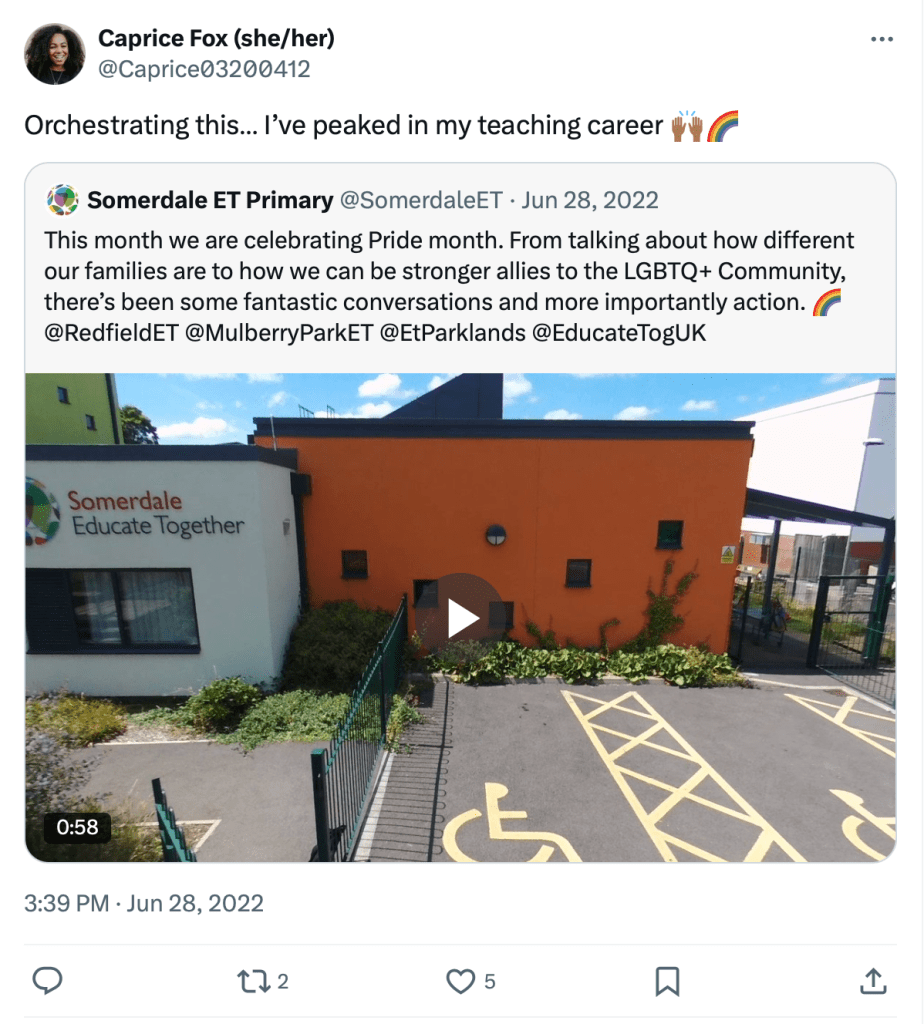
For her final anecdote, Fox gushed with excitement about the ‘gorgeous’ video she made with a drone with a school in a ‘white middle class area’. I believe this to be the video in question, noticed by no one but Fox herself, who describes it as a ‘peak’ in her teaching career.
Question & Answer
A gay man, parent to two young boys with his partner, asked the first question. He wanted to know what the team said to people who opposed LGBT+ resources in schools.
Lynch answered. At first he talks to schools about their inclusivity mission, rather than the LGBT+ stuff per se. Getting them to understand how it sat within their mission statement was important. Then, if parents did complain, the school could reiterate its mission statement and remind parents that it was part of the curriculum. Lynch admitted it was up to schools though to decide if parents could withdraw their children from certain lessons.
Lane piped up that virtually all parents were either supportive of the work they do, or indifferent, and that it was rare to have objections.
Lynch added that parents had been negatively impacted by the legacy of Section 28 and therefore didn’t know how to discuss the subject with their children. He claimed what the team discussed with children was relationship education.
Fox told the parent to talk to the leadership team about their policies, as the policies were there to ‘keep you safe, as well as the children’.
A lesbian said that the gay population weren’t trying to convert anyone, it was actually the straight population who were trying to do that through coercive conversion practices. The gender questioning guidance in schools was non-statutory and transphobic. She didn’t have a question, she just wanted to have a little rant.
What is the future of LGBT+ education?
Lynch said joy and making sure that LGBT+ kids take that joy into adulthood. Lane wanted to empower teachers so that the kids could feel really good about themselves. Fox also felt queer joy would be at the forefront and repeated her desire for it to be truly embedded.
Pike had the final say though – his final pitch to us in the room and watching at home – we were the future. So stick your hands in your pockets and gimme ya money. If we donated a hundred books that would reach a minimum of 27,000 children. This is how many lives we could save! (By the way, purchase of a book costs around £7.99, if you want Pike’s autograph there is an additional £2 charge. Ditto for gift wrap.) A workshop could be even more impactful! Schools don’t have the budget for DEI. It shouldn’t be down to the one teacher really gung-ho to fund it. Therefore the obvious way round this is to privately fund it. And people are, sadly.
Conclusion
Despite protesting that Pop’N’Olly just provides relationship education and challenges gender stereotypes, each of the team members told a story in which a child had appeared to ‘come out’ in response to the Pop’N’Olly presence. Which is a bit weird, isn’t it? (If you want to read more about the brand, see Transgender Trend’s article here.) Also dissonant was the insistence that the children already knew all about LGBT+ and had no problems with it, yet at the same time claiming LGBT+ children were on the verge of committing suicide. So what exactly is their mission?
Then there was the complete absence of enthusiasm for children’s literature or the joy of reading, exemplified by the fact that in Have you ever seen a normal? Pike couldn’t even be bothered to use a few synonyms or differing sentence structures. A character for them, I suspect, is simply tick box exercise. It really is the old joke about the disabled black lesbian all over again but in reverse.
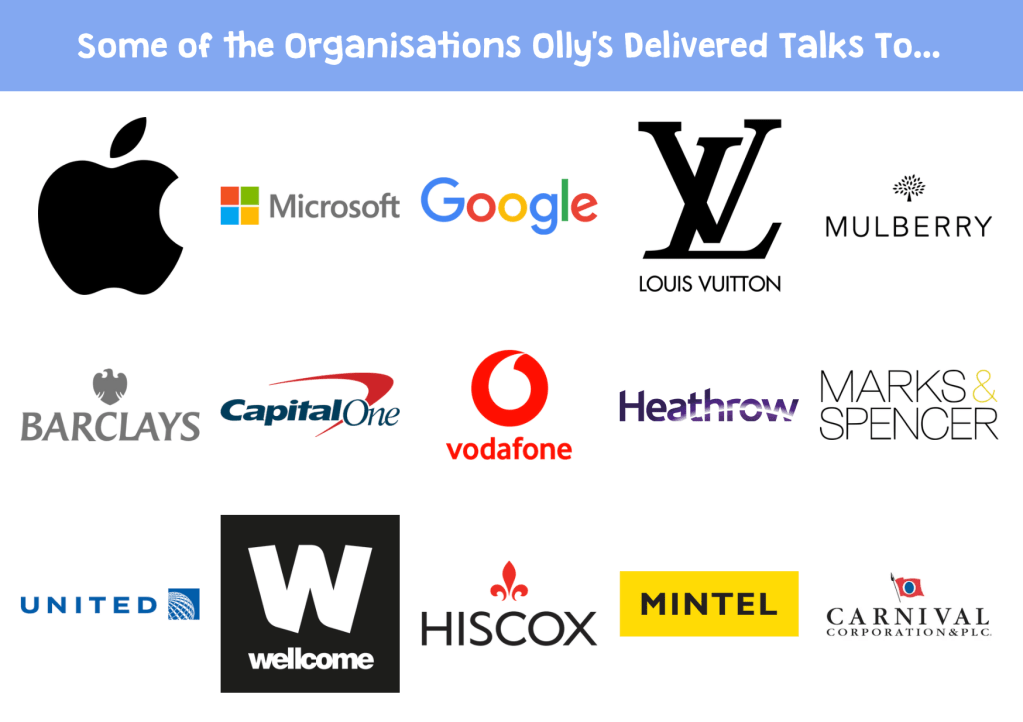
In terms of profit, I note that the Pop’N’Olly account on YouTube is monetised with adverts from the likes of Tonies (toy audiobooks), Grammarly (writing assistance for lazy students) and Toyota (for the parents). There are constant prompts on the main website asking you to sign up for a monthly fee of £3, that’s if you want to get hold some of the restricted resources. It has its patrons and workshops. It sells books. And then there are the corporate talks.
However, interestingly, according to Companies House, Oliver Pike is the only Director of Pop’N’Olly LTD, despite the website listing the three other team members. And according to the filed accounts for 2023, the company has less than £17,000 in net assets and only sold £3,600 worth of stock. Hmm …
Thank you for reading! Sign up to my blog by going to the bottom of the page.
Please share on other forums if you liked it, as I only do Twitter.
 The Lies They Tell
You must be logged in to post a comment.