
Held in June 2024
The blurby bit
Join us for our next Friday Exchange Event with PC Bee Bailey
We’ll discuss…
· How much has changed for LGBTQ+ colleagues in policing?
· What challenges remain?
· What support does the National LGBT+ Police Network provide and how will it develop in the future?
· What can be done to improve the confidence of LGBTQ+ police officers?
· Bee Bailey’s personal experiences of being a trans police officer.
· The broader lessons on making the police service inclusive and representative of the communities it serves.————————————————————————————————————–
Biography:
Bee Bailey is an openly trans police officer based in the southwest of the UK with 24 years’ service in the police. She has worked in intelligence-based roles, frontline policing, operational planning and administrative roles.
In her own words ‘In 2008 I was outed in the police for being trans. At that time, I distinctly realised two things: that I could never put my secret back in its box and it hurt being outed. I felt my world, career and opportunities changed from that moment on. So, after getting back to my sense of ‘normal’ it has been my wish, my passion and my duty to ensure that no one else endures the same hurt’
Bee Bailey has made it her mission to raise awareness of LGBTQ+ hate crime while promoting equality both within and outside policing. She provides guidance and delivers presentations around the world on LGBTQ+ and trans hate crime, best practice and the law. Her audiences are varied and include the police, law enforcement and governments.
In 2013 she was involved in creating the National LGBT+ Police Network and from 2016-2021 was a European ambassador for trans progression. Other European work includes the Access to Justice Programme, working with Stonewall and funded by the Foreign and Commonwealth Office to develop policy, procedure, law and best practice in the Balkans and currently the role of strategic advisor and trainer for countering hate crime, also in the Balkans. She also created TCops, a European-wide support group for trans police and law enforcement officers. She also provides training to governments and diplomats globally.
From the Ticket Tailor listing
Introduction
The Police Foundation
In case you think The Police Foundation is some statutory body, at least feel a little relieved that it is a merely yet another think-tank, whose mission is to embed DEI into an institution which is supposed to be politically neutral.
The Police Foundation is a registered charity, its main income coming from grants released by other charities. There are seven full time members of staff and in 2023 spent £385,000 on salaries and wages. Its most recent project looked at online fraud, the conclusion of which appears to be that fraud needs to be taken more seriously. Past boasts include: ‘Our work on the roles of responsibilities of the police helped pave the way for the introduction of PCSOs’. Nuff said.
According to the annual accounts, the future objective is to be the best think-tank (natch), focus on police conduct (no mention anywhere of inappropriate non-crime hate recording) and thus is conducting ‘conversations’ on Fridays with loons like PC Bee Bailey:

The trans police officer
As per usual the trans-identified male police officer having the ‘conversation’ has done media interviews before, one with Gloucester Live, which details some of his activism history. The other an interview with ITV, where we learn that his police uniform is on display in the Museum of Gloucester.
The conversation
Bee’s inspirational journey
As always, the story is about as clear as mud: Bailey was never ever going to apply to the police, cos’ the police would never tolerate or allow someone like him to join the police, yet during a day of annual leave as a graphic artist and because his boss had been a bit grumpy, he decided to apply. Next thing he received a letter stating had had successfully joined the Gloucester Constabulary, presumably interviews and aptitude tests happening somewhere in between. It was at that point, after being accepted into the force, that he realised being trans would be a big problem, since he had already socially transitioned.

He joined the police in 2000. He knew he was trans at five years old. More AGP bingo: Aged 15 he was an army cadet/lance corporal, ergo not only does he have the T but also the B, since he once found a fellow male cadet slightly attractive. He also ticks the G too, as he had a very short period where he was exclusively same sex attracted and didn’t date girls.
Bailey led a ‘double life’ during his initial phase with the police, a ‘crime fighting superhero during the day’ but a ‘princess at night’. He couldn’t come out just yet, as the way the press talked about ‘gender-bending cops’ was just too horrid and he lived in fear of ending up in Daily Mail Online. No one knew he was trans but somehow a gay colleague was able to warn him against getting found out.
He met his wife, who also works in the police, on the job. They had a whirlwind romance, moving in together after just a few weeks and married within a year. Then he was ‘outed’ by a colleague and he took five months off work for an unspecified reason (I bet it will have been ‘work-related stress’ or ‘bullying’). On his return, he decided to come back ‘as the real me’, in other words he came back with long hair (aka ‘socially transitioned’). Which meant that he was able to the finally tick the L. Boom-boom. However, when Bailey updated his driver’s licence, he opted to describe himself as ‘Mx’, which meant he also had the +. Bad-dum-tish.
Thus Bailey doesn’t do trans awareness activism to help himself. Oh no, it’s a much bigger noble thing than that. He does it in service of others (other crossdressing blokes, that is).
How do you cope with people asking you questions?
Said the bloke from the Police Foundation, going in hard and fast. Bailey noticed that people had ‘trans panic’ around the issue, worrying that they might say the wrong thing. Bailey encouraged people to quell such fears simply by prefacing their questions with ‘may I ask’. This was just like ticking box forms, which have the ‘other/please specify’, which is ‘another area that I try and push’. By putting this small phrase in front of any question, the question was automatically rendered non-offensive. Apparently, this is how friendship often begins.
You set up various peer support bodies within the police. Tell us about that and the work you’re doing now.
Bailey got involved in the Gay Police Association which learnt him how such groups worked, from governance and the practicalities. Then he came in contact with seven other trans-identified police officers who had just been through training and identified that there was a need for a support association for trans people, thus the National Trans Police Association (NTPA) was created in 2010 and Bailey took on an ‘executive role’ there – see here for the website, which is a one page affair. Around that time, Bailey claimed that stories about him appeared in the press (on Googling, I couldn’t find any articles, nor did he expand on what these stories were, could it be they appeared under his former name?). From there he got involved in the European LGBT Police Association as European Ambassador for trans people, working on disseminating policies, etc, meanwhile the UK Gay Police Association had dissolved and had left a gap which needed filling. There was a meeting, which the Chief Constable of the Staffordshire Police attended, Bailey himself, and about seven others, to set up the National LGBT+ Police Network. It was also at this meeting that Bailey met his ‘fabulous work husband’ (well, he did say that he was a B).
In 2018, whilst in Paris wearing his European Ambassador hat, he made a promise that he would create and deliver a peer support group just for trans-identified officers – this is called T Cops Europe (existence of which appears to be limited to Bailey’s Twitter account) and has no rank or structure, with open membership. I suspect this is basically a Whatsapp group.

What kind of things have you worked on then? Policy change?
Perhaps sensing bullshit, the bod from the Police Foundation wanted to know what it was that Bailey actually does. Bailey said that, yes, he had put forward trans policies in policing, but evasive with the details. Forces had supplied trans policies where they existed and one person in the LGBT National Network had been working towards a national policy. Within his own force, Bailey had been involved with the Transition in the Workplace Policy.
What about interactions between the police and trans people held as suspects? Searching people, etc.
Bailey said there was a ‘beautiful group’ called the Independent Custody Visiting Association (ICVA), whose volunteers check that the police meet detention standards. The ICVA approached Bailey with the hope of building a national training package. Indeed there is a training video on YouTube, featuring Bailey, for ICVA’s volunteers (screenshots below). Bailey’s ridiculous ‘May I ask?’ is the recommended approach to be applied to detainees and he was due to deliver further training to the group.
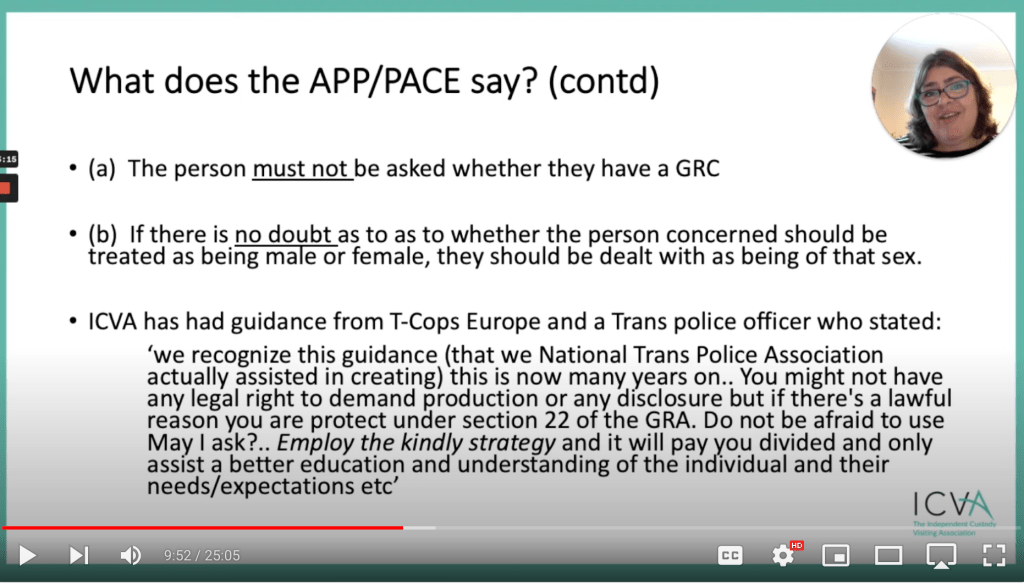
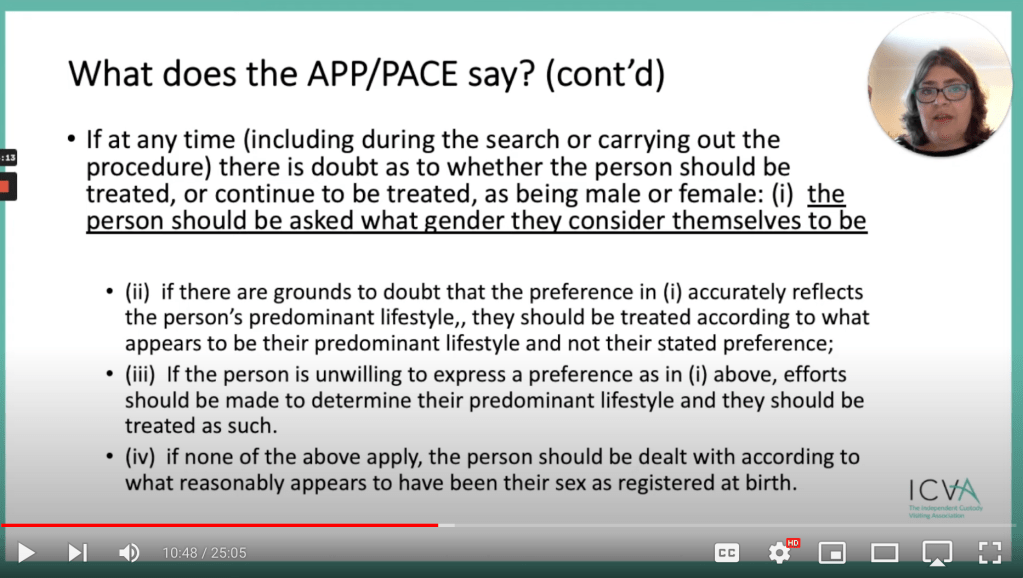
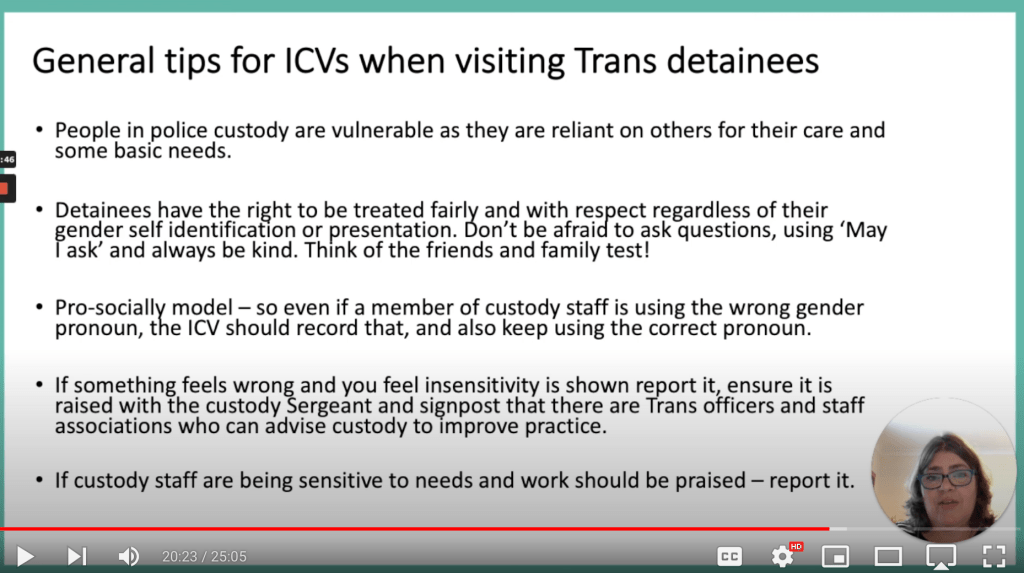
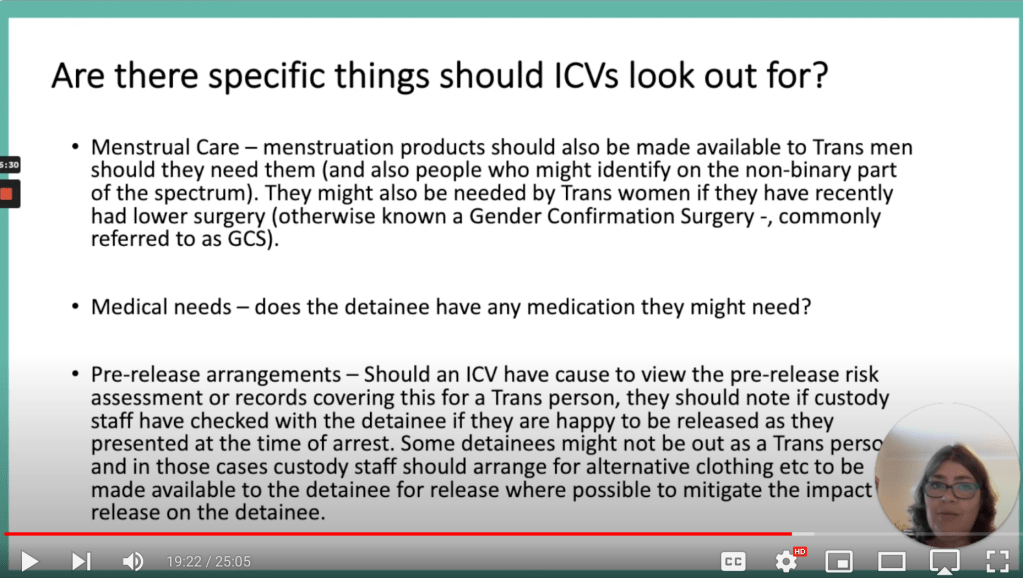
It was the defunct NTPA which had contributed to the Code of Practice for the detention, treatment and questioning of persons by Police Officers (see pages 88 to 90 of the Home Office document). Bailey described the policy, which essentially stipulates that a detainee can claim to be of the opposite sex on a whim no questions asked, as a ‘dollop of common sense’.
How much has policing changed in terms of inclusion for LGBT+?
There was now a Transition at Work policy, overt support from executive leads for the LGBT and occasionally the various rainbow flags would go up on special days. Bailey was also regularly invited to visit the OPCC (Office of the Police and Crime Commissioner) to help advance their understanding. Twenty years ago trans did not exist and weren’t part of the conversation. In March 2024, the Gloucestershire Police Commissioner had issued a formal apology to the LGBTQ+ community with the help of the Peter Tatchell Foundation – see Attitude article – and had created a role for a ‘hate crime co-ordinator’. He had gone from not being able to mention it to being able to promote it – the force apparently had a ‘better together’ department now. Bailey wanted to remind us though that there would ‘always be work to do’ but mainly he was over the moon to be able to drape himself over police cars (see here for some of those photos) and be applauded for it.
How progressive is the UK comparatively-speaking?
Bailey had achieved a lot with two colleagues, one whose name I didn’t catch and a Peter Rigby. (Peter Rigby, according to his LinkedIn profile, is a DEI trainer in the area of Hate Crime, providing training via the British Embassy and is also the founder of True Vision, a third party online reporting platform.) During a training that Bailey had delivered in Macedonia one participant, senior in the force, had become angry and banged the desk (I know how he feels). Reading between the lines, it sounded as if Bailey had been forced to back down on the issue of the prevalence of gay and trans people serving in the Macedonia police. Bailey was feeling positive about the state of things for LGBT+ police officers in the UK, but obviously there was ‘always work to be done’.
How has the relationship between the trans community and the police changed?
Bailey wanted to the police to look inward and rely on trans-identified police officers to do transgender awareness training in-house. The community now had trust and confidence in the police. We saw this in Pride with police cars being dressed up with rainbow insignia. Bailey was still involved in hate crime and providing advice on how to deal with victims (putting correct pronouns, ask ‘are you out?’, etc).
Questions from floor
The searching by transgender officers and staff policy was withdrawn this year for review; what are your thoughts on that?
Bailey understood it, in a way. And was sure the next question would be about toilets as well. Bailey wanted to assure us that a (male) trans officer doing a body search of a (female) detainee would be more scared than the detainee. It all boiled down to ‘we’ve got to do the policing bit’. Bailey opined that detainees had to be searched for their own and the officer’s safety. It was never done on a whim. He didn’t know what the magic answer was and had tried to think of it from all directions. We could open a bottle of wine and talk about it all evening and we still wouldn’t find an answer. It needed sensible conversation, not angry conversation. The policy would return in any case. The jerk from the Police Foundation described this prevarication as ‘really helpful’.
However, I will say it was the first real honesty we had seen from Bailey in the entire session. And he was saying it loud and clear; he didn’t care about the violation of women’s boundaries, be they detainees or female police officers.
Lessons learnt on transitioning in the workplace.
Bailey had been on hormones and ‘lumps and bumps’ were changing, which is around the time you want to start growing your hair. He had to give his Inspector photos of what he thought his hair would look like, so Bailey provided a photograph of the actress Samantha Bond. Bailey complained that no ‘born woman’ had to do that.
Funny story. Bailey had been tasked with policing a Royal Tattoo, when his hat went missing. He went to uniform stores to ask for a new one. The bloke behind the counter eyed Bailey up and down. Well, particularly his chest area, you-know worra-mean, but got to his face area and asked: ‘What hat do you want?’ ‘I know what hat I want,’ says Bailey, ‘but I’m not sure what hat this organisation would be prepared to give me.’ Bloke behind the counter wobbled, getting paler, but suddenly had an eureka moment. He would give Bailey all the hats and he could decide which one he wanted to take. Bailey walked out with all the hats under his arms (why not just on top of his head?). But the story gets even funnier! He bumped into the then Chief Constable, *Tony Melville (‘great bloke’) with all the hats. Melville was the first ever person to hear the hilarious uniform stores story, which made him laugh so, he told Bailey to keep all the hats, just as long as he never put them on Ebay. He also gave him permission to tell this wonderful story. Throw another coal on your fire, my tweeps!
The moral of the story was of course to always allow the trans-identified individual to do the leading. Everyone transitions at a different rate. This was the ‘dollop of common sense’ which should be adhered to, not the policies in place.
*Tony Melville reportedly left the force protesting police cuts.
Were the police now collecting data on sexual orientation and gender identity?
Bailey thought data was being collected but imagined a lot of callers wouldn’t want to share that information. The key to success all boiled back to Bailey’s amazing ‘May I ask?’ innovation. Bailey said he was the only trans-identified person in his constabulary, but also ‘I know, I’m not,’ which clearly contradicts his claims to be an effective change maker, doesn’t it?
What is your perception of the role media is playing in the acceptance of trans people and trans rights?
This final question was asked by the host. Bailey wasn’t so concerned about the media as he was about the various grass roots groups which had popped up over the last few years, which he alluded to only, described them as ‘angry’ and ‘argumentative’. Referring to sexual predators as ‘baddies’, Bailey wanted us to know that there were ‘baddies’ in all communities and the percentage was very low. Bailey wanted to assure us that all he wanted to do when he went to the (women’s) toilets, was to ‘have my toilet, wash my hands and get out’. He also wanted to assure us that he was more frightened than any other ‘individual’ who might be there with him. All he wanted was a civilised conversation and nothing was achieved by ‘vile angry arguments’. The host from The Police Foundation readily agreed, clearly sharing the ‘exasperation’.
A video of the conversation is available on YouTube.
Conclusion
Think-tanks whose sole purpose is to grift money to pay staff ultimately focus on identity politics to justify their survival, I reckon. In turn, many of the organisations they listen to, are nothing more than what we see here – Bailey and friends, who have clubbed together to run a website or three, getting quoted as if they are some legit outfit. Utterly chronic.
Thank you for reading! Sign up to my blog by going to the bottom of the page.
Please share on other forums if you liked it, as I only do Twitter.
 The Lies They Tell
The wife disappeared (in the Argentinian passive). No change there then, though rozzers often have funny marriages from what little I’ve observed. Bit of a T-list ’70s rocker, ‘ent he (as they say near Gloucester)? All that diamond geeza stuff on top must’ve made the event like Top Gear in drag.
LikeLike