
Trans-identified female explains how she ‘fucked herself goodbye’.

The blurby bit

The room
I expect the audience were principally members of London Metropolitan University’s LGBT group and students who considered themselves ‘cis allies’, but perhaps also students/colleagues of Avi Ben-Zeev, a senior lecturer in psychology at the London Met. There were 40 people, quite mixed sex but notable for the lack of trans-identified males (well, a whole-assed woman was speaking after all).
The event itself was held in an irregularly shaped building, whose rooms had slanted walls. A physical emanation of queer theory itself and all that is ugly. Also, terrible sound proofing, as the sounds of Holloway Road never dimmed. A publishing colleague of Avi Ben-Zeev’s was also on hand with credit card machine to sell copies of her memoir: Calling My Deadname Home: The Trans Bear Diaries. I have no plan to review the same, as I think we very much got the essence of her tiresome trans memoir from this event.
The hosting academic
The academic hosting, a fellow lecturer in psychology at the London Met originally from Colombia, told us he ‘queers psychology every day’ for his lucky students. He also told us he was a ‘trans-inclusive queer man’ and that his current research area was with the trans/non-binary South American community in London (in other words, a ‘chaser’). The obligatory trigger warning was given because ‘disturbing’ content might be mentioned. We could leave the room if we needed to. Also, the event was not to be a debate on ‘whether trans people exist’, thereby forbidding any salient questions about Ben-Zeev’s claim to be a homosexual male. Our thumbs up was requested to show compliance to this demand. Then he held a 30 second silence for Transgender Day of Remembrance, informing us that it was started in 1999 to remember Rita Hester, whose murder to this day remains unsolved and thus motive unknown.
The Transgender Day of Remembrance was set aside to memorialize those who were killed due to anti-transgender hatred or prejudice. The date of the event, Nov. 28, was chosen to honor Rita Hester, whose murder kicked off the “Remembering Our Dead” web project and a San Francisco candlelight vigil in 1999. Rita was stabbed to death; like many other anti-transgender murders, her death has yet to be solved, said It’s Time Illinois, organizers of the Chicago event.
[…]
The vigil was co-sponsored by Chicago Gender Society, Equality Illinois, Horizons Anti-Violence Project, Howard Brown Health Center, Human Rights Campaign, TransAction, TransGenesis, and Chi Chapter of TriEss.
https://windycitytimes.com/2001/12/05/trans-vigil-recalls-those-lost-to-hate/ – this was the oldest article I could find on Googling dated 5 December 2001, wasn’t able to find out Rita Hester’s former name
About Avi Ben-Zeev
Avi Ben-Zeev’s other snappy title is: Trans Homo…GASP!: Gay FTM and Cis Men on Sex and Love, whose front cover features an idealised graphic of two musclebound figures kissing. Ben-Zeev claims to be attracted to men only, but what is the reality?

On introducing Ben-Zeev, it was emphasised that she was a ‘high school failure, an academic, and a writer and grew up in a working class right wing family in Israel, who barely even finished high school, but engaged in pro-Palestinian activism’. Ben-Zeev says she avoided national service by faking mental illness.
Throughout the event, baseball cap pulled down tight on her head, the peak obscuring her eyes, it was impossible to read the emotions on Ben-Zeev’s face; hiding from us all in plain sight. As an academic psychologist, she believes that most people experience an existential crisis of identity. What did mean ‘home’ mean? Especially to those who were immigrants and had a differing sexuality or gender. She found that the tools of psychology didn’t provide the answer and decided to investigate it instead via the practise of creative writing.
Conversation with Avi Ben-Zeev
The host asked Ben-Zeev to explain the term ‘deadname’ and ‘deadnaming’. A deadname was assigned at birth, usually by ‘guardians’ (aka as mum and dad). Deadnaming, however, was a very harmful and transphobic experience, which Ben-Zeev had experienced from her own mother, who had also addressed her using Hebrew’s grammatical gender. To call her own ‘deadname home’ was a way to subvert that and also meant that she could refer to herself as ‘Talia’ and ‘she/her’ as much as she wanted (as is always the case whenever trans activists break the rules). As Talia, she was passing through life as a drag queen and spent ‘many many decades’ as a woman (she looks roughly 50 now, so probably transitioned about 30). It had been very difficult to connect back to her ‘deadname’ but she realised saying it out loud lessened its power and had a healing effect.
Ben-Zeev referred to her old self as it were a different person, always as Talia, rather than I, me or myself (with the last chapter being a notable exception). Talia was apparently a very flamboyant hyper-feminine woman, almost like a Drag Queen, or so she reckons, with high heels, long hair, nails and a voracious appetite for sex.
Readings from the memoir
The book cover is made up of photos of Ben-Zeev’s eyes, despite her having obvious reticence in showing them to us that evening.

Rebirth

From publicly available sample via Google books
The story starts with Talia being in third grade (approx. 8-9 years old) and finishes with her in San Francisco on the eve of transition, so she started her reading from Chapter Zero – Rebirth. The year was 2003.
So let’s just cut to the chase. This is a serious case of pseudo autogynephilia. That’s right. Ben-Zeev is so far through the looking glass, she has looked back at herself through the eyes of an AGP male. I’ve heard similar from other trans-identified females before, even though photographic proof shows they were never stereotypically feminine. Which makes sense, as being uncomfortable performing femininity is why these women transform themselves with exogenous hormones. Ben-Zeev spoke of tossing long hair, perky breasts, fishnet stockings with leopard print platform shoes. She is only 5 foot 7, according to her memoir, so not particularly tall.
Talia, as Avi Ben-Zeev was named then, went on a date with a ‘trans man’ called Ozzy. She had not known that they existed. Crucially, during sex with this trans-identified female she had realised something was missing. She held herself, ‘like a father would,’ rocking back and forth, as she realised she needed to be reborn.
Ozzy was only attracted to women. However, Ben-Zeev immediately recognised that she was only attracted to men, a ‘gay trans man’ no less. She was immediately tantalised by the challenge of fooling a gay man into believing that she was male. There was only one path forward, to ‘come home’ to herself, by endeavouring to radically change her outer appearance from being ‘hyper feminine’ to a gay male (i.e. looking like she jumped out the pages of Tom of Finland). If she had to lose friends and family, so be it.
Wild Side
She read from the chapter entitled Wild Side, including the two paragraphs below:
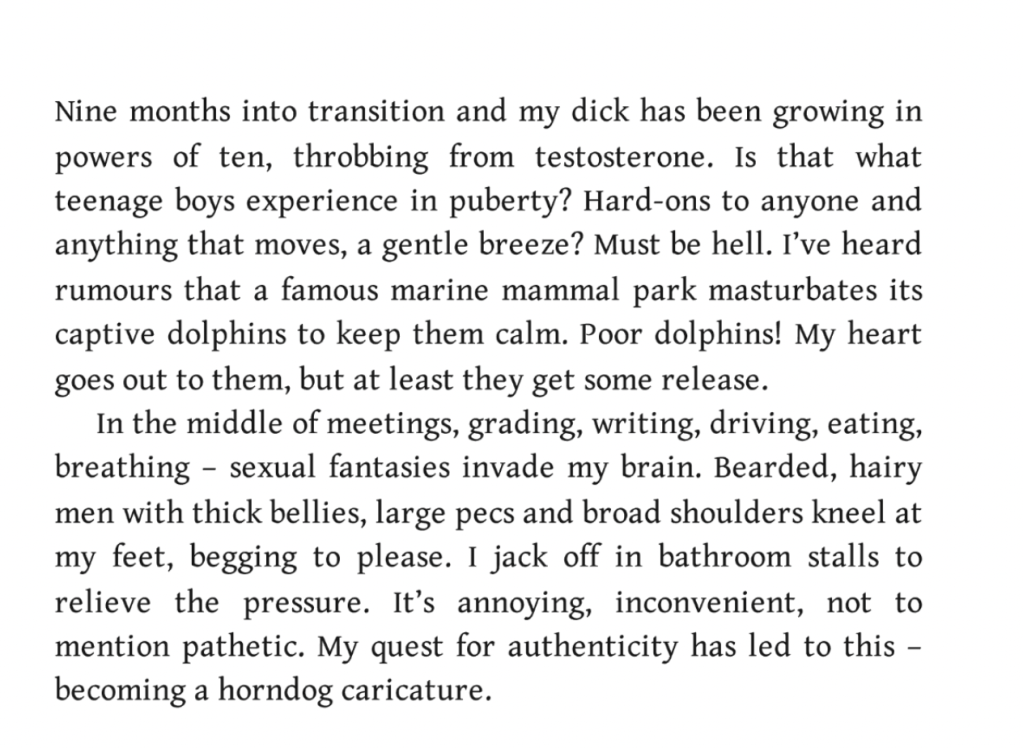
The above is interesting on two counts – one, the queer theorist’s intrinsic interest in the sexuality of children. Two, same but for animals. Her adult experience of an enlarged clitoris due to steroid abuse has nothing in common with the pubertal development of boys. As for the morality of masturbating dolphins? Well, there is none and no excuse.
As expected, taking male sex hormones hugely increased her sex drive, so she found herself a therapist to talk to about her supposed fear of having a sexual encounter with a ‘non trans gay man’ – in other words, the sessions pandered to delusions and encouraged sex by deception. They discussed that gay men were likely to be turned off female genitalia but also that Ozzy’s body hadn’t disgusted her, so perhaps she would be all right after all? The therapist encouraged her to pursue her sexual exploits, so Ben-Zeev put posted an ad describing herself as a ‘trans man who was a submissive but with a big … heart.’ (Sounds like her ‘dick’ wasn’t much to brag about after all.)
As she found ‘more and more joy’ and ‘more authenticity’ (hah!) with her own body and being a man, she had to comfort those around her mourning the death of Talia. The brother who she had dedicated the memoir to, who she claims she was very close to, apparently cut her off because she had forced ‘Talia to commit suicide’.
The second part
Was all about Talia’s journey; how she grew up in a small town in Israel, under right wing ideology. One of her brothers was wounded in war but refused the hero treatment and instead engaged with pro Palestinian causes. It was at this point that she decided to leave Israel and never go back because with an Israeli passport ‘you can’t go anywhere’. (Actually, you can go to 161 countries, including all the ones you’d want to go to.) She travelled to Italy and onto the US.
Fucking Myself Goodbye
Is the title of the last chapter. She wanted it as the title of the book but was persuaded otherwise by the publisher. Ben-Zeev did her reading, torpid prose indeed and also very confusing. Talia is the woman she wants to fuck, – as a man, as Avi. She wanted connect to the physical parts of the herself which caused her pain and self-loathing (which directly contradicts the narrative of Talia’s sassiness). She attempts to do this via her imagination but can’t, so settles instead on finding a Talia-lookalike (another trope of AGP males, trying to imitate the women in their lives). An ad is put out: ‘Gay trans man in search of his past doppelgänger’, with a lot of blurb after that, the final line of which was: ‘PS: I’m not attracted to women’.
Ben-Zeev reckons a woman, who was ‘absolutely irresistible’, got in contact, desperate to complete her fantasy. Ben-Zeev is nervous though, as she’s never been with a woman before! What if she doesn’t know what to do?
After that, the host asked some undemanding questions, which were answered with typical dishonesty about seeking out ‘authenticity’.
Cosy Fireside Chat with random TIF
There are few phrases in the world of DEI more banal and untrue than ‘cosy fireside chat’. The trans-identified female Ben-Zeev pretended to interview, jokingly described herself ‘assigned Malaysian at birth’, oblivious to the fact this accurately describes the legal nicety of citizenship. She had previously worked in investment banking (reminder: rarely are these people down-at-heel types). Interestingly, Ben-Zeev was much more animated and comfortable talking politics. The only ‘cosiness’ though was the conviction we all agreed that Trump was evil and his upcoming administration would be VERY BAD. ESPECIALLY FOR TRANS PEOPLE. We had to find QUEER JOY instead. It took far too long for the pair to explain this to us. Quite what we might do about Trump as UK citizens, I have no clue.
Question and Answer
Is Talia another person or a facet of your personality?
In a typical dodge, Ben-Zeev answered the question with a question. Do you see your past self as you or do you see it as someone else? Talia was a ‘gendered aspect’ of her past but she was ‘really, not real’. My suspicion is that Ben-Zeev had the confidence to say that, because the hyper-feminine boy-loving girl was a confection in the first place, thus the detachment was not fake.
I find that trans narratives often end up serving a didactic function for cis audiences, as trans experiences are unfamiliar to most people. What pressure did you feel for your book to be a teaching moment to a cis reader?
Seemingly apropos of nothing, Ben-Zeev informed us that she refers to her vagina as a ‘front hole’ (uttered with such obvious excitement, we reflexively cringed). Ben-Zeev had been challenged by an academic colleague, who had argued that ‘front hole’ was infantile. In response, Ben-Zeev had explained enough about how she felt but not so much that she educated the other person. If you want to be educated, go read a book! Doh!
What would you want young trans people to take from your story?
Ben-Zeev wanted to make the distinction between being young in years and young in transition – both should be acknowledged. The former could be very sophisticated but didn’t have the life experience; they could take hope and patience from her experiences, as she had come out as trans later in life. It was also suitable for those who were transitioning in their 30s and 40s. Ben-Zeev complained about people responding to transition as if there had been a death, despite her memoir’s solid depiction of the death of her former self.
Conclusion
Other than the typical want wanting-and-eating-cake syndrome on display, the most obvious reading of her personal history would be that she was so conflicted by her lesbianism that she could only allow herself those experiences via the facsimile of a male-ego and -body. Also, would she have transitioned if she had rocked up Chicago, rather than San Francisco? It seems Ben-Zeev didn’t ask herself these questions whilst writing about her confusing past.
However, one thing Ben-Zeev said did strike me and has stayed with me since. ‘Culture eats politics.’ She admitted she was misquoting a famous management strategy maxim: ‘Culture eats strategy for breakfast,’ thus using it out of context, but I agree this is where we are now in popular culture. The plethora of transgender characters and issues appearing in culture is ever on the rise and thinking ‘trans’ will go away once unfair legislation is corrected and medical malpractice exposed, is naive. It is quite the full blown cultural phenomenon.
Thank you for reading! Sign up to my blog by going to the bottom of the page.
Please share on other forums if you liked it, as I only do Twitter.
 The Lies They Tell
You must be logged in to post a comment.