
Trans activist gives talk on being ’emo’ but tells bog standard transition story instead.
Organisers
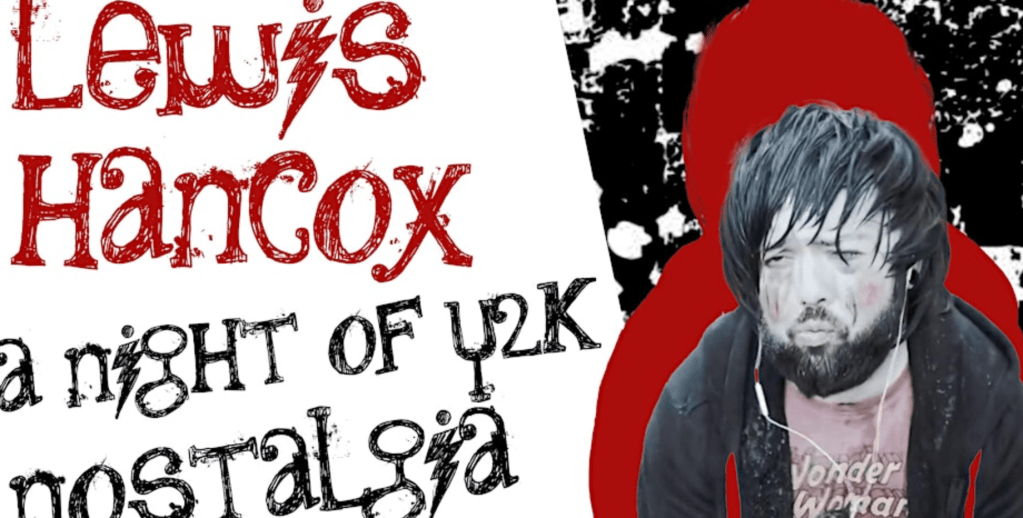
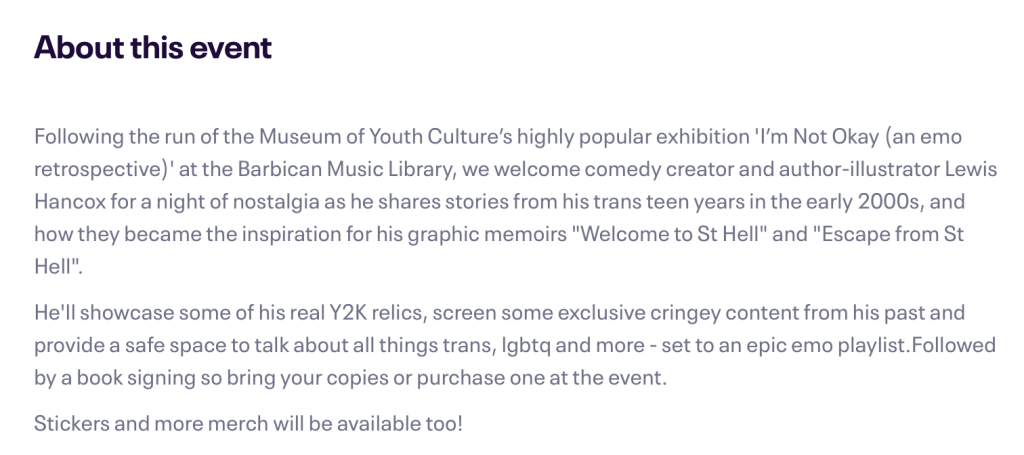
As per usual, the Barbican hosted a trans activist on its premises, this time the location the Barbican Music Library, and Lewis Hancox, the activist. Hancox is one half of the trans-duo My Genderation and had been invited to speak by the ’emerging’ Museum of Youth Culture, whose funders naturally include Arts Council England and The National Lottery. The City of London promoted the exhibition no less than eight times from its X account, using the #emo hashtag. The event was well attended and the audience mainly trans-identified females in their 20s/early 30s but there were also some parents in tow and what we suspect were a few emo die hards.

What was emo?
No one during this event explained to us what emo was, nor was it clear from the exhibition materials, so in lieu of here is a (sort of) explanation.
From memory, emo was short for ’emotional’, a way of signposting your vulnerability c/o thick black eyeliner. Emos were basically goths, and like most copies, a lesser reproduction. Whereas goths had the laconic humour and menace of The Cult, The Cure, Siouxsie and the Banshees, the emo era had (and we had to look them up) My Chemical Romance and Linkin Park. Pfft. Okay, fair enough, everyone idolises the bands they grew up with, but it’s noticeable that bands post internet explosion have not impacted the larger cultural memory. We suspect that emo was much more based around MySpace and Tumblr than it ever was a music fan movement and the section of the exhibition we saw in the Barbican Music Library seemed to confirm this. All emos appear to have left behind is a plethora of posturing selfies, one eye covered by fringe. In that sense, Lewis Hancox was quite a good choice as a speaker on the era.
Also, as part of our diligent research, we looked up #emo on Twitter on our journey into work one day, and found ourselves directly accessing hardcore pornographic images posted by Only Fans users. Quite how this has passed the City of London and the Museum of Youth Culture by, we can only guess, but cheers! and not hair raising in the least.
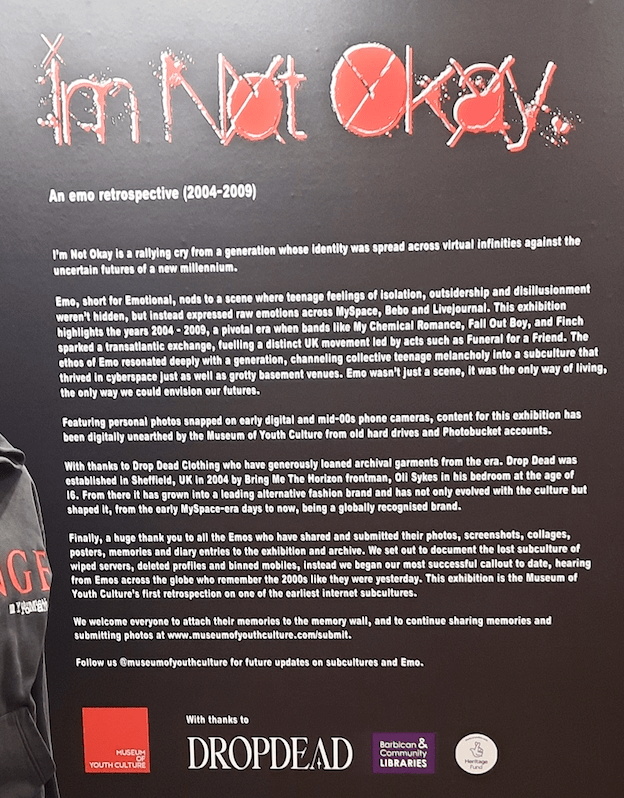
Post-completion of this piece, we realised that we had actually taken a photo of the blurb for the exhibition. As you can see, we got very close. And no we couldn’t be bovvered to revise our text.
About Lewis Hancox
Lewis Hancox started by telling us that she couldn’t quite believe that one of her videos had been viewed more than 28 million times. We can, it’s a huge number but looking on her Instagram, a few days after the event, a video short she’d posted only the day before already had nearly one hundred thousand likes. That’s likes mind, not views. So she’s pretty used to huge numbers and we guess a healthy profit. We don’t say this often about our subjects, but Hancox is likeable, instantly relatable and effortlessly funny. Her video shorts are clever, well edited and we guarantee if you click on any one of them, if you don’t raise at least half a smile, well -heart of stone and all that.
However, as one half of My Genderation, whose output is focussed not only towards children but often features them (see here for my blog about one of their child subjects), her content isn’t without concern. (Incidentally, just a few days earlier to the event, her non-binary-identified business partner, Fox Fisher (45), had undergone her second ‘lower surgery’.)
Back in February 2015, Hancox was the subject of a Mirror article, in which she talked about the help Graham Norton and Stephen Fry had given in helping her to get a double mastectomy (Fry tweeted about it and Norton donated one quarter of the cost).
“My mum realised when I was about five years old. I would cry every night saying I was a boy trapped in a girl’s body,” he said.
‘Graham Norton and Stephen Fry helped me change gender and become boy I harboured inside’, The Mirror, 6 February 2016 – link
She would have been around 25 then and is now around 35 years old. So not a young person anymore, but -like almost all YouTubers- keeps up the just–sitting-in-me-bedroom aesthetic, when she really has a mortgage and cats. Chronic.
The talk
Camcorders
Interestingly, Hancox began by acknowledging that feeling like a misfit was a universal teenage experience and that her teen years had been ‘hell’. She had got into camcorders young, so unusual for that time, had a wealth of clips of herself and friends messing around with skateboards or doing comedy skits. The first clip was her aged 13, skateboarding, mainly falling over after doing stunts. Although we were nominally there to hear about all things emo, it quickly became Hancox’s transition story and how she had only ever hung out with boys (quickly dispelled by other videos). She was honest enough to admit that she hadn’t actually identified as emo at the time but that looking back realised she had the haircut/look and had been into emo bands, which is true enough (the talk was also labelled ‘A night of Y2K nostalgia’). She hadn’t heard of the word ‘trans’ back then but when the boys all started to talk about their puberty she realised she was different. She ‘tried’ to be a girl. She went through the ‘wrong puberty’ and dieted and exercised to excess. (Sounds familiar.)
However, she did have a creative streak to offset this and started to make films, the first one was a ten minute story and included the help of mates. Of the one minute clip she showed of this it noticeable these were all girls.
Mobile phone technology
College was easier than secondary school and mobile phone technology also suddenly shifted, meaning everyone suddenly had a camera on their mobile, ergo the birth of the selfie.
At college she started getting into the emo scene, developed the floppy haircut and wore black eyeliner, explaining that a lot of ‘guys’ were also doing that then. As she became more androgynous, she became more herself and came out and accepted herself as a ‘boyish lesbian’, embracing the small lesbian scene in her little northern town. Despite feeling very accepted by her peers, she still knew her ‘body wasn’t right’. The next video shown we saw her mucking about with her lesbian friends at a house party, All The Things She Said by t.A.T.u, the ‘lesbo’ pop combo, on the backing track. She had wanted to make a documentary about house parties in the noughties but instead produced a video of herself getting progressively drunker, until passing out, ending with friends drawing all over her with marker pens. It was very funny. We suspect it was very Jackass.
Birth of YouTube
It was YouTube, created in 2005, which taught Hancox all about trans. In the beginning, there were obviously no YouTube stars or polished videos. Rather, it was nerds uploading personal vlogs which didn’t get watched. It was amongst these vlogs that Hancox started to see American trans-identified females talking about and documenting their ‘transitions’. Eventually she started to do the same, having learnt she could ‘lead a happy healthy life’, and to provide information to people in the UK. She also showed her mum these videos, so that she could understand what it was that she wanted to do.
On and on and on about trans
She showed us a montage of her transition vlogs, which included sketchy efforts into music making, singing badly whilst strumming a guitar (we remember this period, when every other lesbian dating profile featured guitar-holding). It was at this time that she began testosterone and felt the videos showed her becoming ‘more confident’ as the time passed. At around two weeks on testosterone she had wanted to cry but hadn’t been able to. At three weeks, people were apparently noticing her voice was breaking (though not evident on the audio). At three months her voice is noticeably an octave lower and hot flushes have begun (a sign she was going through menopause?). Black hair appeared on her chin around four months. And then we see her singing, voice comically breaking. At a year, her voice deeper (as deep as it has ever got by our surmise) with more facial hair. Then her three weeks post ‘top surgery’, happy with the results. Then her relaying the information that she had had a consultation for ‘lower surgery’ – 2013 was going to be an interesting year with a lot more cool music videos; cue her and girlfriend doing an awful duet.
Hancox told us that she didn’t regret these videos, though admitted that she had set them to private online. Channel 4 contacted her in 2011 after seeing her YouTube vlogs, inviting her to take part in My Transsexual Summer. She was keen to do it, to show people what being trans was all about. She also hadn’t met anyone else who was trans at that point. The programme got a ‘lot of things wrong’, like focussing on details of surgery rather than the person – which is a bit rich when participants had clearly been found via YouTube transition vlogs. Channel 4 apparently also forced Fox Fisher to pretend she was FTM, when in fact she was ‘non-binary’. It had been argued that non-binary was too complicated for the audience to understand. Even the title was outdated now, i.e. the use of transsexual, for some reason this observation from Hancox drew much laughter.
However, trans rights had taken a ‘backward turn lately’. Channel 4 had removed My Transsexual Summer from its on demand service and Hancox thought this a shame because it was shows like this which were needed now. In other words, she was implying that the show had been withdrawn due to gender critical backlash, when its removal much more likely relates back to the demands of trans activism, as she had just outlined.
Hancox and Fox Fisher meet on the programme and shortly after they set up My Genderation to continue the work. One of the videos Hancox highlighted to us was Josie & Poppy, which premiered in 2018, according to their YouTube account. Hancox described the film as capturing ‘some special moments’.
Summary: Josie (70) had a botched vaginoplasty surgery fixed by the infamous Marci Bowers and discusses this with Poppy (11) and tells him he might one day be able to have a baby.
Hancox reflected that the documentaries were ‘very serious’ and felt much more comfortable making comedy (and – dare I say – more talented at). The dream was to have her own comic, hence during lockdown she began to draw her graphic novel Welcome to St. Hell (volume 2 came out in 2024). She felt that there weren’t enough trans stories out there. (Clearly by this point, everyone in the room had forgotten this was supposed to be about being emo-identified.) At the time of coming out as trans, mum was worried that her life would be really hard and dad felt like he had lost a daughter. Making the book had given her a lot of empathy for their situation. However hard it was, friends and parents can learn to understand and accept you, Hancox soothed us. Which was surely the message the parent/teen combos in the room wanted to hear.
Hancox has a particularly close relationship with her mother, who is very supportive of her career and lifestyle. From what we can see, almost of of her video comedy shorts feature her dragged up as mum arguing with her teenage self. Sometimes mum even appears in her videos, and she screened one in which her mother plays teenage Lois (as Lewis was back then) and Lewis plays mum. Her mother wrote part of the script, which we understand she often does.
Hancox’s first comic ended where she discovered she was trans, the second dealt with all the questions and problems, e.g. what kind of man am I?, etc. This involved breaking down stereotypes (i.e. not being a penis-owner). A sneak preview of a video she was almost ready to post publicly was played, which included photos of her pre-transition. She found it liberating that she was not ashamed to show those photos (though I have to say, from her back catalogue, it appears that she has never had a particular problem with this). This was because she was so comfortable with herself now, ‘as a man’. She was always the same person inside.
Question & Answer
How did your mum react to your first impersonation video?
It was about ten years ago, when Facebook videos was the big thing, when Hancox had first acted out being mum and realised that she had hit upon a theme that a lot of people could identify with (she didn’t say it, but she obviously meant teenagers).
How do you deal with cruelty online?
‘Yeah, well it is hard,’ said Hancox, sounding not at all pained. She apparently finds just general criticisms difficult, like seeing someone say they hadn’t found something funny. Online trolls hide behind keyboards and she had never really encountered animosity in real life. Hancox concentrates on the positive, especially feedback from people who have found her work help them [transition]. Creativity drives her.
Question about the emo scene.
Hancox admitted again that she had not actually identified as emo at the time but that she and her friends had all had the haircut. Avril Lavigne was the first female skater she had ever seen and it had made her realise (but clearly not enough) that girls could wear baggy clothes too. There were a lot of positives from that culture. She said it meant something different to everyone, which sounded like to us that there wasn’t much in the emo scene to make it truly distinctive.
Our reflections
Hancox’s videos told a different story from the one that she was telling. She seemed confident (enough to be on celluloid), popular (enough for friends to indulge her hobby) and happy with a ton of energy. What didn’t come over was that she was ’emo’ in any way, though, as we have already pointed out, this is not something she claimed to have identified with at the time. Clearly she is a child of the internet though, and that made what she had to say interesting.
What it left us wondering about most of all though, was those early YouTube algorithms, the ones that drew her (perhaps inexorably) towards these handful of transition vlogs made by American women (from San Francisco, we bet). So we went on YouTube and searched ‘transition vlogs’ and, after watching the first video we clicked on, YouTube then automatically started to play the video below, produced by My Genderation, presumably because they are in our recent search history and know our general age group. It’s called Never Too Late To Come Out As Transgender: Heartfelt Stories. Nice to see My Genderation covers the whole spectrum of the market! My Genderations, baby!
Thank you for reading! Sign up to my blog by going to the bottom of the page.
Please share on other forums if you liked it, as I only do Twitter.
 The Lies They Tell
You must be logged in to post a comment.