
Hosted by the department of Gender Studies, LSE, London on 20 January 2025
The blurby bit

About the lecturer
The speaker, Asli Zengin, is an assistant professor in Women’s, Gender and Sexuality Studies at Rutgers-New Brunswick University, New Jersey, USA. Her research interests, according to her official profile, are ‘trans, queer, sex worker and sex/gender transgressive lives’. One suspects the LSE paid her airfare to come and give this talk, which just fifteen people attended, at least three of whom were academics supporting the event.
The talk
Introduction
The author had already started ‘winning awards’ for the book, we were told. So, I looked this up later and it turned out to be the Ruth Benedict prize from the Association for Queer Anthropology, a prize so prestigious, the Association hadn’t even bothered updating its own website about the win (at the time of writing). The event was co-organised with the Middle East research centre at UCL, even though Turkey’s status as a middle eastern country is highly debatable, especially given its ongoing application to join the EU. Associate professor Alex Hyde, a gender studies wonk from UCL, chaired the meagre Q&A at the end.
The best thing I can say about this talk is that it only lasted thirty minutes and the session, in its entirety, only an hour. That’s some manageable bullshit, let me tell you.
The book arose from ‘ethnographic* and archival research among queer-, trans people, feminists and sex workers’ and was about the ‘everyday troubles with transness in social and institutional life’ in Istanbul, Turkey, since 2016. She wanted to know how trans people dealt with such ‘state power’ in everyday negotiations. It was her claim that there were two currencies – violence and intimacy; hence ‘violent intimacies’ were an ‘entanglement’ that trans people were caught in. Therefore, the book offered a novel (i.e. stupid and cockeyed) concept and was presumably chosen because sustained endemic violence, the traditional got-punched-in-the-face sort, was absent.
*Data collected through observation and interviews.
Violent intimacies could happen anywhere, including in the health service and at home. The research was ‘trans feminist’ in nature, informed by ‘trans politics and trans perspectives’. (Though the author isn’t a they/them, she did look as if she was on the verge.) Trans studies scholars had helped with the book (snort).
Recent scholarship in critical trans studies had pushed us to think more critically about transness as a place of possibilities and as such her book showed that transness was a kind of ‘other world making’ (in other words, non-demonstrable bullshit), like ‘geographies of theoretical production’ (bullshit, with sugar sprinkled on top). What it boiled down to really, was proving that we are all victims of Capitalism and that Marxism was the answer, albeit using new fangled terms like ‘neoliberalism’ and ‘cishet normativity’. So far, so predictable.
On violence
The state used the technique of violence to intimately govern different identity groups by stigmatising them. This applied to trans people in the following ways: bodies, personal relationships, places of habitation and socialisation were made sexual and more ambiguous by other social actors, such as –well, anyone they came into contact with, including other trans people.
Her conceptualisation of violence owed a lot to anthropological studies, i.e. her violence wasn’t the run of the mill punched-you-in-your-face sort. No, her sort of violence was nuanced, multilayered, thus all the more pernicious. There was a mutual absorption between ‘the violence’ and ‘the ordinary’. Memories of ‘violent’ events counted too. How could we understand the culmination of such events in trans peoples’ lives? Patriarchy was to blame.
On intimacies
Predictably, intimacy also eluded definition but could be described as fluid, plural, flexible, contingent on- and difficult to contain (versus the accepted meaning of simply knowing someone well or a super polite way of referring to shagging). Interestingly, Zengin held a binary view of the world, where things were simply divided into two halves: individuals and the social, private and public, personal and political, global and local, etc. Obviously she hadn’t given much thought over to the nature of non-binaryness in the world. Intimacy can be the site of a radical position in life, a refusal of examination and erasure, she told us. Understand? Someone sighed loudly as if they had.
Zengin’s book traces trans intimacies and their labours – both creative and imaginative – in building a place for trans peoples’ lives in this world (as opposed to –say– Mars?). One absolutely amazing concept trans people had come up with was to socialise. But not just any sort of socialising. They had decided to do it at a particular location and thus created – the never-heard-of-before phenomenon – of a club night. Not only that but they used it as an opportunity to drink, chain smoke, dance and get laid. Or simply share a joke together. Awww. For Zengin this was proof of a creative attempt to foster trans joy and euphoria but to everybody else it looks like just what it is; a night out on the lash with those you are potentially sexually available to. Such club nights offered a refuge from the daily violent intimacies trans people were subjected to.
Another very original thing that trans people do is have friendships against the background of the violent intimacies of their families (not that Zengin dare use the F-word, preferring instead ‘kin’). Trans people created their own kinships (just like every cult does). Trans people had a transformative effect on physical surroundings, be it the home, communal spaces or literal urban geography. Five minutes after initially trumpeting the unoriginal- that trans people meet to socialise, Zengin was still opining the beauty of the trans picnic whilst tying it in to the overlying theme; there was violence in intimacies.
Funerals & Experiments with Trans Kin
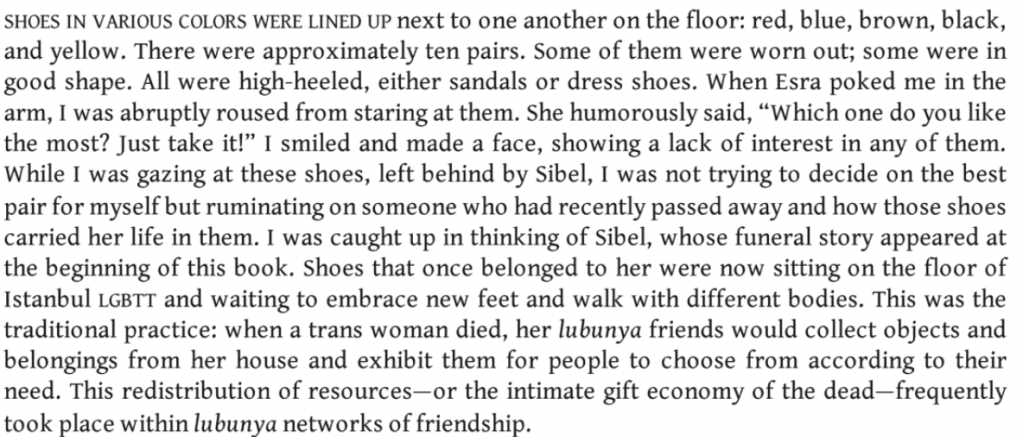
Zengin felt this chapter in her book best demonstrated how the relationship between violence and intimacies worked. In the only interesting part of the lecture, we learnt that many trans (and thereby homosexual or any other type of transgressor) could not be buried on consecrated grounds or be washed, according to Islamic practice. There were few Muslim clerics who would be prepared to officiate and many families would either abandon or (I guess) not even both trying, which is understandable when ultimately a large payment would likely be the main motivating factor for a cleric to agree. However, in Zengin’s hands the issue was merely a chance to political point score and she seemed generally unbothered by such restrictions being exerting over people in general.
Zengin claimed that in such cases, trans people – the creative creatures that they are – would organise their own funerals, and do the washing of the bodies themselves. (Hands up if you think this is normal family practice when a cleric won’t play ball?) Referencing her ‘field work’, Zengin spoke of the funerals she had attended but failed to mention the number. Families were referred to as ‘blood-families’ and she maintained that trans individuals preferred to be buried by their ‘queer/trans-family and -kin’ instead. And, instead of concentrating on the interesting fact that people in Muslim societies act outside of the religious framework when necessary, made a meal instead (she called it ‘theorising’) on the straightforward differences between family and constructed fake families, the former being the site of violent intimacies of negotiation, confrontation, coercion, domestic violence, the latter being, well, just sugar-and-spice.
Zengin also complained about the nature of Turkish inheritance law – even if a ‘trans woman’ specifically only wanted to leave his worldly goods to his amazing ‘trans women’ friends (remember a lot of these blokes are older, describe themselves as ‘mums’, and are nothing more than pimps), the state overrode that consent and the reserved portion always went to family. You will be amazed to learn that this law applies to all Turkish citizens with the dividends being calculated by fraction. Family also retain the right to decide on burial too. It was notable that she placed the family, the state and Muslim practice as equally responsible for funereal restrictions, when it seems more likely a religious restriction.
Many ‘trans women’, once they came out to their families, were regarded as dead and disowned. Naturally Zengin had zero reflection that the families rejection and the men’s gender identification might simply be due to the stigma of homosexuality. Such disinherited people were therefore buried on (the equivalent) of unconsecrated ground. Zengin wrongly likened this to the concept of a pauper’s grave (i.e. one paid for at public expense).
The last few minutes was a spectacle of tautology: ‘creative solutions’, ‘intimate survival strategies’, ‘trans bonding and belonging’ and ‘trans kin work’ being just a few. Of course, the trans-identified men engaged in ‘sex work’ who sought ‘more customers’ weren’t characterised as exposing themselves to violence (the punch-you-in-the face sort) but as creatives seeking ‘material gain’. It is unbelievable, in a lecture on the nature of intimacy in violence, that one would fail to talk about the rape and murder of those engaged in prostitution, or the existence of pimps, but there you go, that’s gender studies for you.
Question and Answer session
And then the charade of the assembled academics and students pretending that they had heard a brand new philosophical concept, rather than a worn out rehash of microaggression theory, poorly illustrated by Zengin’s meagre research, which could only make sense if you truly believed that trans people lived in a vacuum. Though it was worse than that, they pretended it was so complicated it was struggle to understand it.
The academic leading the question and answer session announced she was excited by the prospect of teaching from the book and the ‘deep ambiguities’ it exposed. Hyde opined there was love and laughter but violence was the social glue. Romance was the resistance. What is the political power of that? There were political allegiances between queer-, trans- and feminists in Turkey, especially on the issue of femicide, said Zengin. Some groups focussed on hate crime legislation. Since 2015 the government had upped its anti-LGBT discourse, mainly as a distraction from its occupation of northern Syria. Pride marches in Turkey were still political marches and had not been commercialised yet.
Hyde, still very slow on the uptake, stammered out a hesitant question: Was it that trans people reappropriated violence and turned it into something more positive? (Doh! Zengin had only explained this umpteen times.) Unfazed by this blatant simpering, Zengin replied in the affirmative and repeated again her immensely simplistic theory: violence also produces the opportunity for intimacies, e.g. trans people change urban geographies (aka as setting up a club night). Hyde sighed as if she was struggling to understand.
Another academic present congratulated Zengin on her presentation, which she characterised as ‘beautiful and terrifying’. She wanted to know more about the violence which forged kinships. Was it the moment of the violence itself which instigated intimacy? Was it the violence between interrogator and trans person? The academic also asked a question about graveyards. Zengin was clearly more comfortable with concrete examples, as she talked for quite some time on this issue before addressing violence. She again informed us that there were several forms of violence: symbolic, familial and physical, etc, which all fell under the umbrella of cis-heteronormativity and then needed the question to be repeated. The impenetrable question was repeated. Zengin: ‘Ja, ja,’ – as if she had understood perfectly. There was institutional violence from the police, who had broken down the doors of the trans community living in Istanbul in the nineties (so thirty years ago). There was also violence embedded in the medical and legal systems, as people underwent gender affirmation surgery and there were specific steps they were required to complete, e.g. after completion of vaginoplasty surgery, men are required to have a medical examination to check that the surgically created hole was deep enough. Zengin explained this did not exist in the law but did in practice, her evidence for this relied upon the testimonies of an (unstated number) of trans-identified male(s). Apparently 9cm was the depth required. Such an examination obviously more than qualified as ‘intimate violence’, an institutional rape no less! (But nothing about castration being an act of violence, I noted.)
It’s a shame that Zengin couldn’t be bothered to google, as I did, to corroborate such claims because it is set out in law. I suspect all that is required is a letter from the operating surgeon, that the surgery was performed, and the stuff about depth being tested by an independent witness a masochist fantasy.
Article 40 of the Civil Code (2001) states that gender markers can be rectified through a judicial procedure. According to this law, the person concerned, who has to be over 18 years of age and unmarried, must undergo surgery. To access this surgical intervention, they must prove that “they are transsexual” and that they require it for mental health reasons, which they must prove by attaching an official report from their hospital’s medical board certifying so. Once the surgery has been performed, the medical board formed of various specialists must certify that the person has undergone a “sex reassignment surgery in accordance with the medical purpose and methods and in accordance with the authorisation granted”.
https://database.ilga.org/turkiye-lgbti – bottom of the page of the ILGA database entry on Turkey
Following Judgment No. 165 (2017) by the Constitutional Court, Article 40 no longer requires certification of “continued deprivation of their reproductive capacity” (i.e. sterility), although in practice the nature of the surgery required often results in sterilisation.
According to the Association for the Study of Social Policy, Gender Identity and Sexual Orientation (SPoD), the vagueness of the current provisions means that the way in which the judiciary handles applications for legal gender recognition varies depending on a number of subjective factors, such as the stereotypes that individual judges may harbour about trans and gender-diverse people.
Another violent infringement against trans-identified males were that they were stereotyped as being the receivers, rather than an active partner in penetrative sex. It sounded like Zengin had very much discovered this was a myth from her ethnographic research.
An audience member, an academic, asked a question about imams and funerals – were imams agents of the state? Zengin relied again upon her singular example of having been to the funeral of a trans-identified male, who had not completed his full medicolegal process (it sounded like he had breast implants but had kept his penis). Therefore the body washers deemed him not quite male, and not quite female. ‘Of course, she was a woman, regardless of what she had on her body,’ said Zengin pompously. They looked for an imam who would accept the body as a female. Eventually they found one who lived in the Istanbul district where trans-identified males also hung out (which made me wonder where exactly they had begun their search).
Reflection
It was interesting to note Zengin drop the term ‘trans people’ and refer to ‘trans women’ as the lecture went on. And so, as per usual, ‘trans men’ didn’t get a look in. Probably because she didn’t want the men to take everything over, eh?
‘Violent intimacies’ is nothing more than a moronic reboot of microaggression theory, and I note she carefully avoided the phrase. Also noticeable was the lack of basic information, statistical and legal (homosexuality is legal but same sex marriage is not recognised). What was really unforgivable though was the absence of any analysis with regards to homosexuality being forbidden in Islam. Or that trans activism itself is a major sponsor of all types of body modification – isn’t that also violence? Utterly pathetic.

Thank you for reading! Sign up to my blog by going to the bottom of the page.
Please share on other forums if you liked it, as I only do Twitter.
 The Lies They Tell
You must be logged in to post a comment.