
Another attempt by academics to link the gender critical movement to far right extremism.
The blurby bit
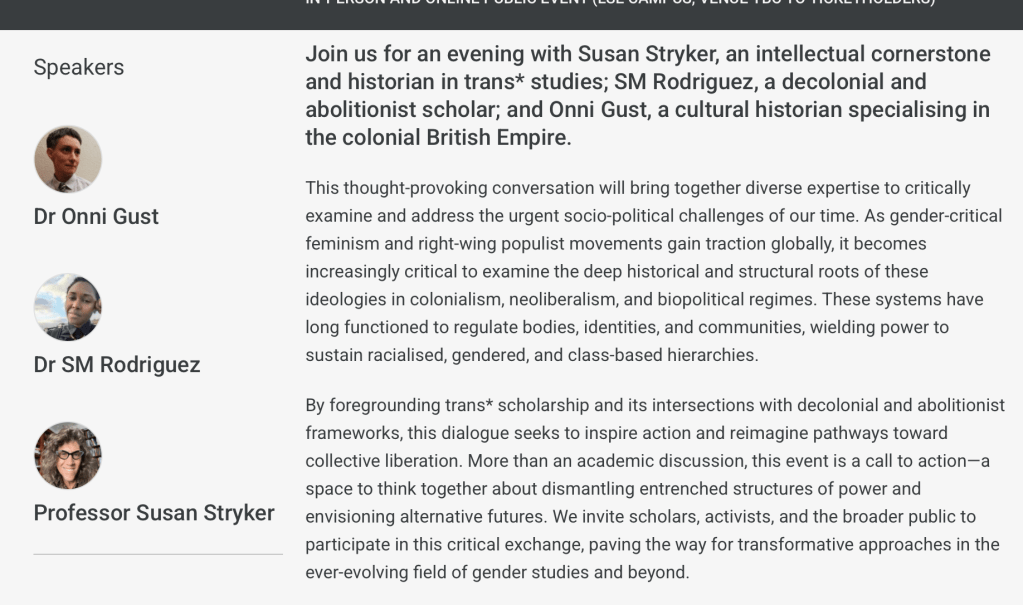
*The reason for the asterisk was not explained.
Further: The event was hosted by the Departments of Gender Studies (natch) and International History (?!) at the LSE. Dr SM Rodriguez was unable to make the lecture, so it was just Dr Onni Gust and Professor Susan Stryker. The chair of the event, Emrah Karakuş, reminded us of the theme; the rise of the far right and anti-gender movements, who were ‘seeking to criminalise resistance’, amongst other unspecified and bad things. Again, cis-heteronormative patriarchal norms was what we needed to fight against. Dr Karakus also mentioned the ’75 year oppression of Palestinians’ and a ‘trans woman’ who had been sent back to Syria (I think this might be Arma Almsrawi). The seminar that night was to ‘make sense’ of the time that we were living through.
Most interestingly, Stryker had been Karakus’s PhD advisor and a ‘source of inspiration throughout my career’.
Dr Onni Gust’s lecture
There were ‘three moments in history’ that Dr Gust wanted to focus on. The flavour of the talk is very much caught by her official biography. Prepare yourselves:
My research asks what it means to be human and how the boundaries of the human and non-human animal were constructed in the 18th century. In particular, I look at the relationship between European colonial expansion, ideas of a male/female sex binary, and the meaning of the human.
https://www.nottingham.ac.uk/humanities/departments/history/people/onni.gust
Setting the scene, Gust told us that day had been a day of action for Palestine against genocidal violence (for context, Hamas had refused to release further hostages abducted from their homes with no sign of Shiri Bibas and her sons), puberty blockers had been banned for trans kids, there was an athletics ban for trans women, etc. All of this was ‘boring’ and ‘depressing’ and so Gust turned to the history of trans people to cheer herself up. Namely, mermaids. Or merfolk, as she mostly failed to remember to call them.
The mermaid moment
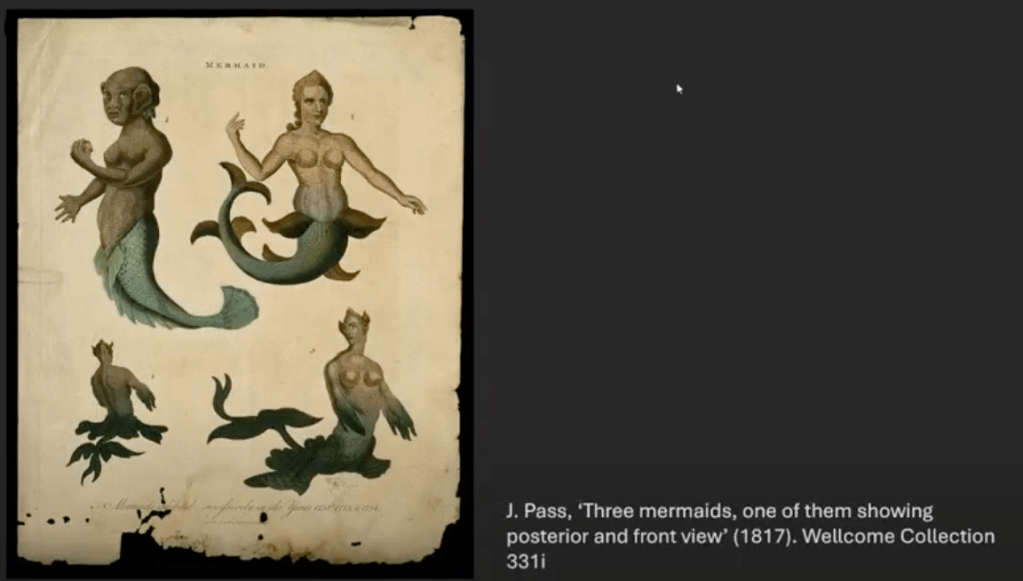
Mermaids were beings which ‘sowed confusion into the minds of natural historians’, apparently. Perpetrated by mostly white men. The thing what Gust loved most about merfolk was that no one knew exactly what they were. It was an ‘unanswered question across time’.
I love that look of confusion. That moment of complete incomprehension- towards me (a historian of mermaids), towards mermaids, towards all of us who are trans and non-binary.
Dr Onni Gust, around 12.55 minutes
At the local trans support group she had been involved with, none of the attendees really knew who or what they were and it didn’t matter. Connecting with mermaids helped her connect with the question: What are you really? The question didn’t really matter, it only mattered to everyone outside (and not her, the person who kept asking this very question).
The Chevalièr d’Eon moment
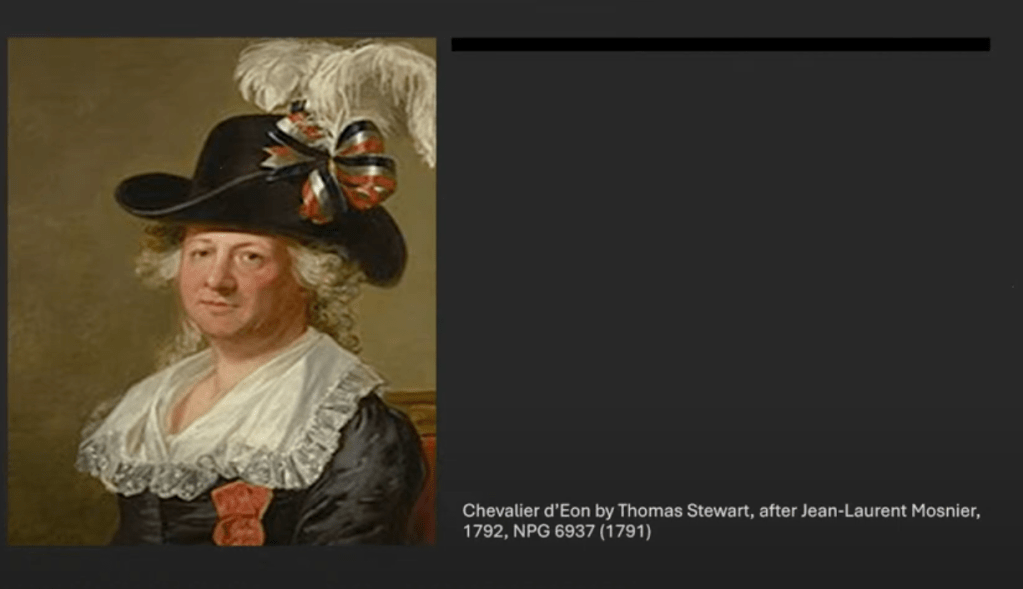
Gust teaches her second year undergraduates about the Chevalièr d’Eon. What they so desperately wanted to know was ‘what was the Chevalier really?’ In other words, no one was buying her bullshit that it was anything other than a man in a dress, indeed one had even suggested that the bones were dug up and analysed for DNA. For Gust, it was about ‘unravelling the desire to really know‘. Unsurprisingly, such comments wound her paying-through-the-nose-for-this-shit students up. A space to ‘not know’ opened up the space to be ‘creative’. ‘Knowing’ was a Western patriarchal colonial endeavour and ‘to not know’ was a decolonial practice, which she was passing on to her pissed-off in-debt-for-life students.
Third moment – Criminal Tribes Act
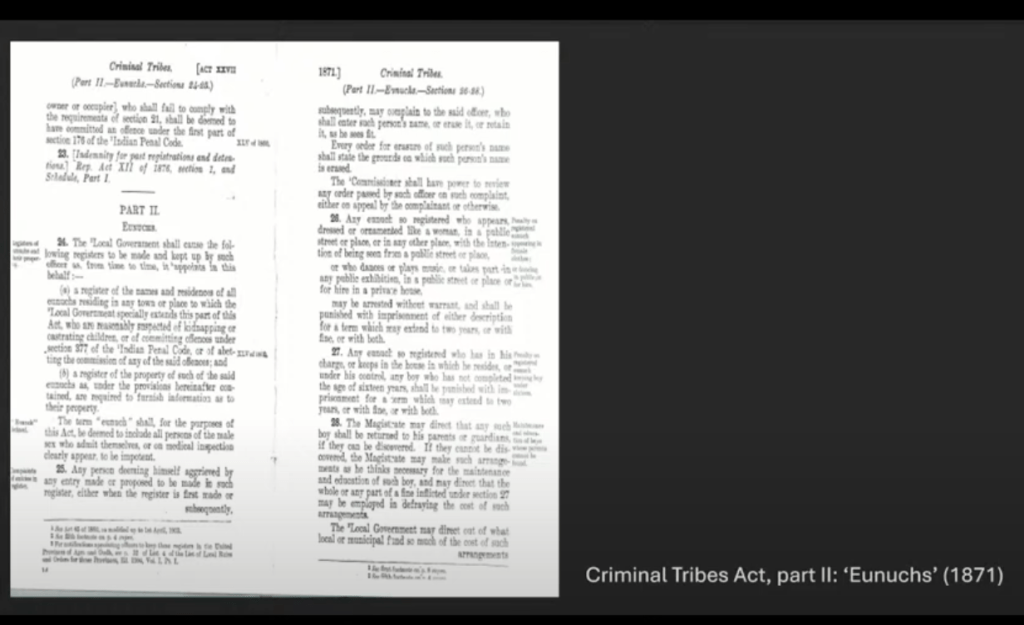
According to Gust this Act, passed in India during the time of Empire, criminalised any man who appeared to be impotent but did not give a definition of impotency. It also referred to such men as eunuchs (there’s your clue, love), which encompassed such groups as Hidra (a sexually exploited caste, made up of males from poverty stricken communities regarded as feminine and forcibly castrated). Men deemed to be part of this group were forbidden to dress in women’s clothes or perform in private houses, so essentially this sounds like it could have been an anti-prostitution bill.
Summing up
What linked all three examples was that they involved peoples who couldn’t be neatly defined, which was a great help in fighting the new wave of fascism. There was a real threat that trans people might be forced to make unequivocal statements about who they were! In response, they should say: Non-binary people are valid.
We must resist the demand to make sense. History for me is an act of creativity, a form of storytelling, in which the sources are our tools.
Dr Onni Gust, around 22 minutes
Nuff said, Doctor.
Professor Susan Stryker’s lecture
The lie about the Compton’s Cafeteria riot
Following on from Dr Gust as he did, Stryker had the distinct advantage of sounding saner and more erudite, even though what he said was as much of a load of bollocks. Everything was so bad at the moment in the US with the new Trump administration, especially for trans people. However, just the week before, the site of the Compton Cafeteria riot had made it onto the National Register of Historic Places in the United States, he told us.
Just a little background about the Compton Cafeteria – the made up story of the riot is essentially his life’s work, a prequel, if you will, to the myth of the Stonewall Riot a few years later. I reviewed his documentary Screaming Queens: The Riots at Compton’s Cafeteria (see here). Essentially its problems are this: Stryker met only two people who claimed to have remembered the incident, no date for the alleged riot is established, a key contributor and ally to the drag queens contradicts several of his assertions, no hard evidence from police records is presented, nor are there corroborating stories from newspapers at the time. Worse still, the film suffers from directorial sleight of hand, with talking heads appearing to be responding to entirely different issues to the ones suggested. And that’s just for starters.
I also did a search of the database of the National Register, using the search terms Tenderloin, Compton and Cafeteria, and could not find an entry. Perhaps they hadn’t had a chance to update the spreadsheet yet and were still preparing the press release?
During this lecture, Stryker went even further in his false allegations regarding the fictitious event than even the lame documentary, claiming that ‘hundreds of people winded up fighting in the street with the police’. The fact that the incident had made it onto the official register, claimed Stryker, (mem: it hasn’t – at least at the time of this going live) showed that there was resistance inside the establishment. M’kay.
Historical erasure of trans people
On Trump’s very first day of office, an Executive Order: ‘Defending Women from Gender Ideology Extremism and Restoring Biological Trust to the Federal Government’ was signed. There were five others too, he claimed, which banned ‘trans women’ from sport, stipulated where ‘trans people’ had to be housed in prison, military service, etc (really I think all of those points pertain to the one Executive Order). The Executive Order that Stryker wanted to highlight though, was the one which had a list of ‘banned words’, not to be used in any published text by organisations which received public funding. Stryker claimed it included the words ‘transgender’, ‘transsexual’, ‘assigned male at birth’ and ‘gender’. I did try to find the Executive Order he was referring to but couldn’t. I’m guessing he was referring to the Executive Order pertaining to the removal of DEI in public life. It seems more likely that bodies in receipt of public money are getting nervous and removing phrases themselves, in order to avoid financial penalisation. So, not a ban at all then. The EO pertaining to gender ideology simply states that biological sex is real and that language related to the same should reflect reality. Stryker didn’t tell us what the Executive Order was called, so we will just have to trust my Google search skills, won’t we?
Stryker bemoaned that the word ‘gender’ had been used for almost a century. He was implying, I think, that people had used it to describe gender identity all that time. In reality, gender has only had that flexible meaning since around 2015. So, just a decade. He went further, to use the word gender now in the US was a ‘thought crime’. An apt comparative to the current situation in the US were the book burnings which had taken place in Germany under the Nazis. Cue reference to Magnus Hirschfield’s Institute for Sexual Research being the target for the infamous book burning outside Berlin’s Opera House in 1933.
(In fact, there is photographic evidence suggesting that the Institute was plundered – see here for a photo showing the books being ‘sorted’. It is also worth pointing out that the Institute existed to treat psychological sex disorders, which included homosexuality, and used experimental treatments on patients, like the surgical implant of animal gonads and injection of animal hormones, the latter being a favourite amongst Hitler’s inner circle and Hitler himself – see the excellent Blitzed: Drugs in Nazi Germany.)
Stryker continued his narrative regarding ‘trans erasure’, the Institute treated and employed ‘transgender’ people and was targeted by the Nazis, back in the US, today, – well, Trump had said he wanted a return to biologically correct language regarding the sexes. Two completely analogous situations, I’m sure you’ll agree.
Stryker then went onto misquote Walter Benjamin, a German Jewish philosopher writing in the 1930s, reading the two paragraphs below, out of order, from Benjamin’s essay Theses on the Philosophy of History (originally written in German):
The tradition of the oppressed teaches us that the “emergency situation” in which we live is the rule. We must arrive at a concept of history which corresponds to this. Then it will become clear that the task before us is the introduction of a real state of emergency; and our position in the struggle against Fascism will thereby improve. (VIII)
The only writer of history with the gift of setting alight the sparks of hope in the past, is the one who is convinced of this: that not even the dead will be safe from the enemy, if he is victorious. (VI)
Source: https://www.marxists.org/reference/archive/benjamin/1940/history.htm – paragraphs VIII and VI respectively – see 37 minute mark for Stryker’s rendition
Notably Stryker removed the salient religious references from paragraph VI.
Next up, George Orwell’s Nineteen Eighty-Four got the Stryker treatment:
Whoever controls the past, controls the future. Who controls the present, controls the past.
Every record has been destroyed or falsified, every book rewritten, every picture repainted, every statue and building and street has been renamed. Every date has been altered. And the process is continuing day by day and minute by minute. History has stopped. Nothing exists except an endless present in which The Party is always right.
Stryker, doing his own version of Nineteen Eighty-Four, 38 minutes in
Again, Stryker had conflated two quotes from the novel. The first, from early in the book:
‘Who controls the past,’ ran the Party slogan, ‘controls the future: who controls the present controls the past.’ (Chapter 3).
Part 1, Chapter 3, Loc 855, Penguin Modern Classic e-book
Here, Orwell is clearly critiquing the use of slogans – note how the four parts mirror each other and leaves you with a quizzical feeling. Essentially it’s a riddle. How apt that Stryker concealed the origin of the quote from the audience, added ‘whoever’ and improved its punctuation so that it appears to make more sense. Chapeau! However, even with those improvements, the slogan is still a slogan which doesn’t make sense. Though we must admit, it is far more complex than the rubbish: ‘Trans women are women’.
The second part of what Stryker quoted aligned with the text, but again he failed to point out that he was quoting the reported speech of the character Winston Smith, a Party apparatchik no less, and who, just a few sentences later, admits:
‘I know, of course, that the past is falsified, but it would never be possible for me to prove it, even when I did the falsification myself.’
Part 2, Chapter 5 , Loc 2718, reported speech of character Winston Smith holding an illicit conversation with Julia
Why was anti-gender ideology so similar to anti-semitism?, posited Stryker. Well, there was the fact that trans people were just a tiny minority for a start (and ran out just there). Also, chattel slavery was very similar to that feeling of being in the wrong body, he told us, which isn’t offensive in the least, is it?
Transness was a practice of freedom, preached Stryker, available to all of us, to carry us all beyond what ever confinement we found ourselves limited by. The power that trans people were perceived to have to transition themselves was the reason why they were being targeted.
Question and Answer
The Q&A was only really notable for one question. A man, exercised about the issue of female sports. At first I thought he was going to make a terf point, but no, his simmering anger was directed the other way (go to 57 minutes on the recording): Wasn’t the issue just that female competitors weren’t allowed to dope themselves so that they could compete at the same level as trans athletes? And, why had no one pointed out women had been trained to assassinate men much bigger than them in the Second World War? Why was no one making a statement on this? It was not fair what was happening to trans women, it wasn’t fair, it was right. It was murder. As a man, he found it appalling, that the issue couldn’t be discussed with nuance. The panel, of course, just nodded along as the dribbling fool spat out this nonsense.
Gust offered an answer; she didn’t know enough about sport to answer, so at least honoured her motto of not-knowing.
Stryker couldn’t understand why men in women’s sports had been such an issue in the recent US election. He also wanted to recommend a book (published by Penguin) The Other Olympians by Michael Waters. Stryker said it was a book about ‘three trans athletes competing in the 1936 Olympics’.
(As an aside, the book was obviously written to emphasise the supposed link between the ‘anti-gender movement’ and fascism and the blurb for it mentions one female athlete, who declared she was male after she retired from athletics, and a man raised as female due to a DSD. Notably it excludes Dora Ratjen, a male the Nazis placed in the female high jump category, hoping to win Gold.)
There were no sex differences, said Stryker, except that most sports favoured those bodies which went through an ‘androgen driven adolescence’. Whereas sports which played to the strengths of an ‘oestrogen driven adolescence’ were regarded as less important because they were feminine and patriarchy ruled. He didn’t care to mention which sports these were. Eating yoghurt and crocheting?
Conclusion
As per usual, the panel demonstrated the Left’s obeisance to Hamas and its anti-semitism, whilst obsessing over the evils of the Nazism, with Stryker – in a massive head-desk moment – comparing himself to Walter Benjamin, a German Jewish intellectual who committed suicide rather than face the Gestapo. And then Stryker had the cheek to misquote George Orwell’s dystopian novel, as if it were a political treatise (misusing the fictitious Party slogan no less) to imply that the Trump administration were falsifying historical records to eradicate crossdressing men. On top of that the Compton Cafeteria Riot is a pile of fictional shit, shat out of his own giant arse. Quite impressive really.
The event has been posted publicly by the LSE, if you have the stamina.
Thank you for reading! Sign up to my blog by going to the bottom of the page.
Please share on other forums if you liked it, as I only do Twitter.
 The Lies They Tell
You must be logged in to post a comment.