
No, it’s trans ideology which is homophobic. And it’s not new.
The blurby bit

Discussion held at Queer Britain, the UK’s LGBT+ Museum, on 23 June 2025.
The panel

Zoe Playdon
I have written about Playdon before when he spoke on the ‘history of trans healthcare’. That time I immediately spotted he was male, but a reader asked for corroboration so I had to backtrack. Since then someone kindly furnished me with the corroborating evidence, which is really quite interesting, as it turns out Zoe Jane Playdon is none other than P, in P versus S and Cornwall County Council. Thus, Playdon fits the typical trans-identified male, transitioning in middle age.

Source: https://lok.gires.org.uk/exhibition/podcasts/episode-4-policy-over-politics/
Playdon and Lynne Jones, MP, set up the Parliamentary Forum on Transsexualism in 1994. Playdon now refers to the 1996 case, as if it were outwith of himself. Certainly when he bought it up during this panel, he felt no compulsion to elaborate and even squeaked out a ‘not me’. Whether the others are aware of his history, is anyone’s guess.
During the discussion, Playdon repeatedly claimed that trans had previously been understood as an intersex condition. This confused me until I found Lynne Jones’s page, and realised he was referring to the supernatural belief that it is possible to be ‘born in the wrong body’ (see below) and obviously has nothing to do with true DSD conditions. This idea is now so old hat, I had forgotten it existed.

Nat Thorne
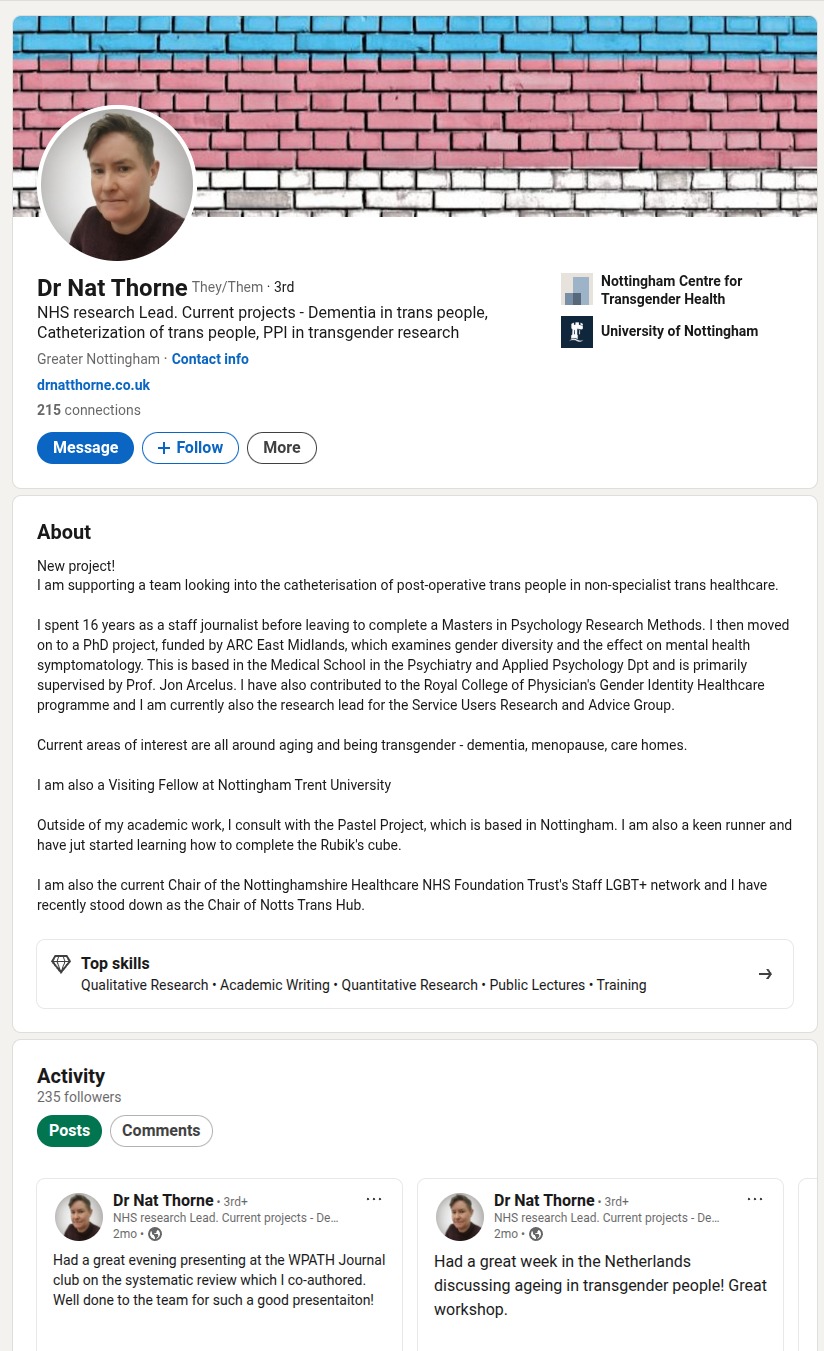
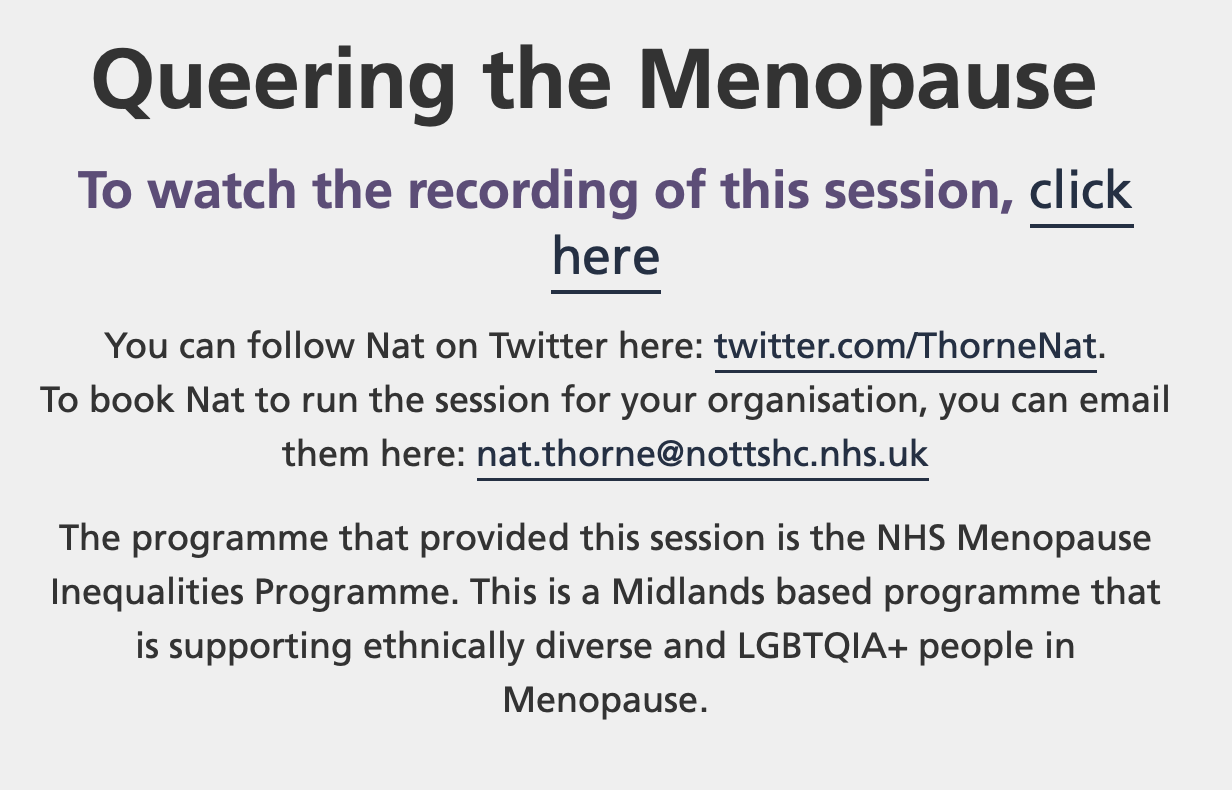
Dr Nat Thorne is not a medical doctor, but a former media jobber with an unspectacular career history, until she became ‘clinical researcher’ in ‘trans healthcare’, according to her LinkedIn profile. She is currently being supervised by Jon Arcelus (a Professor of Mental Health and Wellbeing and member of WPATH/ EPATH) for her current project into the catheterization of post-operative SRS victims. The project is being funded by ARC East Midlands, which in turn is part-funded by the NHS, ergo the taxpayer. She has also been a self-employed transgender awareness training consultant since January 2020.



Marcus Collins
I knew I recognised Marcus Collins, the academic who organised this discussion, and sure enough, it turns out I attended a talk he ran called ‘Trans Lives in the Seventies‘. At that session he told us the first BBC programme on male homosexuality was The Problem of the Homosexual, broadcast in 1957. Collins had noted that the silhouetted figure interviewed, when asked what solution he would seek for his homosexuality, responded he would like to have been a woman. He also showed us several other clips featuring transvestites broadcast in the 70s, including the odious Della Aleksander from the Transsexual Liberation Group. So, it was somewhat of a surprise that he actively lapped up Playdon’s take on things.
The room
However, to be fair to Collins, he allowed more critical questions to be asked than I have ever witnessed in these spaces, though things were rather pre-empted by the question: Is Transphobia the New Homophobia? Well, no, it isn’t, never was and I would argue that trans ideology is far more homophobic than just old-fashioned hatred. A point, unfortunately, that no one at the event managed to make coherently. Also never mentioned was the very real and understandable fear around HIV in the 80s, such is the distraction that trans ideology presents. It’s like the entire episode has been memory holed, even for the gay men who were there and had direct experience of it.
The event was sold out, so nearly all the seats were filled. There were a few terfs but the main gender critical presence came from a bunch of gay men, sick of hearing about the trans, which perhaps explains the tolerance of dissenting opinion.
As the event was being funded by public money, via the Arts and Humanities Research Council, Collins wanted feedback as to the usefulness of the discussion. It was one of two dozen events which had been organised; the very first to be held. As a historian, Collins knew ‘a lot about the past’, i.e. historical homophobia, but not that much about the present, hence the panel were there to help him explain what ‘contemporary transphobia’ was. The homophobic experiences of ‘queer men’ in the 1950s (as they were known back then) was what had inspired him to run this particular panel. The panel was to focus on the civil rights, or lack thereof, of homosexuals (who ultimately are just same sex attracted persons) versus the rather nebulous blob which makes up the trans-identifying/gender-fluid crowd.
The panel presents
The discussion was based around five different topics, to be introduced by the panel. An online poll also ran throughout the session, where people put their honest thoughts. Credit to Collins, he read out many of the gender critical comments and no one ran out the room, which just goes to show that these people can listen to our debating points. Whether they comprehend is different matter.
First voxpop
The online thingummy wasn’t working, so we had a hands up for the first loaded question: ‘Who strongly agrees that transphobia is the new homophobia?’ Half a dozen put their hand up. Another half dozen for ‘agree’. Neutrals were thin on the ground, I think. There was a half dozen for ‘disagree’ and one ‘strongly disagree’ (though all the disagrees were really stronglys). For once, the room did have a diversity of views, albeit polarised.
Fears
Lisa Power was there to lecture us about ‘fears’, which is the basis of a lot of phobias, doncha know. Homophobia was much harder to do these days, since so many of us know people who are lesbian and gay (which isn’t really true outside of London, to be fair, which Power isn’t). Therefore, because trans people are so few in number, transphobia naturally followed. There had been trans role models in the past, but these had already been erased from the cultural memory, she claimed (of course, the trans lobby has never retroactively transed any lesbian or gay icon). Fears about trans people were being stoked by people for whom it was beneficial and amplified by the media. As per fucking usual for these things, Power failed to give a single relevant example.
Revealing upfront the disdain she now held for her peers, Power told us in the late twentieth century, lesbians and gays had been no help to bisexual people, but failed to say why, how or what the relevance was. Homophobia in the 50s was less bad, she claimed, reasoning that because homosexuality was such a taboo subject, it got mentioned less, ergo there was not that much of it. The volume of scaremongering articles about trans people had been off-the-scale the last five years, though prior to that there had been lots of positive images about them. Namely, the storyline of Hayley in Corrie (a character played by a whole-ass woman), and Nadia, who had won Big Brother with ‘very little prejudice being displayed at all’. (It was only the whole point of him winning, if that’s what she meant?)
As per the current narrative, Power warned that soon the anti-trans narrative would become an anti-lesbian-and-gay one. She knew people behind the scenes, and therefore for a fact, stories were being fed to the media. The current terf plan was to pivot away from stories about toilets to education, because it had been realised the general public didn’t care about toilets. This gave Power a chance to remind us about Section 28.
Back in the 70s, there was a lack of visible lesbians and gays, similarly there were a lack of notable trans now, especially social leaders and politicians. There were also loads of lesbian and gay politicians now (wildly over-represented, in fact) but we didn’t have any ‘successful’ trans politicians. Only one unsuccessful one, who had had a major scandal issue, said Power ruefully, alluding to Jamie Wallis, who days earlier had admitted to harassing his wife, and rose to notoriety in 2022 after he drove into a lamppost wearing a leather mini-skirt and heels, claiming he was trying to avoid a cat. There was very little representation of trans people in the media, whereas there were so many lesbians and gays, there was no going back into the closet for us! The key to unlocking transphobia was simply for the transphobes to know someone who was trans, said Power.
Very little representation of trans people in the media …
Here's your 'study', Lisa Power.  In June 2025:

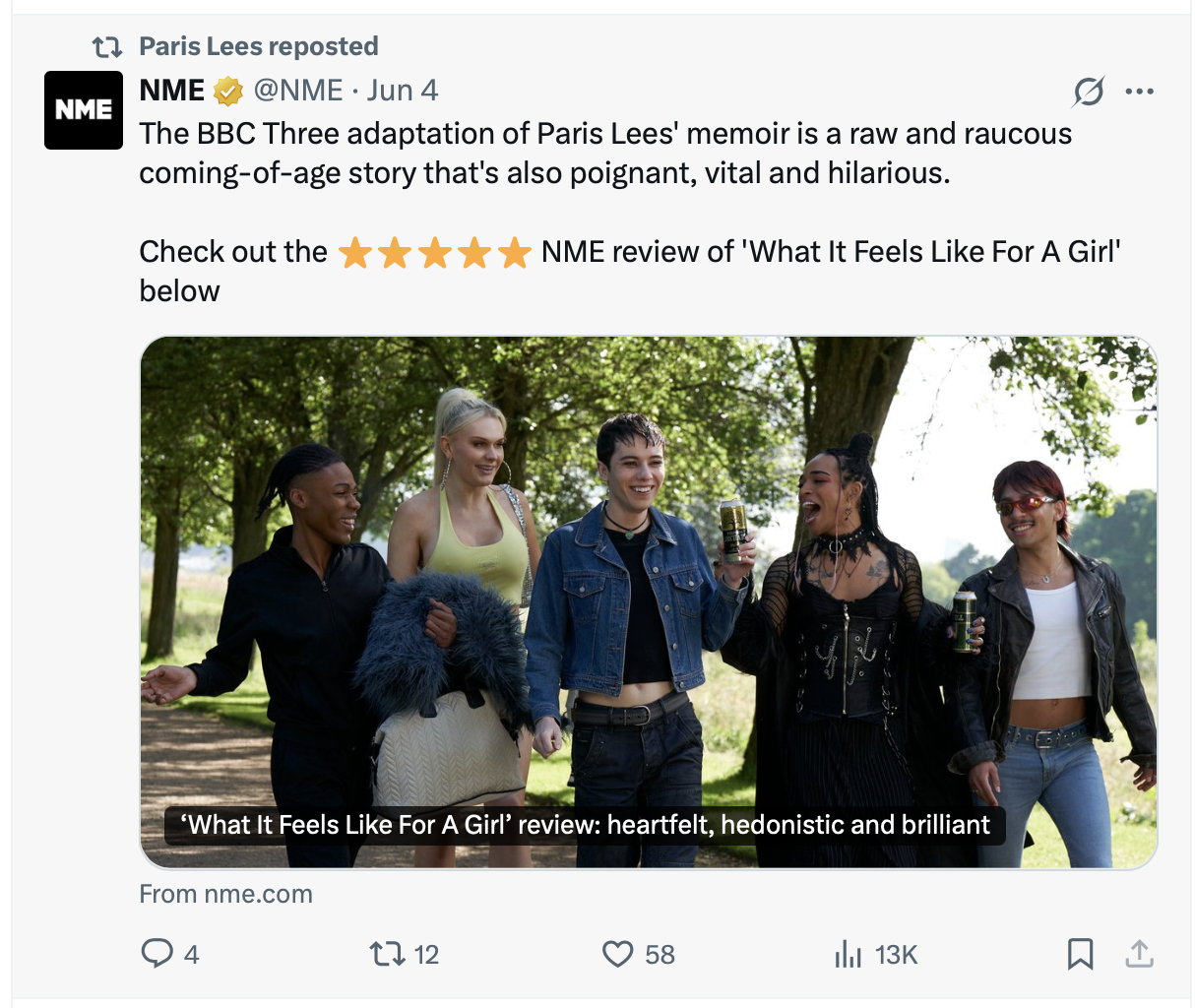
BBC1 showed What It Feels like For A Girl - Paris Lees' story of being a gay teen who transitioned.
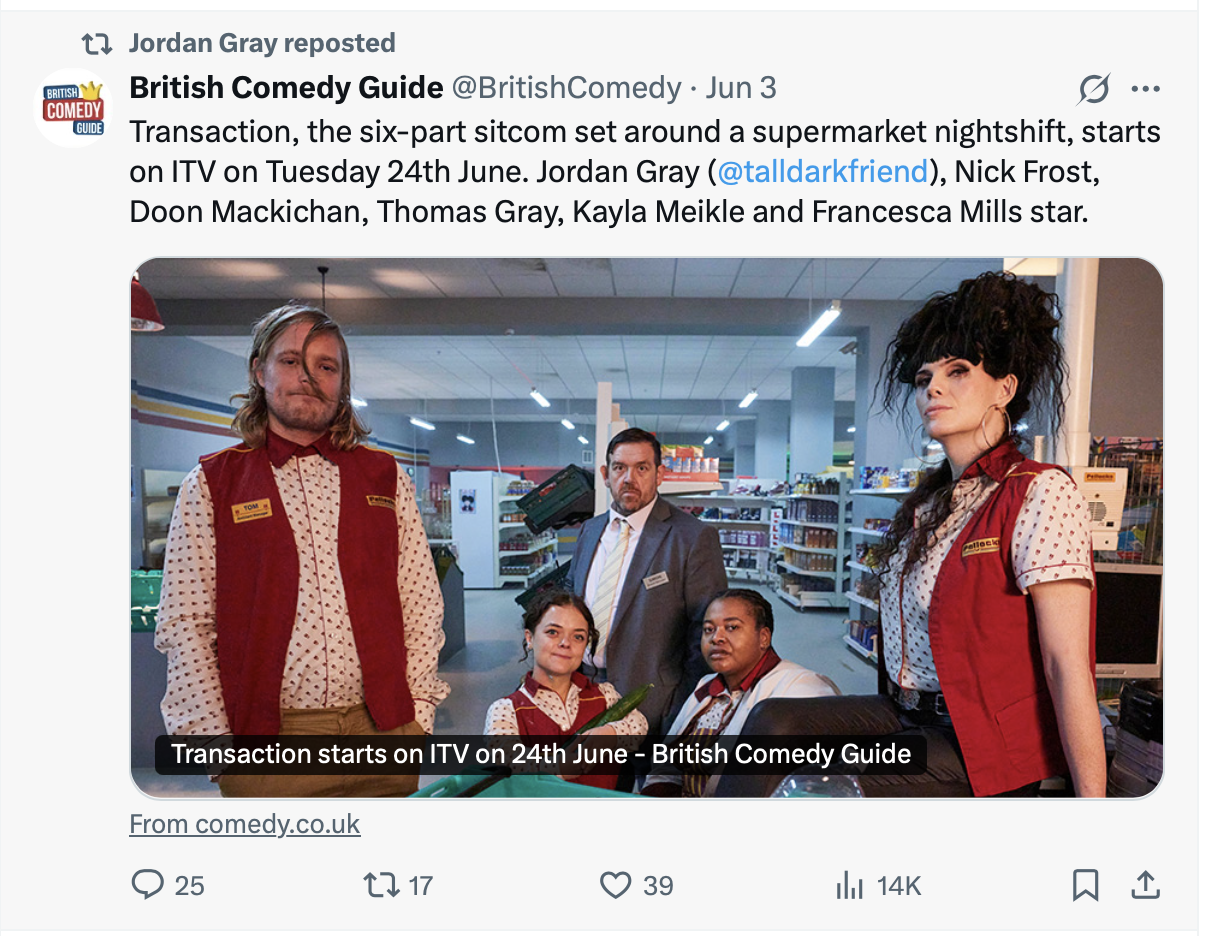
ITV aired Jordan Gray's sitcom, Transaction, about an 'egomaniac trans woman' working in a supermarket*, tying in with his second tour.
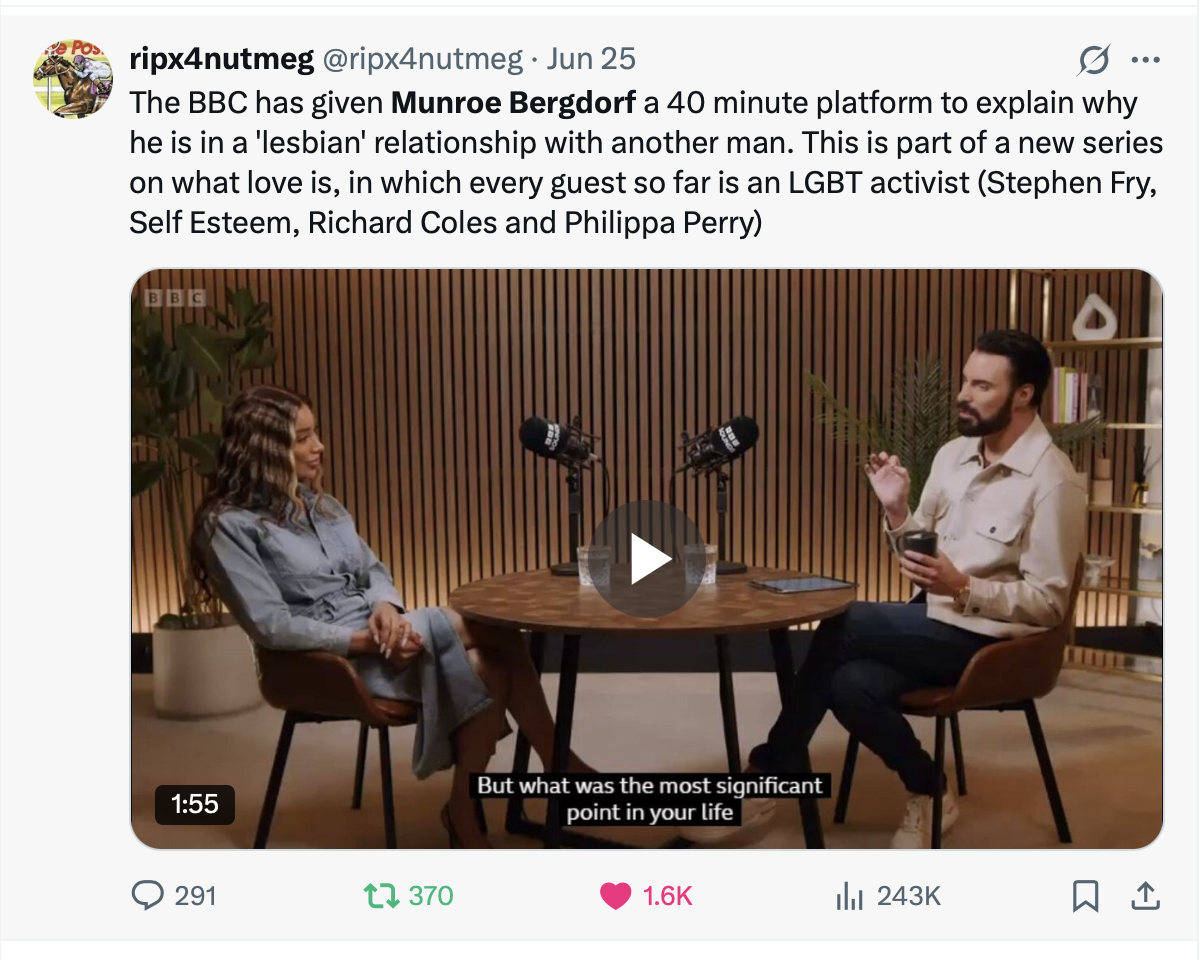
Munroe Bergdorf was interviewed by the BBC, hot on the heels of his new documentary, Love & Rage (distributed by Universal) and book, Talk To Me (Penguin). Bergdorf is also a gay man who transitioned.
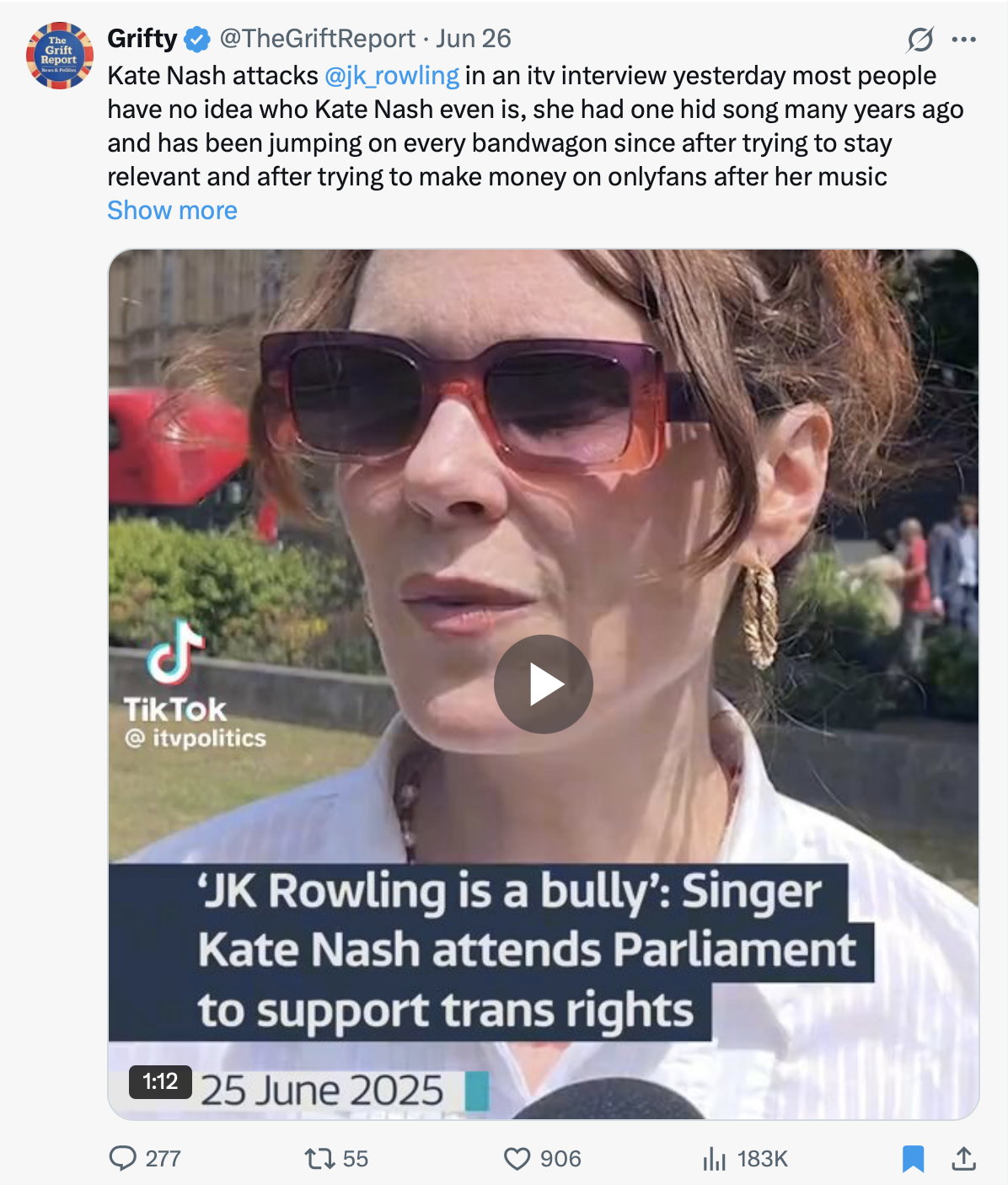
Kate Nash (who she?) was interviewed by ITV News on her trans allyship.
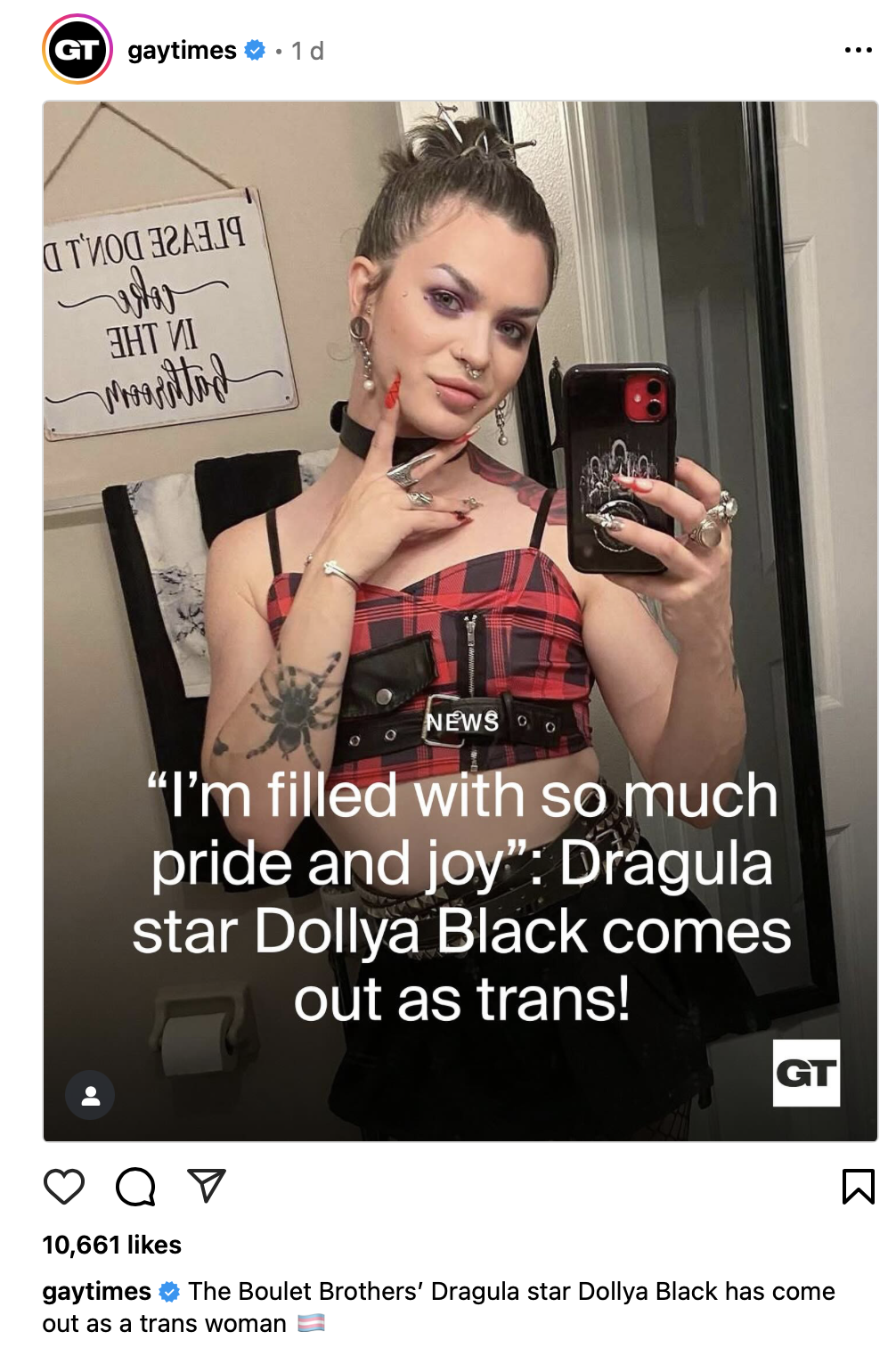
Some dude on a drag show announced he was taking hormones, published by the Gay Times.
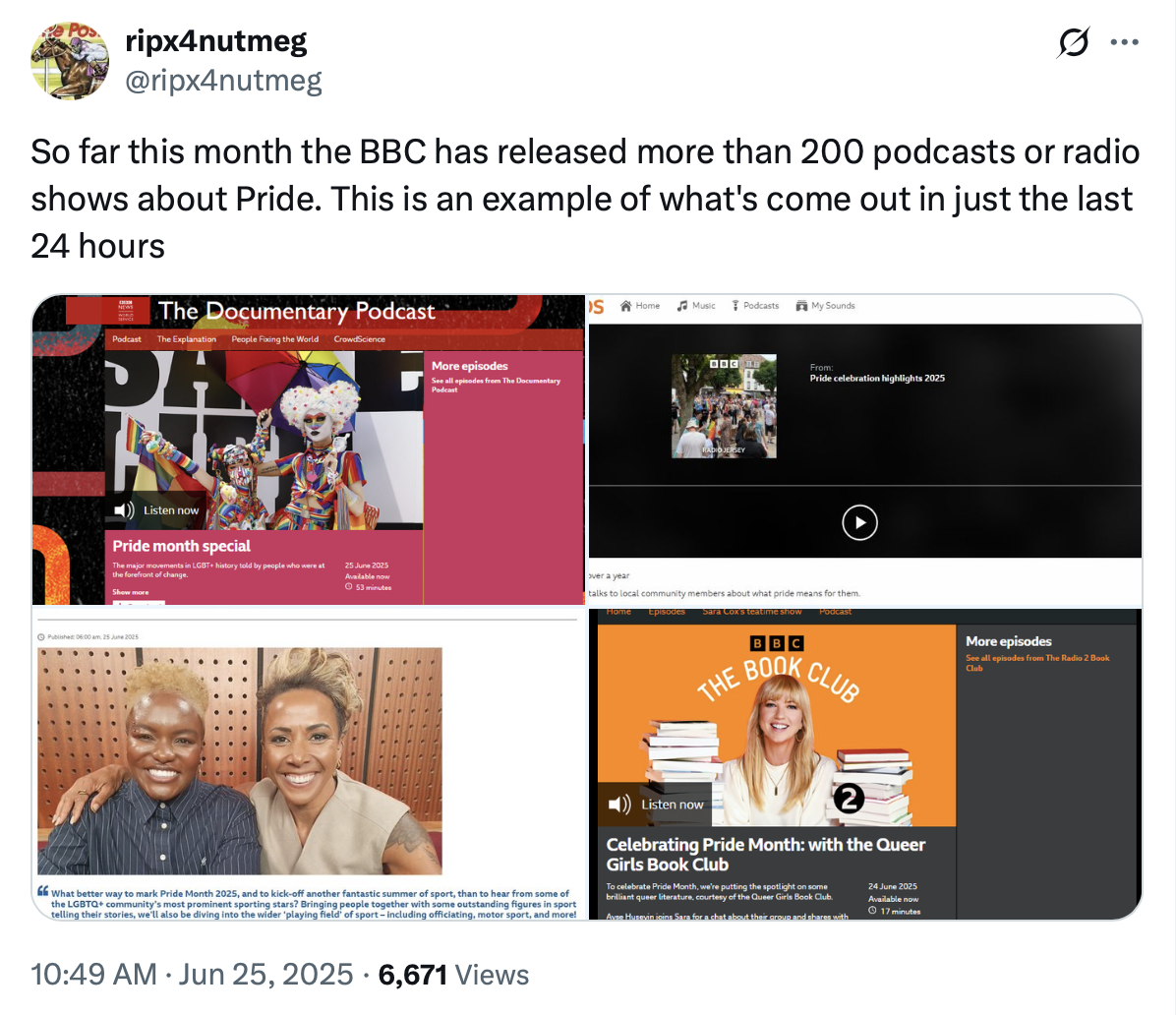
The BBC had published over 200 pieces about Pride month.
Etc, etc.

*Could have just said 'trans woman.'
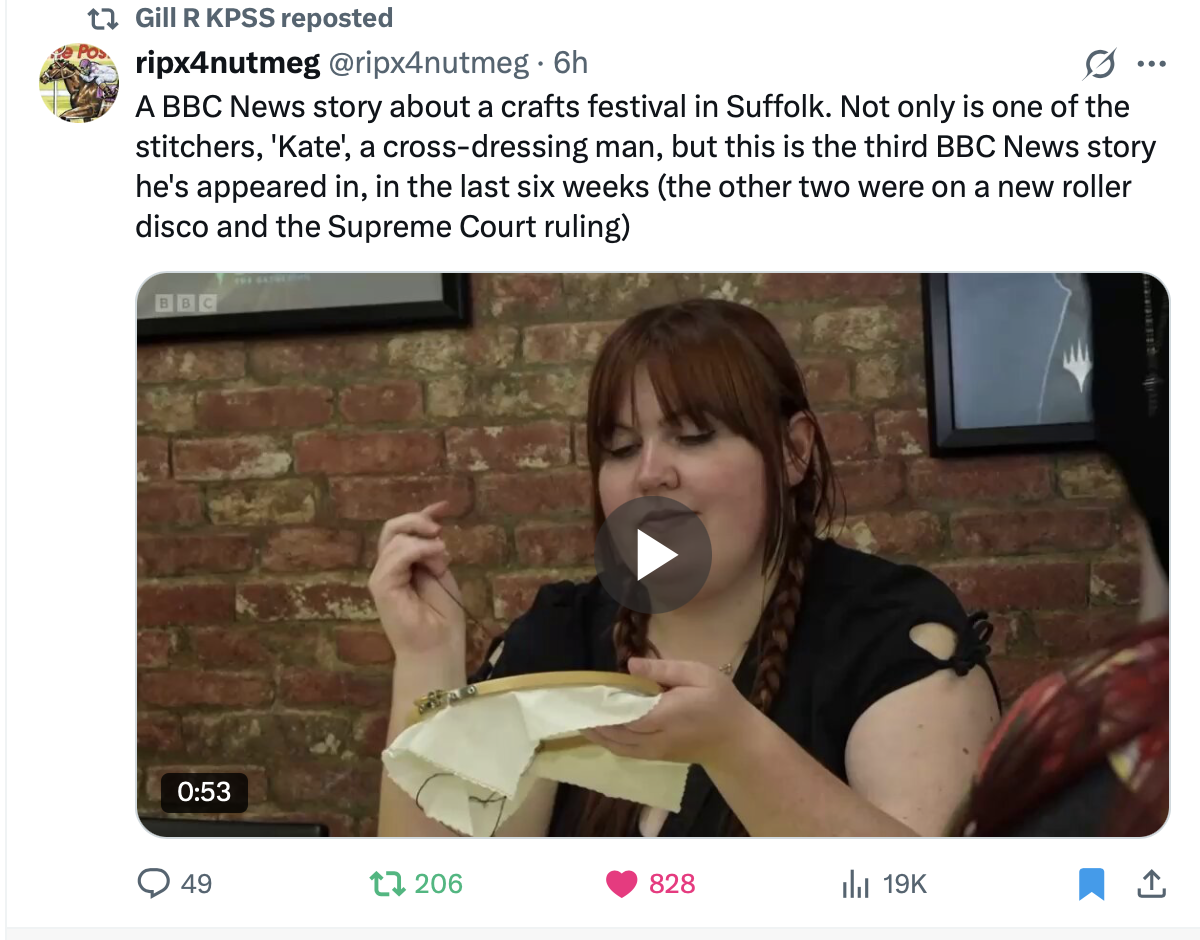
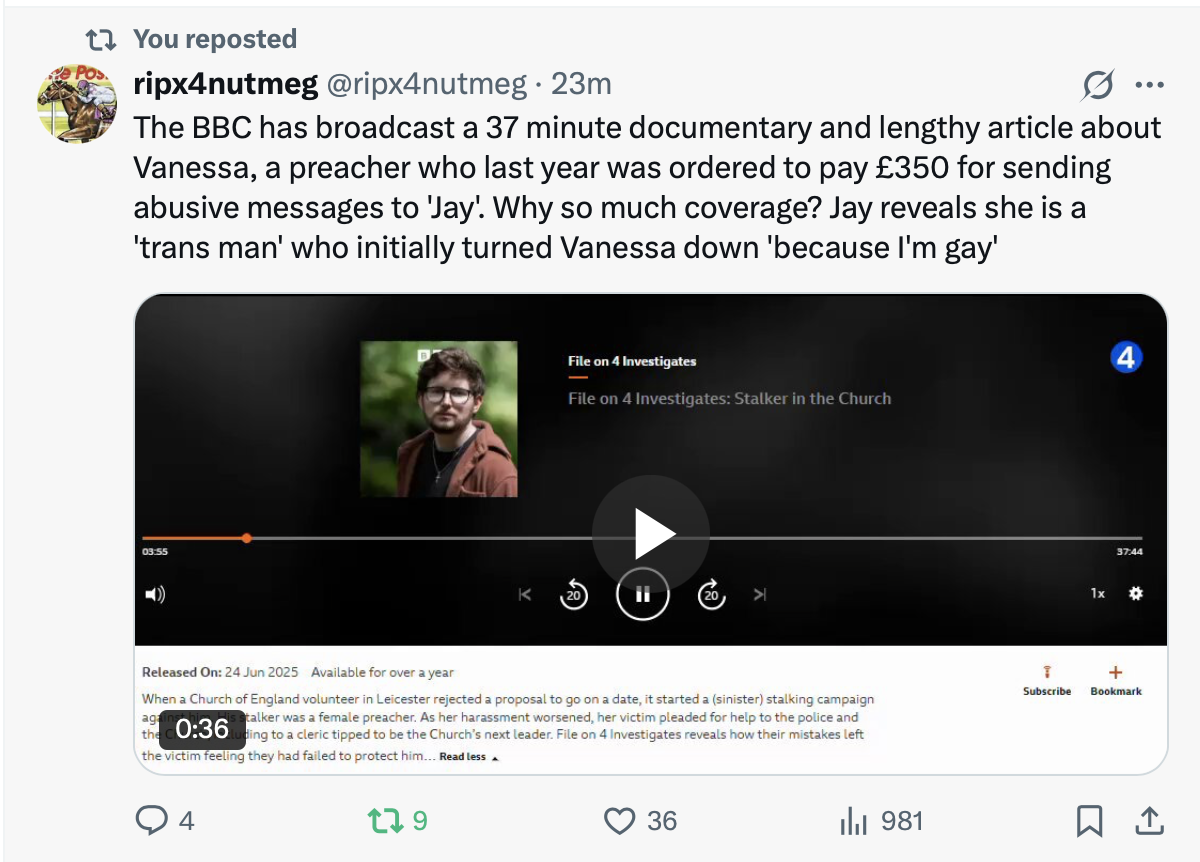

Nat Thorne, who told us she was 47, had been through homophobia and transphobia. First as a ‘gay person’ and now as a ‘trans person’. The fact that she didn’t say lesbian, nor seem to realise that she had eradicated herself as a same-sex attracted woman in favour of trans, wasn’t lost on me. She had ‘literally’ been called a paedophile and pervert attending protests for both these issues and experiencing the mental torpor of not having her identity believed-in, all over again.
Playdon claimed that being trans had always been understood to be an intersex condition. Apropos of nothing he also mentioned the Third Reich and death in concentration camps. (In February 2022, Playdon gave an interview to Mermaids, stating that there was a ‘trans genocide’ in the UK, 1970 – 1996.) The crossover point of homophobia and transphobia was that of the crossdressing feminised male, in particular, the case of April Ashley, who had apparently been described as a male homosexual transsexualist. Playdon claimed that prior to Ashley’s case, trans people could easily change sex markers on legal documents, including birth certificates, access elective surgical care and live in ‘complete legal equality’. Post the Ashley case, trans people could no longer alter birth certificates. Trans people also had to ‘out’ themselves for two years in order to access ‘healthcare’.
Playdon told us in the past that drivers licences were secretly coded so that police could tell when a person was trans, which clearly contradicted the point he was trying to make, i.e. special treatment was already being granted for these men, well in advance of the Gender Recognition Act. He also alleged that ‘trans women’ had been raped in male prisons, by prisoners and guards alike, and that these rapes were not considered crimes. The Crying Game had also legitimatised violence against trans people. Meanwhile, the NHS had imposed compulsory sterilisation on trans people from 1970 to 2004. His very next point was to claim that the Cass Review, which was set up in part to look at the clinical use of gonadotropin-releasing hormone analogues (known to cause sterility), had restricted healthcare to ‘trans children’ and that the Supreme Court was seeking to ‘roll back’ trans human rights. Thus, a new period of structural inequality and transphobia was commencing. In short, Playdon was arguing that trans people had always had it worse and were still having it worse.
Collins then interjected to talk about ‘queer men’ in 1950’s Britain and the reason why he was doing this session (presumably he didn’t mean men with blue hair). Referring to the Wolfenden Report of 1957 and the background to it, he felt it very resonant to the culture war right now, inviting us to comment via the app. Parallels included similar levels of public controversy, fears about numbers, social contagion, competing political pressure groups, fears around public toilets, fear of sexual deviancy and discourses around vulnerable people who need protection.
Differences included everyone was a homophobe in the 50s by today’s standards. Also, men who engaged in homosexual activity were imprisoned, even for private acts. Those arguing for reform in the 50s were heterosexual and largely men, claimed Collins, thereby conceding, albeit indirectly, that today there are lots of trans activists. There had also been no ‘homophile’ organisations. The only ‘out’ men were those who had been prosecuted. Opponents of homosexuality were intent on eradication, whereas transphobes just wanted to ‘circumscribe’. Another difference was the lack of feminist input in the 50s debate.
Collins thought the current fear was that a proliferation of identities would undermine social cohesion.
The Charing Cross Clinic
‘What were our experiences of fears around sexuality/gender identity?,’ Power wanted to know from us, but Collins interrupted her, asking Playdon to explain why there was ‘compulsory sterilisation of trans people,’ instead, neatly setting the tone for how the audience might answer (i.e. massaging allies, riling terfs). Playdon repeated the lie that until the late 60s, being trans (as it wasn’t known back then) was considered a natural variation of human development – an intersex condition, no less – and were granted ‘elective medical care’ (rather than a cure for homosexuality). Meanwhile, in the US, psychologists had an evil scheme to categorise trans as a mental illness, in the same category as homosexuality. The first gender identity clinic was opened in 1962, Playdon said, to cure ‘trans people’. In 1969, at an international symposium held at the Piccadilly Hotel, the idea was imported into the NHS via a takeover bid for NHS care. Playdon claimed that there had been multiple services available in the NHS at the time, which then became centralised at Charing Cross Hospital under the auspice of Dr John Randell (the psych who appeared only off-camera in A Change of Sex). It’s true that Randell ruled with an iron fist, and was a secret crossdresser himself, but Playdon’s claim that Randell forced men to have surgeries they didn’t want is not correct. Rather, patients under his care desperately sought these surgeries and it was his power to either grant or deny them. Playdon however claimed it was ‘unconsented and compulsory’. He said the numbers were not known because no records were kept.


According to trans blogger (see screenshots above), Randell did keep an eye on numbers, and treated around 2,500 patients, who were likely seeking surgery.
Audience discussion
One man commented that fear of gay men related to sexual advances but didn’t really see that parallel with the transgender controversy. Collins explained to him that women were worried about ‘trans women’ taking sexual advantage of them in single sex spaces, proving he fine well understood the gender critical position.
Another pointed out that children were still being treated with puberty blockers, despite the Cass Review recommending against them due to adverse effects on brain development. He also pointed out there were trans people in the media, including a TV show, shown in May on the BBC (I Kissed a Boy), which featured a trans-identified female. Power disagreed and said that a study was needed.
Nat Thorne jumped into say if she had known about trans when she was a child, things would have been drastically better for her, vehemently denying there was any medicalisation of children and that it was ‘illegal’. The man pointed out the ban had only just come into effect. Thorne retorted that puberty blockers had been used for many years with no deleterious effects. Playdon interjected, he knew Polly Carmichael from the Tavistock well, having been on the same parliamentary committee as her. Unfortunately because the Tavistock was so underfunded they had never been able to run a proper study.
Playdon continued that the Cass Review had been very contentious as it was ‘ahistorical’, having not taken into consideration the ‘past history of trans healthcare for kids’ and that it ‘ignored a gold standard in healthcare’ (presumably referring to the standards set by the nutters at WPATH). It had also been criticised as ‘methodologically inappropriate’, had ‘openly misused data’, had ‘rested its conclusions on speculation’, ‘repeated spurious claims about trans people’ and ‘conflicted with the norms of clinical-based research and healthcare’. Its upshot was to ‘restrict healthcare to trans children and adolescents’. Parents had been warned that if they took their children abroad to access puberty blockers, they could get reported to social services. Good.
A trans ally talked about nefarious persons controlling social media. Thorne said that social media was a bad thing, as terfs could instantly find other people who thought exactly the same as them, providing a safety net and community hub for them. For example, on Mumsnet, other mums might tell the parent of a trans-identified girl that she was ‘just a bit boyish’. What a hotbed of hate, eh?
An older gay man made the point that although things were much better, homosexuals still had to come out, and that covid had proved that going against the grain was difficult – this was what it was like back in the day. People did have a disgust about gay sex. However, having questions and concerns about transgenderism did not equate to a phobia.
Someone had posted a comment, pointing out that ‘trans’ was a nebulous term – what did it mean? And, what was a transphobe? People who actively hated? Or, people who held differing views? Collins wanted to take this into consideration and admitted that it was true; there had been trans people who had acted in a predatory way. But there were also comments from allies, which argued that worrying about women’s safety was ‘paternalistic and anti-feminist’ and ‘denying the agency of women and children.’
Hopes
Playdon’s topic was ‘hopes’. More interminable guff, this time on the Boy Scouts and eugenics. Harrods sold heroin in the First World War. Playdon gave lots of factoids like this, finally getting onto the Lavender Menace, which was slightly more relevant but I still have no idea what he was wanging on about, other than to imply a trans genocide. Again.
In 1996, employment rights were ‘reclaimed’ for trans people (i.e. the case he bought as ‘P’), ditto the GRA a few years later, ‘regranting’ the right to marry, etc. Anti-gender funding totalled $707M per year during the period 2009-2018, from right wing and religious groups. From 2015 onwards, gender critical activism spread via social media, these people were ideologically driven (natch) and ‘anti-scientific’ (?). Gender crits wanted to remove the autonomy of trans people, spread disinformation and manufacture doubt. They also create media pile ons and troll to silence any opposition. It was effective, as in 2019 the government shelved its LGBT Action Plan and dismissed the committee which produced it. In 2024, the Cass Review curtailed kids access to trans affirmative healthcare and Playdon repeated his falsehoods on it. He then turned his attention to the Supreme Court judgment, which he said established ‘a new set of criteria for distinguishing trans people from cis people’, and, of course, ‘reducing their human rights’. Anti-trans people had an obsession with toilets and ‘trans women’. What was behind all this? Playdon asked hypothetically. A nice little hobby for lonely, socially isolated people, to join a community which had a simple target and to gain a sense of themselves, he said. It’s fair to say a few of us laughed at that.
Responses to Playdon’s comments on the Cass Review
Collins allowed us a right to reply. One man said Cass had been a comprehensive paediatric review of children with gender dysphoria and that he was concerned about such children who may decide to take puberty blockers and/or go onto cross sex hormones. There were many cases of children having done this and regretted it and he was concerned about Playdon’s dismissal of a serious review proving harm was being done. A trans ally responded: What about if you told a gay child that they would be harmed if they were gay? Isn’t that the same thing? No!, said several of us, we do not medicate gayness anymore. (Except we clearly do, and this would have been a perfect time to say this.)
Thorne jumped in to say that children weren’t operated on under the age of 18 in the UK, despite the point being about drugs, and that you couldn’t get surgeries at all until you were 25-26*, unless you went privately. Regret rates were minuscule. In the NHS clinic Thorne works at, they monitor the regret rate every single month and they have ‘very, very, very few’. Unfortunately the press had over-promoted people who had regrets. She found that regrets often resolved over time and were largely due to external pressures, i.e. the media, etc.
*I looked at the clinic Thorne works at, which does not confirm there is any such age limit. Patients can be admitted onto the waiting list for the service once they have had their 17th birthday.
A woman pointed out that there were now thousands of people had identified as trans, who no longer did, having had unsatisfactory surgeries and medical treatments, – were they also transphobes? Thorne pivoted away from the question – where was the data proving these people existed? she demanded. Playdon interjected to tell us that the regret rate for men who have prostate surgery was 14 percent, whereas the regret rate for ‘gender affirmative surgery’ was 2 percent. (Regret rates for prostate surgery relate to poorer urinary, sexual and bowel function, so it’s amazing that losing your entire reproductive organs could result in a lower regret rate.)
Another person took up the point Playdon had made about the men seeking treatment at the Charing Cross Clinic – surely they had put themselves there? It was not like today. The point is, the point is, Playdon flapped, they were operated on without their consent. Which clearly contradicted the point just made that the regret rate was a measly 2 percent. No records were kept, said Playdon of the Charing Cross Clinic, so we don’t know what the regret rate was.
Then a young woman trans ally, told us that it cost 20 grand to have a double mastectomy and you were bedridden for a month after surgery (neither of which is true, you can get them as cheap as £6,000 in Poland and you should be ambulating pretty quickly, though clearly sleeping position is affected for a good while) and that it took five years to get hormones. She rubbished the idea that gender critical people in the room cared about trans people. Being trans was harder than being gay or queer because of the medical necessity aspect. There was a higher rate of Harry Potter tattoo regrets, than there were of trans affirmative care, she quipped. Terfs and trans allies alike laughed at this.
Another gender crit took up the point about the lack of data; which was why we couldn’t say with confidence what regret rates were. Playdon jumped in again, the Tavi didn’t have the resources to do a longitudinal study and pulled a sad face. Why then, the questioner wanted to know, when Cass had the money and Parliament changed the law so that all the adult data could be followed up, did so many of the consultants who worked in the GICs refuse to contribute data? Thorne claimed that the ethics in the study didn’t meet the normal standard, e.g. data protection. Also: the manpower needed to provide the detail made it impossible, plus there had also been no provision given for data analysis and who would pay for the qualifications of those people doing the data analysis in the clinic? (Surely, Cass’s team would have done that?) You couldn’t just dip into data in the NHS and hand it over willy-nilly, Thorne warned.
A trans ally said the conversation thus far had reminded him what homophobia and transphobia had in common, i.e. the conversation about protecting children was mainly a specious one. He was frightened a new Section 28 was on the way and that J. K. Rowling and others weaponised the community against itself. What could be done?
Thorne said that most transphobes were really concerned about trans adults (I think she just meant to say ‘men’) but went for the ‘low-hanging fruit’ of children instead, who could only socially transition at the moment. Power just wanted to make life better for people.
Who are the phobes?
Thorne didn’t want to use the word ‘transphobes’, rather ‘people who have bad feelings towards trans people.’ She found it difficult to define and claimed to understand the criticisms. Homophobia was more obvious to spot, said Thorne, forgetting that she had once identified as a lesbian. Like Power, she believed that the problem was that gender critical people in the room hadn’t had enough exposure to trans people and thus had followed ‘the dominant narrative’. Confirmation bias was also a problem and it was much easier to find thousands of people to agree with you on social media, whereas in the days of homophobia it was probably just at church. At the moment it was very hard to change someone’s views and ‘a doctrinal problem’ on the behalf of people who didn’t believe in gender identity.
Thorne also blamed trolls who fed off negative attention, not necessarily anyone in the room, but that subset did exist, who just liked arguing. Revulsion about the various medical procedures was similar to the revulsion that people might have about gay sex. Thorne didn’t feel that she was perverted, wrong or weird and the reasons why she wanted to do (unspecified) things to her body, was personal to her (though I highly doubt she is planning for a phalloplasty somehow, aged 47).
Gender crits used arguments which had no internal consistency, for example, Thorne keeps on asking everybody: How many transgender women were arrested in toilets for sexual offences last year? The answer; a big fat zero. How many cis men did the same thing? Many, she said. Which meant any cis man could go into a women’s toilet now and just say he was a trans guy. (Or, alternatively, he could just say he was a woman?) So we didn’t need to police toilets. If we really wanted to stop the abuse of women, we should ban heterosexual relationships! Thorne just hoped that one day she would get her rights as a trans person and that they wouldn’t be taken away.
Power said you could only move The Window if you didn’t treat everyone as your enemy. There were a lot of people who had read things about how awful trans people are and we know that such views had influence. Unfortunately her next examples, that she had been on a Pride march the weekend before in Cardiff where families with small children waved trans flags as the parade went by, and that most people just thought it was a silly argument, did sort of contradict this.
Collins read out more dissenting comments from the online platform, this time being openly dismissive. The mood in the room began to shift. The man who had posted the comment responded directly to him and Collins quickly corrected his attitude, but the mask had slipped, I think.
A trans-identified male spoke up to say that there weren’t loads of men exploiting gender identity to abuse women. When lesbians made ‘transphobic comments’ to him, he would remind them that before Lucy Letby, there had been Beverley Allitt, who was a lesbian. Did that make all lesbians child killers? He had always wanted to challenge gender norms and gender restrictions, and finger-pointed homosexual behaviour as a case in point. Why couldn’t we stop policing people?
A gender crit made the point, that yes, there were definitely people who hated trans-identified people, just because they were trans, but what had J. K. Rowling actually said that could qualify as hateful? He had previously been involved in LGBT activism, working with transsexuals seeking acceptance and help with their gender dysphoria, but there had been a dramatic shift in the politics since then, and it had become untethered to the reality of biological sex. Furthermore, the fact that no one could give a definition of transphobia was problematic and talking about when sex matters shouldn’t be stifled or labelled as hateful.
Misquoting him, Thorne responded that he had hit the nail on the head when he said he didn’t know many trans people and that we knew so much more about gender identities now. She also told him he had a learning curve and a very black and white view of trans people. Playdon said the appeal to biology had a very poor history because of eugenics and that the sex categories of male and female was ‘scientifically illiterate nonsense’, and, in terms of the law:
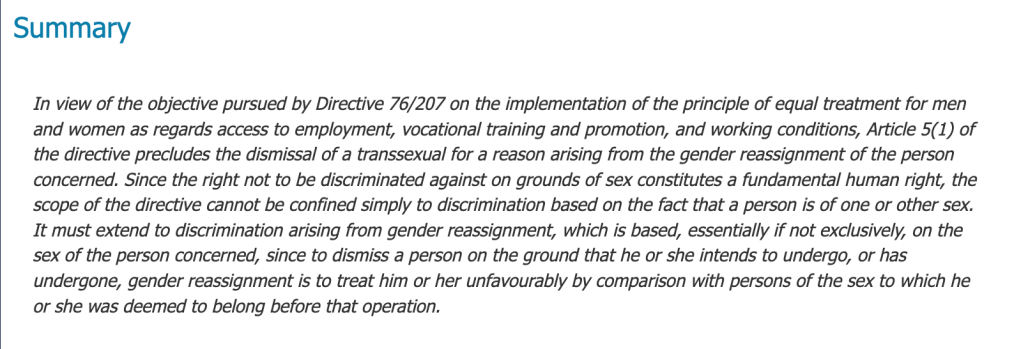
In terms of the law, from 1996 onwards, the European Court of Justice said, and I’m quoting here, that the woman who erm er got, the woman who erm got employment rights back for trans people, they said he was ‘female, regardless not only of her original sex, as it appears on her birth certificate, but also the moment at which, as a result of the primary surgical operation, successfully changed her physical sex.’ In other words, legally, trans women are women from birth. That’s it. Not me. The ECJ, 1996.
Playdon talking about his 1996 legal case. Again. And accidentally correcting sexing himself in the process.
Playdon said he was quoting, so I searched the judgment for those words and – guess what- found no matches. The judgment summary is as below and starkly different.
Thorne wanted to know if it was found that there was a biological origin to being trans, would that change opinion? She believes herself to biologically trans and that no one could tell what her chromosomes were.
Another trans ally felt that transphobia was worse than homophobia, as the attacks were coming from within the LGBT community and outside of it, whereas that wasn’t true for gays experiencing homophobia. Thorne bemoaned that she couldn’t go to some of the LGBT spaces she used to, because she felt like she didn’t know her own community in those spaces and was uncertain how a gay person might treat her. Unless the venue states it is explicitly trans-friendly, it worries her. It was a shame that I have to live with that fear, said Thorne, sounding jubilant. Playdon repeated his false claim about funding – the money had bought an awful lot of disinformation.
Another gender critical man said we needed to acknowledge that we were all male and female but was rudely cut off by Thorne, who guffawed and said that one in one hundred births resulted in an intersex individual. When she was disagreed with, she turned to ridicule and starting giggling and the discussion dissolved thereafter.
Another trans ally expressed their sadness that there were homosexual people who weren’t supportive and that those of us who had expressed such views, didn’t have the data to support our views, nor the lived experienced, or were just following the media agenda. We all had to stand together because we were only one community, even if we didn’t understand the issues. That got a round of applause.
Collins appraised the session; there had been a good deal of understanding and respect up until the final moments. He knew it was a difficult discussion. Had anyone changed their minds? Predictably, no one had, we were all more entrenched, in fact. Thorne, now in her element, opening smiling and laughing, repeating more or less what she had at the beginning of the session, that transphobia was ‘so much more complicated’. Power, in a pointed dig at the older gay men in the room, warned that some people just turned into their ‘bloody grandparents,’ which had the derisory effect she wanted.
So much for respecting to your queer elders, eh?
Conclusion
I genuinely don’t know if this event proved we have to get better at challenging these people or whether it is pointless engaging with them. I’m inclined to think the latter, though I would like to think that at least one trans ally came away with a seed of doubt planted. It is also worth pointing out that two days after the panel was held, trans activists, calling themselves The Dyke Project, attended a gender critical event at UCL (not run by the Lesbian Project, as they claim) and behaved like this – stealing bags, honking horns and generally acting like arses. This is what these people do when they attend our events.
Thank you for reading! Sign up to my blog by going to the bottom of the page.
Please share on other forums if you liked it, as I only do Twitter.
 The Lies They Tell
Thank you, as always. I’ve not got round to contacting you previously, for which I apologise – I really appreciate your work.
Alice
LikeLiked by 1 person
“…main gender critical presence came from a bunch of gay men, sick of hearing about the trans, which perhaps explains the tolerance of dissenting opinion.”
Of course. The only opinion that counts.
LikeLiked by 1 person
Thanks for the comprehensive summary of this event. I was at the event and made the point about data that you reference; as you imply, Thorne’s response was evasive and delusional self-justification.
I have a slightly different perspective on the purpose of attending such events.
It is indeed hard to challenge a panel of ‘experts’ who are steeped in the arguments and data that support their case, and can quote it instantly and ad infinitum. I doubt we can counter that when it’s not the driving force and essence of our lives.
The purpose for me is to remind them that gender ideology is contested and arguable, and that it isn’t accepted by everyone just because we are supposedly part of a ‘community’. (Whether such a community actually exists was being debated forty plus years ago when I came out… and it was much smaller and less ‘diverse’ then!)
The last person to comment from the floor said that she had been expecting to come to an affirming and uplifting event, and was disappointed and depressed at how much questioning and disagreement there had been. My instant thought to that was: ‘good’!
LikeLiked by 1 person
Thank you for your comments. Yes, let’s hope that at least someone there from the trans ally side has second thoughts!
LikeLike