
Did you know that Cleopatra lived eleven hundred years before the term ‘woman’ existed? And that children were transitioning in the 1930s? Prepare for a real history lesson.

The blurby bit
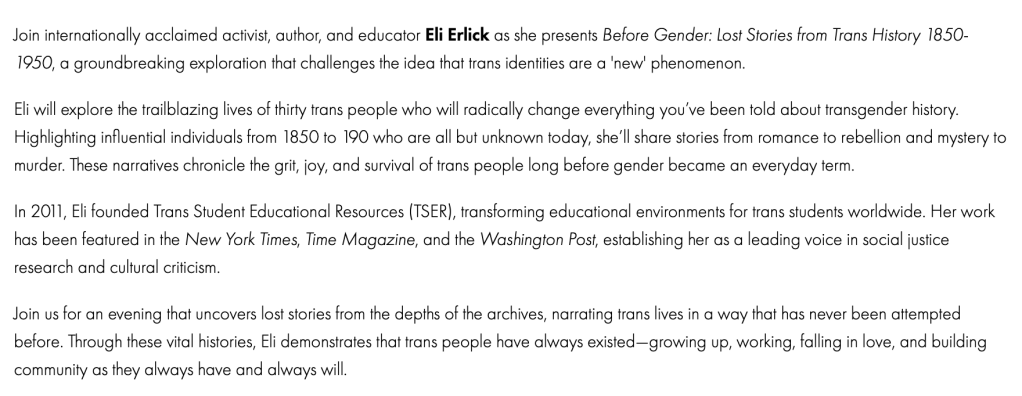
About Eli Erlick
Those who have been around since the Trans Tipping Point will remember Eli Erlick’s signature look back then, when he proudly sported a T-shirt emblazoned with: ‘I support women and cis women.’

Erlick was born in 1995, making him 30 years old at the time of writing. In a blog published in 2013, he claims to have came out as transgender aged 8 (which involved wearing dresses and make-up to school) and that he independently coined ‘transgender’ before he even heard the word. Kim Petras became an inspiration when Erlick heard he was getting surgery under the age of 18. Erlick’s mom was a doctor and helped research the topic and, shortly after his 15th birthday, he began taking taking estradiol and spironolactone (female hormones and male hormone blockers). He also apparently benefited from a late puberty and changed his sex marker on legal documents. He claims underwent surgery aged 17.
According to the Wikipedia entry, in 2011 (aged 16), Erlick co-founded the Trans Student Educational Resources (TSER) and thus partly responsible for the gender unicorn infographic (a complete and total rip off of the genderbread person), a fact of which he continues to be proud. A ?former/current TSER volunteer, who describes herself as a ‘non-binary person of color,’ made claims of sexual abuse, including that Erlick would not allow her to take testosterone because she would not be attractive to him if masculinised, and bitterly noted that other masculinised trans-identified females had been his lovers. I note today TSER does not currently mention Erlick by name in its ‘about’ section.
In August 2022, Matt Walsh and Libs of TikTok reported Erlick to the US Drug Enforcement Administration for illegal distribution of cross sex hormones (see Fox article and Daily Wire report) following the discovery of a YouTube video (now made private but captured by Genevieve Gluck – here). In response, Erlick doubled down and boasted of his acceptance as a PhD candidate at the University of California Santa Cruz. He was never investigated.
In more recent times, he has had a book published on the nebulous topic of trans history (the subject of this talk) and completed his dissertation on ‘disrespectablity politics’ (sounds riveting) as part of his PhD in feminist studies.
I can well believe that Erlick started on hormones aged 15, judging by the sophistication of his humour.
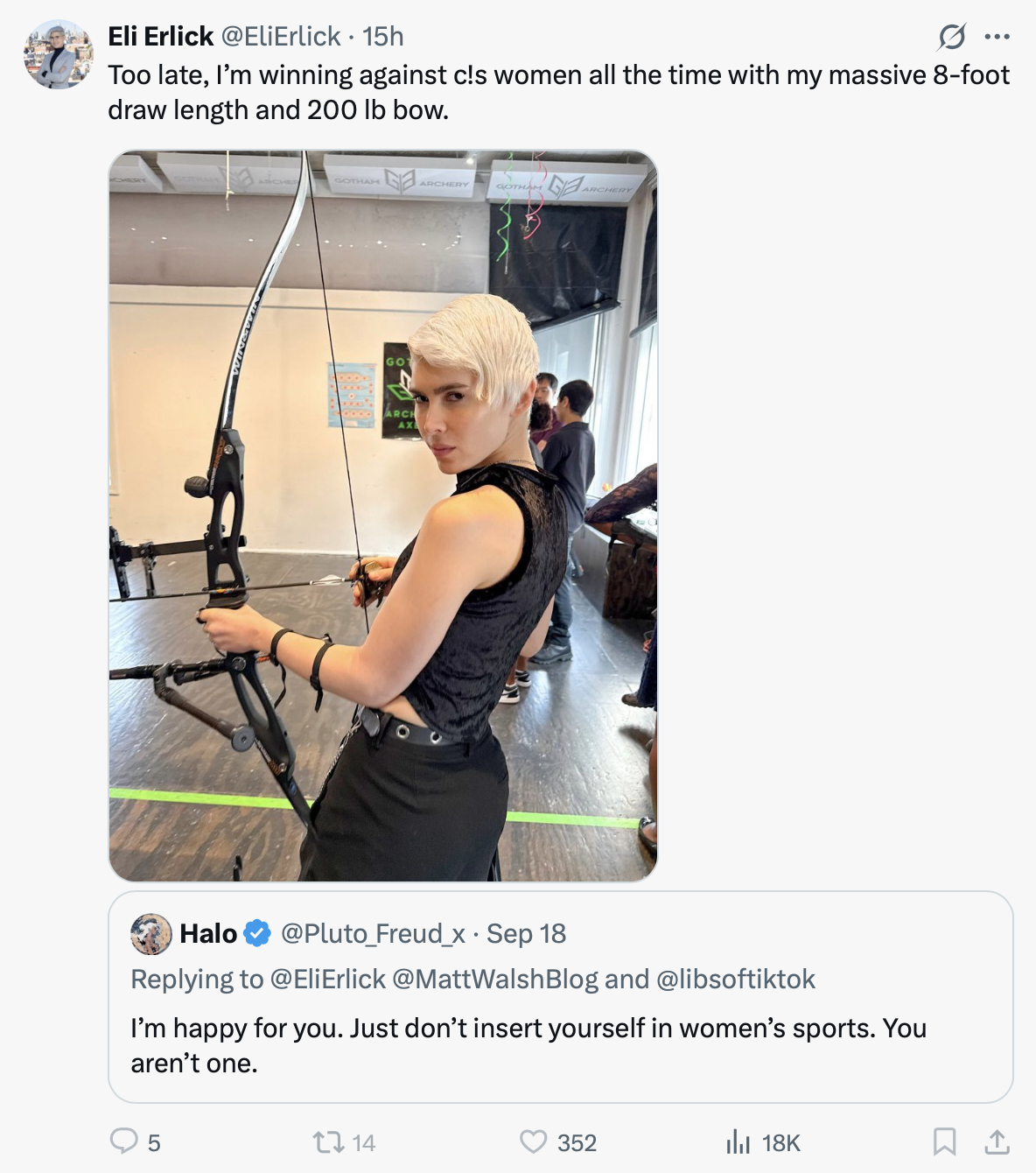


You can read the AOL article about the archery here.
The book – Before Gender Lost stories from trans history 1850-1950
Who better then, to be rewarded with a book deal from Manchester University Press? MUP claim that their publications go through ‘at least two external scholarly peer reviews and guidance from our editorial Committee’. Hmm.
Discover the trailblazing lives of thirty trans people who will radically change everything you’ve been told about transgender history.
Highlighting influential individuals from 1850 to 1950 who are all but unknown today, Eli Erlick shares thirty remarkable stories from romance to rebellion and mystery to murder. These narratives chronicle the grit, joy and survival of trans people long before gender became an everyday term.
Organised into four parts, paralleling today’s controversies over gender identity – kids, activists, workers and athletes – Before Gender introduces figures whose forgotten stories transform the discussion. These ground-breaking histories include two of the first teens to access gender-affirming medical treatment, a countess who instigated an LGBTQ+ riot forty years before Stonewall and the greatest female billiards player of the 1910s.
Bold and visionary, Erlick’s debut uncovers these lost stories from the depths of the archives to narrate trans lives in a way that has never been attempted before.
Book blurb
The interviewer
None other than Mr Cotton Ceiling himself, Morgan M. Page, interviewed Erlick, harp in background, describing himself as a ‘gal about about town’, Erlick as a ‘shit disturber’ and us as ‘folks’.

Page has been aware of Erlick since before the Trans Tipping Point but this was apparently the first time they had ever met. Despite Page being a budding historian himself (see podcast One From The Vaults) there were a lot of stories he had never heard before in Erlick’s book, which was very impressive because he spends all of his time reading.
The interview
What was the genesis of the book?
Erlick wrote the book in response to the current attack on trans people, particularly trans youth in the US and UK (the medical transition of which turned out to be the overriding theme of the conversation). He chose the stories according to how useful they would be in providing counterpoints to arguments presented by the gender critical movement. So, not at all cynical then. The stories Erlick focussed on was of ‘trans youth’ accessing medicine in the 1930s and two ‘queer riots’ which predated Stonewall by decades.
It is claimed by detractors, like Trump, etc, that trans is something new. What are your thoughts on contradicting this?
Erlick claims that in Berlin, in the 1910s, trans people had become so numerous there had been a similar moral panic over their existence. It was a not new thing. Naturally Erlick didn’t provide the deets but did mention the name of Gerda von Zobeltitz (phnarr), who he had devoted a chapter to.
(It turns out that Zobeltitz was one of Magnus Hirschfield’s first transvestite patients, by no means undiscovered, since this subject has his own Wikipedia entry, created in 2023 following a Munich exhibition of ‘queer lives’ in which Zobeltitz had featured. And interestingly, men in possession of a warrant (Transvestitenschein), allowing them to crossdress, also rendered them automatically ineligible for conscription. Zobeltitz was an impoverished aristocrat, who had crossdressed during childhood, perhaps in response to the whims of a violent father, including making his own dresses, eventually becoming a tailor. Not that Erlick managed to mention any of these interesting facts. I’m sure it’s in the book.)
Erlick was eager to return to the now and the transitioning of minors, referencing the governor of Utah who had said that hormones were harmful, only for the commissioned study to apparently contradict this claim. As a result the governor did not bring in the restrictions on minors transitioning, listening to the ‘evidence’ instead, but ultimately overruled by state congress. Trans people could use history to push back against such false narratives about the community. Page congratulated Erlick on how well the book had been organised to facilitate the trans activist argument.
How did you find the stories?
‘Long and daunting,’ said Erlick. News archives, sexological texts and census records were all utilised. Once he found a story which met his criteria, well then, he had a subject!
Nothing like cherry picking the data, is there?
News coverage of trans people in the past was a lot kinder than it is today, however journalists were known to make up information or exaggerate stories about trans individuals. Also trans people might have told different stories about themselves to escape punishment/make themselves understandable. In light of that, how did you figure out what’s the truth and what’s not?
Oh, Erlick used as much evidence as he could gather! The 1870s was notorious for yellow journalism, where hacks would make-up sensationalist stories. Often these stories were about trans people (and not the Spanish-American war). An example of lying on the part of transgender people, was that they would claim to have an intersex condition (i.e. the claim that they had been born with a female brain in a male body, vice versa, as per the transvestite mantra back then).
Back in the day it was ‘mostly it was the young white trans boys who were celebrated,’ said Erlick cryptically, ‘whilst everyone else were thrown under the bus as deceivers.’ Page effusively reflected that chaps like themselves were moving away from the patriarchal system and the victims of it (ergo, *TIFs not so much).
*Trans-identified females always get a double dose of misogyny, don’t they?
How do you ‘clock’ trans people in history?
Simples, just look for the big feet, head tilts and cow-like stares into camera. Should have been the answer. Instead Erlick explained he looked for people who had declared themselves to be of the opposite sex and crossdressed. ‘Intersex people’ were excluded because they were not useful in undermining the right wing arguments Erlick was setting out to challenge. Erlick refers to the problem (of correctly ‘clocking’ trans people) as ‘the Cleopatra problem’ because ‘how do we know Cleopatra was a woman?’ (Well, she had babies for a start, dipshit. Four of them.)
According to Erlick, Cleopatra was born ‘eleven hundred years before the term woman even existed.’ We know that Cleopatra was a woman, said Erlick, because she fulfilled a cultural role and fulfilled certain cultural expectations. Erlick had never heard anyone argue that Cleopatra wasn’t a woman, so why were we treating trans people the same way?
Erlick claimed that trans-identified people were subject to more regulation whilst also admitting (more or less) that it was semantics and trickery. By ‘following the Cleopatra problem’ we could clearly see that ‘trans people were trans, before the word trans exists.’ Page agreed, cleverly pointing out that the word ‘heterosexuality’ was coined in 1869, but heterosexual people had existed way before then! No one was questioning that! It was just LGBT identities which were questioned historically.
What do we do with difficult cases?
In terms of the book, Erlick mostly threw those cases out. Unfortunate as he had ‘found hundreds of people’ who would have fitted his criteria (a contradiction in terms, surely) but which didn’t have the impact he was looking for, nor were they revolutionary enough (too many white trans men, ’nuff said). Anyone who had ‘detransitioned’ was automatically excluded (but it’s nice to know they were so plentiful).
What is your favourite story in the book?
Gerda von Zobeltitz for his involvement in an amazing Berlin riot in 1930. This was the earliest known queer riot and had remarkable similarities to Stonewall (in that all the participants were drug-addled prossies, I bet). The riot disrupted the notion that queer and trans people had not resisted before, which was something Erlick’s often hears. Weirdly, only one paragraph had been written about the riot in English and the newspapers documenting the event were all burned by the Nazis three years later. So, I’m not quite sure how Erlick managed to learn about this momentous event, in which trans and queer people had broken beer steins over the heads of the Nazis with gay abandon. Erlick found this ‘really beautiful’. Not to mention made-up. Erlick had also discovered a riot in Tokyo, which strangely also only had one paragraph written about it in English before. (Fluent in Japanese as well?) Tokyo was 1938 and involved the obligatory group of trans sex workers.
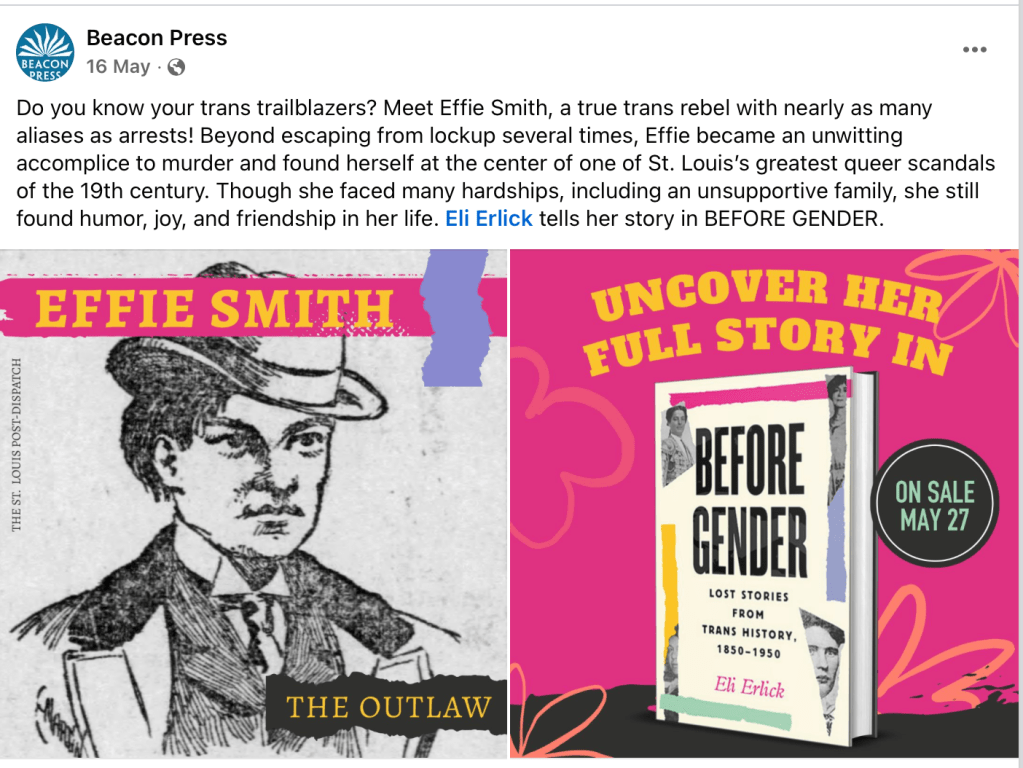
Stefan Pekar was a trans man athlete, who transitioned late in life and after two other peers. Thus, when Pekar transitioned, people weren’t really interested. In fact, so many athletes in the 1930s transitioned, it was considered pretty mundane, said Erlick. No, what he found more interesting was the juicy gossipy stories, like that of Effie Smith, a trans woman outlaw from St Louis, who used to meet with his compatriots in a sex dungeon in downtown St Louis. (Now that I can believe.) Ooh, the book’s so readable, squealed Page, in response to this tidbit.
I’m very worried about the revision of history which is going on at the moment, said Page. The ‘Stonewall historic website’* had recently had to remove the words ‘transgender’ and ‘bisexual’. Where did Erlick think this was going?
*Eh? There is no such thing.
Erlick wasn’t sure what could be done to ensure that trans people weren’t historically erased again. Things were dire in the US, funding for trans studies was being cut and trans professors were being fired. It had even affected Erlick personally, as he had been told by academics that he couldn’t be a speaker on campus because he was trans, conveniently forgetting that this talk, hosted by Fane, was kickstarting his international book tour. (By the by, LSE’s gender studies department has promoted one of his book tour events on its events page.)
The fight back continued though, and Erlick knew of radical groups who were synthesizing their own hormones (eek!) and generous people were providing low/no cost care to trans people. The US had never been a democracy, said Erlick, but somehow Trump had made it even worse. Trans people had always found ways to exist, even under the most repressive state regimes. Today was a very different situation (as in worse), as there was mass surveillance and AI and more police than any other point in history. Not only that, but Erlick can’t legally use a woman’s restroom in Florida right now and that could potentially be an issue (or a wet patch).
Page commented that in the UK, the pushback was coming from both the left (not true) and the right (also not really true, if you consider Reform’s recent announcement on prisons, or the Tommy Robinsons of this world selective interest). Page described the online trans community as ‘vibrant’. Another good thing was that there were more out trans people than ever, which meant more people knew a trans person than ever before in recorded history (which rather undermines the claim that trans has been regarded as mundane and acceptable in the past).
You don’t shy away from a tussle with far right whack jobs but still keep your cool. How?
This was in reference to the spat he had with Matt Walsh and Libs of Tiktok regarding his illegal distribution of drugs. Erlick’s version was that he had been invited to take part in Walsh’s documentary What is a woman? but had gotten suspicious and had started warning others not to take part. According to Erlick, this greatly annoyed Walsh and then Libs of Tiktok came after him and ‘swastikas and mean letters [were] to my house.’ He made it sound like Walsh and Libs were a tag team. Of course, the truth is that Erlick had been exposed for his boasting in August 2022, three months after the documentary’s release in June the same year. Erlick wanted us to know that he actively enjoys their anger and their hatred, so I guess he was hoping they were secretly watching.
Page gave kudos to Erlick for appearing on Piers Morgan, referring to it as ‘good work’, but forgot to mention he merely turned up to debate fellow demented trans activist, Brianna Wu.
Page noted that Erlick had made a video bragging that he has sent copies of Beyond Gender to the schools of the children of the ‘far right whack jobs’ he detests*. Had there been any pushback yet?
*Which, if true, begs the question as to how he knows such private information.
No. Long story short, no one had noticed yet or had and couldn’t be arsed to respond, said Erlick disappointedly, so made up some shit about receiving threats for the upcoming book tour instead. Even he admitted that ‘no one has actually showed up and nothing has happened,’ qualifying this with ‘they always threaten but never show,’ but was hopeful for the UK events. Page said that anti-trans people in the UK do show up but in very pitiful numbers, like ‘five really annoying people standing outside the venue shouting.’ Although he had come across situations where people had planted themselves in the audience and then rushed the stage (I wish).
Tell us about your forthcoming book.
Erlick has a book coming out in 2026, currently moronically titled Belonging Through Exclusion: Understanding the Transgender Far Right, to be published by University of Chicago Press. Erlick had interviewed over a hundred trans people who had ‘far right politics’ (one suspects this is mainly persons who slightly baulk at mixed sexed sports, or have mild misgivings about child transition). Erlick claimed to have interviewed ‘neo-Nazis, trans acceleratorationists and eugenicists’. Angela Lynn Douglas was to be a big figure in the book.
I have never heard of Douglas before, but, according to Wikipedia, he was a transvestite activist, who, after infiltrating and being chucked out of the Gay Liberation Front in LA, went on to found the Transsexual and Transvestite Action Organization. Douglas ‘came out’ in 1969, had the snip in 1977 and by 1982 was back to ‘living as a man’, which I think says it all.
Erlick’s interest in Douglas was for his flirtation with US Nazi politics. However, there had never been so many far right transgender people than there was right now. Caitlyn Jenner, for example, was a Trump supporting bigot.
Page name-checked two trans bigots he knew from history, Violette Morris (a lesbian and wannabe female racing driver, who apparently had a bilateral mastectomy so that she could fit into racing cars) and Della Aleksander, a man with fascist leanings, who had ‘fought on the side of apartheid in South Africa’. Aleksander was also the founder of the first transvestite activist group in the UK, which Roz Kaveney had also been part of. Roz ‘hairy prongs’ Kaveney found Aleksander ‘very creepy’. Takes one to know one, I suppose.
Erlick bought up the example of Victor Barker, a woman who joined the National Fascisti (apparently because she saw such behaviour as typically male) in the 1920s. Britain seems to attract a lot of far right trans people, said Erlick. Page responded that Britain is ‘a very very conservative country unfortunately’.
People tend to think of trans people and history as liberatory, which is not really true, we’re complex characters and there are aspects of our community which are kind of shadowy, said Mr Cotton Ceiling.
What are your other future projects?
In New York City, Erlick was involved in setting up the first full service trans archive. New York had multiple gay archives but very few of these had collected anything related to trans issues. He would be working on this for the next year. He would also be working academically on ‘participatory alternatives to democracy’, which sounds a bit fascist, doesn’t it?
As a ‘special treat’ (are you listening laddies?) he would be publishing an article on trans men who have had British ballads sung about them. Which was a surprisingly high number, said Erlick, giggling.
Was there anything Erlick wanted to add?
Yes, the UK used to be the centre of trans medicine in the 1930s, including trans youth medicine. Lennox Ross Brewster (?) was a ‘trans surgeon’* at Charing Cross (‘everyone in Europe went to him, he was very well respected’). Erlick said that many of the patients Brewster worked with and operated on were ‘trans minors’.
*The implication being, I think, that Brewster performed SRS, not that he was trans, but it wasn’t clarified.
Erlick suggested that the Ferrow Brothers, whose story makes up the first chapter of his book, may have gone to see Brewster. He thought this because people had reached out to him to give accounts of other minors who had gone to see Brewster at Charing Cross. Erlick found this ‘so fascinating’, so it’s a shame he didn’t include those corroborated accounts, rather than this rather lame tabloid story, about a pair of brothers who likely had a DSD. Jules Gill-Peterson had only found evidence that child medical transition had started in the 1950s, well, Erlick had bettered that and proven it was done at a ‘systemic level’.

In 1930s Germany, there were severe restrictions on who could receive hormones under the age of eighteen. One day, one of the most famous surgeons practising at the time was approached by a 16 year old ‘boy’ and ‘his’ mum, and, solely because of ‘his’ age, the surgeon denied the ‘boy’ surgery and told ‘him’ to come back when ‘he’ was eighteen. ‘You can have your mastectomy then,’ the surgeon allegedly said. The ‘boy’ went home, said Erlick, and cut off ‘his’ own breasts, requiring emergency life saving surgery under the surgeon anyway. This demonstrated the urgency of helping trans kids, instead of listening to the fear mongering which goes on today.
Page said that things in the UK were dire for trans kids, you couldn’t get hormone treatment, but did concede that if you were already on it, you could continue on it (have no idea if this is true, but I will defer to Page’s greater knowledge). Even parents are being investigated. A beacon of light in all this though was the teen activist group Trans Kids Deserve Better (this is now the umpteenth time a prominent trans activist has blown the trumpet for the Fox Killer’s pet project). Page (aged 38) had met some of them, describing them as a ‘group of 15 years olds, who are the most well organised direct action group in the UK right now’ (an oddly similar phrase I’ve heard another trans transgressive use). This was because they didn’t have a choice anymore because everything to do with them was ‘being made illegal’ and likened it to Section 28.
Do you want to talk about the ‘social contagion’ theory?
Yes, these fears had come up before. For example, transgenderism in the 1890s was blamed on western dime novels, which often featured crossdressing characters, was the incredibly weak answer. Also Willie Rae, one of the ‘trans’ characters Erlick had written about, had another trans person claim to be his cousin, despite this not being the case. It seems that the person had read about Rae’s case of crossdressing and had been inspired to do the same. Erlick weakly admitted this did indeed suggest that influence was a real thing. Genius example. Erlick clawed it back by saying that being educated about trans issues could lead to people realising they were trans. Doh!
Respectability politics, Erlick went onto explain, won’t save us. An interesting comment in light of the (likely trans political) assassination of Charlie Kirk which had taken place just two weeks earlier. Erlick had seen activists ‘sacrificing’ surgery for trans kids, in favour of access to hormones, because they didn’t want to be seen as extreme. Erlick was deeply concerned how much ground this conceded.
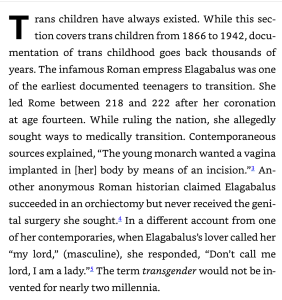
What did trans healthcare for children actually look like, as synthetic testosterone wasn’t available until the mid-30s?
Erlick had actually found that there were earlier testosterones and it began in the 1880s with experiments on ground-up bull testicles and cow ovaries. It didn’t work at first and then in 1905 a chemist and dermatologist were able to ‘extract the gametes’ and chemicals from animals, which did work. Hormones for trans people were available since at least the 1910s, which was when marketing began for them but admitted they were marketed to ‘cisgender’ people to enhance sexual prowess or enlarge breasts. Erlick wasn’t sure if the latter had worked for ‘cis women’ but knows that it did for ‘trans women.’
There were also stories about trans people successfully transitioning with the use of medicinal plants or mare urine but there wasn’t much evidence to prove this, said Erlick.
Page referred to the Steinach procedure, alleging that it involved having monkey testicles sewn into a man’s own testicles, and that Freud had done this. (According to Mr Google, the Steinach procedure was nothing more than a partial vasectomy, which Freud did undergo to help with an oral cancer and that Steinach had developed the procedure in part to cure men of homosexuality. However, Steinach was a contemporary of Magnus Hirschfield and did indeed do experimental animal implantations on humans, so Page was at least in the ballpark of truth.)
On Michael Dillon.
Page thought that Michael Dillon was the first woman to have taken synthetic testosterone and his pretence of amazement at Erlick ‘discovering’ the Ferrow Brother story, because it preceded Dillon’s case by twenty or so years, was just that. A pretence. Like her peers today, Dillon couldn’t wait to get her hands on male hormones and also published a blow by blow account of the changes testosterone wrought on her body. The moral of the story being, of course, be careful of claiming historical firsts in the nebulous field of trans history, as you never know what ahistorical shit the next troon will come up with.
The event is free to watch until the 9 October – click here.
Conclusion
Lie, lie, lie is all they ever do. And they’re so bad at it as well. Yet publishers and production companies, like Fane, the host of this free event promoting Erlick’s academically worthless book, don’t appear to be able to spot the blindingly obvious. As for the obsession with sterilising and removing the sexual body parts of minors. Well …
Thank you for reading! Sign up to my blog by going to the bottom of the page.
Please share on other forums if you liked it, as I only do Twitter.
 The Lies They Tell
Just, wow! Thanks for watching all that and reporting with your usual verve and wit. My sense is that both Erlick and Page are suffering from hormone induced IQ loss. I will now do a half hour of sit ups variations to take my mind and body off of this topic! Thanks~Ute
LikeLiked by 1 person