

Afterlives spends most of its time studiously avoiding Medusa’s gaze.
The blurby bit

The review
Normally I only write about the transgender issue, but in the case of Afterlives I’ve had to make an exception. It might have its heart in the right place (doubtful), but its head is in so many wrong places, it’s mind blowing.
On a damning with faint praise note, director Kevin B. Lee, chose an interesting aesthetic for the film, using his desktop to interact with film clips and his chosen talking heads, which works. What doesn’t work, however, is his piss-poor analysis of why violence could ever be a tool of indoctrination. He starts in the right place, looking at the example of the Islamic State (Isis) ‘blockbuster’ recruitment video – Flames of War – analysing it frame by frame, creating entries in a spreadsheet. However, he eagerly ditches the forensic approach to meditate on ‘cultural colonialism’ instead, via the lens of critical race theory. We learn that it is the fault of white people, Western-civilisation and -foreign policy, that the Middle East is so fucked-up. The rampant expansion of fundamentalist Islam intent on a caliphate, via invasion, summary executions, genocide, forced conversions and the rape of conquered women and girls, is basically neither here nor there, though Lee does occasionally blow his cheeks out and whistle.
Musing on the meaning of violent imagery and how it makes Lee and his talking heads feel, we learn that they only feel badly. But this feels dishonest – who can honestly say that proper horror show violence only does that? Isn’t that the point of its seduction? So, with this fundamental misunderstanding established, we are introduced to the terrorist who narrated Flames of War – Mohammed Khalifa. Khalifa, who is off screen during the Isis ‘documentary’, as narrators usually are, suddenly appears in its closing moments to execute Syrian soldiers. A surprise twist, so to speak, on two levels.
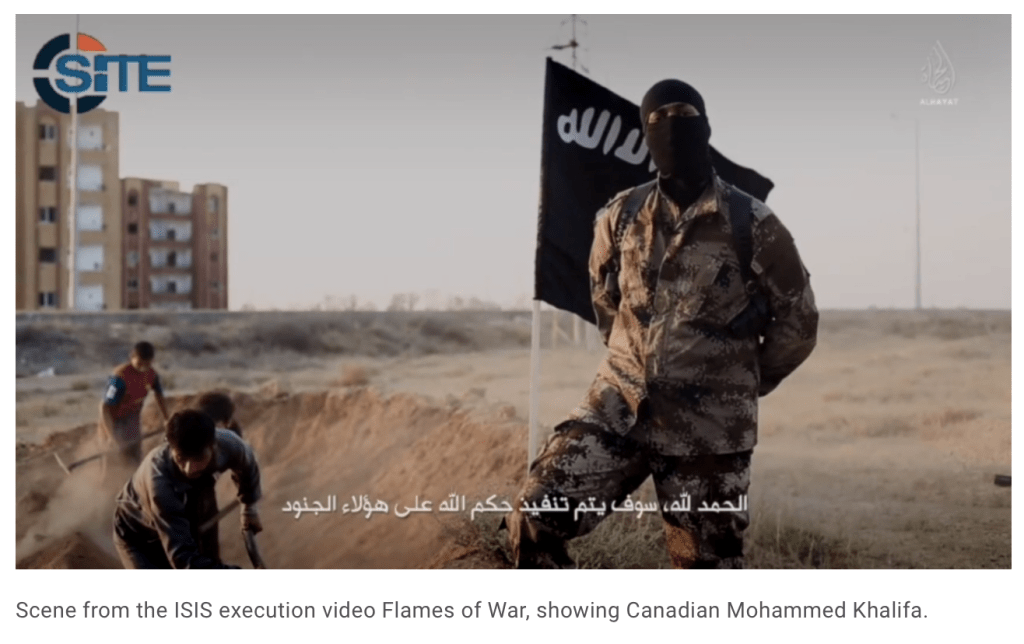
Source: https://globalnews.ca/news/9010912/mohammed-khalifa-canada-isis-propagandist/
One of Lee’s talking heads is psychiatrist, Anne Speckhard, Director of the International Center for the Study of Violent Extremism (self appointed, I’m sure). Speckhard is a kindly (and by that, I mean idiotic) woman, who interviews ex-Isis fighters, and Mohammed Khalifa had been one of her subjects. Her interviewees must have all sunk into theirs seats with the sweet satisfaction that she – with her silly dangly earrings – would never throw them a hardball. Indeed, in the few clips we see of her interviewing Khalifa, he’s as relaxed as a ‘sleb on Lorraine. Although nominally qualifying that she believes that violence is a ‘bad thing,’ Speckhard tells us that terrorists are motivated by ‘social justice’, i.e. they want to fix the violence they have seen on screen (rather than join in on it orgiastically) and are tricked by higher ups into believing that retribution is a just cause. Thus, Mohammed Khalifa is presented to be as much a victim of Isis, as – well – the actual victims of Isis. Not that anyone bothers talking to any.
The film’s most toe curling moment comes with Speckhard demonstrating how she interviews terrorists (kindly and with kid gloves) and Lee farcically pretending to be a hardened ex-Isis fighter, when he has no insight into such men, nor the acting chops to breakout of his drippy tofu-eating persona for even one second.
Lee and Speckhard both think Western aggression/presence in the Middle East make men like Mohammed Khalifa victims and that’s as much as we learn about the Isis spokesman from them. Lee doesn’t even bother to explain that Mohammed Khalifa was a Canadian citizen, originally born in Saudi to an Ethiopian family, who travelled illegally to Syria, a country where he had no roots. Also, Khalifa didn’t just narrate Flames of War, but at least fifteen other films, meaning he was an integral cog in the Isis propaganda machine. Khalifa joined Isis as a fighter in 2013, aged thirty, and was finally captured in 2019. Whilst in Canada he gained a degree in computer science, therefore he was essentially an educated Westerner with options – indeed, his cover story en route to Syria was that he was going to set up a business in Egypt. But Lee doesn’t tell us this backstory, nor speculate/investigate what else Khalifa may be guilty of, because it is of no interest to him. Moreover, the auteur wants it to be of no interest to us, either.
No, what Lee is interested in, is apologia for terrorism with heaps of word salad, and one of the potty Arabic artists he talks with renames ‘cultural colonialism’ as ‘violent care’, just to load the language even more. The film never begins to scratch the surface of why depictions of real (or painted) violence has such a powerful exciting affect on the human psyche.
Additionally, nil (or else very little) reflection on the religious meaning of the word ‘afterlives’ is made. Staggering when you consider that martyrdom is the underlying motivator for the jihadist. Also egregious is the use of Medusa as motif. You know, Medusa, the quintessential icon for female wrath? And -possibly- decapitation? Except the images of Medusa chosen are all decidedly male-looking and nothing of substance is said about the spiritual significance of decapitation. Instead we are shown images of the French Revolution (1789-1799) and its guillotine in a ‘Ooh, we are just as bad, you know!‘ nod and wink. Never mind that Saudi Arabia, home to two of Islam’s most holy sites and a multitude of others, is notorious for carrying out executions by beheading as part of its judicial process. In October 2025 it was reported by multiple sources that Saudi authorities had carried out over 283 executions since the beginning of the year. Why should Isis be held to a higher standard, you might ask?
What is clear though, is that Lee daren’t look Medusa in the eye.
Thank you for reading! Sign up to my blog by going to the bottom of the page.
Please share on other forums if you liked it, as I only do Twitter.
 The Lies They Tell
I welcome this analysis. As always a thoughtful response to the state we are in. In this case highlighting the utter banal uselessness of suicidal empathy. Strange days.
LikeLiked by 1 person
Yes, useful idiots is all they are.
LikeLike
“Kindly, and by that I mean idiotic”….had any of these clowns read the Koran? or looked at the history of the area?
LikeLiked by 1 person
I would very much doubt it, though I understand a honest English translation of the text is difficult to come by these days.
LikeLike