

… this time it’s Magnus Hirschfeld’s Institute of Sexual Science.
‘I like to think of myself as a historian and I don’t feel like I’m doing history,’ Brandy told us, which turned out to be the truest thing she said.
The blurby bit

About the speakers
Brandy Schillace is a she/her according to her website, though identifies as non-binary, as we learned during the talk. She has a Ph.D and describes herself as having ‘climbed through archives’ and ‘tunneled into catacombs’ [sic]. The most obvious thing to note about the blurb for her book The Intermediaries: A Weimar Story, is the absolute absence that Dr Magnus Hirschfeld was principally seeking a cure for homosexuality and whose work didn’t really have anything to do with opposing the prevailing Nazi ideology of the time, rather upholding it.
CN Lester, her interviewer, is a trans-identified female (they/them), who – and I have it on good authority – is a simply a straight woman in a long term relationship with a bloke, who hopped onto the alphabet bag gravy train years ago. She is the curator of the Transpose arts night, which gets a yearly outing at the Barbican, showcasing ‘talent’ from the transgender community (see here for a previous review).
The room
About seventeen people attended, notably just one of those was male, long greasy hair his only effort to present as female, and the rest looked decidedly non-binary/polysexual kind of young women (i.e. the sort which aren’t and couldn’t get any).
Brandy Schillace’s presentation
Why she wrote the book
‘I like to think of myself as a historian and I don’t feel like I’m doing history,’ Brandy told us, which turned out to be the truest thing she said. What she meant though, was that the West was repeating what happened in Germany in the 1930s all over again. Transgender issues were not new, they stretched all the way back in time, she said. She wanted to tell a narrative story with this book and is also a fiction writer.
She identifies as autistic (someone let out a little ‘woo’ in solidarity) and non-binary because she ‘doesn’t understand the boxes of gender’, which was linked back with her autism and ‘not grasping what it meant to be a human being’ (but forgot to add, somehow earning a living being a professional writer).
She had wanted to understand how prejudice and discrimination arose and this was the reason for writing the book. She likened hatred to a snowball rolling down the hill, picking up things to be angry at. She wanted people to know that hatred was not a foregone conclusion, nor should we have to assume hate wins, though it may not feel like that at this moment.
In other words, she had not written the book with a genuine open minded enquiry into the past and the role of Magnus Hirschfeld (1868-1935), nor his Institut für Sexualwissenschaft (Institute for Sexual Science), which was shut down after being plundered by the Nazis in May 1933. Nor was she able to contextualise why the Institute had become a target for the Nazis, which, from the histories I have looked up (admittedly just c/o Mr Google) appears to be driven by the fact that Hirschfeld was Jewish, rather than an ideological conflict about his treatments for homosexuality and transvestism.
Interminable anecdote / try out as stand up
Which lasted twenty minutes. I’m guessing she had rehearsed the anecdote/gag thingy, as it had a narrative arc – how she got a piece of research, by jumping through several hoops, only to claim victory. Her ‘climbing through the archives,’ no less. The thing she was claiming to gain access to was the intake interview for Dora (Rudolph) Richter to the Institute for treatment of his transvestism. Brandy said she knew Dora Richter existed and wanted to find out more about the first ‘trans woman’ to undergo ‘gender affirming surgery’. It was during Covid that Brandy made her discovery but, looking back through the internet, Richter was hardly an unknown, as there are several articles available online, written through the transgnder lens (bar one), many pre-pandemic.
Articles on Ruldoph/Dora Richter:
- https://www.them.us/story/dora-richter-first-trans-woman-to-receive-gender-affirming-surgery – 15 March 2022, written by trans activist
- https://historycollection.com/16-remarkable-historical-figures-who-were-transgender/ – 31 December 2018
- The wikipedia entry – https://en.wikipedia.org/wiki/Dora_Richter – created on 1 October 2017
- https://deschamps-braly.com/facial-feminization-surgery/history-ffs/ – 26 August 2016 – article published by plastic surgery clinic
- And the earliest I could find was published by the Institute’s archive – https://www.hirschfeld.in-berlin.de/institut/en/personen/pers_34.html – 31 March 2002 – screenshot below
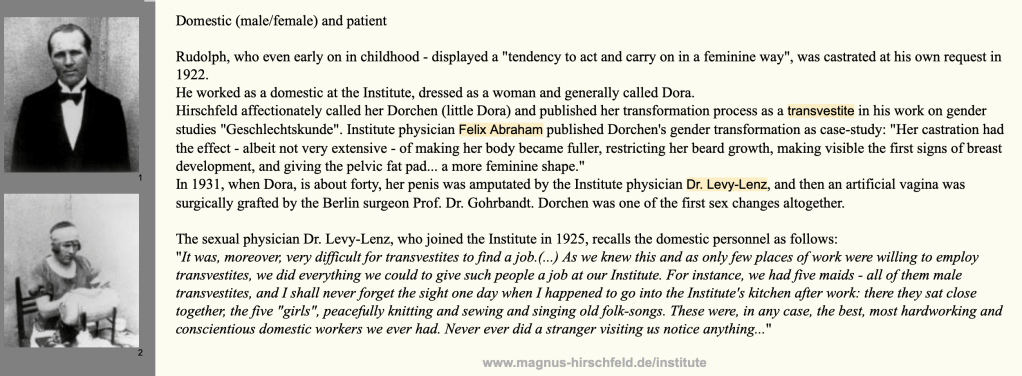
What I’ve gleaned from the Institute’s archive pages is that Hirschfeld and his team believed that homosexual males represented a type of third sex and that they carried female cells in their testes. (An incredibly detailed article from The Washington Post, 1996, also confirms it, which I found linked in Malcolm Clark’s substack on the same.) As for transvestism, Hirschfeld recognised that there were equal numbers of heterosexual and homosexual crossdressing men, believing it was caused by a ‘glandular’ problem and that dressing and presenting as female provided psychological relief (and presumably favoured that, over grappling with underlying causes). The Institute pushed for the issue of ‘transvestite certificates‘, which helped men evade prosecution for public crossdressing and also happily included exemption from conscription, at a time where Germany was being led, inexorably, into the Second World War, still bruised and bloody from the First.
These were all things that Brandy should have been explaining to us in her twenty-minute introductory speech, rather than how much she sweated in her wool suit climbing the stairs of the Humboldt University Library in Berlin.
A reading – First paragraph of Chapter Three
With an embarrassing amount of literary flourish, normally only used in parody, Brandy described to us the place where Rudolph Richter (who became Dora) was born – near the ’tilted after affects of a tectonic plate collision’ which was a ‘sideways spine with secret riches’, Richter belonging to ‘the steep side of the mountain’. Of course, Richter’s birth and childhood in an isolated rural region was not much of an anomaly at the time (1892) but Brandy forgot to mention that.
Discussion with CN Lester
Brandy first came across the story of Magnus Hirschfeld and the Institute a few years before she had become aware of Dora Richter’s story, i.e. a couple of years before the pandemic, which makes it around the trans tipping point (2015). Her main interest being that Richter was ‘the first’ to have ‘gender affirming care’ – aka as castration (1922), penectomy (early 1931) and some sort of vaginoplasty (late 1931).
According to Brandy, Richter thought of himself as a girl from the age of three and would get upset when his father made him wear trousers. However, Richter wouldn’t comply and would sneak off and put dresses on instead. At thirteen Richter tried to commit suicide by swallowing nails because his father wouldn’t allow him to crossdress. Times were hard for Richter because he lived in a small town and didn’t know any gay people, much less transgender. He didn’t have TikTok and Facebook. Bad things happened to Richter but he never let go of his dream.
Interestingly, Brandy’s way into the story of the Institute was through hearing about Michael Dillon’s phalloplasty, which means, I think, she learnt about it via the explosion of trans activists rewriting history around the trans tipping point. She was shocked that no one was talking about the Institute, so wanted to ‘resurrect’ that history. So she read ‘a lot of history books’ (which contradicts the assertion it was an unknown area of history) and realised that no one really knew what happened. Thus, Brandy wanted to write the definitive history, and ‘find the receipts’.
Nazi book burnings
Cue reference to the Institute for Sexual Science being the target for the infamous book burning outside Berlin’s Opera House in 1933. In fact, there is photographic evidence suggesting that the Institute was plundered, rather than destroyed, – see here for a photo showing the books being ‘sorted’. Brandy had a twist on this oft repeated factoid though – it wasn’t the books of the Institute which were burned, but the Institute’s ‘hormone science’ into gender affirming care (rather contradicted by the photographs held on the https://magnus-hirschfeld.de/institute website, which appears to include quite a bit of raw data). It was an effective and deliberate attempt by the Nazis to remove trans people from history.
How did Brandy respond to scepticism about this history?
Before the book, Brandy had written an article for Scientific American called ‘The Forgotten History of the World’s First Transgender Clinic’, published 1 May 2021 – see here. Upon publishing it she received about 800 messages on Twitter saying she should ‘die in a fire’. Apparently JK Rowling and Marjorie Taylor Greene had also not liked the article. What Brandy had noticed the the most though, wasn’t that people said the article was untruthful, it was that they didn’t want for the story to be told. Hmm.
At the time of writing, Brandy had protected her Twitter account but a thorough search of responses to her did not show any abuse as described, and the only responses I did find directed towards her personal account, seems to be in response to something she had written about JK Rowling, and included abuse from TRAs as well. Searches also did not turn up any interactions between JK Rowling, Brandy Schillace or Scientific American that I could see, so this detail appears to be pure fabrication on Brandy’s part.




Aetiology of the Nazis
According to Brandy, the formation of the Nazis was summink to do with the backlash against women in the workforce and the hatred of women. It was organised misogyny in response to women pushing for reproductive rights and, bizarrely, the right for ‘lesbians to marry’. In response to this female agitation there was an über-masculinisation. The übers were very keen on the Greeks. Karl Ulrichs, an early gay activist, believed that gay men had a woman’s soul, which went against the masculinist culture. Thus, there was a division between manly gay men and gay men, who were on board with women having rights. Then the masculinists who were straight started teaming up with the masculinists who were gay, uniting against the gays and ‘anything feminine’, and started accusing Jewish men of being too feminine. Thus, there was a connection between homophobia, misogyny and anti-semitism. Although these three things are connected, never before have I heard the rise of the Nazis boiled down to such a reductive idiotic theory. And I’ve seen the Rise of the Nazis with Ash Sarkar. All this, Brandy said, culminated in The Night of the Long Knives, with the masculinist gay men being the victims, wrongly thinking they would be safe due to their misogyny.
Hirschfeld was on the side of the feminists and had also tried to build a bridge with the gay masculinists, arguing that fighting the Nazis was a more pressing need, said Brandy, demonstrating her misunderstanding that the Institute essentially upheld and supported the Nazi eugenic dream by systematically sterilising its patients. Brandy had clearly also never asked herself how the Institute continued to operate during the early Nazi period.
Brandy continued with her cobbled together theory though, of sticking today’s intersectional feminist politics onto the geopolitics of the 1930s. It’s fair to say the Gen Z female non-binary/polysexual audience lapped up the conspiracy theory though.
Antisemitism was already in existence when Hitler came to power and he weaponised it in a horrific way, but he didn’t invent it. (You heard it first here, folx.) Brandy said that antisemitism is even older than the 19th Century. (Snort.) This was why her book resonates so much now, as it answered the question of why there is so much hate now. Things happen incrementally, like Roe vs Wade being overturned, or people wanting to overturn gay marriage.
Hirschfeld’s influence beyond Germany
According to Brandy, many of the gay rights movements in the United States were seeded by Hirschfeld. So, although we lost a lot of ‘scientific data’, much of the work had already been processed and already out there. Brandy also claims that a lot of Nazis were treated at the Institute, a fact (if, indeed, it is a fact) you’d think she might want to keep quiet, or at least reflect on. Such patients were mainly in the form of the boyfriends of ‘quite high up SS officials,’ as opposed to your ordinary Nazi Party member, and Brandy alleges this information came from Dr Ludwig Levy-Lenz, the first surgeon to carry out a form of ‘sex reassignment surgery’, who was also homosexual and Jewish. These boyfriends of the SS used to tell Levy-Lenz stories about Hitler, referring to him as ‘Adi baby,’ and saying *’blah, blah, blah.’ Hence, there were ‘a lot of reasons to get rid of that archive’.
*I think that means Brandy didn’t quite get the full deets on Adolf Hitler’s supposed indiscretions, but I’m sure the The Sunday Times might be quite interested. Well, perhaps in the Eighties.
Brandy also claims that anti-paedophile activists (aka as parents who oppose Drag Queen Story Hour) in the US are the ones who are getting arrested for paedophilia ‘n’ stuff and were on the Epstein list. No names, natch.
Her book was a book about hope because despite (parents angry about grown men reading to kids in womanface), Nazis were not a full gone conclusion and that there were ‘almost three different occasions when we didn’t end up with Nazis’. She didn’t tell us what these ‘almost three’ occasions were though. Nazis, today and yesteryear, were like ‘caffeinated toddlers in an antique shop’ who go around ‘breaking things.’ Or, building over 44,000 different types of concentration camps. You choose.
Brandy also alleges that Hitler put a hit out on Hirschfeld* and described him as the ‘”most dangerous Jew in Germany”, because of his alliance with women, transgender and LGBT’ – this was apparently what threatened Hitler the most – alliances between people. Brandy then flexed to a story about some teenagers who had come up to her after she’d given a talk, asking what they could do. Brandy had told them that ‘you being you is an act of resistance’ and ‘you daring to be yourself and being joyful about it, is the most powerful thing I can think of and they [meaning Nazis] don’t have anything close to that, they can’t touch that.’
And that signalled the end of the talk, moving onto the Q&A session.
*Hirschfeld was attacked on 4 October 1920 by nationalists, after a newspaper published an article encourging people do so.
Question & Answer session
A question about finding research sources.
Brandy told us that she contacted trans people. In other words, I suspect she simply reached out to the various people responsible for writing crap about Dora Richter on the internet. ‘No one can ferret out the history of trans people, better than trans people,’ Brandy assured us. She hired Ralf Dose, of the Hirschfeld archive, as a consultant. As she doesn’t speak or read German, she also had to hire multiple translators, especially with regards to the medical literature. Brandy has over four hundred footnotes in the book, as proof of how diligent she has been with her research, plus timeline, character biographies and a glossary of terms.
The book was also about how ‘terminology shifts’, i.e. an apologia for the fact that transgenderism is a relatively new concept and would have been unheard of at the Institute, who were unwittingly involved in its first iteration.
Brandy also connected with the trans activist who runs the Lili Elbe library (this one, I think) to find more information about Richter. This activist found Richter’s baptismal record and tracked his movements post-war. Upon visiting the town where Richter eventually died, Brandy’s activist ally found two people who remembered Richter as the ‘laughing old lady who kept a pet bird her in her purse’. Richter wasn’t held up in his town as a ‘trans icon’ because nobody knew who he was, he was ‘just a woman’.
The saddest story …
… was what happened to Hirschfeld’s partners. That’s right, he was in a thruple.
And do you know that Hitler hated Hirschfeld so much, that most of the antisemitic caricatures used in Hitler’s propaganda, were actually of his face? Brandy mentioned a few names in relation to this amazing factoid but interestingly when I looked around on Google, I could only find Hirschfeld gracing the front page of Der Stürmer once and a comparison of other Der Stürmer cartoons reveals that there was quite a wide range of antisemitic depictions in circulation.
We never learned what happened to Hirschfeld’s boyfriends, as Brandy got too excited by the made up facts she’d put in her crappy book; which was a book about hope. Please buy it.
Don’t let anyone yuck your yum!
Despite being asked some reasonably sensible questions, Brandy continued in her philosophical meditation on trans joy and the evils of capitalism. We do deserve joy. Enemies are people who make you feel responsible. Then Brandy told us about her cancer and the need for her to have a double mastectomy. Yep, it was time for another Brandy anecdote – she’d been given an award and during her acceptance speech she’d told the audience that when she came to after the anaesthetic had worn off, Trump had been elected President. Brandy had started to make lists of support groups but it wasn’t clear if this was in relation to her post-surgical status or her Trump derangement syndrome. Brandy started volunteering at a cat rescue and I can imagine she fits right in.
Comment from Jewish trans-identified female
She wanted to thank Brandy for highlighting the issue of anti-semitism, even though Brandy hadn’t really, rather demeaned the real history of Nazi Germany with a load of made up stuff, with the “Adi-baby” story the absolute nadir. This audience member was currently attending a shul where the rabbi was a trans woman and 90 percent of the congregation (i.e. all 9 of them) were on the LGBTQ spectrum. She had heard about Hirschfeld’s story through the rabbi.
Brandy responded by saying that there were some very ‘strange things going on with lesbians’ during Hirschfeld’s time; some of them accepted trans women, and some didn’t. ‘Terfdom is old too,’ reflected Brandy with world weary wisdom.
Hirschfeld’s true beliefs
Right at the end of the Q&A, we got something of the truth about Hirschfeld from Brandy; namely, that he described cross-dressing men as transvestites. Richter, apparently, was the person who changed his mind because he was the first tranny to claim: ‘I am a woman,’ making Hirschfeld rethink his theories. Ditto for when Hirschfeld met his first trans man. He was in a constant state of learning in response to patients saying things to him, said Brandy.
Brandy said that Hirschfeld was also interested in the question of race, because it was a time which very ‘social Darwinnie and eugenicky and stuff,’ and she had to admit that Hirschfeld did endorse eugenics. She claimed that he changed his mind about eugenics though, despite the ton of evidence showing that he did favour of sterilisation of certain homosexuals. This entry in the Holocaust Encyclopedia claims that Hirschfeld was against theories of racial hierarchy but did ‘accept the idea that people diagnosed with chronic alcoholism or certain mental disabilities should not reproduce.’ Brandy, however, claimed that he changed his mind about racial eugenics but one wonders which racial theory he could have supported originally, given the Nazis deemed Jews, like himself, to be bottom of the pile?
Hirschfeld also understood the importance of joy, said Brandy, indeed once he even made out a prescription for one of his patients, directing him to attend a drag party. Presumably this was before Hirschfeld made out the prescription to have the Steinach procedure inspired by experimentation in animal testicular grafting?
P-p-p-poker face
Either Brandy has uncovered new facts about Adolf Hitler’s sex life worthy of serialisation by The Sunday Times or there is a load of made-up shit in the book. How I didn’t crumple with laughter after the Adi-baby-blah-blah-blah ‘anecdote’ is purely down to my amazing ability to keep ma p-p-p-poker face. Everyone there seemed absolutely nuts but pleased by her quasi-religious intellectual googles. At the time of writing, no one had yet written a serious review of The Intermediaries, but I’d be amazed if anyone who knows that period could be bothered giving it the time of day.
Thank you for reading! Sign up to my blog by going to the bottom of the page.
Please share on other forums if you liked it, as I only do Twitter.
 The Lies They Tell

You must be logged in to post a comment.