

The never heard of before practice of documenting one’s transition.

The exhibition
I visited the exhibition Top by Claye Bowler at Queer Britain, supposedly ‘disguised as a museum store’. Comprised of two rooms; one for artefacts (I use the term in the loosest possible sense), the other – a video played. The visual: Bowler half naked, self-destructively shearing off her own hair with a razor blade. The audio: disembodied voices of a man and a woman repeating the same questions, gradually becoming more personal and snide. The questions didn’t ring true though. For example: ‘Is that your dad with you? What’s his name? Roughly how old is your dad?’ And: ‘Did you have friends when you were a child?’ Until finally: ‘What do your genitals look like?’ and ‘What does your body feel like when it has sex?’ I very much doubt Bowler is getting any but I suspect she has a thing for humiliation.
Over on X I have uploaded photos I took of the exhibition, which includes close up photos of Bowler’s mutilated chest. These photos were kept in drawers, so it meant you had to open the drawers to see inside. I suspect many will visit without realising the secrets the drawers contain, as it wasn’t clear whether we could touch and look, or not.
The exhibition is massively unoriginal, since probably tens of thousands of vlogs exist on the same online already. It also had nothing to say about the phenomenon of this cultural documentation or why body horror is de rigueur for the genre. In other words, it wasn’t self-aware, like almost all art produced by queer theory practitioners.
Change of interviewer
E-J Scott, curator of the Museum of Transology, was originally to interview Bowler but this changed to Tomara Garrod (they/them) who is a ‘writer, performer and facilitator,’ which includes providing sex and relationships education via the School of Sexuality Education, which was, he says: ‘sex positive, trauma informed, decolonial, and non-binary.’ He also performs poetry. Badly.
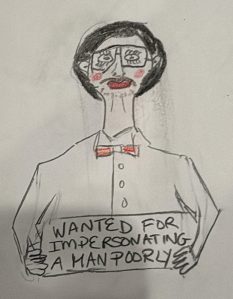
The room
Held in a swank hotel off Leicester Square (no idea why Queer Britain’s ample premises in St Pancras couldn’t have been used) about a hundred seats had been put out, with about twenty people attending. A few of those were friends of Claye Bowler and a minimum of three were volunteers from Queer Britain. As you’d expect, it was mostly trans-identified females, at least one with boyfriend in tow, but there were also two normies, who looked utterly bewildered at the end and could barely meet my eye. They came to learn and learnt too too much.
The conversation
Performative curation
The aim of Top was to ‘make public the private practices of institutions that are so often responsible for the healthcare and eventual erasure of trans lives,’ Garrod told us, in the preamble to introducing the artiste to us. One of Bowler’s bugbears is the lack archives within the NHS and healthcare systems, as you can’t ‘queer’ what doesn’t exist. Trans people had to tell healthcare professionals about their own personal journey and there was a lack of information about transition in the public sphere. Bowler crazily believes that Top provides a sort of one-stop-shop for other women considering bilateral mastectomy for cosmetic purposes.
Don’t wanna be here
It was clear from the off that Bowler didn’t want to be interviewed and she talked in a hushed tone throughout. Whether this was affected or vocal chord damage by testosterone, I don’t know. One thing’s for sure though, she made absolutely no fucking effort whatsoever to project. If the ninety minute long speaking engagement felt like Chinese water torture to us, imagine the interviewer? Tomara Garrod, who presumably has little experience of interviewing, carried on like a veteran, smiling benignly and carrying on when Bowler repeatedly refused to answer the central question: ‘Why?’
How did the exhibition come about?
Bowler was living on her own in a tiny rural village in Yorkshire at the time of the first lockdown and had been due her first appointment with a gender identity clinic (GIC), which got cancelled due to the pandemic. She had been out as trans for about five years at that point and knew she wanted surgery. She shaved her head just after she went to the GP and continued to grow it until after she had had the surgery. The wait was five years, hence her hair was very long by surgery time and then she sheared it off at the very end of the project, which she liberally described as a performance. She had also been thinking a lot about how trans people were represented in the archive, thus these two strands came together, to make an artwork documenting her transition in the form of an archive, each item of which has a tag. (For those who don’t know, this has already been done much more effectively by E-J Scott at the Museum of Transology.)
Why did you prioritise informational sharing versus emotional process?
Interestingly, Bowler was ‘offered’ the show and ‘for that amount of money and that size room’ was advised she should just put in four pieces. Hers ended up being ‘one artwork with about two hundred parts’ and basically includes every piece of crap she picked up along the way. Bowler identifies as autistic and likes collecting stuff. She wasn’t able to articulate further and dried up, then realised this wasn’t really acceptable and started mumbling some shit which didn’t make any sense, could barely be heard and included about a million uses of the word ‘like’.
Garrod interjected to state that even though Top is essentially an information display, it didn’t feel cold, the artist didn’t feel absent, that you did feel the emotions and that Bowler had imbued inanimate body parts with meaning, i.e. about as arse-about-face as he could’ve got. Bowler responded that archives weren’t dead spaces, they were full of people! Why, every time she goes to Bishopsgate (which houses The Museum of Transology, LGBT and fetish archives) she’s always bumping into people! She also rambled on about putting data into spreadsheets. Scintillating stuff.
What do you understand archive to mean?
Garrod asked, after she implied her brand new definition akin to frat party, so Bowler answered a completely different question. Her utterances were barely audible, but she was apparently wanging on about decolonising the archives. Like, the main object of an archive was like, to collect things and like label them and that was a bit like, you know, colonisation and capitalism, and like placing too much like value on objects. (Unlike her exhibition which is JUST LIKE THAT!) We were also to understand that there were very few queer objects being put in museums these days, proving that she really hasn’t been around these last few years, since queering the museum and decolonisation is all the big institutions seem to push these days. More specifically, institutions weren’t putting money into ‘queer’s peoples’ bank accounts’, which probably sadly meant that Bowler was being paid that night.
When Garrod asked if the problem could be fixed by throwing a ridiculous amount of money at it, Bowler switched tracks. Just before she opened Top three years ago, she’d attended a talk given by Morgan M. Page (he of Cotton Ceiling infamy), who had posed the question of whether queer people should even want to be part of the archive of established institutions and perhaps it was time to do things independently. Bit of cheek when you consider she readily accepted the invite to exhibit at the Henry Moore Institute and the only reason she has risen to any sort of prominence at all.
Bowler mentioned the Nazi book burning of Magnus Hirschfeld’s Institute of Sexual Science and, in line with the latest completely made-up tale promoted in a book by Brandy Schillace, published in June 2025 (which I’ve written about here), Bowler said that Nazis had burned the data relating to HRT dosage. Bowler went onto moan that queer peoples’ lives weren’t being archived by institutions, whilst cis-het normies’ were. This wasn’t fair. It was erasure. Such institutions couldn’t be relied upon. (FYI, Queer Britain is an LGBTQ+ only museum and registered charity, whose principal sponsors are Diageo and US investment management company Capital Group.)
What was the process of archiving your top surgery like for you? From creation to presentation.
Garrod hadn’t given up on getting an answer to his original question. Bowler: It was difficult and made during ‘liminal times’, doing the work in the morning before she had her shower so that she could trick herself out of the trauma of having done it. Or summink. Thus, the work was done whilst she was actively dissociating. She made a lot of the boxes for the exhibit after she had had bilateral mastectomy. Her latest exhibit is called Dig Me A Grave being shown at the YSP (Yorkshire Sculpture Park), again supported by major institutions, i.e. Jerwood New Work Fund, Arts Council England and the Henry Moore Foundation. The box making for Top informed Dig Me A Grave. I can just imagine the light bulb moment.
Bowler, other than throwing the word ‘dissociative’ around a bit, lacked the eloquence to describe what this meant in reality, which is strange when clearly her show’s whole schtick relies on this fact, so either she is lying or utterly witless. I would have liked to known, at a minimum, why she disliked her breasts, yet somehow managed to display them publicly, brazen face to camera.
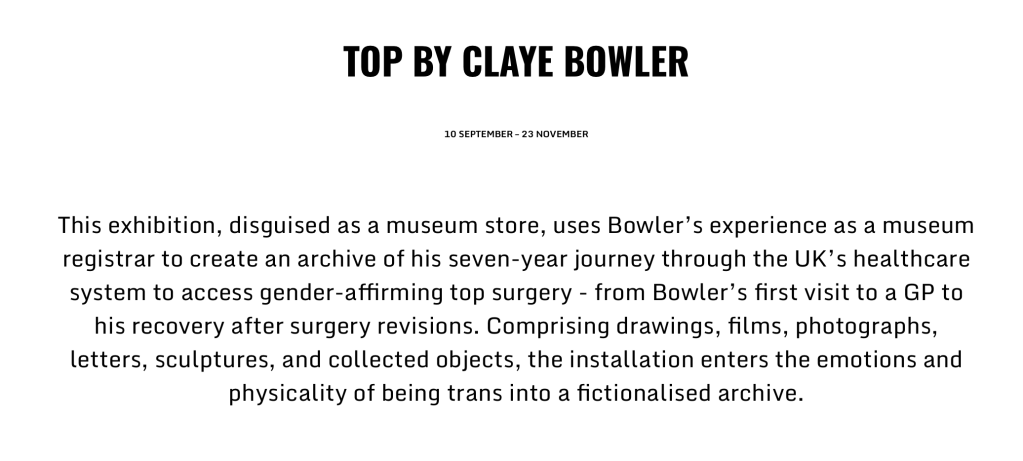
Blurb from Queer Britain’s website
Bowler said that Top isn’t personal or intimate. ‘Really?,’ Garrod responded. ‘What is it, if it’s not personal or intimate?’ Bowler couldn’t answer, so Garrod offered an answer; the work had been made in a dissociative state, therefore Bowler had not really been present in it. Which isn’t a half-bad answer but then doesn’t explain why Bowler agreed to it being billed as ‘his seven year journey’ (blurb she likely wrote herself), rather than, say, ‘an exploration of not really being embodied.’ Garrod continued, talking of the ‘liminal space’, which was the waiting list in the NHS for GIC care, in which trans people became non-existent. ‘I’m not actually in it,’ (meaning the exhibition) claimed Bowler, to which Garrod could only respond with a sceptical murmur, unsure of where to go next. Bowler continued to whisper an explanation, which probably only Garrod could hear.
What were the consequences of sharing this archive?
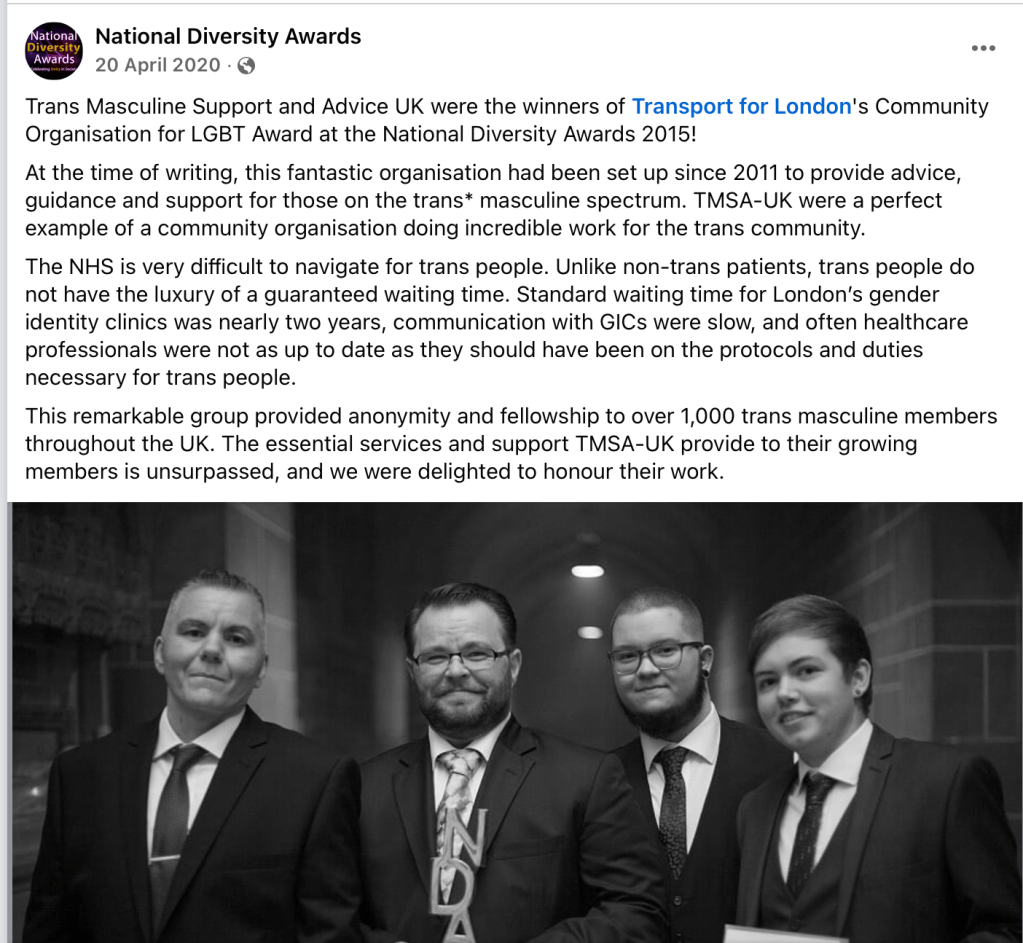
Garrod hadn’t given up on asking the central question though, and really the only question one could ask of an artist who had shared her personal and intimate experience of deciding to have her healthy breasts removed. Bowler admitted that it was a very standard trans story; that was what was not personal about it. It is generic body horror stuff. Bowler was a member of a Facebook group, Trans Masculine Support and Advice UK, which, according to Bowler, currently has about five thousand members. Essentially Top was about group desensitisation to medicalisation and surgeries, which is why it wasn’t personal, rather just your bog standard group-think.
Bowler had traumatic days but she also had days when she was victorious, walking on the moors, being blown about by the wind. Most of the issues, about medicalisation and surgeries, were ‘boring’ to her, she explained unconvincingly.
Garrod argued that being personal was to be close to the everyday reality of life. Bowler counter argued that the work was simply generic. Garrod, not quite ready to admit defeat, agreed that there were generic elements but what was different was that we watched Bowler do it. Bowler mumbled some derisive nonsense about Antony Gormley, the artist who created the Angel of the North, instead.
Why mark the time by growing your hair?
In her first sort-of coherent answer, Bowler told us that hair is the first thing you have the power to change. As a child she had been resistant to hair cutting, wanting it long, inadvertently revealing she had been gender-conforming. She had shaved her hair when she first came out as trans. Then, as mentioned previously, grew it out until post-surgery and it was only after she cut her hair that people stopped ‘misgendering’ her, not in response to a newly flattened chest. Nowadays, due to testosterone, she is going bald and wearing a cap to disguise this. However, the misgendering continues, as when she is clean-shaven, people can still see that she is female. It is only when she lets her facial hair grow that people perceive her as male.
Q&A
The Q&A was really more like a comment session, but was more revealing than the interview had been.
Fellow archivist
A trans-identified female, civil servant with a role in archiving, complained that working for the government was ‘not great’ and that too much about archiving was about ‘materiality’ and that the work caused her to ‘dissociate’ (know the feeling love, I’ve got a dead boring job too). In the profession there was a lot of talk about materiality and what the media is. With regards to Bowler’s rubbish exhibition, however, this woman felt the materiality of it was ‘inherently beautiful’ as it was ‘in context’, whereas in real archives, unless you know what you’re looking for, they are all just pieces of paper in boxes (no, I have no idea either). Bowler, of course, readily agreed and shared that she had interviewed for a job with a major archivist institution and had learnt that they keep all the national railway timetables.
We should just feel lucky that they’re working with paper, rather than people, I suppose?
Henry Moore Institute
Someone wanted to know about Bowler’s experience of working with the Henry Moore Institute. Bowler was part of the Yorkshire Sculpture International network, set up in 2020, in the wake of Covid and initially involved about twenty ‘sculptors’ (I’ve put in quote marks, since clearly Bowler was one of these). They met on Zoom on a weekly basis, including an in person meeting with one of the curators. The upshot of this online involvement was that she was offered to exhibit at Henry Moore. That’s how it’s done, folks!
Bowler complained that a (thoroughly undeserved) puff piece about her in The Guardian had boasted that she was the first trans person to exhibit there, when in fact she was the first person based in Yorkshire, other than Moore himself, to exhibit there. This seems highly unlikely given local artists would be drawn to it, indeed, this was why she moved to Yorkshire herself. Yet another beneficiary of diversity and inclusion policies over talent.
The increased visibility that comes from a solo show at the Henry Moore is something that can be a double-edged sword. The exhibition has created a backlash – there’s apparently “a Mumsnet thread” about it – but Bowler’s concern is about where that backlash will go; he admits that while he’s personally getting “stick as part of the show”, the abuse won’t all necessarily be aimed at him. It’s the spectre of this backlash – and the ignorance that so often informs it – that Top is responding to.
Claye Bowler: ‘I want to put trans people on the map in sculpture’, Guardian interview, 26 October 2022
Queer Britain
Another wanted to know what was it like working with Queer Britain as an institution. Bowler, talking as if she was a veteran of the fine arts scene, was wary because Queer Britain, whose doors opened its in 2022, had never held an art exhibition before and she wasn’t sure if Top was ‘the right space for it’. She also felt that Queer Britain had misunderstood the exhibition, as in the press release Top had been described as an exhibition about ‘trans joy’. It peeved her that Queer Britain had tried to change the narrative by focussing more ‘on the positive’. Top was so much more complex than that. For what it’s worth, I don’t recall Queer Britain describing Top as such but I am swift email deleter, so can’t corroborate.
Bowler also recollected how she had giggled that the Henry Moore Institute had advertised Top and that some people -tee-hee- wouldn’t have understood its double-meaning. ‘Queerness isn’t in the archives but it is in the memories of queer people which is passed down in the archive of the queer community,’ Bowler pontificated of the slang word anyone could guess the meaning of*, explaining further that queer people who visited Top would have an extra layer of understanding. Given Bowler doesn’t have a penis, we wonder in what sense she believes herself to be a ‘top’? Also, as someone who visited Top and wasted several minutes opening and closing the fiddly drawers of the two filing cabinets to gawp at her mutilated body, as well as looking at her very large bust on full display, we can confirm that the theme of bumming is never raised.
*A ‘top’ is a man who mostly prefers active anal intercourse with another man, if you really don’t know.
Top has a third meaning, as in to top oneself, but no one mentioned that. Some of us were thinking it though.
Going outside the archive
A woman commented that she favoured going outside of the institutional archives, because they pander to cis-het-normies, did Bowler agree? A very stupid question, given Bowler had already said upfront that she did. Bowler mentioned that the V&A had done an exhibition on masculinities which had included a breast binder and ‘packer’ (a type of dildo worn by TIFs to mimic normal male anatomy) but her criticism was that these items were new, thus unused and inauthentic.
On the ethics of record keeping
I’m not quite sure how the topic arose, as Bowler was well into her whispery mode, but I did hear her cringey boast that she kept records of her sexual conquests on a spreadsheet. You’d think someone working ‘in the archives’ as their real day job might take a more moral view on this, but no.
Commodifying the human experience
A woman commented that the institutions which had platformed Top had presented it as if it were representative of the trans experience and were, in general, in the business of ‘commodifying the human experience’. Clearly she had no clue what ‘commodify’ means, given that Top had free entry at Queer Britain and, I suspect, elsewhere. The ticket to see Bowler speak, however, was paid.
‘Trans joy’ is the acceptable narrative
Someone commented that ‘trans joy’ was one of the acceptable phrases to use when talking about trans people, the other narrative was ‘trans medicalisation’ (aka trans misery). These were like railroad tracks. Bowler continued to inarticulate and whisper about why she had chosen to represent her own story so generically.
Boring!
Top only has one story to tell; Claye Bowler’s decision to remove her breasts and on that she had nothing to say. Okay, not nothing. Nothing of interest. The thing which will stay with me the most is the look of the faces of the two women who thought they were coming to listen to a cogent explanation of why breasts had made Bowler feel othered enough to dispense with them, perhaps something to do with sexist stereotypes and non-conformity, or even childhood trauma? Instead they had to listen to ninety minutes of abject impenetrable nonsense. Like I say, they could not meet my eye. Now that’s a real dissociative state.
Thank you for reading! Sign up to my blog by going to the bottom of the page.
Please share on other forums if you liked it, as I only do Twitter.
 The Lies They Tell
You must be logged in to post a comment.