
According to the Barbican, we should be celebrating voyeurism.
The blurby bit
The Barbican has slithered even further down the queer theory slide to hold a ‘Dirty Weekend’. I’ve no idea how this fits in with its stated purpose and values, nor its communities and neighbourhoods aims, but we all know that it would not host any organisation whose stated values were against the current so-liberal-my-brains-have-fallen-out politic (Nordic Model Now, for example), so one can only guess that someone high up at the Barbican has membership at a private dungeon*. I didn’t really want to go to something so ick but given the programme was quite heavy on the queer/trans stuff, it was a duty. So, I went to the keynote panel talk for its promise to address the issues of ‘bodily autonomy’ and ‘access to healthcare [for] trans people’.
*A prescient joke, it turned out.
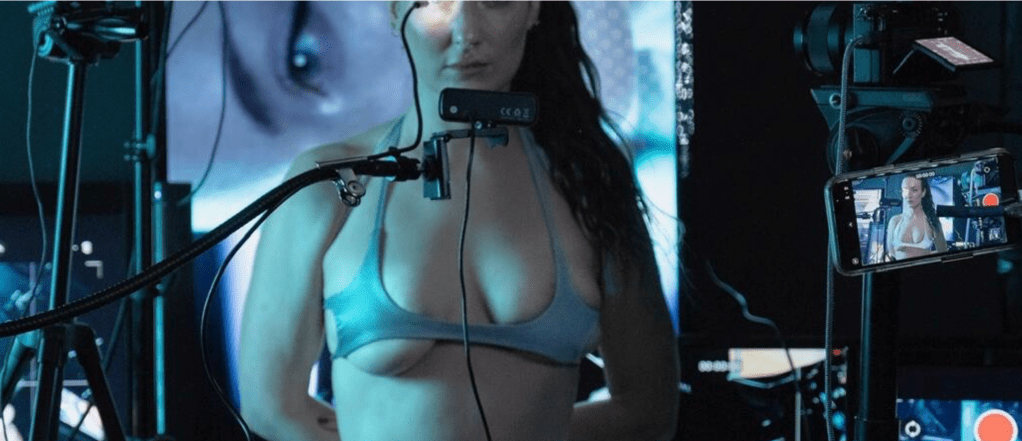
The programme covered voyeurism, latex fetishism, quite a bit of female nudity (fancy that!), a speed dating event for people of ‘all genders and sexualities’, a T-shirt printing workshop, discussions held on how AI will affect sex, one on the connection between being ‘queer, dirt and dirtiness’, a screening of a film called SHINY hosted by ‘dedicated fetishists’ from the UK Fetish Archive, and a club night for Club Stamina, which champions ‘trans femme talent’. Oh, and also a literature and ‘ephemera market’ (a poncey way of saying ‘stalls selling porn’) described as a ‘take over’ and literally took over the whole of the ground floor on the Saturday, as I understand it.
One of the exhibitions
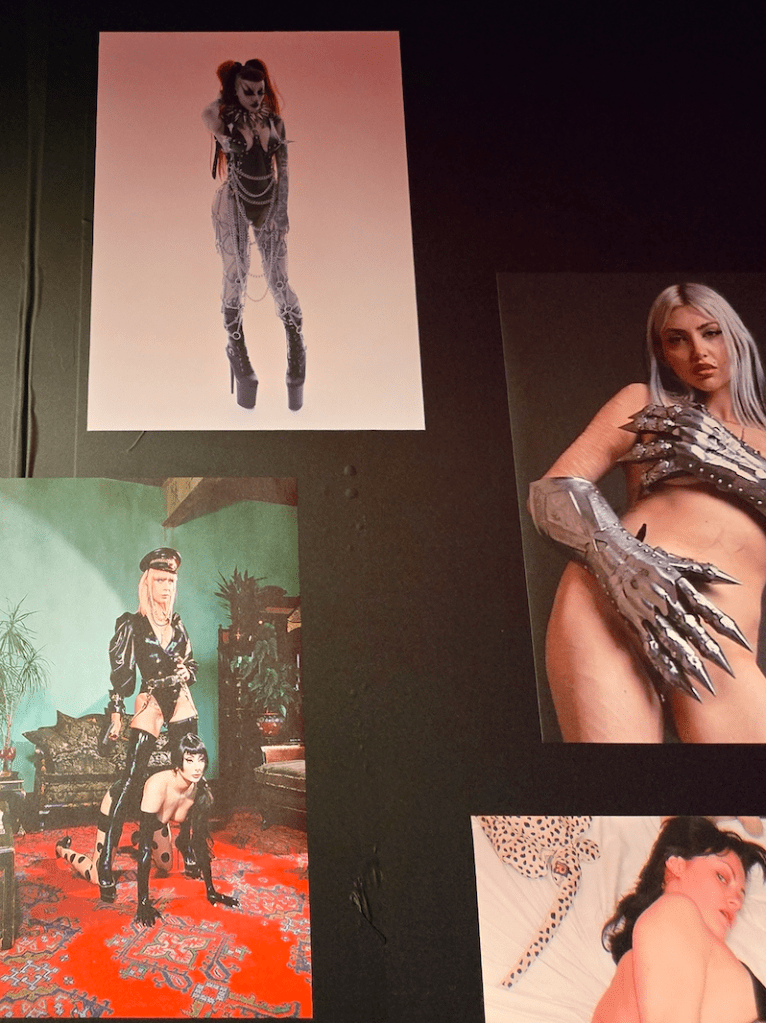
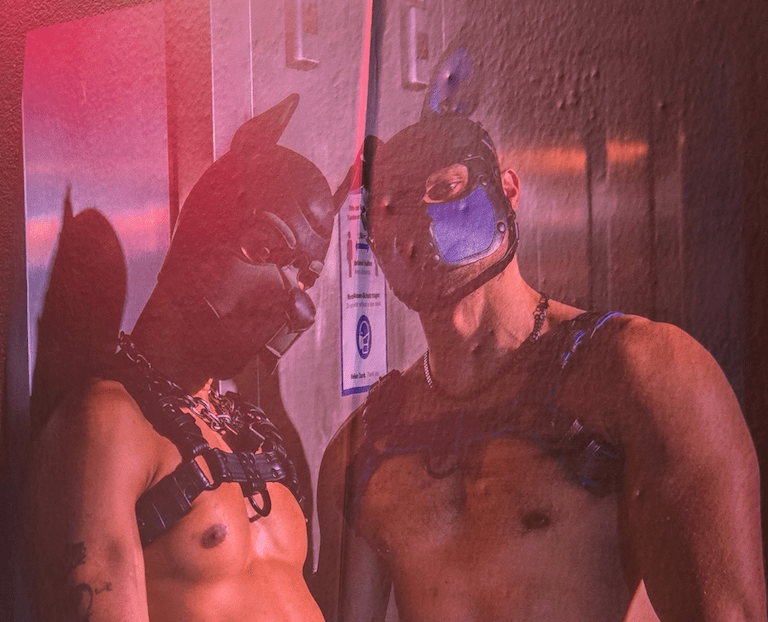
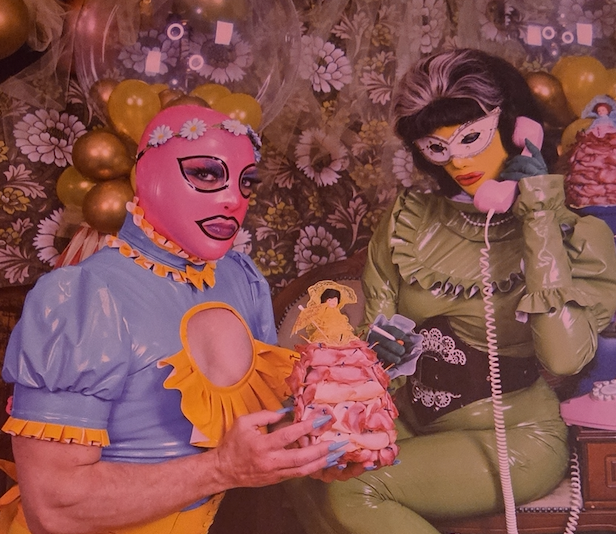
There were two exhibitions on show on the Sunday associated with the Dirty Weekend, both were well cordoned off, and could only be visited if you had bought a ticket for one of the events. I looked around the first one, which was small, maybe about 30 to 40 pieces, mainly photographs, a few costumes and about three videos. It was hardcore pornography though, featuring extreme fetish wear, a preponderance of *pups and female nudity. One video showed full on anal sex between two men. Another was a black and white ‘arty’ but hard core pornographic film, which I managed about a minute of, and showed a full fisting (looked past the wrist to me, but was fleeting) and an extremely graphic golden shower scene between two men. I didn’t have the nerve to explore the other cordoned-off area after that.
*A form of BDSM whereby participants adopt a ‘puppy’ persona, typically including mask-wearing, ‘training’, being part of a ‘pack’, etc.
The room
I have now attended over three hundred trans-related events as an observer, so lost my embarrassment at the door many many many moons ago. Attending this, however, reintroduced me to paper-bag-over-head desire, which, ironically, the people on the panel do do, for real. But with latex. The talk was held in the Frobisher room, which seats up to 245 people. Maybe about hundred in the room? Not that well attended. I suspect the mostly young women there were interested from a lifestyle perspective, whereas the gay men were likely involved in the scene for real. These are just impressions, you understand, but I didn’t get the vibe that ‘the community’ had come together for the day, but then what would I know?
The panel
Six incredibly middle class and well spoken people, I’m betting privately educated, essentially talked about their money-making, empty lifestyles and victimhood.
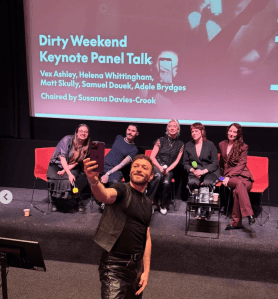
Chair, Susanna Davies-Crook
Susanna Davies-Crook is the current Curator of Public Programmes at the Barbican Centre and hence it was her idea to hold the ‘Dirty Weekend’ and bought it to fruition. Davies-Crook happily admitted that she has been a regular at the Torture Garden (a fetish club) these last few years. Oh, and she’s also a yoga teacher.
Vex Ashley
Vex Ashley creates pornographic films under the auspice of A Four Chambered Heart and also performs in them and has been in the business for over ten years. The films are high-end productions and, I suppose, pornography aimed at professional GenZ females dating bearded hipsters. She has previously shown her films at the ICA, whilst Davies-Crook was ICA’s curator of talks, so I take it they’re fuck buddies. For the Dirty Weekend, Ashley had been given a whole room to curate and chose to explore ‘sex in the online space’, which featured a ‘mirrored fuck-box‘ you could go in.
Helena Whittingham
Helena Whittingham is part of the fetish scene and is one half of Content Warning, which collates ‘fetish archival material’ (the archive is currently stored at the Bishopsgate Institute) and screened the fetish film, SHINY, which took place after the panel. She also runs a talent management agency for porn performers – Lover Management Ltd, helping them connect with brands. Vex Ashley is a client, as I guess many of the weekend’s turns were. That’s how these things work, isn’t it?
Matt Skully
Matt Skully runs a club fetish night, has extensive experience of marketing and event management, is a sex worker and currently teaching creative writing workshops at Bishopsgate Institute (which recently ditched all its adult education classes in favour of kinksters, it seems). The classes will explore ‘the power of transformation within kink and fetish,’ and he gave pup play, *drone play and sissyfication as examples.
*Wearing gas mask type apparatus, I’m not sure what else is involved.
Samuel Douek
Samuel Douek is a film director and a found of Howl, ‘a platform for pleasure’. He explained that he runs ‘massive queer raves’ (meaning ‘gay sex parties’) and makes (meaning ‘sells’) ‘innovative sex tech products’ (meaning ‘lube’) and eager to ‘revolutionise intimacy’ (meaning ‘make money from facilitating anonymous sex’). Douek, however, wanted us to believe his motivating principle was ‘sex education’.
Her agent is Whittingham/Lover Management.
I had a good look round the pages of Howl and couldn’t find any such advice, and certainly nothing about safe sex. The shop sells lube and butt plugs but not condoms. The Dirty Weekend really resonated with him and his brand and everything they stood for, which was about putting ‘pleasure’ as a fundamental right into the mainstream and doing so unapologetically. So finally a little bit of truth.
Adele Brydges
Poor thing. I feel like Brydges was the token vanilla as she only makes artful-looking pleasure tools ‘which challenge the shame and taboo around sex toys’ (which normally means making them look nothing like a penis, just like hers). Her latest work is an ‘erotic ritualistic expression’, which just looked like a big bum with a hole in it to me, to her though it was about ‘opening the shadows out of yourself.’ Whatever.
Introduction
Davies-Crook, as chair, naturally did the introduction. She counted the panel members as friends, which they clearly were, and wanted to focus on the issues facing ‘the community’, thanking various members of the Barbican team for their input. Skully had been an active collaborator in getting the pieces of ‘ephemera’ (aka bums, titties and willies) on show.
Ashley commented that it was ‘very surprising programming for the Barbican,’ revealing that she has no idea that the Barbican has been adjacent to this kind of stuff, literally forever, or else witlessly lying.
The discussion
Why was the weekend so successful?
There’s nothing like blowing your own trumpet, I suppose, and this was Davies-Crook’s first question to the panel. Why had the thing, she’d organised, been so bloody good?
Douek believes we are in the middle of a ‘pleasure revolution’, there had been revolutions before, but this was one was connected to ‘hyper capitalism’ and went on to talk about how his brand could ‘create incredible opportunity for community’. Which is hilarious when you consider Howl’s product is over-priced lube. Also, people could now ‘experiment and explore and breakdown the barriers which have held us back’ due to this ‘high growth market’ (phwoar). Asked to expand on these barriers, Douek whipped ‘global heteronormative patriarchy’ out and said that it all came back to shame, which all our upbringings were ‘riddled with’. The idea that shame was no longer a bad thing was being marketised now, in a way it had never been before. Hard agree.
Whittingham said that the event’s popularity was to do with the ‘censorship’ people encountered online, they wanted to do more stuff in real life, and Vex Ashley’s fanbase attending. With regards to the commodification, her talent agency was doing well because a lot of sex products couldn’t be placed using normal advertising streams, but they could be promoted by her clients, like Lucy Huxley (who has a podcast called The Whore’s Bedroom and a large TikTok following).
Whittingham noted that institutions were more receptive to showing pornography when the word ‘archival’ was slapped onto it but wanted more current stuff to be shown, which could be sold as archiving what sexuality is today. Genius. Davies-Crook felt that institutions needed to pay attention to the voices of sex workers (but one suspects not the voices of ex-sex workers).
At the beginning of 2025, Vex Ashley and others, including SWARM (the sex worker union), had shown at Somerset House under its biannual Hyper Functional, Ultra Healthy series. This included performances and a talk by Ashley. Ashley said she thought there was a real hunger for people to meet in real life and that ten years ago the online space was very different, with many opportunities, especially ‘building communities’, led by the desire to ‘fuck in new and interesting ways’. However, it had gone from an experimental community to being about ‘selling you stuff,’ said the pornographer, who sells stuff online. It was now easier to sell sex online but she’d prefer if the online space returned to a place where it was easier to explore sex. Yeah, right. Money and pleasure were polar opposites and almost cancelled each other out. Weird, that she would chose to make this her living then, huh? She really really wanted a return to doing things in real life, as opposed to sex online for profit, and wanted a return to something more ‘organic and embodied’. Meaning what-? Gang-bangs? Live sex performances? It’s a shame there was no one there to question any of these statements.
Then it was the turn of Matt Skully to respond. According to Davies-Crook, he has built an enormous community through the running of live events (aka sex parties). His background in event running was for a fetish company, which had given him extensive experience organising large scale events (i.e. more than 2,000 people), across multiple countries. (Proving gay men do it, whilst everyone else just talks). There was a push to be in a physical space, yet more and more spaces were closing. This is most probably due to high rents, I reckon, but Skully cried ‘censorship’. People on the fetish scene apparently need little management and always spent money (i.e. they’re minted). Running workshops, and the event at the Barbican, gave people another space in which they could be validated, said Skully, which didn’t always happen in a club. Skully had previously worked at the legendary gay leather bar Backstreet, which, according to Mr Google, closed due to soaring costs and was saved from closure in 2019 after intervention from Tower Hamlets council. He reflected that it had been an easy job organising exhibition pieces for Dirty Weekend and I’m sure it was, with everyone leaping at the chance to update their CVs with ‘exhibited at the Barbican’. Responding to Skully’s mealy-mouthed comments, Davies-Crook noted that there were ‘multiple layers of censorship’ and moaned with pleasure about the incredible artistry she had witnessed (below are some photos from the exhibition I visited).
How is censorship affecting people in the real world on a day-to-day basis?
Whittingham said censorship was ‘super insidious’ and could ‘crop up in really weird ways’. For example, some merchandise her company sells was banned from a platform because the cock, which was an illustration, looked too hard. I’m guessing this was more simply a breach of the company’s terms and conditions and that her company continues to sell on the platform. Also, one of her company’s bank accounts had got shut down, a common occurrence in the sector apparently, but she failed to say why it had been closed and that she simply set up another one. She was always at threat of Instagram shut down and had a complicated relationship with Meta. Many of her clients had been threatened with social media deletion, but her company had been able to get them back. In other words, she didn’t have one concrete example of censorship to give, which, to my mind, means all of these examples were likely straightforward breaches of policy due to extreme content. Even Davies-Crook wondered if there were any specifics. Whittingham responded that with the Online Safety Act things were just getting worse, namely age verification to access porn online. (What’s the problem with that? If there’s nothing embarrassing or problematic about porn, why shouldn’t people identify themselves?) Whittingham says that she has been restricted from watching the content she wants, as she isn’t prepared to age verify herself, and is stuck with masturbating to the archival porn that she already owns. Bleurgh! Imagine how sticky that must be.
Pushed further on the Online Safety Act, Whittingham felt that the independent Lead Reviewer’s last name – Bertin – sounded kinky (?because). Baroness Bertin had conducted a review into pornography – a critique of which is summarised here – and expressed, what can only be described as sadness, that strangulation porn was going to be banned. She had had two conversations with Ofcom about this, when Ofcom has appeared on panels (so not conversations at all then), and had commented that it was difficult to know how to navigate the new restrictions. Erm, not posting strangulation content might be a start?
Ashley, who presumably regularly exposes her vulva for the camera, was another who was against people having their faces scanned for age verification and warned that this would affect – of all things – dating apps. Doh! Companies, like hers, would live under the threat of being sued. The ordinary person, she reflected, didn’t want their sexual proclivities laid out for potential investigation. Being able to rove around on the internet – unchecked – was a lifeline for so many people, especially for those people whose sexualities were more ‘marginalised’. I understand, I really do, if I was a professional working in child services, I wouldn’t want to leave a digital footprint in the wrong place either. What we would be left with, Ashley warned, was a very safe palatable homogenised heteronormative sexuality. Ashley didn’t want the extra responsibility of handling data, though I’m sure she’s quite happy storing peoples’ cookies really.
Why is sexual freedom important?
Davies-Crook explained that people were simultaneously being restricted and freed, a contradiction in terms, which she didn’t (couldn’t) explain. Ashley explained that she felt most ’embodied’ at a club and made a commitment to herself a while ago to have less sex for work and more sex for fun and exploration (it was around this point I began feeling sleepy but also majorly FOMO). She felt blessed to have a group of equally weird experimental friends (aka fuck buddies) who inspired her to do more with sex stuff and this was what helped when she felt the forces of ‘restriction’. This was what gave her hope for the future and for people circumventing the measures being forced upon them by the Online Safety Act.
There’s a line from The Handmaid’s Tale, that has really affected Davies-Crook. It’s the bit where Offred notes that the Commander is fucking the lower half of her body. She’d had recently met Margaret Attwood in person and still sounded in awe. ‘I want to be slammed back into my body,’ is a line from one of Vex Ashley’s films, and that has really stuck with Davies-Crook too. As a yoga teacher, she believes that sex and yoga are about being in the present moment. (So much misunderstanding with this one, not that it was in anyway a honest comment, given she gets her rocks off at the Torture Garden.)
Skully really likes the curation of physical spaces, his first exploration of sex was through old school cruising (i.e. searching for sex with an anonymous person in public spaces) just before the internet came into its own. He then went onto curate very large events, like Fetish Week, and is involved with Torture Garden. Real life spaces had an educational aspect, as people were forced to have an understanding of how to navigate these sexual spaces. He also enjoys creating different areas for people to explore, e.g. social spaces, dungeons, cruising spaces. In these different spaces people could learn about their own level of comfort (which really sounded like overriding one’s fight or flight mechanism). You had to learn the rules of navigation through signifiers that weren’t obvious (aka secret) and could help manage your understanding of ego, rejection and validation. Skully admitted that sometimes such revelations weren’t always healthy but hopefully mostly were and helped you become a more rounded person. (Or, alternatively, being beating senseless in a dungeon, trapped by a compulsion you don’t understand, he should have added.)
Douek led with we’re living in the most conservative and frightening of times and alluded to Thatcher’s response to the AIDS epidemic*, which most of the room weren’t even alive for. However, said Douek, there was a bubble in which there was a revolution on intimacy taking place. (Again, this unexplained contradiction of things being both better and worse at the same time.) To undermine his point about conservatism further, he told us his brand couldn’t have existed five or ten years ago because there was more of a demand for ‘sex positive nurturing spaces’ and sex products now. Howl is a queer rave, not a sex party, Douek said, adding that it now had a ‘gender inclusive dark room’. This was an important thing to include for Douek, because most gay cruising spaces didn’t have one. It was difficult to create because, like Skully had already mentioned, gay men understood the nuances of navigating sex spaces but FLINTA people (aka women) didn’t. Skully pointedly nodded in agreement. It also sounded like what little experience Douek did have of the problem of females in gay cruising spaces, he’d no idea how to manage but claimed to have solved it with an ‘experienced welfare team’, who are ‘reactive, not proactive'(!). Howl also has detailed policies, he said. I searched extensively but couldn’t find these, nor any mention of gender inclusive anything, so this was pure lip service to trans activism and I suspected as much at the time.
*For those who don’t remember it, public information films made clear AIDS was a deadly and untreatable disease. What else could a government have said at that point? ‘Don’t worry, in forty years there still won’t be a cure, but you’ll be able to keep it at bay on lifelong medication?’
How to fight back.
Davies-Crook talked about the ‘rollbacks on bodily autonomy’ and predictably talked about the issue of abortion in the US, which has literally had no impact on the UK or Europe, but forgot to mention that the UK has now legalised assisted suicide, which surely is a big win? Things were really really urgent right now. What do we do?
Douek had recently been at The Groucho for a special event and the club had put in ‘temporary beautifully considerate gender neutral toilet signs’. He bumped into a woman, presumably in the ladies, unhappy with situation. Douek reflected that the ‘propaganda against trans people, is just- wow.’ Identity politics had been weaponised and everyone who was engaged with identity politics needed to fight against the right, because the right was winning and the left was in pieces, preoccupied with policing and faction-splitting.
Brydges had been scared off being her real self due to the conservative push back, affecting how she ‘showed up online’ and had been forced to take twelve months out to do an art residency, so that she could regain her confidence. She wanted now to make pieces (dildos?, I really don’t know) that people can really connect with. Honestly, the comedy writes itself with these people.
Solidarity with Judith Butler
Davies-Crook, as well as least one other panel member, and several members of the audience, had been at the Judith Butler talk held at the Southbank in March 2025, at which Julia Long had asked the anointed one, a simple question about the issue of men being housed in women’s prisons. Davies-Crook, of course, didn’t go into any kind of detail about the hoo-ha, preferring to characterise it as ‘speaking out against trans people’, though she may as well have cried transphobia, and be done with it.
Question & Answer
What did the panel think would happen with porn created by AI?
Ashley felt no one could truly comprehend how mad things were going to get. She already knew people in the business who felt it had huge creative potential and that people were already ‘fucking their AIs’; how, she didn’t say. It wasn’t possible yet to know if this was a good or a bad thing but could foresee the mass decentralisation of control of the image and that it would lead some people very deeply into the world of fantasy/experimental reality. It would inevitably become more difficult to delineate what was real, and what wasn’t, and would push some to seek out only authentic content. (Meanwhile, I’m sure AI will lead people to viewing more extreme content than they might normally have done, thus creating a desire to see/act things out for real, so a bad thing, ultimately, for children, vulnerable adults and the dispossessed.)
How can we overcome restrictions put on kink scene performers to advertise? Also, how do we grow the kink scene, whilst preserving it?
Whittingham complained that exhibitions couldn’t be called ‘the art of pornography’, having to use more demure terms instead, which often misled the viewing public. Skully runs a fetish night called Ziber and uses vintage fetish imagery in its promotion (thereby avoiding copyright claims, I suspect) and uses flyers to spread the word about it, rather than deal with the rules and regulations of social media. (A quick visit to Skully’s Instagram account soon proved this to be bollocks, with flyers for his events all over the place.) What works well marketing for the kink scene was ‘playing the game a little bit’, like using the ruse of sex education and historical contexts to validate projects, and makes them more acceptable (to naive third sector organisations).
How will returning to a more embodied space affect Four Chambers?
Question asked by woman who had been a fan of Vex Ashley since her Tumblr days. Making films reminds Ashley of how important it is to be physical but honestly she was feeling burnt out. Doing these events alongside Whittingham had reinvigorated her though and reminded her that sex was so important to being human and why community was important. Blah-blah-blah. She had released two films this year but didn’t know what she would be doing next. Exciting.
How do you navigate and deal with council licensing departments?
Questioned asked by gay man who had been to a Howl ‘rave’, who wanted to go professional but couldn’t understand the process of getting the appropriate sex establishment licensing. Douek believes the last such licence was given out in 2001 and that it wasn’t possible to get a new one at all (seems unlikely when most councils, when I searched, have a page with application forms, etc). The venues which do have them, have had them for a very long time and are able to preserve them, Douek continued, and that Howl only works with venues which hold such a licence or with ‘venues who turn a blind eye’ (an elevated way of saying he’ll work with anyone). This does create some problems as Howl is so public about advertising their dark room policy and safeguarding policy (again, I could not find these), so working with a venue where it was a bit under-the-table was something he would recommend for a smaller party because you could then just ‘get away with it’. Hmm, interesting.
Should larger cultural institutions continue to hand over space? Also, what do we do with people who question Judith Butler?
Predictably Matt Skully believed it was very important for cultural institutions, like the Barbican, to hand over their space to this ‘community’. Skully takes his responsibility of being ‘a bridge’ very seriously. Interestingly, he knew the guy who programmed the Judith Butler Southbank event, and there had been a lot of troubleshooting beforehand to ensure that any disruption could be short circuited.
Davies-Crook said it was a lot of work involved in a Dirty Weekend type of event. Why, she’d had to have discussions with trading standards and everything!
Conclusion
This is going to be a rather long, so please bear with-.
Firstly, I never thought I’d meet a bunch of people more self-pitying than trans activists, but here we are. Plus, it was so boring I almost fell asleep, saved only by a nascent snore. The brass neck of complaining about censorship, whilst simultaneously whining that an academic philosopher was asked a simple question about a conflict of rights at a public meeting, proves that at heart these people are authoritarians and should be nowhere near power.
Which leads me onto the nature of kink itself. Sexual acts, like fisting, pup play, extreme fetish wear, all revolve around sadomasochism, master/slave narratives (however you want to describe it) and necessarily uphold and fetishise power imbalance, often for monetary profit, the panel being proof of that. It does not sit well with the ‘diversity, equity and inclusion’ ethos that the Barbican, et al, push non-stop and it is notable that the panel studiously avoided mention of it during this über woke discussion. Which is nauseating because the usual refrain from these institutions is ‘only together can we stop narratives of division and [insert any ism/phobia] and fight the far right.’ Meanwhile, in their personal lives they wank over acts of sadism and humiliation. Let that sink in.
Thirdly, I think I saw Davies-Crook wince when Douek proudly admitted that he wantonly breaks the law and thus means he run events without valid insurance, but she didn’t say anything. Proof that the Barbican’s current Curator of Public Programmes is far too close to the subject to have any neutrality or offer any balance. Or even, you know, just point out law-breaking is bad.
Lastly, whatever consenting adults chose to do behind closed doors is theirs to do. If there are clubs, where people can get together and do those things, -fine. When it crosses over into being a problem is when you consider the amount of abuse there is in the industry and, I imagine, on the scene and there really is no need for institutions, such as the Barbican, to promote these businesses. Yes, businesses. The only way to enjoy pornography is if you don’t care about the people you’re watching. As in, not one bit. Any degree of caring will lead you to questions about the person/people you’re watching and if you arrive at wondering about consent and still continue, well …
Thank you for reading! Sign up to my blog by going to the bottom of the page.
Please share on other forums if you liked it, as I only do Twitter.
 The Lies They Tell
You must be logged in to post a comment.