
A curiously muted crowd.
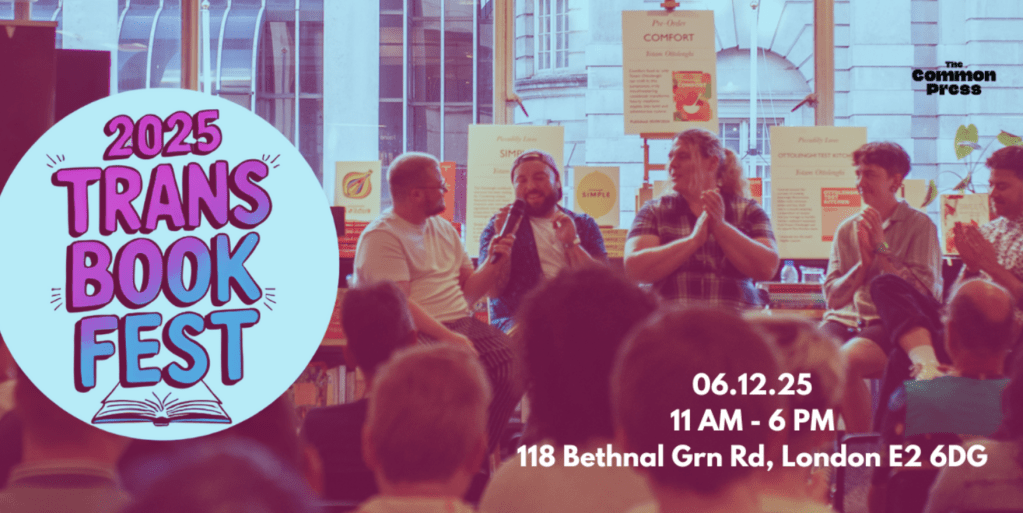
The blurby bit
The Co-sponsors
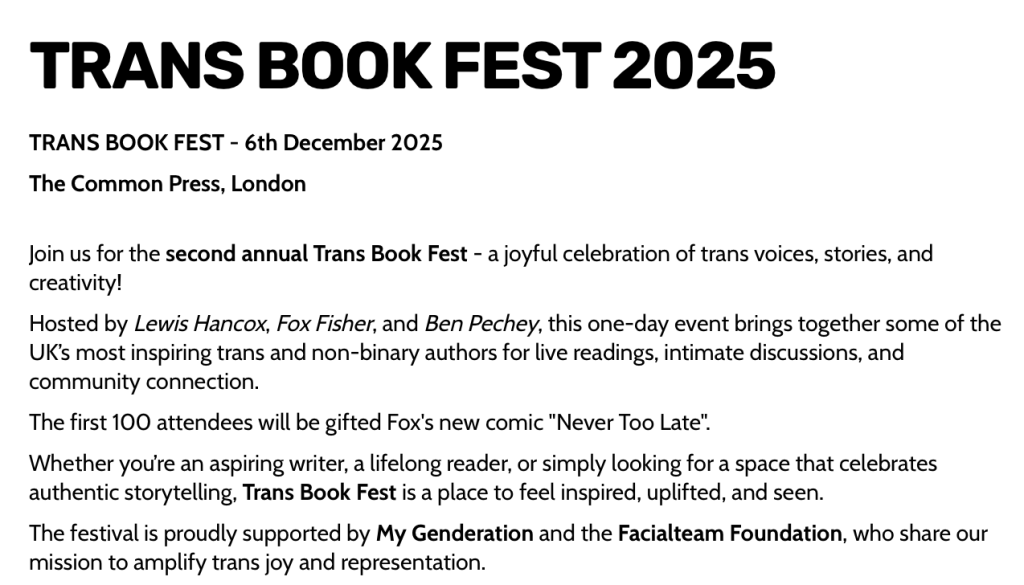
The event was co-sponsored by My Genderation, who my regular tweeps don’t need introducing to. If you do need an introduction, however, then I shamelessly recommend reading my review of their documentary Life of Kai. (I note the video segments comprising the documentary have now been made private and like to think I had something to do with that.) My Genderation have previously worked with Stonewall and multiple other agencies, including the NHS using their videos for training.
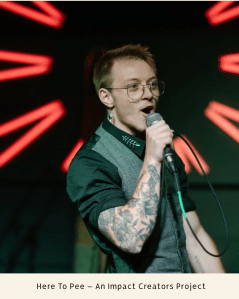
The other sponsor was Facialteam Foundation, which funds arts projects led by trans-identified people, including one called ‘Here to Pee’. Inspirational. I note they have previously helped My Genderation. The plastic surgeons behind Facialteam Foundation, specialise in facial feminisation surgery (FFS for short). Whilst visiting Facialteam, its business website, an advert popped up – the team would be in London soon (February 2026). Hence the logic in them getting involved with the Trans Book Fest held in early December 2025, I guess.

The room
Peeps were coming and going at the queer bookshop it was held in, in trendy Shoreditch, i.e. the epicentre of the trans mania. Attendees were as you’d expect, mostly dishevelled blue-haired student-types, sporting pronouns badges and keffiyehs, supping flat whites whilst nibbling vegan matcha cookies.
Three panels were held, the earliest one story-time for small children and the last on fiction. Around fifty seats had been put out, all of which were filled for the non-fiction and memoir panel I attended.
The panel
The panel comprised Morgan M. Page (he, of the Cotton Ceiling Fame), Lewis Hancox (one half of My Genderation), and Sabah Choudrey (professional whinger). All this was moderated by rent-a-gob Ben Pechey, who is also ambassador for the ‘inclusion educator’ – Diversity Role Models.
Pechey introduced himself as a they/them, with ‘strawberry blonde hair’, which was strange when we could all see he’s bleached blonde. Despite being an ‘award winning author, presenter, educator,’ the hand wringing began immediately. Things were so awful right now, and he was so very thankful that the other panel members had braved the mean boutique-laden streets of Shoreditch that morning to sit alongside him. Brave and stunning.
What drove you to share your voices, experiences and lives?
For my teenage self
Lewis Hancox, whose entire schtick is stuck on her emo teen years, albeit humorously, spoke about her graphic memoir: Welcome to St. Hell, an account of her time in secondary school. She told us she’d interviewed her friends and family and included these in the memoir, as she thought it important to get ‘other peoples’ perspectives.’ Talk to us like we’re ten, why don’t you.
Grifting
Sabah Choudrey’s book is Supporting Trans People Of Colour: How to make your practice inclusive. It had come about because Choudrey, who is an Asian trans-identified female on testosterone, kept being asked how she could be supported better and finally realised it would be better if it was ‘written down somewhere’. Hence, a Jessica Kingsley book deal materialised. Writing the book hadn’t stopped her from talking about it though (wouldn’t want the corporate work to dry up, would we?). She said the need for the book had arisen ‘from desperation’, describing herself as an activist who did things ‘right at the margins,’ but that she was also ‘a reluctant activist’ (not that reluctant, if you look at her website dedicated to the same). She needed to not be the only trans person of colour in the room.
History revision
Morgan M. Page described himself as a historian, in particular of the histories of trans people. He had been in the middle of making a film with his friend and collaborator Chase Joynt* and then the pandemic hit mid shoot. Joynt suggested they write a book together instead on the ‘trans classic’ Boys Don’t Cry (you remember, the film about the lesbian who hid her sexuality and was murdered when it was discovered she wasn’t a man). For Page, writing about this film and the story behind the film, was really about ‘trans activism in the 90s’ and that Teena Brandon’s death was a ‘real flashpoint for organising groups like Transsexual Menace’ and people like Leslie Feinberg (author of Transgender Warriors) and Kate Bornstein (Scientologist cum trans-activist). Writing the book was an opportunity to re-evaluate how they felt about the film and its female director, Kimberley Peirce (boo-hiss, apparently).
*Chase Joynt’s upcoming film is State of Firsts, a documentary about Sarah McBride’s election to the US Congress, you can watch the trailer – here. Page and Joynt also worked together on documentary Framing Agnes, which ‘breathes life into six previously unknown stories from the archives of the UCLA Gender Clinic in the 1950s.’
A bit of an aside
The boo-hiss jibe about the film director led me to look up some of the reviews of Boys Don’t Cry from the time, and this Guardian article, in which Kimberley Peirce was interviewed, appearing to believe that Brandon identified as a transsexual.
“I said to Lana, when did you first know that Brandon was a girl? She replied, ‘Oh, I knew the day that I met him.’ I thought if she knew when she met him, there’s no story here. Then she said, ‘No, I didn’t really know until that day Brandon told me.’ Then she said, ‘No I didn’t really know until later.’ “
Lana and Brandon had planned to run away together and when Peirce asked Lana if they meant to go as lovers or as friends, Lana replied, “As friends, of course, because Brandon was a girl.” But when Peirce mentioned Brandon’s desire for a sex change, Lana said quickly, “Brandon didn’t need a sex change, he was always a man to me” As Peirce says, “Whether Brandon is a boy or girl changes for Lana, sentence by sentence. So I have to ask myself, what can I trust? I can trust that she loves Brandon.”
Kimberley Peirce talking to the Guardian in March 2000 – Girls will be boys
Another article from February 2000, published by the Los Angeles Times, doesn’t mention transsexualism at all. Ditto, the review published by the New York Times (October 1999). Roger Ebert’s review, also published in October 1999, states that the film is nothing to do with transsexualism. I’ve never seen it, but I guess: one, I should, and two, the theme of transsexualism was never obvious.
In this interview from 1999, Peirce merely says that she was interested in telling a story about a woman who passed as a man and that she saw transsexuals whilst casting. Swank, however, mentions the word ‘transgendered’ (an incredibly rare phrase back then), refers to Brandon by male pronouns and talks of having the courage to be your true self.
I wonder to what extent Peirce and Swank were pressured at the time by crossdressing men into pushing the then burgeoning trans activist narrative? After all Michael Bailey’s harassment, the sexologist who dared write sympathetically about autogynephilia, was just a couple of years later.
Did the writing of your book reveal anything about yourself you didn’t know before?
Page had discovered that he loved to collaborate and that he and Joynt had written every sentence of their book together via video call during lockdown. It had also taught him to consider his audience more carefully, as not everyone attracted by the subject would enjoy his grim sense of humour. (He is a humour-free zone by the way, so not sure what this was in reference to.)
Choudrey continued to talk about how her book came to be. She had been asked by the charity Gender Identity Research & Education Society (more commonly known as GIRES) to write about the experiences of trans people of colour, as she was a regular on panels. Choudrey said this was in 2012 (in fact it was 2016) and that she was paid for the work. The pamphlet, which ended up being called ‘Inclusivity’, was published on GIRES’s website and is still available. An editor at Jessica Kingsley apparently read the pamphlet and was so impressed by it, he offered Choudrey a book deal. No wonder given her seductive prose:
DON’T PLAY ‘OPPRESSION OLYMPICS’
Being an ally is not about comparing who has a harder life, or comparing oppressions to other oppressions. Just because someone is trans doesn’t mean they know what it is like to be BAME, or that they can’t be racist. There is no winning or losing to who is the most oppressed. It’s possible for multiple groups to face oppression, don’t ignore intersectionality.
From ‘Inclusivity’ published by GIRES and written by Sabah Choudrey
Meg-John Barker (non-binary, Edward Lord’s missus, or perhaps ex- now) asked for Choudrey’s opinion on a book proposal and Choudrey realised that she too could do book writing innit, eventually publishing in January 2022. The biggest thing she learnt about herself was that it was difficult making the case that trans people of colour were not a homogenous group of people, whilst pontificating on their wants and needs. Rather than admitting it was therefore a useless cause, she said she was proud of the number of different voices included in the book, which included intersex people, indigenous people, disabled people and people of different lived experiences across the world.
Hancox found it therapeutic to write about the past and even developed a love for her past self and the town she grew up in. She had overshared, especially with regards to the details of her gender dysphoria. She thought at first to hide details of her girlhood, in case she might be seen as less of a man. Her publisher had been very supportive, especially of her drawings of her body and dislike of it.
Pechey, who has also written books (The Book of Non-binary Joy and Your Gender Book: Helping You Be You), said the worst thing was wondering if anyone going to read the book/care what you had to say. However, Pechey had found that people talked to him all the time about them! Like Choudery, Pechey is also a grifter. Sorry. ‘Reluctant activist.’ Some days were worse than others. Like, sometimes he just didn’t have the energy, you know? Others, he’s prepared to scrawl scarlet lippy around his big mouth and dress like Widow Twankey, to do gigs just like this. He wrote his first book in six weeks. He had felt the urgency then but he was a very different person five years on and ready to write another book. Hint, hint.
Things have changed, they’re more hostile now. Have you considered changing how you share yourself through your work? What toll does this take on you? This continual lived trauma.
Hancox: ‘Yes, it does take its toll,’ and claimed that people who watched her comedy shorts on YouTube often asked why she was playing a female character. Which is interesting as she describes herself as trans pretty much everywhere she is present and has posted numerous transition vlogs. Hancox also appeared in Channel 4’s My Transsexual Summer in 2011. She was ready to move on from memoir writing now and do fiction instead, wanting to include trans issues and characters in a more subtle way. Pechey claimed that he initially hadn’t realised Hancox was trans, inspiring Hancox to irrationally claim she’d been ‘stealth’ for years and thus it was only with the memoirs she had felt confident enough to present herself as ‘a man with a unique experience of being a teenage girl.’ Which, ironically, is something an AGP might also say.
Page understood how some people might feel the need to withdraw or retreat during such trying times. Trans people and transness was the lens through which he viewed the world and his friends, family (as in chosen, I guess) and lovers, were all trans. He wanted to make two horror movies in America but it was very hard for the dolls at the moment, and, despite having big names attached to the project, e.g. Lily Wachowski was producing, he could not get a callback. Currently he was making a documentary in the UK, about a 1970s feminist activist group (didn’t share the name) which had been funded in an instant, though did admit it had a trans element (of course). Page felt a sense of urgency, given the climate, to speak about things through the trans lens.
Asked to expand on the issue of trans oppression, Page responded that trans people were in a constant state of being discovered and that this happened once every ten years. This could be traced all the way back to the 1630s with Charles Hamilton, aka the female husband, (it was actually the 1740s, but hey). He saw troubling parallels with other time periods, for example Weimar’s Berlin, and thought these very strong at the minute, and especially the 70s. David Bowie apparently dated two trans women in the 70s (Romy Haag was one, not sure who the other one is supposed to be). Trans people had to go ‘stealth’ again during the oppressive Thatcher era, retreating into private support groups. Of course, no one in the audience was old enough to question this bullshit, so Page carried on unimpeded. Currently trans people were in the thick of it, but with his historian hat on, Page wanted to assure us that it would come to an end. Thus his advice was to ‘be out’, otherwise it would get worse.
Choudrey gave another meandering answer but interestingly claimed that she had given a talk the day before for a group of clinicians on how to make their practice more inclusive for trans people of colour. She is doing more corporate gigs now, giving out an ‘ew’, but – out the corner of her mouth – added: ‘Pays well.’ (Her website currently states she can only accept bookings with two months notice, such is the demand.) Pechey wearily noted it was where the money is, adding that he likes ‘dropping the C-bomb’ when doing such gigs, as he ‘doesn’t give a shit’, virtue-signalling to us, presumably, his distaste for capitalism and the young professionals he ‘educates’.
Choudrey is also a psychotherapist and boasted she’s adept at creating spaces comfortable enough for people to ask her difficult questions. Additionally, she is able to cope with their discomfort at her existence and I guess they’re equally as good at feigning interest. I know I am.
Was it discomfort which is stopping your films from being funded, Morgan?
Page informed us that not a single trans actor in Hollywood had had an audition in two years. Hurrah! Even big names, like Laverne Cox*, – nobody was getting work. He was hearing from people this was because it wasn’t ‘politically in right now’ to include trans characters and blamed cis het white upper middle class men being happy to ‘assimilate to the agenda being given to them by the **White House.’ It was also happening in the UK.
*According to Cox’s IMDb entry, Cox has four credits for the 2024-5 period and one upcoming project.
**Reminder, Trump started his second non-consecutive term on 20 January 2025, so this ‘two year’ thing didn’t start on his watch.
Post event, I saw that Lily Wachowski had a new sci-fi movie out with an all TIM cast. It’s called Dolls.
The utterly ridiculous outrageous decisions of the Girl Guides and Women’s Institute … how are you coping?
Lamented Pechey with faux outrage.
This was vis-a-vis the Girlguiding and Women’s Institute decision to comply with the Supreme Court clarification on sex, rather than face inevitable legal actions further down the line. Pechey said the Scouts had announced that anyone could join them, clearly unaware it has been a mixed sex organisation for decades.
Girlguiding’s statements:
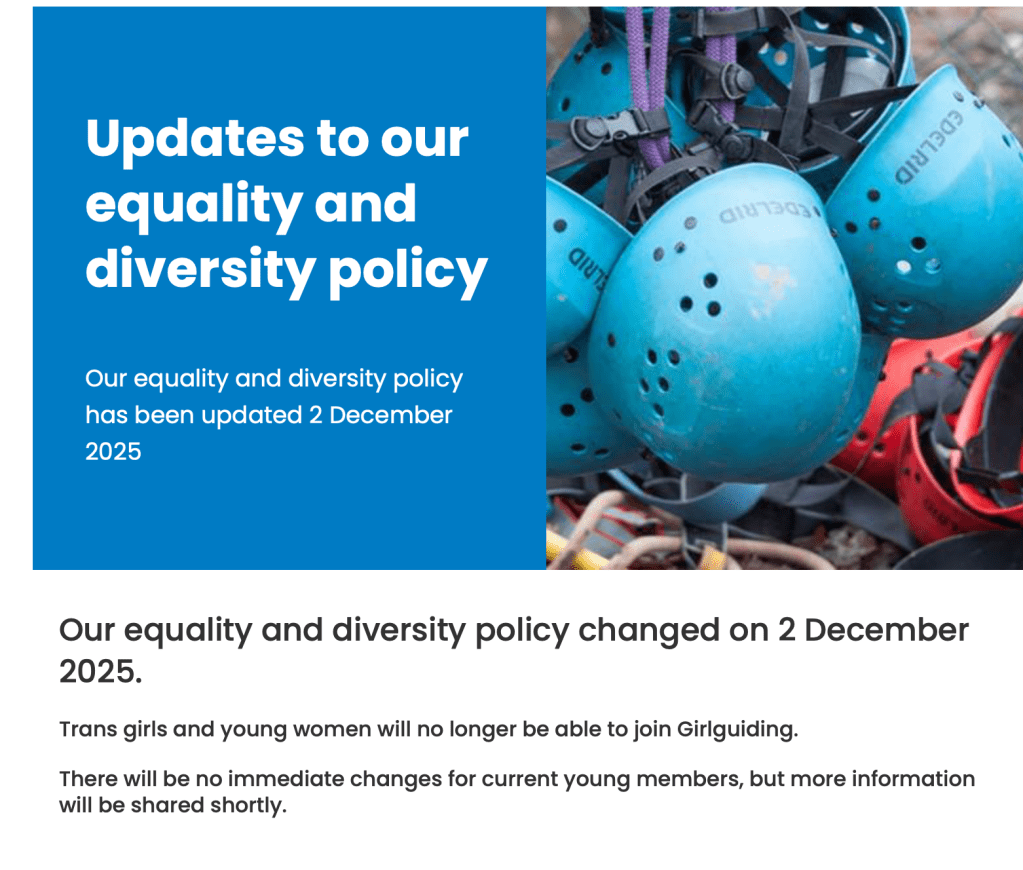
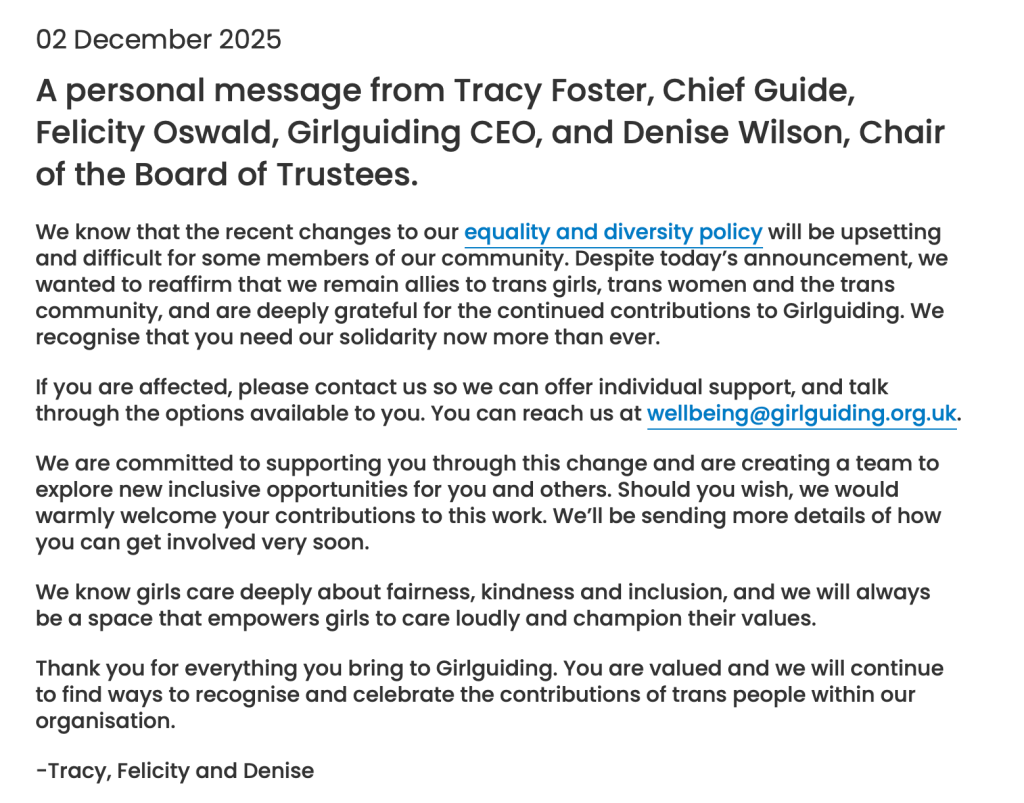
The Women’s Institutes statement:
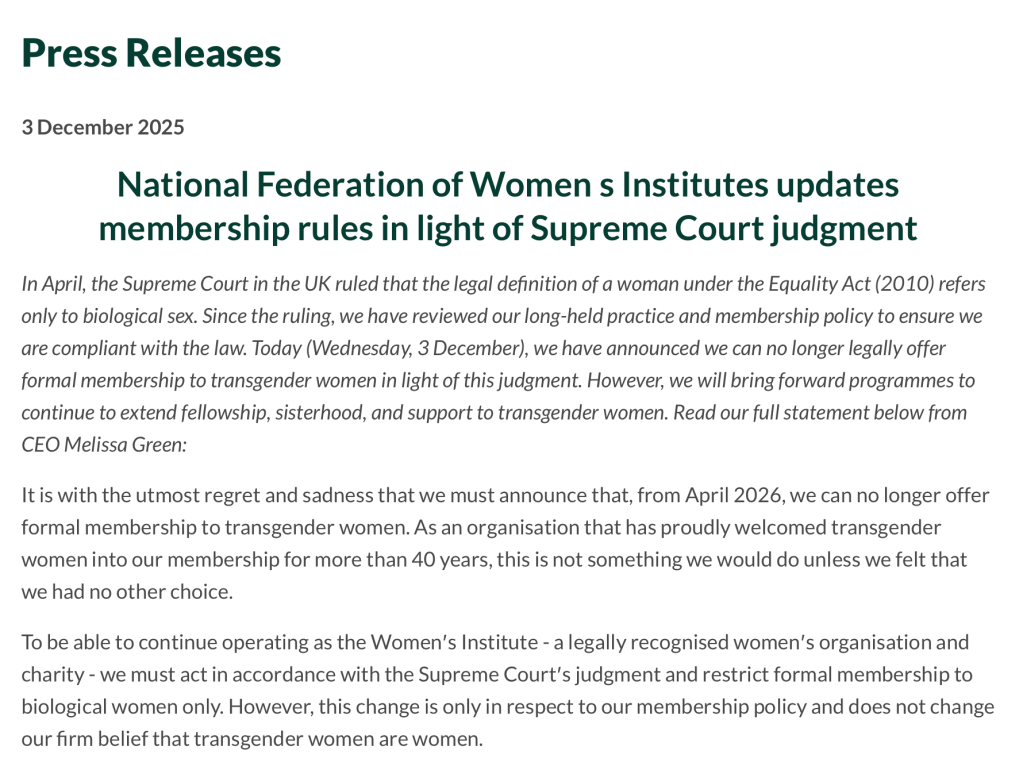
Pechey wanted to know how people were coping.
Hancox struggles to prioritise herself and had taken herself offline, even though it’s her entire bread and butter (again, a visit to her social media pages proves there is no real gap in her postings). In her everyday life, most people were supportive; don’t listen to the fear mongers. Pechey complained that Pink News and Gay Times published articles about Girlguiding, etc, but then ‘didn’t do anything about it’.
Hancox also returned to the criticism she had received for her representation of gender dysphoria (see below), stating that the illustration in the book had been taken out of context, and that it was to do with how she had wanted her girlfriend at the time to see her body, though surely she can’t have expected the girlfriend to see ‘an imaginary willy’?
Choudrey was ‘very angry’ about the decisions of Girlguiding and the WI, but failed to sound it. Nor did anyone in the room stir at all, regardless how many times it was mentioned. Choudrey said it would not make women and girls safer and moreover it was very invalidating. The trans satire which had arisen over the last few days critiquing the announcements were ‘chef’s kiss’. (Ahem, what satire? They have nothing, literally nothing.) She had learnt about the Girlguiding decision via a ‘cis’ colleague at the climate justice charity she works for, who had been equally outraged. She had since ‘journalled’ to get her through this difficult period.
Page said the community couldn’t be idle or rely on the Good Law Project and other such allies, people had to do things themselves. He had been a foot soldier in this battle for the last twenty years and felt the thing which would save people both collectively and individually, was getting organised with people you knew or people you didn’t. He recommended a book, Mutual Aid by Dean Spade, a trans-identified writer, because it was a how-to on activism and being proactive, rather than reactive. The community should also focus more on the positives and on the wins, e.g. celebrating when someone won the right to change their gender marker (which is easy to do across most of the West already for many years). Use your power, was his message.
Laila from Pride in Education was in the room. Pride in Education was running a campaign against the ‘very transphobic’ sex education guidance and she wanted everyone to sign the open letter to the Secretary of State for education and junior ministers. Pechey told us Laila could put us in touch with activists if we wanted to get involved in campaigning.
What’s bringing you hope?
Pechey started by telling us about his voluntary work with Diversity Role Models (DRM), which goes into schools. They often ask children to take part in blind straw polls, getting them to close their eyes and raise their hands. DRM then counts up the responses to gauge how supportive the children are of LGBTQIA+ issues. Over the last couple of months there had been cases where no one was raising their hands when asked if they would support a friend to come out. However, the last primary school he’d visited in Sunderland, which was quite socially deprived, every kid put their hand up. That gave him hope.
Anything which bought trans people together, especially for a creative reason, was inspiring for Hancox, like the Trans Book Fest, which she’d organised.
Choudrey wanted to remind everyone that trans people existed, even though nearly everyone in the room was trans. She wanted to see trans in films, even if was incidentally, like driving or waiting for a bus. This meant people could have the realisation, ah yes, trans people do do normal stuff too. Trans people have been around for millennia.
Page wanted to give a shout out to Trans Kids Deserve Better. This is now the umpteenth time I have heard a prominent trans activist state the same, they must all be in the same WhatsApp group. Page described them as his ‘idols’ and said that he was ‘obsessed with them’ (they are mostly teenage girls, I think), having attended several of their ‘occupations’ over the last year or so. It was also a reminder that adults needed to do much more.
Q&A
There was just a few minutes left for the Q&A. Someone in the audience wanted to name check the Trans Solidarity Alliance’s project, which was running its annual Trans Secret Santa, whereby anyone aged under 25 could receive a free gift (in exchange for sharing data, it appears).
One woman, who identified herself as Gen X and non-binary, was angry that ‘cis gay men’ didn’t believe in the existence of the blue hairs. She wanted to know how to challenge such wicked attitudes without losing her cool. Pechey also felt the pinch of not having his identity legally recognised and thus it was very easy to discount the voices of non-binary people, and compared it to the experiences of black and brown people in the 70s. He advised her to continue to be present as a non-binary person in those [?gay male] spaces. He also felt gay men needed to be reminded of all of the sacrifices trans people had made in getting them their rights. There was also the element that ‘big transphobia’ wanted division and polarisation. All unite against cis white men, seemed to be the message, because everyone else had a legit axe to grind and yes, the word genocide was uttered, followed by a plea to buy their books.
Conclusion
It was distinctly odd hearing Page beseech us to celebrate wins, because, just two weeks before the reluctant Girlguiding and WI communiques, it had been announced that puberty blockers were back on the menu for children expressing distress about their gender identity, despite the Cass Review deeming them unsafe and Wes Streeting pausing their usage in urgent response. Naturally the design of the clinical trial is seriously flawed and has trans activism’s sticky fingerprints all over it. Surely, that should have been a cause for celebration, at least for the panel? However, no one made even the vaguest allusion to the impending doomed medical experiment and thus the cognitive dissonance hung over us; celebrate wins – not that one – unspoken.
Thank you for reading! Sign up to my blog by going to the bottom of the page.
Please share on other forums if you liked it, as I only do Twitter.
 The Lies They Tell
“Pride in Education”? Did nobody google the acronym before choosing that name?
LikeLiked by 1 person
Ha! I read the bit about the Dolls movie and thought parody! But no, looks like ultra serious navel gazing and hog washing.
LikeLiked by 1 person