
The importance of ‘trauma-informed kink education’.
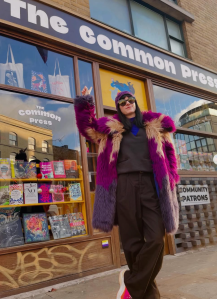
The blurby bit
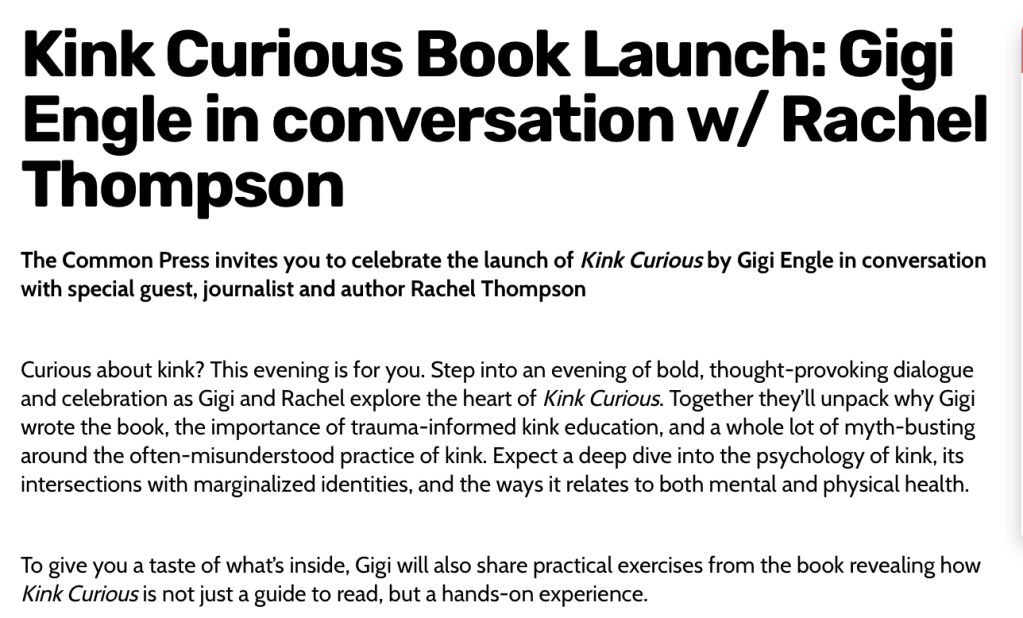
The author
Gigi Engle is an award-winning writer, certified psychosexual therapist, sex educator, and author, specializing in Gender, Sexuality and Relationship Diversity. Gigi’s work regularly appears in publications, including Cosmopolitan, Marie Claire, Elle Magazine, Teen Vogue, Glamour, and Women’s Health. She is originally from Chicago and is based in London.
From the blurb for the event
Gigle Engle is managed by Lover Management Ltd, who supplied the talking heads for the Barbican ‘Dirty Weekend’ I attended.
The interviewer
Gigi Engle chose a friend to interview her, Rachel Thompson, who is the author of Rough: How Violence Has Found Its Way Into the Bedroom And What We Can Do About It, the opening pages of which recounts her experience of being sat on by a man to the point she couldn’t breathe. It’s highly probable that the audience for that book is the same as for Engle’s.
The room
Lot of friends in the room I think, rather than people eager to learn about the subject per se, but I did lock gazes with a couple of swirly-eyed loons, which was unpleasant, if not unnerving. An official photographer was on hand to take a million snaps of the preening authors and there was a plethora of kink-related books on display, including a how-to on being a ‘bottom’. (Just taking it up the arse, surely?)
The discussion
Interestingly, the phrase ‘trauma-informed kink education’ wasn’t used much and I certainly don’t think Engle did a good job of explaining it. I guess I’d have to read the book, which I won’t, obviously, though did flick through to note that ‘having sex in public’ is brave and stunning. Hopefully, Engle also managed to point out it’s illegal. During Thompson’s opening preamble, ‘big tech’s censorship of all things sex-related’ was cited as being a stumbling block to gaining access to reliable sex education, ‘especially when it comes to kink.’
How the book came about.
Originally journalist Engle had an agony aunt column, which led to her studying to become a psychosexual therapist to work with ‘marginalised communities’, so wisely chose the cash-rich BDSM community. Her publisher (Jessica Kingsley, natch) invited her to write the kink guide and Engle wanted it to be informative. She began writing it whilst heavily pregnant and a ‘ton of amazing experts’ helped, many of whom had turned up that night.
What makes this kink guide different?
As already mentioned, Engle’s book is not the first how-to in the area of ‘kink education’ by any means, but she felt what set her work apart was that she had a unique perspective as a pyschosexual therapist, particularly as she specialises in seeing clients with this type of behaviour. The book includes exercises and journal prompts, so that people could map their ‘kink journey’, identifying specific kinks, with the aim of integration of the behaviour into daily life, thereby enabling people to live ‘authentically’.
In other words, it is simply an affirmative book, no use to anyone who might wish to rid themselves of an unwelcome compulsion or needing help identifying one as such.
The psychology of kink.
Engle went onto explain that the desire to understand the psychology behind aberrant sexual behaviour was due to social pressures and that really the best way to deal with the issue was to embrace it. For example, if you had a balloon fetish, this might well be something to do with having a sexual response as an adolescent to a balloon being popped. ‘Where your kink comes from isn’t actually what matters,’ Engle told us, what mattered was ‘integration’.
This was a needle-off-the-record moment for me. How can a balloon popping possibly be an enjoyable or normal sexual response?
The importance of being ‘trauma-informed.’
Kink play is an ’emotionally rich’ but ‘confusing terrain’ to be in. This was due to ‘social taboo’, of course, rather than normal psychological responses we experience in response to danger. For example, when engaging in ‘blood play‘ and other types of dangerous BDSM, we needed to ‘think about our triggers’ and ‘how to keep things grounded’ (a contradiction in terms and surely laying the foundation for vulnerability to coercion).
‘Aftercare’ (an unexplained term) should be practised in a ‘safe and contained way,’ which sounded much more exciting than I suspect it actually is, and, in the case of blood play, probably boils down to crossing fingers that you didn’t get infected with a dirty blade and won’t have to attend A&E with some faux explanation about a DIY mishap.
Being trauma-informed really meant understanding our bodily responses, understanding the nervous system and finding a way to be grounded, she told us, as if it were some sort of ancient yogic practice.
NB: There is no way ‘to understand’ the nervous system, other than that it is automatic and acts to alert us to danger. In terms of perception, there can only be narrowing in such situations, as it necessarily closes down to focus on a perceived danger.
The overlap between LGBT people and the kink community.
This was why I signed up for the talk, for the supposed ‘intersections with marginalised identities.’ Engle has a chapter in the book which explored the link between the ‘LGBT community’ and the ‘kink community’. According to her, the LGBT community were ‘responsible’ for ‘making kink what it is.’ I suspect that she really meant ‘gay men’, since lesbians aren’t famed for kinkiness and being trans-identified isn’t supposed to be anything to do with sex? (according to the official line anyway).
Engle had a weak explanation of why the ‘LGBT community’ were so influential: when you come from a marginalised community, you’re used to being othered and considered a freak, which meant you had the freedom to explore your sexuality more adventurously.
Or, we could just say that when men get together to fuck, it’s no holds barred? Seems a little bit more likely to me.
Mapping the erotic mind.
Based on the work of Jack Morin, Engle had included exercises to help readers map their own erotic mind, i.e. identifying the what, the why and, again, the how-to integrate it into your sex life. The more you know yourself, the less room shame has to breathe. Allegedly.
Thompson suggested that we could use the internet (remember, the one censoring our access to kink) to work out what we were into sexually. Engle backed this up, assuring us that however weird our kink might seem, an online forum existed and that the people in these forums were actually ‘pretty nice’. Hmm, ha, ha, ha.
Other recommendations were Pink Label TV (an ‘indie porn website’, according to Vice, whose output includes a staunch lesbian asking if she is really straight – groundbreaking) and Erica Lust (ditto).
It helps us be our inner child.
Engle wanted to make clear that she wasn’t talking about being a child.* No, she was talking about being a ‘playful and uninhibited version of ourselves.’ Kink is about consent and acting out fantasies in a loving way. What it is not, is abuse, nor a derivative of trauma, though she was forced to qualify this with a ‘by-and-large’, because clearly, if you get your rocks off from the sound of a balloon popping, something has gone extremely wrong.
*Though I’d like to make clear she considers role playing as a daddy (or mummy) with a daughter (or son) valid and authentic, going so far as to recommend it – see her article – What Is the DD/lg dynamic in kink?).
Did she find it annoying that people associated kink with trauma then?
Very much so. Just because one might enjoy extreme pain play, that did not mean that you had any trauma in your background, said Engle, rather dimly, claiming that participants viewed it as fun.
The trope of the dom as abuser was also ‘extremely annoying’ (I think she meant ‘inconvenient’) . Again, Engle believes that in a consensual BDSM relationship both dom and sub have equal power (which makes no sense whatsoever and quite bizarre that one would even attempt to argue for this). Don’t get into kink if you don’t like talking!, she warned. Of course, as we all know, people driven by the thrill of violence also deeply care about mental health.
The most annoying thing though was that abusers co-opted the language of BDSM to justify their behaviours. And while I’m sure there are online forums which explain how-to coercively control much better than Engle’s book, it’s slightly (okay, very) pathetic she failed to see that she also has a hand in such phenomenon.
Message to people new to the kink scene.
Engle hoped people realised they were not alone and thought that most people had sexual interests outside of the ‘socially prescribed heteronormativity.’ She also hoped people realised that kink was a very broad umbrella (sound familiar?), encompassing sensory play and any kind of power dynamic (that’s every human interaction, then). She thought most people had engaged in kink but hadn’t realised it and ultimately she felt her book is about self-exploration (which it obviously isn’t, if affirmation and integration are the only pathways offered).
Q&A
There wasn’t much time for Q&A but a couple of the questions were quite revealing.
Advice for meeting up in real life.
Engle recommended people look on FetLife (according to Wikipedia, FetLife sells itself as a social network, rather than a dating site) for their IRL events. There were also ‘great parties’ happening in London, for example, Klub Verboten (on looking at their website, vetting is strict and somewhat esoteric-sounding, and clearly highly exclusive) and Joyride (vetting sounds laxer but the organisers seem to admit there is a known problem with sexual assault, recommending you don’t attend alone). Great advice, Gigi!
How to suggest pegging to your boyfriend.
(For those who don’t know, pegging is commonly understood as the act of anal penetration of a man by a woman wearing a dildo.)
Engle suggested that the woman discuss first with her boyfriend what the power dynamic was going to be, interestingly suggesting first: Were they going to pretend she was doing it against her will, with him directing her how to do it? Or, were they going to pretend she was doing against his will?
Both sound like labours of pretension to me, even if the number of people actually wanting to do it is two.
What advice did she have for people fetishised on the basis of their ethnicity?
It was about comfort levels. If an individual was okay with someone having a race fetish towards them, then it was fine. However, Engle said, someone with a race fetish clearly had a lot of layers as to why they felt that way and such behaviour ‘veered into racism.’ Thus, a clear pivot away from the stupid mantra about all fetishes being fun, no matter how abnormal. In fact, Engle went so far as to say race fetish was ‘problematic and dangerous’.
Yes, I will point out the obvious. A lover asking if they can slice you open with a blade – absolutely fine and valid. Someone being overtly/covertly racist? Well then, that’s when you really need to worry.
Sticks and stones, won't break my bones, but names will always hurt me.
TRADITIONAL
Lies goes all agony aunt
Honestly, if you genuinely ever meet anyone who says they are turned on by balloons, then there are two options. A. The person really is turned on balloons, in which case, something traumatic happened to them. Or, more likely, B. They aren’t really turned on by balloons, rather exhibiting a pseudo-affliction, to camouflage a narcissistic and controlling personality. There are no third options, peeps, and never argue against logic.
It seems to me that much of this kink stuff is really about conditioning yourself and has a lot in common with how trans-identification arises (and how counsellors also identify it), especially with regards to those afflicted with autogynephilia via ‘sissyfication’, so I suppose we shouldn’t be surprised.
Thank you for reading! Sign up to my blog by going to the bottom of the page.
Please share on other forums if you liked it, as I only do Twitter.
 The Lies They Tell