
Juno Dawson sounded like he was sucking on a secret supply of helium.
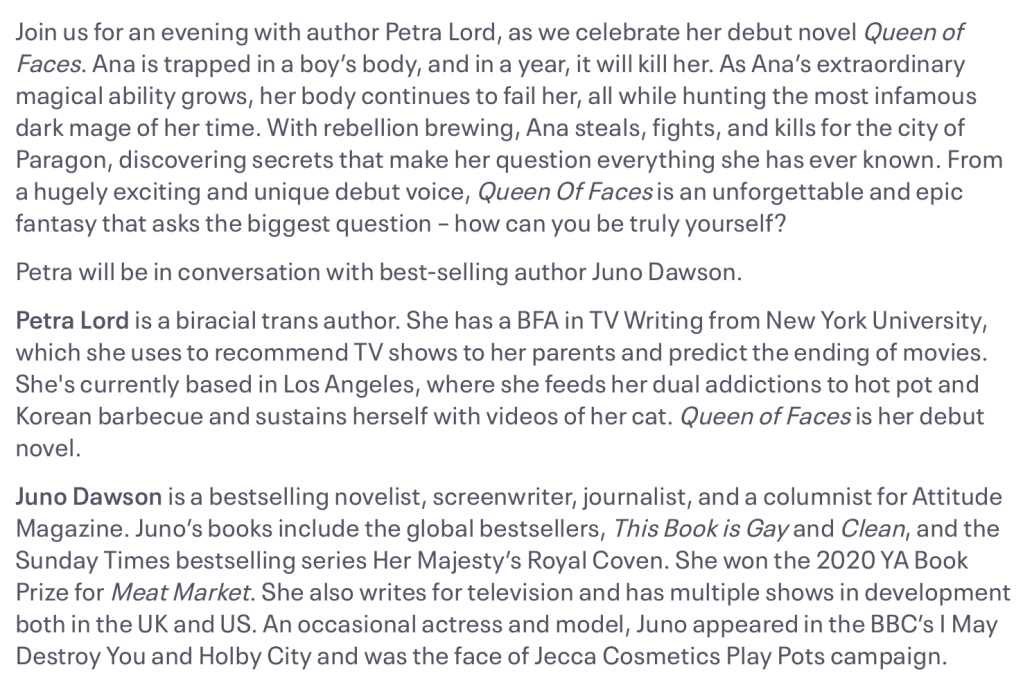
The blurby bit
The room
Not particularly a trans crowd, I have to say, but it was a nerdy bunch. Quite a good turnout. Mostly adults. Juno Dawson, who sounded like he was sucking on a secret supply of helium, described himself as an ‘anxious girly’, who’d had ‘panic attacks’ at events in the past, the last one conveniently being 12 years ago, before he transitioned (hint, hint).
Author on theme of book
Petra Lord began by talking about Caimor, the fantasy world his novel is set in. The basic premise of Caimor’s society is that people swapped their ‘pith’ (pith meaning either ‘soul’ or ‘identity’, but was never really clarified) into different bodies. Technically everyone could do this, but practically-speaking it was only available to those who could afford it. Hence, the novel’s main metaphor is medical/surgical ‘transition’. Lord’s main character is Ana, whose female pith is stuck in a ‘cheap defective’ (male-appearing) body, known as an ‘Edgar’, which is mass-produced, and – a bit like a white good – falls apart after a decade. Like so many fantasy novels, the setting is really England, or, more correctly, Lord of the Rings. One suspects that Harry Potter also played a big hand, given the importance of a magic school called Paragon, not that either dared mention her. There is also an eco-issue running throughout, as Caimor is subject to flooding.
Ana is a 17 year old trans girl. That is, a person with a female pith stuck in a male-appearing body, desperately seeking the congruence of a feminine one. Ana lost her original ‘feminine-appearing’ body due to terminal illness, and, because mama was poor and alone, the best she could afford was the cheap generic Edgar-model. The plot revolves around Ana’s attempts to find a new female body to live in, join a magic school and work as a mercenary, targeting political enemies. So far, so trans.
Ana’s main adversary is a character called Wes, who also has a female pith and also disguises herself in a male-appearing body, intent on revenge. Thus, everybody in the book who occupies the body of the opposite-sex is trans – a metaphor which doesn’t work, because like all things trans, the incongruence only makes sense when one recognises that biological sex is real. Moreover, Lord didn’t think through the ramification on a society in which no one can trust what they see, as, clearly, this would produce an extremely low trust society, rather than an okey-dokey one. The book is okay, as long as you don’t think about these things too much. I got through half of it but then something torpedoed my interest. I may return one day.
Lord began writing the book back in 2017 (i.e. two years after the trans tipping point) whilst an undergrad at NYU’s film school and posted early drafts online for free to ‘small but dedicated fanbase’ (sounds like my readership, phnarr). Then Covid hit and he started to pour so many hours into its writing, he developed nerve damage in his hands (hmm) and had to edit it down from two thousand pages to five hundred. He has now written two further books in the series.
Definitely not Harry Potter inspired, nope
When Dawson wrote Her Majesty’s Royal Coven, he was looking for a new magical world, because he felt one particular magical world was no longer accessible to him as a trans person (that’s right, a full grown man crying about an author’s personal views outside of her fantasy series). This tragedy lead to him thinking about magical schools which had had a massive influence on his life prior to Hogwart’s, and has realised that The Worst Witch books by Jill Murphy were actually a lot more influential on him. So nurr. Lord reluctantly admitted that he had been a Potterhead but likewise was also keen to float the idea that his magic school, Paragon, wasn’t an ersatz Hogwarts. Magic schools was a sub-genre and the nature of elitism was what made it an attractive idea to readers. However, Lord reflected, the sense of being rejected, or not being special, was a far more common experience, especially if we weren’t white, straight or cisgender (because we all know how uncommon those things are). Thus, he wanted to tell a story about a character who was not from one of the ‘chosen elites’.
‘Being trans’
Dawson then announced he wanted to discuss ‘being trans’, even though the first half of the conversation had pretty much constantly referenced this. He praised Queen of Faces for being one of two books about the trans experience, which dealt with the subject without being heavy-handed. The other one was Every Day by David Levithan. Lord had wanted the book to fundamentally be about the trans issue, and said it was inextricable from it, but didn’t want to use modern language to describe this phenomenon, in order to preserve the fantasy world. Dawson felt it made it accessible to ‘cisgender’ people, as they could engage with ideas about gender identity in a way which was easy to understand. (Which isn’t patronising at all, is it?) Lord agreed, he wanted people to read the book for fun, not for education.
Had Lord been mindful of the fact that novels which sell themselves as trans tend not to sell very well? asked Dawson. Lord repeated he just wanted it to be a fun story. Dawson opined that the trans conversation was toxic and tedious. In the UK there were front page headlines every single day about the trans issue. For example, the ongoing Ladies Pond debacle had been reported on that day and Dawson gleefully mocked women’s fear of male predators. Then he boasted how his novel, Her Majesty’s Royal Coven, did not have the word trans anywhere until about a hundred pages in, when one of the characters (presumably a trans one) beats up a girl. Dawson, encouraged by an indulgent audience, chuckled at his own cleverness.
Question & Answer session
Hands went up and Dawson, being the gentleman that he is, wanted to go for ‘someone I’m clocking as a woman first.’ The woman tediously confirmed that she was a ‘cis white woman’ but had a sibling who was gender-non conforming. Lord’s novel had opened up so many conversations with this blue-haired sibling. What was the one thing Lord wanted readers to take from the book?, she wanted to know. ‘Transforming yourself in mind or body is one of the most difficult, terrifying, things you can do, but it was also completely and utterly worth it,’ said Lord, clearly oblivious to the hardships of life and his lack of passing.
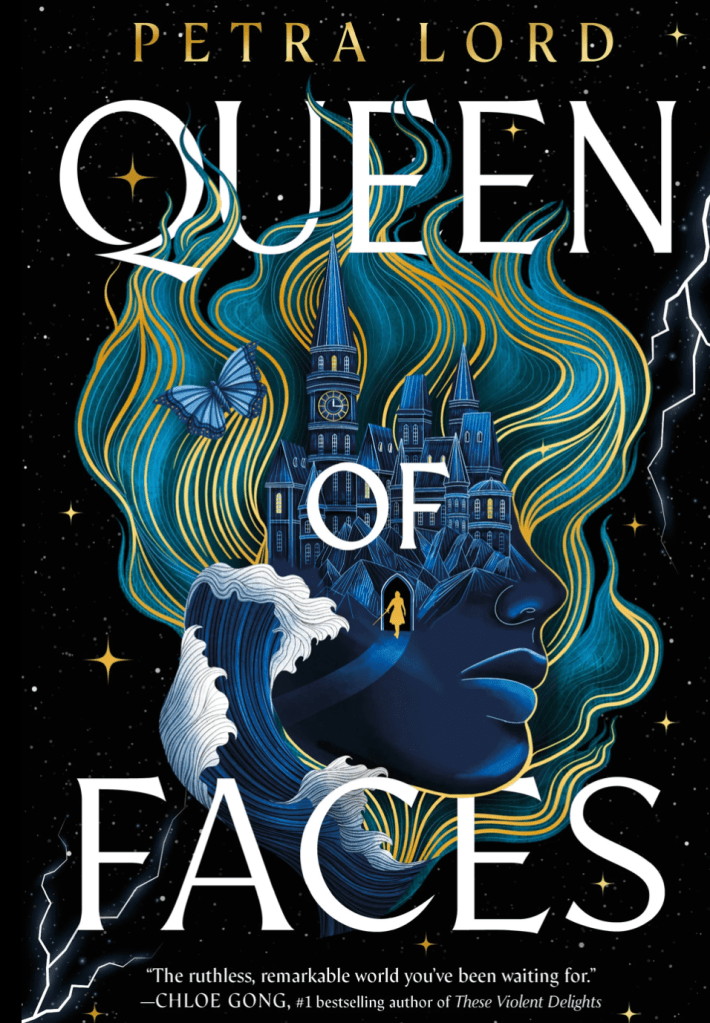
A man wanted to know how much input Lord had had into the book cover design (which, I think we can all agree, is pretty stunning and totally sold the book to me). Lord had stayed hands-off and only contributed a few paragraphs of his writing here and there, as inspiration.
How do you feel about other people (i.e. ‘cis’ people) writing about trans characters, an older lady wanted to know. She thought most were scared to depict trans characters, either due to making mistakes or accusations of appropriation. Lord felt that anyone could write anything, as long as you weren’t lazy or a bigot. What really mattered was ‘doing the research’ and listening to members of the community, reading their works and making sure you didn’t use cliches or lazy tropes. If you weren’t in the community, you were much more likely to leap to do this.
Dawson claimed that he quite liked it when ‘other people’ wrote trans characters because it took ‘a bit of the pressure off.’ Normally writers did it out of a sense of allyship. Dawson was aware though that as a writer he was appropriating other peoples’ lives all the time and that ultimately readers would have their own opinion (clearly limbering up for his Philippa Pearce Lecture later on in the year, titled “The Death of Reading for Pleasure and How to Prevent It“). He also revealed that he had been a sensitivity reader for various authors (presumably for the trans issue) but promised us that he really believed that people should write whatever they want, that he was against censorship and hopeful for the future. Altogether now, – aaah!
Thank you for reading! Sign up to my blog by going to the bottom of the page.
Please share on other forums if you liked it, as I only do Twitter.
 The Lies They Tell
You must be logged in to post a comment.