
A mediocre mind enlightens law students.
The blurby bit
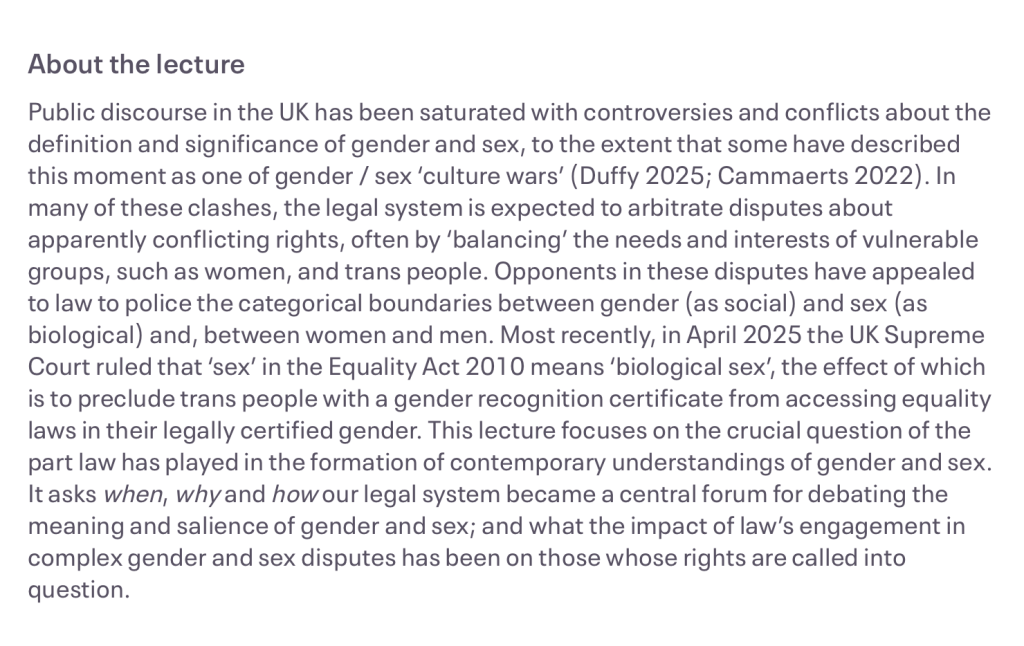
The man who introduced the speaker
Professor Carl Stychin of UCL, was the person who invited the speaker, Sharon Cowan, and is apparently ‘best known for his research on law, gender and sexuality.’ An eyeball of his papers is underwhelming. Stychin had known Cowan since she was a post-graduate student. He bigged up her queer- and feminist scholarship, noting achievements along the lines of ‘she’s looked at lots of things’ and also held many academic admin positions, which means, of course, she is multi-talented.
The speaker
Sharon Cowan is Professor of Feminist and Queer Legal Studies at the University of Edinburgh’s school of law. I have literally no idea how such a mediocre mind gained a professorship, but here we are. Looking through her publications, it appears she has two main interests, ‘queering’ the law and rape trials. Not worrying at all.
Shaz, as she will be known hence, told us in a nasal burr that she had a Glaswegian accent. A patent lie, since not only was she entirely legible, she had less range than a fridge-freezer. I nodded off several times, saved only by the distraction of a rather ugly and hairy trans-identified male sat in front of me, who wore pink and twirled his hair to signal gender euphoria. Shaz, however, wore a black boiler suit and a face made for the phrase ‘cheer up, love’.
*I have previously written about Cowan before, back in 2021, when I was rude about her voice that time too and she’d made about as much sense.
The room
Mostly law students from UCL, I guess, and well attended. The room felt entirely compliant, apart from one woman who gently asked some probing questions at the end. The lecture was also streamed live, so it was probably a couple of hundred people in all, in attendance (at least that’s what the list on reception looked like, being quite a few pages long).
The talk
In the beginning …
Shaz was there at the beginning of it all, i.e. the 2004 Gender Recognition Act (GRA). There had been a Telegraph article titled: Gender is no substitute for sex. (In fact, the article is no such thing, rather a jokey piece written by the Telegraph’s sketch writer, worth reading, especially for a dig at a young David Lammy, being unsure about sexual reproductive anatomy.) Anyway, Shaz appeared to think it a monumental article on the GRA, and although it’s true that the proposed bill slipped under the radar at the time, surely she could have a found a more serious (?feminist) critique to direct law students to?
Thus, in 2005, Shaz wrote an article with her own response to the GRA, and titled it, as the Telegraph sketch writer had, ‘Gender is no substitute for sex’, but added the snazzy ‘A Comparative Human Rights Analysis of the Legal Regulation of Sexual Identity’ as subtitle. It is 29 pages long and published by Feminist Legal Studies. Interestingly, the title suggests she thought it to do with ‘sexual identity’, which, of course, it is. In the paper, she argued that the proposed Bill was flawed as it required sex/gender changes be permanent and because of its ‘continued pathologisation of transness,’ due to it referring only to two sexes and thus binary. In other words, Shaz was ahead of the game, foreseeing a time when a multitude of genders would spring forth …
Mythical, almost mystical power of …
What Shaz is most upset about though, is the ‘mythical, almost mystical power’ of biological sex. She had thought that this power might dissipate over time, wryly noting a theme tune from youth that ‘things can only get better,’ but, in fact, hadn’t. Two decades later, how to define sex and gender legally had not disappeared, bewailed Shaz, citing the media reportage of the numerous legal cases (to undo the effect set in motion by the GRA).
Shaz’s main argument appeared to be that progress had been stalled. For non-binary people. Because wimmin were spending so much bloody time worrying about the trans! Queer emancipation was key.
Mentioning the unmentionable
Shaz mentioned some legal challenges, for example, holding gender critical views in the workplace, access to changing rooms, etc, but not the cases themselves, e.g. Forstater, Darlington nurses (wouldn’t want to overload law students with the relevant, I suppose). Shaz categorised this as people ‘intent on excluding trans people’ from specific services and the right to express bigoted views (she didn’t actually say bigoted but clearly meant it). You’d think a legal academic might welcome people using the law to debate contentious issues, but Shaz saw it merely as ‘argumentation’ which had resulted in ‘exclusionary legal and sociopolitical effects on queer and trans people’ and ‘narrowing of trans people’s rights.’ All because sex was far more quantifiable.
Then she got onto the For Women Scotland judgement, without even mentioning For Women Scotland, assuming that the audience had not come to learn about the subject from scratch and that we were all supportive of her position. She did, however, admit that the Supreme Court deemed that sex in the Equality Act 2010 meant biological sex. This meant, Shaz claimed, that persons with a GRC were no longer protected under the protected characteristic of sex under their legally certified gender. Moreover, such persons with a GRC were now to be treated as if they were a person of their ‘birth sex’ and bemoaned that a ‘trans man could have a same sex marriage with a cisgender partner’ but she would be classed as heterosexual under the Equality Act. (Seems fair enough to me. And I’m sure Shaz is fine with it being the other way round.)
Was this compliant with human rights laws? questioned Shaz, such as the right to private and family life as per article 6 of the European Convention of human rights? (See, she was capable of quoting the salient, when convenient.) She felt the scope of Article 6 covered ‘harmonious psychological and bodily integrity’ and the right to ‘consistent and coherent, rather than fractured and fragmented private and family life,’ and referenced the Christine Goodwin vs UK case, which had eventually led to the formulation of the GRA.
Absence of trans people’s voices
Trans people hadn’t been consulted, Shazzer whined, whereas Sex Matters and LGB Alliance had. (I suppose this might be something to do with For Women Scotland being a Ltd company and bringing a private prosecution?) Also, no one had considered how defining sex as a binary would affect people with DSDs (Differences in Sex Development), who weren’t mentioned in the judgement (because they are still either male or female), nor were non-binary people (same).
Although the Supreme Court were merely clarifying the law, admitted Shazzer, they had neglected the ‘interpretation and narration of the law’, in that they hadn’t listened to trans (activists, basically). Indeed, its own starting view had been that ‘trans women’ were not women, since ‘If sex means certified sex how can an organisation consider the needs of, or disadvantages to women separately to men?.’* This meant, said a shocked Shazzer, ‘a trans woman who had certified her sex, is a man.’
*A point Shazzer unwittingly made herself later in her presentation.
Of course, trans activist judge, Victoria McCloud had tried to intervene in this case (helped by Garden Court Chambers and the Trans Legal Clinic), his application was denied and he is now taking it to European Court of Human Rights). Shaz reflected that currently the judgement stood and we were ‘stuck with it’ but that it was trans people of all genders who would bear the costs, – ‘economic, psychological and somatic.’ Not only that, service providers had already started obeying the law, whereas previously they hadn’t. This marked a downturn for the rights of the gender-addled.
Worsening attitudes
A 2023 British Social Attitudes survey had shown that people were markedly less positive to transgender people over the last few years, with 64% describing themselves as not at all prejudiced, which was a decline of 18 percentage points since 2019. Plus, an independent expert for the United Nations for the trans lobby, had expressed concern about ‘the levels of misinformation feeding political, social and legislative debates in the UK.’ Shaz might also have mentioned this person was Victor Madrigal Borloz*, whose main focus was on ‘colonialism as one of the root causes of violence and discrimination.’ But hey, what does it matter?
*Borloz, a lecturer at Harvard Law School, appears to have just two published papers in his name. Impressive, or what?
Our Shazzer is sex-obssessed …
… but who isn’t? Shazzer’s main bug bear though was that sex was ‘grounded in normative assumptions’. You know the sort, men have willies, women fannies. This, according to Shaz, is an assumption ‘steeped in deference to the medical knowledge and a culturally-produced hetero-cis norm framework about body shapes …. which categorises each of us according to legibility within that framework.’ Another assumption was that true biological sex was chromosomal and could never be changed but not everyone was xy or xx, doncha know.
Sex was much more complicated than obvious anatomy or imperceptible chromosomal markers, opined Shaz and determined by a number of variables, these were: genitals, gonads, hormones, chromosomes, the brain and, most recently, genomic sex. (Basically Shaz had unwittingly counted both sex chromosomes and hormones twice in her little list.)
18th Century trope
Shaz spewed the ‘sex was only discovered in the 18th Century’ trans activist lie, explaining how British had introduced this idea to the world via her colonies. Although sex was all made-up, the binary delusion of sex was hard to shift; it was all a big conspiracy to exclude trans people (i.e. men) from certain (i.e. women’s) spaces. Trans people sometimes called this ‘bio segregation,’ said the sex non-believer approvingly.
The inevitable Judith Butler quote.
‘It is as if merely acknowledging the idea of gender, somehow denies the reality of sex,’ said Shazzer, finally quoting Judith Butler. Sex realists denigrated the meaning of gender to only one meaning: gender identity. This negated the decades of work done by feminists on gender, demonstrating how gender is conceptualised as a social construct.
Corbett v Corbett
Several word salads later, we learnt that the world was full of binaries, demonstrative of our limited understanding of the world. How did sex get so entrenched in our legal system? Corbett v Corbett, reckons our Shaz. (Basically the judge deemed that April Ashley was male, not female, and therefore, according to the law at that time, the marriage was simply not legal. Crucially it was deemed that Ashley was not entitled to maintenance payments.)
Shaz was overwrought by the fact that the judge in the case, Sir Roger Ormrod, had, according to his obituary in the British Medical Journal, been awarded a Fellowship by the Royal College of Physicians, and also held a degree in medicine. He was co-founder of the British Academy of Forensic Sciences, said Shazzer conspiratorially. Ormord has been credited with developing the law on no fault divorce and also apparently commented that surrogacy was ‘irresponsible, bizarre and unnatural’. (So all round good egg, then.)
Shaz was also annoyed that gender crits referenced the case and pointed out that it was now over fifty years old, implying it was outdated. Corbett v Corbett had even been mentioned in the Forstater case, said Shaz, mentioning Maya Forstater’s employment tribunal by name for the first time, well over thirty minutes into her lecture.
Sex discrimination isn’t about sex …
… it had expanded to include gender, argued Shaz. Gender is experienced by an individual and is expressed and performed outwardly. (Like wearing black boilersuits and no smile, eh Shaz?) The For Woman Scotland decision had contracted the meaning to just mean sex discrimination, which hadn’t taken account of how gender norms were performed. For example, said Shaz, hoping to sound reasonable, caring responsibilities often fell to women, this wasn’t due to their biological sex, but due to the expectations upon them for their gender. She explained further, it wasn’t because they were female, but because of the social scripts and stereotypes assigned to gender. (Shaz clearly can’t see the circular nature of this argument.)
Why are people going to the law to resolve the conflict between sex and gender?
Why would a law academic even pose this question, as if it were a problem, you might ask. Moreover, Shaz wanted law students to think of the claimants in this area as a nuisance problem and for them to think about instead ‘who was choosing not to go to law’. She had a new project starting in September which would address these questions (funded by public money, I’ll bet). She left us tantalisingly on this point and I guess we’ll have to tune in, folx, for what happens next but it sounds very much a re-run of Davina ‘Thickie’ Cooper’s project – The future of legal gender, which aimed to write sex out of the law entirely, which, if I recall correctly, had been funded by EU money.
The only thing left to do was a call to arms to the assembled blue hairs to take up queer theory within and outside of the the law to smash the cis-het capitalist fascist state, yeh. (Very much paraphrasing here, but it’s basically what she meant.)
Question & Answer
What is your definition of gender and sex? What is your definition of transgender and transsexual? How do you account for trans people who advocate for both the definition of sex and gender? And, if gender is real, why can’t trans-identified males simply be regarded as feminine men?
Shaz was ready on her back foot, querying why anyone would want to know what her definitions of sex and gender might be! However, she was able to reveal that she didn’t feel the need to have any concrete definitions for either because she was only interested in how other people use them, thus no need for her to understand them herself. Shazzer felt that sex could mean something biological about the body but also that persons who had undergone surgery to their genitalia and secondary sex characteristics had a new biological sex. She clearly didn’t feel comfortable expanding on the salient, so starting talking about her upcoming project instead, which was going to focus on why the word gender took over. Also, because Shaz doesn’t identify as trans, but as cis, (one and the same, AFAIK), she wasn’t able to comment on how a trans person might define themselves.
Shaz claimed to not understand the point about gender reaffirming sex, though, to be fair, she probably doesn’t, so the questioner re-explained:
Gender is on a spectrum, where you travel from masculine to feminine, whereas sex is either male or female. So, if someone transitions, for example, from masculine to feminine, why do they then require to claim that they are now female, rather than having a ‘feminine gender identity’ recognised?
Shaz couldn’t answer the question, because – as a slapped face cisgen in a black boiler suit – it wasn’t her experience of the world. However, her understanding of trans people and equality law had shown her that transgender people wanted to live a congruent life and this meant something different to each individual trans person, such is their uniqueness.
What do you think of the work of Davina Cooper, i.e. getting rid of sex and gender in law? What would the social implications be?
Even with a question asked by someone on side, Shaz still didn’t make much sense. She thought Cooper’s project was really interesting and had been thinking about it for some time: What to do with sex and gender? (These two things being something, she herself cannot define.) But, said Shaz, if we can’t define these two things, then how would we track inequality? But there again, when you use categories, you also enshrine those ideas as legit factual things. Time to go back to the drawing board.
How does the Supreme Court decision affect sexual orientation? It obviously isn’t possible to have an attraction to a gender recognition certificate?
Shaz said that if you believed that sex was biological and binary, it still trapped you in the binary world of the heterosexual versus homosexual. This was a limited and bizarre understanding of human sexuality and it left out, for example, asexuals and was regressive.
Whoops-a-daisy
Although Shaz is obviously very much a gender essentialist, she was essentially hobbled in her presentation by the fact that sex and gender are different and even had to say as much herself, several times, particularly her ridiculous assertions regarding women and trans-identified people both being ‘historically oppressed’ groups. Did the students in the room notice though, that’s the question?
Thank you for reading! Sign up to my blog by going to the bottom of the page.
Please share on other forums if you liked it, as I only do Twitter.
 The Lies They Tell