
A thoughtful documentary too invested in queer theory.
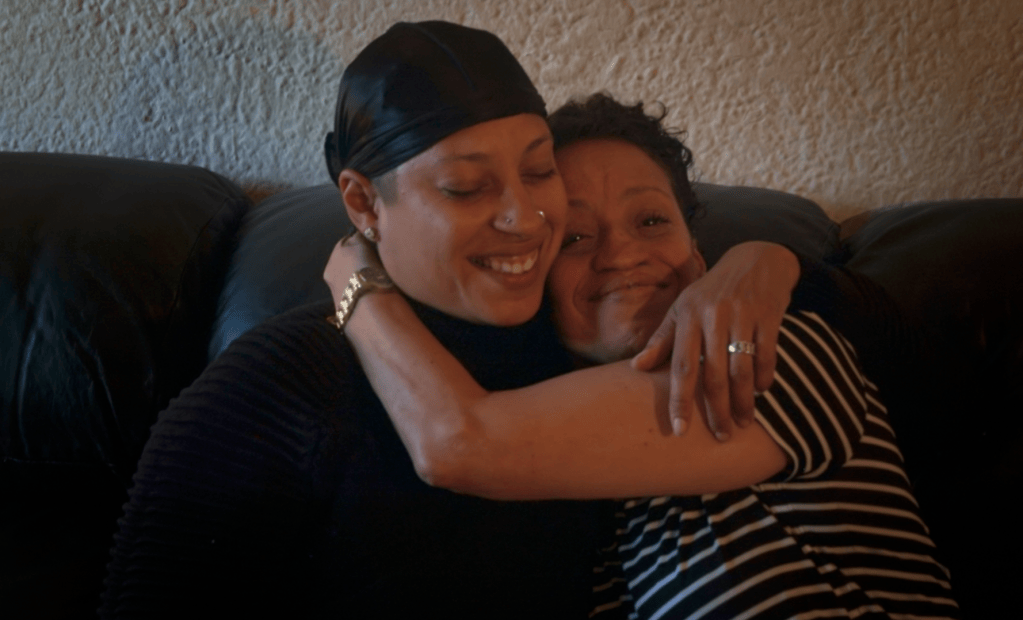
The blurby bit
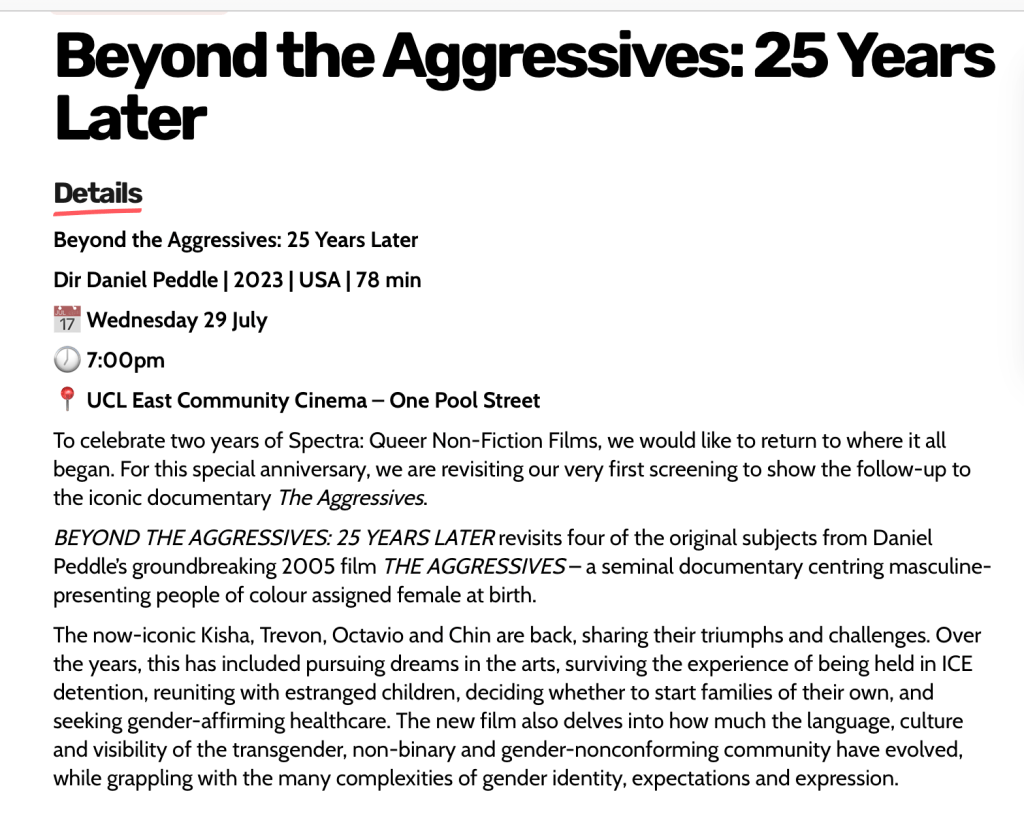
Introduction by director, Daniel Peddle
Daniel Peddle began by explaining how he, a white man, ended up documenting the lives of non-white butch lesbians living in New York during the 90s for his documentary The Aggressives (not released until 2005). He’d been at film school and a struggling artist, making ends meet by scouting modelling talent on the streets of New York and kept scouting the same person again and again, ‘a good-looking dude’, Kisha Batista (who has really never looked male at all), who features heavily in the first documentary. Whilst hanging out with Kisha one day, he was introduced to her friends, women who referred to themselves as ‘aggressives’ or A-G. Peddle claims to have thought they were guys and, being confused by the term, he finally asked someone to explain and was told ‘aggressives’ were ‘masculine-presenting people of colour, queer, assigned female at birth.’ It was a lightbulb moment for Peddle who started to film the same night (the year was 1994) and continued for six more. Peddle claims he saw hundreds of ‘aggressives’ for casting (I find this slightly eye-stretching, given the era, but okay) before settling on the final six who feature in the documentary. It was supposed to be a fly-on-the-wall but he found himself making friends with his subjects. Meanwhile he was struggling with his own demons, coming out of the closet (as it really was known back then) and a failed suicide attempt made him realise he had to finish the documentary off. At that time he had not given much thought to the fact that he was white and his subjects weren’t, but does now. With the follow up documentary – the subject of this review – he wanted to do something more collaborative and hopeful. But again, it took him another six years. When his religious conservative father saw the film, he told his son: ‘Your movie made me realise how hard it is to be a human being.’ Which is a nice summary I think, because Beyond the Aggressives really does highlight how hard it is to come from a background fraught with poverty, conflict and lack of education, with the story of Chin’s imprisonment by ICE (Immigration and Customs Enforcement) an absolute scandal.
The review
So, let me start by saying that this is an excellent documentary on a technical level (photography, sound design, etc) but also in the way Peddle has observed his subjects, allowing them to open up. It looks back quite a bit at the original documentary footage of the women as teens. Of course, the main shift is that back in the mid-90s, the word ‘trans’ wasn’t in usage yet and most were simply butch dykes, and I wonder to what extent they leaned into being ‘aggressive’ or ‘A-G’, simply because Peddle was pointing his camera at them. I asked a friend if she had ever heard of these terms, either at the time on the scene, or since. She hadn’t, and neither have I in all the years I have been writing around this issue. Was this simply because black working class lesbians really were invisible? Or was Peddle’s film the co-creator of this sub-culture? Or perhaps it was just a New York thing, limited to one club which ran every third Tuesday night? I suspect it is six of one and half a dozen of another.
Kisha Batista
The main subject of the first documentary, Kisha, is now a professional photographer and we see her carrying out a photoshoot of trans-identified females. These TIFs provide commentary at the start of the film, setting the tone for what’s to come, and in its closing moments, defining what Peddle would like to finally emphasise; that gender identity ideology is truly progressive because of its ability to create new gender identities and subsequent neologisms.
These TIFs, many of whom have taken testosterone to masculinise, yet protest being ‘in touch’ with their feminine sides, describe themselves as queer (the L-word not being mentioned (at least not positively)). They are there to testify to the importance of the original documentary, opining they have no interest in labels, whilst liberally using the same, and trotting out ridiculous mantras about ‘transcestors’, etc.
Kisha no longer sees herself as an ‘aggressive’, nor really as trans, being clearly the most feminine of the lot, back then and now. It’s also hugely significant, that of all Peddle’s subjects, the one who didn’t transition is stabler and more confident than the others, having taken up photography and art, with far fewer ongoing issues. It’s of note though that Kisha appears to have not had a serious long term relationship (perhaps because she too attached to the idea of herself as a Lothario?).
Trevon Haynes
Post the initial documentary, Trevon set goals for herself, one of which included taking exogenous male hormones. Nowadays she doesn’t see herself as an aggressive but as a transgender male/non-binary, her previous identity as an ‘aggressive’ due to being told she was aggressive (which makes sense, given the real antipathy towards butch lesbians at that time). She has not yet had bilateral mastectomy and would like to be flat-chested but is uncomfortable with the scars it would leave behind. (I wondered if she was also concerned about losing nipples, given how common this is, but it was not mentioned.) Trevon is emphatic that she does not want to go from one uncomfortable state to another.
Trevon does have a stable relationship though, with Jay (a former lap-dancer), who is into dating ‘aggressives’. One gets the impression that Jay would like to describe herself as heterosexual but since Trevon identifies as non-binary, this isn’t really possible, and there is an underlying tension between them as to their respective gender roles. There is also a jaw dropping moment where we learn they want to have children together; Trevon wants to provide the eggs (age 36) and Jay to gestate the child (age 32). The egg extraction does not take place though, since Trevon can’t afford it, working extra hours doing DoorDash to pay for Jay’s buttock reconstruction surgery (which had been overinflated to a life-threatening degree). Later Jay returns from Turkey, having had multiple face procedures and almost unrecognisable. Trevon reflects that, as her mother died of AIDS aged 12, she is used to looking after other people.
We learn that a gynaecologist recommended Trevon have a hysterectomy for cervical cancer but Trevon put off investigating this further due to being ‘misgendered’ when she called around clinics. Later we learn that it apparently wasn’t cancer but abnormal cells and, again, Trevon remonstrates how difficult it is to visit a gynaecology clinic as a man. She expresses sadness that she won’t ever be a mother. There is no reflection as to whether the exogenous testosterone caused the abnormal cells/cancer.
Octavio Sanders
Octavio was a street kid, whose parents were drug users. We see her in the original documentary describing herself as male and reporting that many of her friends have ‘changed gender’. She had wanted to, at that time, but couldn’t because of her young son. Her son was adopted by her aunt and she faced family rejection due to her ‘lifestyle’ (I presume this to be drug using and sexuality, but it is not clarified). After her aunt died, she had a chance to rekindle her relationship with him.
Now, in middle age, it sounds as if Octavio has done several stints in prison and finally reformed, retraining as a mechanic maintenance worker. She has been considering the virtues of transition in the intervening time but kept off doing it because of her son. However, now he is adult and gives his blessing, she pursues ‘top surgery’ and testosterone, the effect of the latter being more or less immediate, as she goes from having a soft face to an aggressive one (the irony of her being an ‘aggressive’ again, 25 years later, was not lost on me) and has the typical arrogant swagger of many a testosterone-infused woman, with a ‘pat on the head’ attitude towards other women and a sense of grandiosity verging on the absurd. Octavio also claims, rather illogically, that changing your outward appearance doesn’t change who you are on the inside but that she had to do these things in order to feel comfortable with herself. Post ‘top surgery’ Octavio loses her fiancé, who had liked her due to her femininity.
The son is also interviewed and it is clear that it is difficult for him to have his mother identify as male and he keeps calling her ‘mom’ (which she accepts) but does use he/him pronouns for her. It is decidedly uncomfortable.
Chin Tsui
When Peddle catches up with Chin Tsui, he discovers that she is being detained by ICE for 15 months already. We are told that she is being held in solitary confinement because she is transgender. The poor woman is clearly broken and Peddle literally her knight in shining armour, because, up until the point he turns up, no one is aware of this rather questionable detainment. The nub of it is this: she lost her social security documents and, when she got a new job, had a fake ID made up using her real social security number that she lost. But a fake is a fake and ICE swooped in and took her.
In the documentary it is starkly put that the solitary confinement is discriminatory due to Chin’s transgender identity. Did Chin demand to be treated as a male? Were there concerns about putting a woman loaded with testosterone in with other women? We don’t know and the documentary utterly fails to address these rather moot points. On researching, I discovered that ICE officials argued they genuinely did not know whether to house her in the male or female estate (Irwin County Immigration Detention Center is a mixed sex facility) and solitary confinement was administrative segregation, rather than punishment.
Chin has also been denied proper medical care in regard to his identity. At times he has been given the wrong dosage of medically necessitated testosterone, at incorrect intervals, or even denied it completely. One time he was given a bottle of medication that was not even his.
The Plight of an Asian Trans Man in Georgia Embodies ICE’s Cruelty, 31 May 2019 – The Advocate
Of note, it was the Transgender Law Center (TLC) who stepped into resolve the case, and its own article about it confirms that Chin was moved from solitary confinement to the female estate. So clearly the TLC does understand safeguarding issues and begs the question as to why it campaigns for gender identity to trump sex, which puts dangerous men into women’s prisons, with its robust support of California Senate Bill 132. Nevertheless, one can quite agree Chin’s detainment is utterly shambolic but it does highlight the dilemma officials face when forced to accommodate badly made policy (now rescinded under the current Trump administration). Again, this is something the documentary should have clarified.
After Chin’s release, it’s clear that she is still in dire straits emotionally, physically and economically, sofa surfing with family, chain smoking and working a low paid dead end job. We learn that her mother walked out when she was very young, never returning, and had been mercilessly bullied by her grandmother for being ‘ugly’ whilst she was just a small child. Her sister and father are supportive, however.
Queer theory is not progressive
Despite Peddle’s flex that the progressiveness of gender identity ideology (aka queer theory) liberated these women, they are just older and a little bit wiser. Less angry. Time has worked its natural effect, basically. Obviously Chin Tsui has fared worst, since, as a direct result of trans activism’s impact on detention policy, she experienced 18 months of unnecessary solitary confinement. These women, born with the deficits of poverty plus childhood trauma, ran head first into queer theory when they came out. ‘Beyond aggressive’ they might be, but they’re still chasing their own tails.
Thank you for reading! Sign up to my blog by going to the bottom of the page.
Please share on other forums if you liked it, as I only do Twitter.


You must be logged in to post a comment.