
Was there a more bittersweet song in the 80s than ‘Smalltown Boy’? Possibly only ‘Dancing With Tears In My Eyes’ …
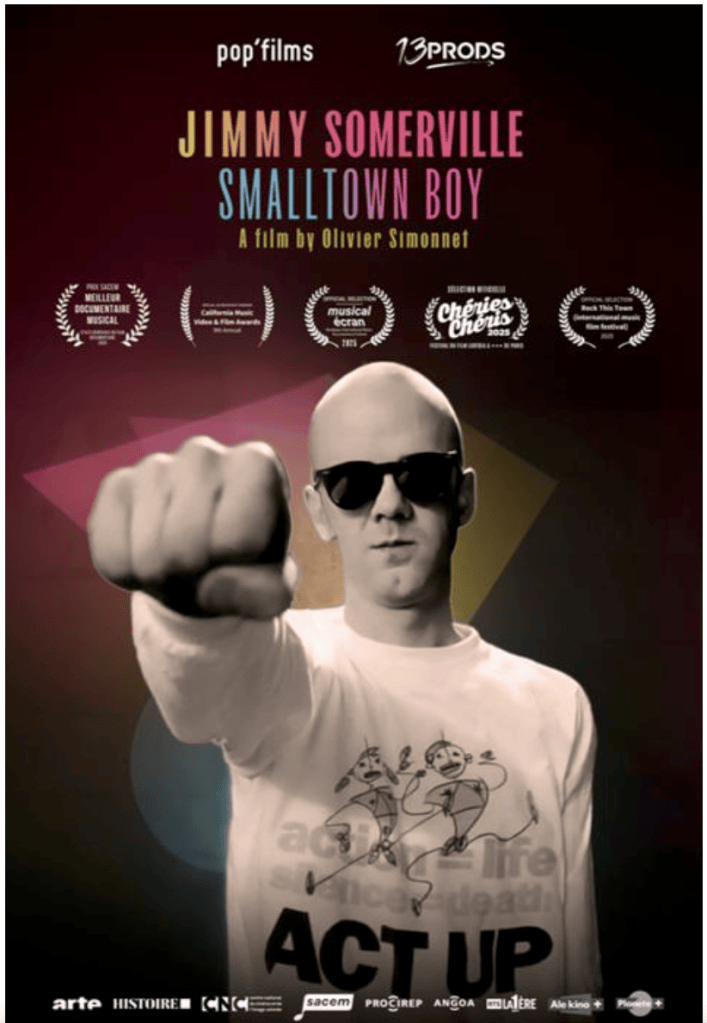
The blurby bit
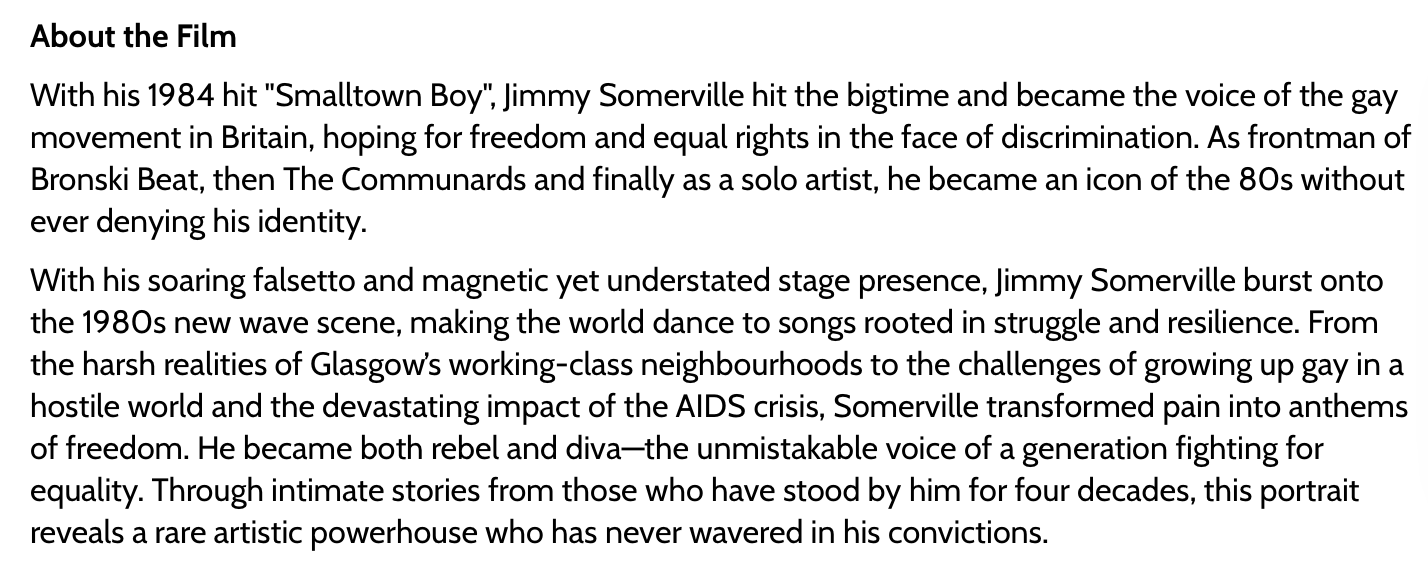
Wee Jimmy
So, a bit of contemporary background on wee Jimmy, the ‘worst and most shocking of traitorous gays’ as a good tweep of mine bluntly put it. Somerville disallowed LGB Alliance to use Smalltown Boy on a video it produced of its annual conference (apparently the song was used as walk-on music and now removed), stating that LGB Alliance was ‘anti-trans’. However, he obviously did give the thumbs-up to the piece of cack below.
As you will note, this a ‘queered’ re-release of Smalltown Boy, which removes the line ‘cry boy cry’ (see around the 3 minute mark), presumably ‘de-boying’ the song to appeal to enby boys who hate their own maleness, or, more likely I think, avoiding upsetting angry little manlets (aka trans-identified females). There is a nauseatingly heavy use of the trans tricolour throughout.
Worse still is the schlock above which bats for trans activism (age-restricted so you will have to sign into YouTube to watch) ending with an endorsement for Stonewall UK, no less, by Somerville himself. As per usual, people who oppose puberty blocking for children are presented as bigots. How did Somerville fall so far from grace? What is even ‘homophobia’ to him, if teenagers and vulnerable adults end up chemically castrated just to avoid being seen as homosexual? And was it a sign of how ludicrous the documentary was going to be?
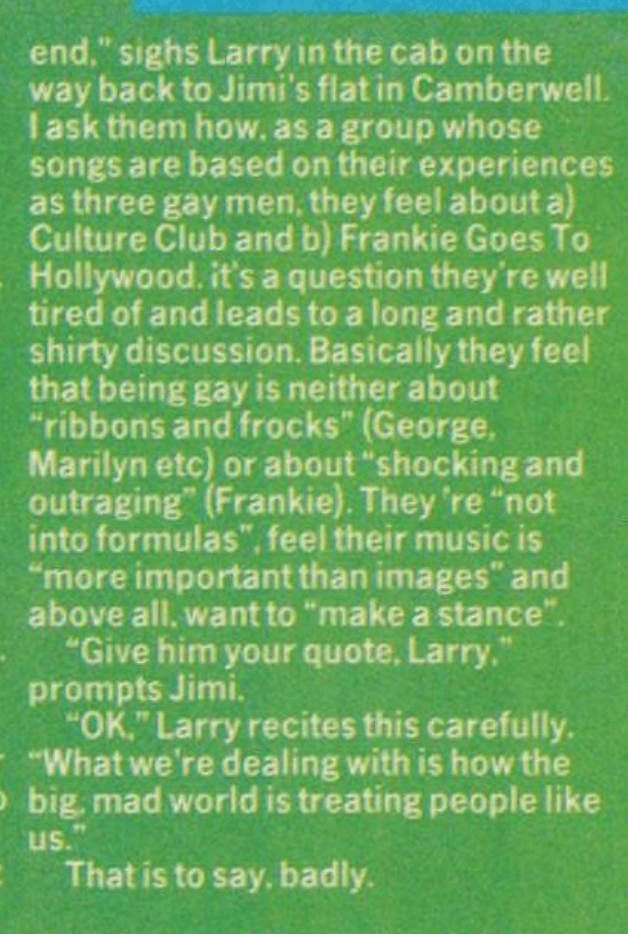
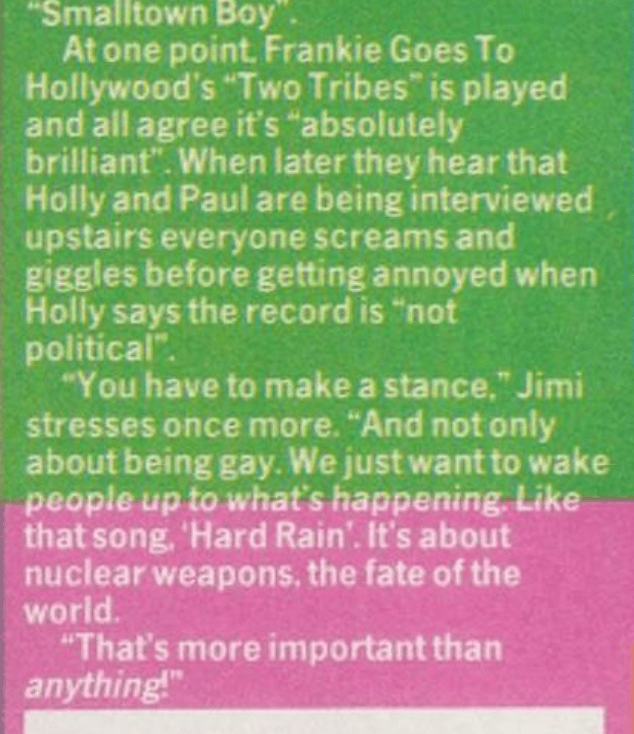
Ah, memories. Above are excerpts from Smash Hits magazine (a formative literary experience for moi), published in June 1984, which perfectly exemplifies Somerville’s holier-than-thou attitude towards other gay pop stars at the time. Smash Hits was, I recall, quite merciless though in describing him as ‘potato face’ and ‘Tin-Tin’ back in the day.
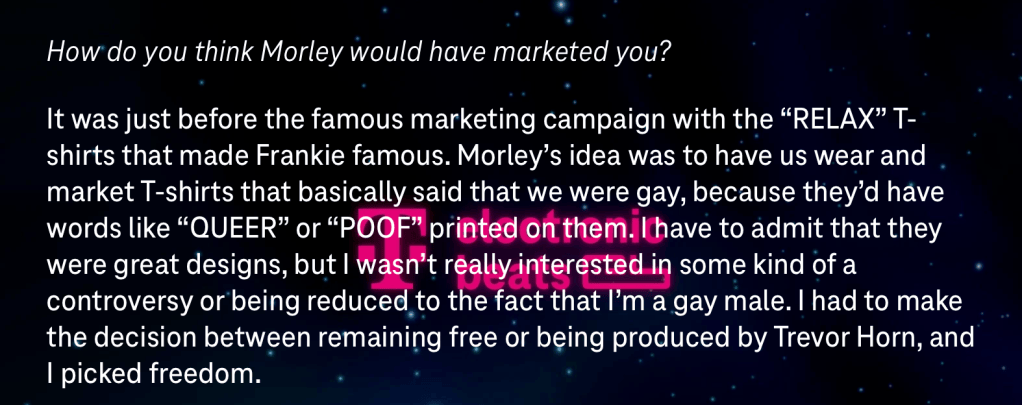
Jimmy did consent, however, to being marketed by Colin Bell, of London Records, as a ‘normal’ gay …
Anyway, on with the review …
The documentary is okay, I think, and not too queer-washed*, but suffers from two stumbling blocks. One is major, as Jimmy himself refused direct involvement, though did allow friends to be talking heads. Therefore, the only thing we have of the most reluctant pop star ever are a few uncomfortable interviews held at the time.
*This is the purpose of all my reviews, by the way, if you are not one of my regular tweeps.
The other problem is the reliance on Smalltown Boy itself to carry quite a part of the documentary, when Jimmy should have been a far more interesting subject (which feeds back into they couldn’t get him). It’s an undeniably powerful song, which speaks to anyone who ever felt like they didn’t belong. Which is everyone. It would have been interesting to have had some contemporaneous footage as to how it affected people, in the absence of Jimmy’s input.
So, lacking Jimmy to give any specifics as to how Smalltown Boy arose (he wrote the lyrics), we are instead given a contemporary scene inside Gay The Word’s bookshop, with a woman, probably born around 2000, saying she could connect with the song because she once left home (probably ‘escaping’ to university to be a blue hair) and stood on a train platform with a suitcase. Seriously.
There is also a moment where it is claimed that Jimmy Somerville did something other gay popstars didn’t do by being officially out, which felt a tad petty, given he was literally riding on the coattails of (perhaps not officially out but really out there) gay popstars, like Boy George, Marilyn, Marc Almond, Freddie Mercury and Holly Johnson, all of whom trail blazed before him. (But that is so Jimmy, and probs why he got given the moniker ‘potato face’.)
At the panel, we learnt that the filmmakers felt that there needed to be a connection between the gays of yesteryear and the queers of today, hence Tom Rasmussen (35 years old) pops up to mumble something-something-trans-rights. And that pretty much, give or take, is the totality of queer-washing in the film, as otherwise it focuses on Jimmy’s political activism for gays and raising awareness about AIDS. Of note, right at the end, Sarah Jane Morris, says that society is getting more right wing again, leading to more ‘racism, sexism and homophobia.’ It felt significant to me that that was left in, given how sensitive trans activists are to being left out.
Jimmy emerges as an intensively shy man he clearly is but we don’t learn that much more. During the panel it was said that his talent for singing was discovered when a flatmate, who was a filmmaker, overheard him singing in the bath. Which speaks to a working class boy living it up with bohemian types and would have been a far more interesting story. But if your subject won’t comply, I guess you have a find a better way and this wasn’t it.
Thank you for reading! Sign up to my blog by going to the bottom of the page.
Please share on other forums if you liked it, as I only do Twitter.


Jimi/Jimmy, potayto/potahto. Won’t be rushing to see this despite the song being an absolute classic.
LikeLiked by 1 person