
It’s teapot time at UCL. Again.
The room
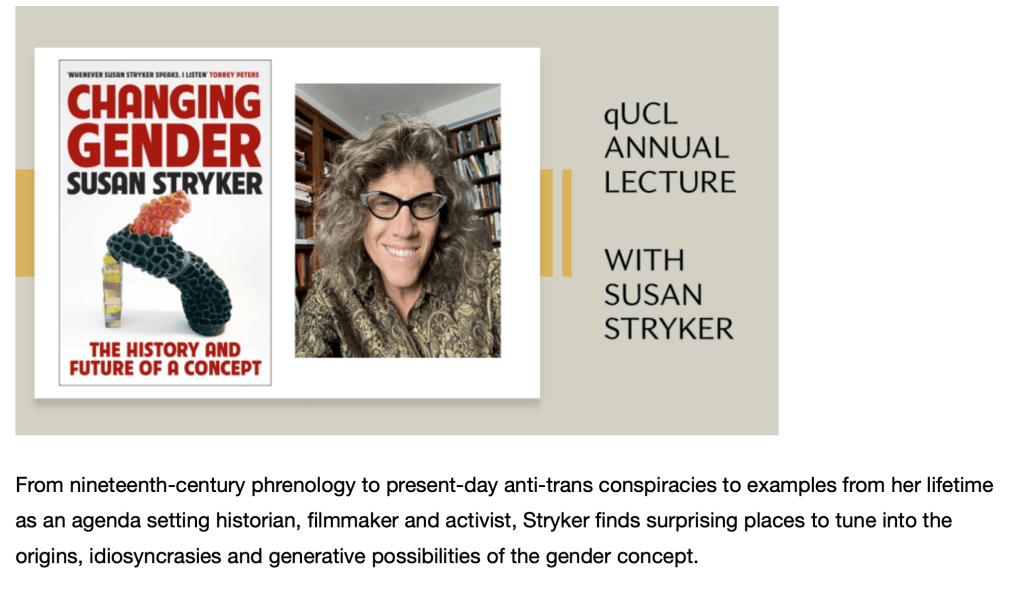
Full trans activist turnout for Susan Stryker’s lecture about his new book: Changing Gender: The History and Future of a Concept. Trans-identified luminaries included, in no particular order, Zoe Playdon (P vs Cornwall), Morgan M. Page (cotton ceiling jerk-off), Jaye Hudson (BFI film programmer), Pippa Catterall (University of Westminster), EJ Scott (Museum of Transology), Roz Kaveney (Auntie) and non-binary extraordinaire Dr Ronx (former BBC presenter/A&E doctor). I’ve not seen for Ronx for ages but they was reliably over-animated. Bless. And these were just the ones I could put a name to. Many other familiar faces. Stryker is a big hitter, folx.
qUCL
Xine Yao, who co-leads the qUCL group, introduced Susan Stryker. (As an aside, Yao once described my sarcastic tweets -read by literally dozens of people– as a threat to academic freedom.) Yao wanted the audience to know that she hadn’t been able to release the details of Stryker’s lecture until very close to the time because they had to ‘make sure the audience was as safe and collegial as possible’. Now, she did fairly trip up over her words, since she was thinking of the incident at UCL in 2025 – see: We watched activists disrupt a ‘gender-critical’ meeting dressed as clowns.
Yao and Stryker go way back and met when she first came to London several years ago. Yao had been particularly impressed with how Stryker had ‘smacked down’ someone who had asked a ‘not in good faith’ question, which also neatly served as a warning for the lecture that evening.
The speech
Stryker began with a little word game – from the Latin word to respire, there were many derivatives –, inspire, transpire, conspire, aspire (but failed to mention the ultimate – expire).
Changing gender wasn’t about sex or gender change, Stryker explained, it was about ‘changing gender as a social system’, i.e. being affected by cis-het patriarchy due to ‘unchosen aspects of our own bodies.’ Bodily autonomy, obviously, being top of the list in priorities for this brave new world. The book was a mix of literary styles and his book tour 25 events long in over 20 different cities.
The word ‘gender’
For this lecture, since it was being held at the academy itself, he was going to focus on the concept of gender. What did the word mean, how is it used in different contexts, how it has changed over time, how it is changing now and how it needs to change further still. Interestingly, the idea for the book came to him when he attended a talk given by Matt Walsh (an American right wing commentator, who co-created the excellent documentary What is a Woman?). Stryker described Walsh as ‘Jordan Petersen without a PhD’ and people dutifully tittered, despite the fact Walsh was almost certainly an unknown to them.
Matt Walsh, according to Stryker, had said: ‘I have no use for the term ‘gender’ in the first place. Unless we are talking about the gender of words, masculine and feminine words, which is where this term originates. I see only males and females, men and women.’ Then Walsh starting ‘riffing’ on ‘gender ideology’, which Stryker regards as a ‘vacuous buzzphrase’ signalling ‘hostility’.
The current accepted narrative
Walsh had continued: ‘Gender ideology was invented by people and we know who those people were. All five guys. They were paedophiles most of them. Everything The Left says about gender arrived from a very small collection of degenerate perverts, like John Money and Alfred Kinsey. These guys invented all of this. You can read the book and watch them inventing this. It is a construct.’ (You’ve got to give it to Walsh, when he’s right, he’s right.)
Stryker regards this view as the ‘orthodox history of the gender concept’, i.e. that the word gender had strictly been a grammatical term which then became deliberately associated with [biological] sex, either as a synonym or as a social construction of sex. Walsh had simply parroted what has come to be the accepted narrative on gender, however, during Stryker’s year of research on this topic, he was now able to reveal this narrative was simply empirically wrong …
However, even Stryker had to admit that John Money did play a role, describing him as carrying out ‘medical research’ into transsexuals and intersex conditions but downplayed and did not mention the main controversy regarding the *Reimer brothers, saying instead that Money had his ‘reputation clouded by credible accusations of unethical conduct with his subjects’. Then he admitted that it was 1955 that Money published articles where gender was used in relation to sex and identity, rather than grammar, and reiterated Money’s theory of gender roles, i.e. that behaviour can be indicative of how one perceives one’s own sex (e.g. wearing lipstick, as a man, might indicate presence of a lady brain). Importantly, Money’s main idea was that surgical and medical treatment could help such individuals (hence his enthusiasm on performing surgery on David Reimer in the first place (who had not been intersex or gender dysphoric, but a victim of a botched circumcision).
*Money serially raped the Reimer brothers and both ultimately committed suicide.
Stryker continued, explaining how Money had, in turn, influenced other sexologists, psychologists and sociologists, etc, including Dr Richard Green and the setting up of the first formal gender identity clinic at John Hopkins. At the same time, homosexuality was being depathologised and feminists had also started to theorise on the subject [of gender roles]. Janice Raymond’s seminal book, critiquing the medicalisation of transsexualism, The Transsexual Empire, was published in 1979.
This ‘standard story’, said Stryker, omitted the contribution that trans people had made to this history and the development of feminist thought. For example, said Stryker, Virginia Prince (a transvestite man who created a secret society for crossdressers), had published ‘peer reviewed works’ which argued for the separation of [biological] sex from gender identity [stereotypes associated with biological sex] arguing that it was a ‘new semantic position’. Prince had a PhD in pharmacology and significant influence over the work of psychiatrist Dr Robert Stoller.
Pivot to revisionist history
The real history, Stryker informed us, is that gender has always referred to words and people and well before the 1950s. This was the point at which Stryker went from making some sort of sense, into sending us all into a trance, with his dissembling on the boundaries between words, e.g. ‘the precipitation that becomes snow, the snow that melts, the meltwater that moves to lower elevation, the tributary, which then becomes a stream’ and into an ocean, etc. Utterly meaningless twaddle.
With regards to grammatical gender, Stryker asserted the most prevalent use of this related to the living and the lifeless, rather than masculine and feminine, which made it sound like perhaps he doesn’t understand tenses and/or the difference between accusative and dative. Who knows? All I know is that he had gone well into woo-woo, failing to create a sensible or believable alternate history/argument, eventually having to resort to citing the fad of phrenology. In short, Stryker used the fact that 20th Century intellectuals were obsessed with identity to prove that gender identity pre-existed Money’s discrete invention of it.
Stryker also claimed that American Indian cultures were proof that ‘diverse’ genders existed in pre-Western times. And, of course, the trans activist standard misuse of the Simone de Beauvoir quote. In other words, he has brought absolutely nothing new to the conversation, rather just repeating the chatter of trans activism ad nauseum.
Cybernetics, Stryker reckons, also has to do with ‘biological systems’, in that it relies on a feedback loop. Norbert Wiener’s book (see Wikipedia link) Cybernetics: Or Control and Communication in the Animal and the Machine explained how both systems were underpinned by similar mathematical principles (Wiener clarified in a later book that human beings have agency and aren’t that much like machines). John Money’s gender theory was little more than the cybernetic theory, said Stryker. Plus, Money had studied in the same academic department which set up the first study into cybernetics (which sounds like coincidence to me). Stryker’s pleas sounded like a lame attempt to ‘eruditely’ advocate for transhumanism.
The history of gender was also closely associated with the use of psychedelics, like LSD. The dudes who pioneered genderism also experimented with these drugs (as did most bohemians who made up the ‘tune-in and drop-out’ generation). Money was a regular user, surprise-surprise. Harry Benjamin, another sexologist pioneer (Stryker referred to him as ‘the father of transsexualism’), would dose his patients with acid to see if their gender identities remained stable. Oddly, this factoid drew much laughter, but when I asked Mr Google if there was evidence for this, a blank was drawn. Benjamin obviously did, however, treat his patients with entirely arbitrary doses of exogenous cross sex hormones.
Hormones, Stryker pointed out, was another means for taking control of oneself and altering identity, and used in much the same way that people use psychedelics. The CIA had used it to brainwash. American Indians had used such substances in religious rites. Thus, gender, cybernetics and psychedelics were all linked, appeared to be his argument. I have no idea how this related back to his assertion that gender, as a theory, had pre-existed Money’s invention of it, but perhaps that bit is in the book? Not only that, he admitted that gender ideology had travelled around the world off the back of the United States’ soft power and via powerful institutions, like the UN.
Gender is not biology. Now, as always, gender is the human practice of attributing meaning to difference. To the creating and relating of categories of objects defined by cultural beliefs. It is about shared conventions that change shape to show which category objects belong to, whether those are change shape things or words, or whether they are women and men […] gender is not a false ideology stolen from grammar and foisted onto people. It is a collective practice of transformation and liberation, that we can undertake at any time, and there is no time, like the present.
Susan Stryker, 19 October 2026, closing remarks qUCL annual lecture
Question and Answer
Given the quality of trans activist ass in the room, it is worth in covering. As per usual, troons made long-winded impenetrable statements, which apparently were questions, that Stryker then attempted to answer. Obviously they were all complaints about the terfiness of the real world.
On terfism
Very much in line with Sarah Lamble’s recent book The Carceral Roots of the Anti-Trans Backlash, Stryker emphasised that some terfs were beyond reach, especially ones fixated on biology. Others, however, might be gettable, the right arguments just had to be used. Proof that trans activism is now pivoting to appear more reasonable/collegial.
How is Stryker?
Ole Sue is actually doing okay, despite being a member of the most persecuted minority to have ever walked this earth, thanks. In particular, accessing single sex spaces was very difficult for the gworls right now. And getting gender affirming paperwork.
On the academy
There are certain types of knowledge that the academy doesn’t regard as useful or necessary, said Stryker cryptically. I think he was referring to supposed knowledge he believes the body contains, but could be wrong. There was legitimate knowledge and illegitimate knowledge. The academy was another place where the existential struggle had to take place.
NB: Stryker founded the supposedly peer reviewed academic journal, Transgender Studies Quarterly, proof the academy has been more than welcoming.
Why does gender provoke such strong reactions?
The questioner wanted to know. For example, some found it liberatory, but others, like the Berlin Police, who just the day before (18 October 2026), had busted a community centre which had been illegally giving out prescription-only hormones – see article: Care under fire.
Stryker said gender created the possibility for change to happen and that transness was threatening because bodies could change and weren’t immutable. Or summink. Indeed, he believes that ‘transness is prison breaking.’ It was a political movement, powered by suffering and grown by desire, where the ultimate liberation was [a secret in] the body.
What is your book cover trying to tell us?
See image at top – it is a photograph of a sculpture. A phallus which resembles a stiletto shoe. Part of it is made out of bricks. Nuff said. Stryker (a perfect brick himself), said we might like to think of it as the ‘shape of gender, yet to come.’ Which gives me the excuse to post the image below, created during a workshop run by gender academics at the University of Westminster, June 2019. Seven years have passed and these people haven’t moved on at all.

Conclusion
Interestingly, Stryker’s religious background, according to Mr Google, is Latter Day Saints, whose founder Joseph Smith translated the Book of Mormon by placing a stone in his hat (with all light blocked out) and gazed into it. It seems Stryker has his own hat.
Post script
As I was finishing this piece, we learnt of the death of trans activist and trans-identified female, Jason Bhugwandess. In 2022, her self-harm- and mastectomy-scars were glorified in posters across Amsterdam, after she was chosen as one of the official ambassadors for Pride Amsterdam, the campaign theme being “My Gender, My Pride.” However, by November 2026, she had apparently chosen to be euthanised, despite being just 28 years old with no terminal health condition. Bizarrely, people who supposedly loved her, posed with her for a photoshoot. Is this the ultimate bodily autonomy (her apparently being completely immobile), or something else?

Thank you for reading! Sign up to my blog by going to the bottom of the page.
Please share on other forums if you liked it, as I only do Twitter.

