
There was nothing in the law which was not violent, said Feder.
The blurby bit
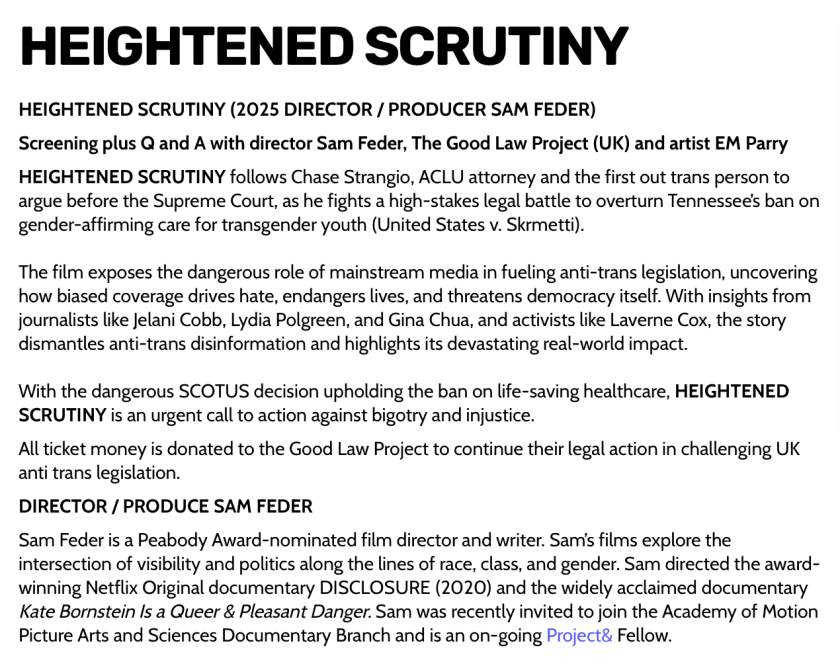
Review of Heightened Scrutiny
My review of the documentary is here.
About Sam Feder
Sam Feder is probably in her 40s and likely acquired a gender identity quite some time ago, as her film Boy I Am, which follows three women pursuing ‘transition’, was released in 2006. She also made a documentary about Kate Bornstein, Scientologist-cum-trans-activist, and her most successful documentary to date is Disclosure, featuring Laverne Cox, still available on Netflix.
‘We are being murdered all the time’, ‘the more we’re seen, the more danger we are in’ and ‘we need more trans representation so that we are murdered less’ is the #braveandstunning argument which runs through the documentary. Of course, the documentary is called ‘Disclosure’ and many of the clips shown revolve around final reveal moments.
From my Twitter thread review of the documentary ‘Disclosure’
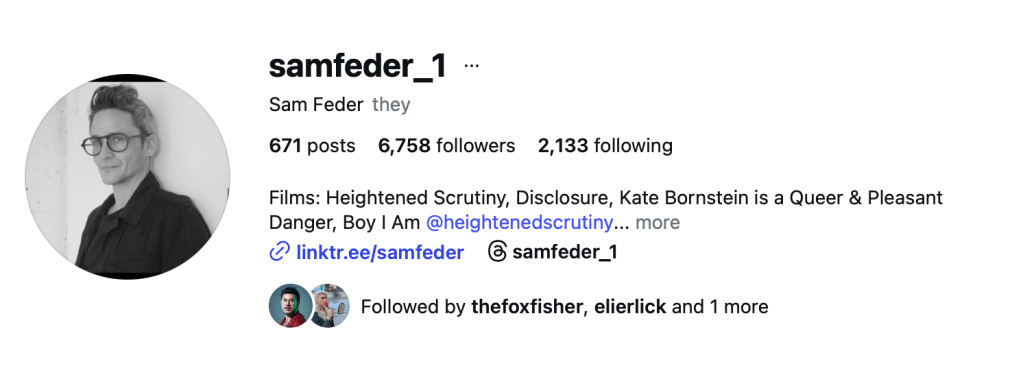
Sam Feder is a transgender American filmmaker whose work is focused on the exploration of visibility regarding race, class, and gender. Feder is concerned with bringing visibility to trans people’s experiences, and prefers to be identified with gender-neutral pronouns.
From Feder’s Wikipedia entry
About the Good Law Project
How to describe the Good Law Project (hereafter GLP) to someone who had never heard of them? We would have to start with Jolyon Maugham, its founder and Executive Director, a tax barrister who became Twitter famous for boasting about killing a fox on Boxing Day whilst dressed in his wife’s kimono. Let’s just park it there, for brevity’s sake. Anyway, it sponsored the event.
About the non-binary artist
E.M. Parry is a trans*disciplinary artist and award-winning designer, working across scenography, performance, visual art and drag. Splicing genres and platforms, their work has been seen in the West End, international opera houses, pubs, clubs, cabarets, ships, museums and haunted basements. They work with, through and for queer bodies, squinting at history, flirting with ghosts and the things that go bump in the margins.
From EM Parry’s website
Parry’s CV credits include ‘Queering Piracy’, commissioned by the National Maritime Museum as lead artist, working on the 2024 series of Doctor Who, various theatre designs for Shakespearean plays and also on We Dig, one of the worst but most funniest trans plays I have ever reviewed, so brava for that.
She is also a trans-identified female, who likely has used testosterone, given the gravel in her voice. She is currently working on a project which considers the impact of legal language on queer and trans peoples’ bodies, which she described as a ‘sculptural process’. As per the norm for a trans activist, she claims that she is looking through the archives.
The discussion
It felt like we got to know Chase Strangio very well, despite his privacy being so protected, how do you manage to do that? And the two men who held back tears, you must have good interview technique?
Feder explained that she gives her interviewees complete control over their image. If, after the fact, they feel they have said something they regret, then whatever they are unhappy about is cut. Admitting that such practices are contested amongst documentary film makers (aka as not cutting out the best bits), Feder explained that she was an activist, working alongside other activists, so clearly there would be no point in making life more difficult for her colleagues. Such accommodations also helped with relationship building. Feder often ends up befriending her subjects. One of the men who cried on camera, Alberto Cairo, a father of a ‘trans’ child, is now a friend and they are collaborating on a ‘number of different things’ together. The other crying man was Jelani Cobb, journalist at The New Yorker, and Dean of The Columbia Journalism School, who had just invited her to speak to students.
Was it a deliberate decision to include so many journalists? Why not include more trans people and/or activists?
Feder said that all the talking heads were professional journalists, except for Chase Strangio and Laverne Cox. At the beginning of the film-making process, in Autumn 2023, she had just started looking at media coverage of trans issues. This was ten months before the announcement that Strangio would be chief petitioner on behalf of the ACLU to the Supreme Court. Twenty-six journalists were interviewed in total, during March 2024, with about fourteen making the final cut, the set made to look like a diner. Feder followed the structure she had used for Disclosure. Once all the interviews were done she felt the results were ‘too cerebral’ (wrong!) and that she needed to demonstrate the consequences of what was being discussed. Luckily, Chase’s story began to unfold in July 2024 and it seemed a good launch pad to scream from the rooftops about the media’s connection to law.
This explains a lot, I think, the film being originally to be about one thing but belatedly became another, resulting in the disjointedness we see between Chase’s ‘fight’ versus the narrative of the journalists.
How did Feder deal with child safeguarding issues when dealing with Mila*, as a subject in the film?
*Mila is a 12 year old boy, who apparently identifies as a girl.
Feder said she was ‘very reticent’ about including Mila in the film and that it was ‘very difficult’. However, her concern over the national conversation that was taking place about these young people was more important. She claimed she really struggled with the ethical responsibility, considering various scenarios, including inserting an animation to tell Mila’s story or putting him in shadow.
Feder described the first time she met Mila as ‘so organic’. This was at the school board meeting, which appears in the documentary. Feder claimed she attended it as a ‘concerned adult’ and that 12 year old Mila approached her, coming out of the crowd ‘like a parting of the sea’, explicitly telling her: “You have my permission to film me.”
Feder was very moved after she saw Mila speak but claimed she still didn’t know that she was ‘going to work with her’. After the school board meeting, Feder had a conversation with her producers and with Chase. Feder told us that Chase already had a relationship with Mila (‘they were already friends’) but then, correcting herself, clarified that Chase was ‘already friends with Maria, the mom – the families already knew each other’. Surprise, surprise!
Over time, Feder and Mila’s mother had a lot of conversations about Mila’s involvement, worrying her attitude towards Mila might be paternalistic. This was slightly undermined by Feder’s next statements that she believed that Mila was ‘a thousand percent’, ‘really wants to perform’ and ‘wants to be in the movies anyway’. Additionally, mom was ‘one hundred percent.’ The mom and Feder are still in touch, as they continue to have conversations around Mila’s potential involvement in Q&As for the documentary and about what kind of social media might arise around Mila.
There was also consideration of the mother’s safety as she apparently has a job that could be questioned if she was seen in the documentary. Feder believes that because Mila’s last name has not been shared, nor the family address, there is still some privacy.
Does the Good Law Project take on cases for transgender youths?
Yes, the GLP had taken on a case in 2021 regarding puberty blockers, helping a ‘young trans boy’ who wanted to continue on them. The case was won but unfortunately the Labour government went on to ban the use of puberty blockers for gender dysphoria in 2024. There were a huge amount of young trans activists doing amazing work in London, especially Trans Kids Deserve Better, who were described as ‘phenomenal’ due their in-depth understanding of policy and law. Unfortunately now it was really hard to make any further legal challenges against the puberty blocker ban. The Cass Review was described as a ‘semi-medical policy document’ and sadness was expressed that the government had followed it (but forgot to mention there is now a puberty blocker trial as a direct result of Cass’s shitty recommendations).
Parry chipped in that Trans Kids Deserve Better were very well known in the trans community and ‘inspirational’, speaking approvingly of the time the kids had released ‘live crickets’ (failing to mention this was at LGB Alliance’s annual meeting and with no thought given to the poor buggers who had to annihilate thousands of insects, or the insects for that matter).
The real end game appears to be to ban transitioning for adults?
Yes, agreed Feder, and children were just being used as a pawn in a culture war. People weren’t really concerned about children. It was about eradicating trans people from public life. It was important to insert that into the film as often as possible so that no one forgot that it was not really about the children.
Fascism is very organised when it wants to be, so where are the allies? And how can they be mobilised?
Feder said people thought putting their pronouns on emails (i.e. as we have all been instructed to do by woke activists) was enough. Of course, this was not enough. Allyship is action. For Feder it was all about bodily autonomy and therefore trans activism needed to overlap with other groups seeking bodily autonomy. One of the first events Feder launched in promotion of Heightened Scrutiny was a conversation between the President of Planned Parenthood (Alexis McGill Johnson) and the trans activist Laverne Cox, on the supposed intersection of reproductive rights and trans rights.
In April 2026 Feder was planning a further event to get together media persons who are critical of the New York Times. This was so the impression could be created that: ‘We are one voice, telling the rest of the world, that the New York Times is shit.’ Feder believes that she is an ‘introvert activist, a filmmaker, not an organiser’ and ‘would love to know how to do it better.’
Q&A with audience
There was a chance to ask questions directly.
On the Trans Tipping Point
A trans-identified female in the audience commented that she had transitioned before the Trans Tipping Point and that right wing people were were persuaded by emotion, rather than facts. On the other hand, trans people had to engage in discussions in good faith, having to present rational arguments about desistance, etc. How can we get out of this hole and what did the panel think of the respective roles of law versus media? Feder responded that she made Disclosure because she was critical of the Trans Tipping Point and wanted it to serve as a warning that the backlash was coming. She never saw the Tipping Point as a positive thing but rather thought it was happening way too quickly in all the wrong ways and for all the wrong reasons. She felt that it had emboldened the right wing to use trans people as a scapegoat.
In terms of language and demonisation, what do you notice about how trans people are written and talked about?
Parry complained about how arcane legal language is, especially when you looked at it across centuries. Legal language had been a weird turgid thing for hundreds of years. She had ploughed through the Supreme Court Judgment, which was like ‘a foreign language’, which, in and of itself, said so much about power. Power puts a wall between itself and people.
Currently Parry was looking at a medieval court case and the person who was on trial had everything going on in Latin. You might think things had gotten better since then but they hadn’t, since Parry was reading the Supreme Court Judgment, which directly affects her life, and it was just like reading medieval Latin! It was obtuse but it was also absurd because it didn’t know how to speak about the gender-addled. From a creative point of view though, it was great, and she had been making weird cut up poems out of the text because it was so abstract. ‘It’s like Judith Butler, but stupid,’ said Parry. Of the Judgment. Phnarr.
‘The law is a system of violence and my job is to mitigate against it worst excesses,’ noted the host of Chase’s demented statement in the documentary. Could Feder expand?
Well, explained Feder, right wingers don’t really care about children, so how could it be anything else but violence? Then she claimed that all the laws with regards to chattel slavery were about ‘policing peoples’ bodies’ (a rather timid obscuring phrase to describe slavery, if you ask me) and it was violence. That was the foundation of law and you couldn’t get rid of it. (I think she was referring to the proverbial ‘property is nine-tenths of the law’, but who knows?)
*Chattel slavery was abolished in the US on 6 December 1865 by the 13th Amendment to the US Constitution, according to Mr Google.
However, some institutions did evolve, said Feder. For example, Planned Parenthood was started by people who believed in eugenics and it had clearly left that legacy behind. (Planned Parenthood is a major provider of ‘gender affirming care’ in the US, offering its services to those 16 years on. Chronic use of cross sex hormones causes infertility.)
There was nothing in the law which was not violent, said Feder.
The real work of the ACLU
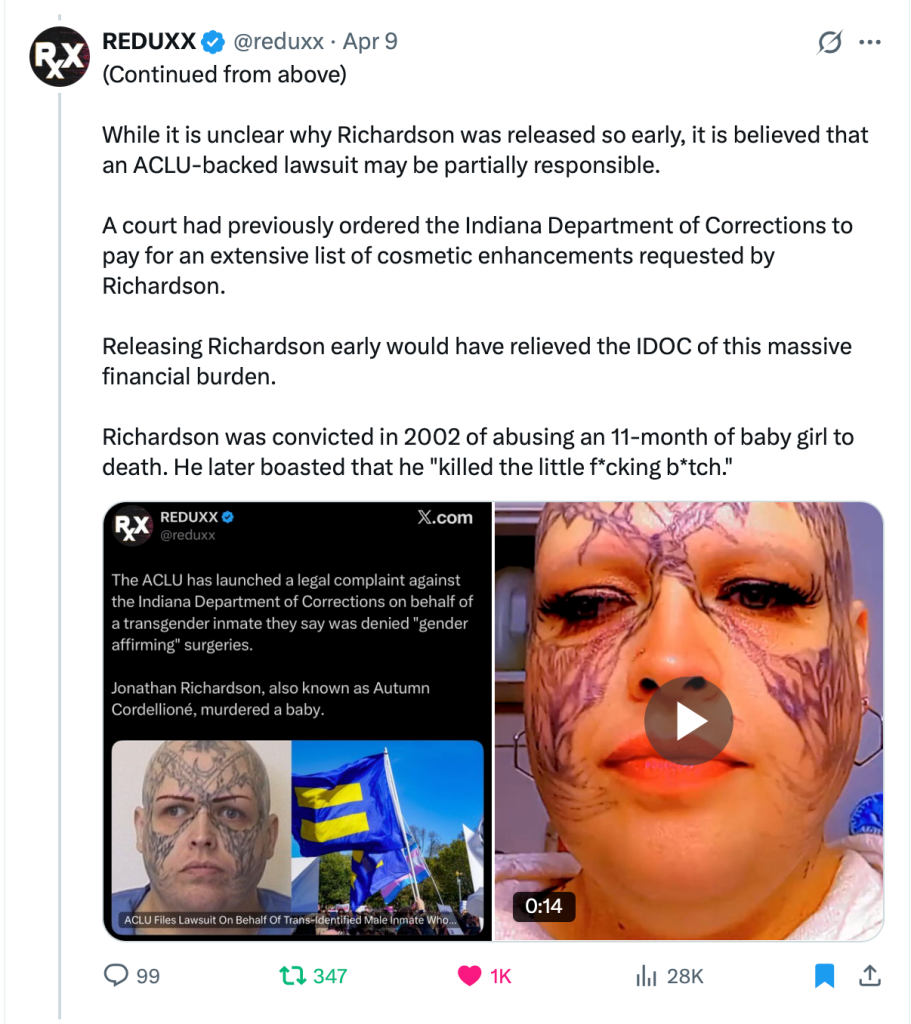
The American Civil Liberties Union (ACLU) is deeply tied up with trans activism, petitioning on behalf of simple trans folx, defending their right to inject themselves full of chemicals and chop unwanted bits of bodies off. And they do this for all trans folx. Including sex maniacs who kill baby girls. The law is a system of violence indeed.
Thank you for reading! Sign up to my blog by going to the bottom of the page.
Please share on other forums if you liked it, as I only do Twitter.


One comment
Comments are closed.