
The Derek Jarman lecture is Queer@Kings flagship event and captures the politics of what they aim to do at the University. It is King’s College, of course, who are running the puberty blocker trial for gender dysphoric children.
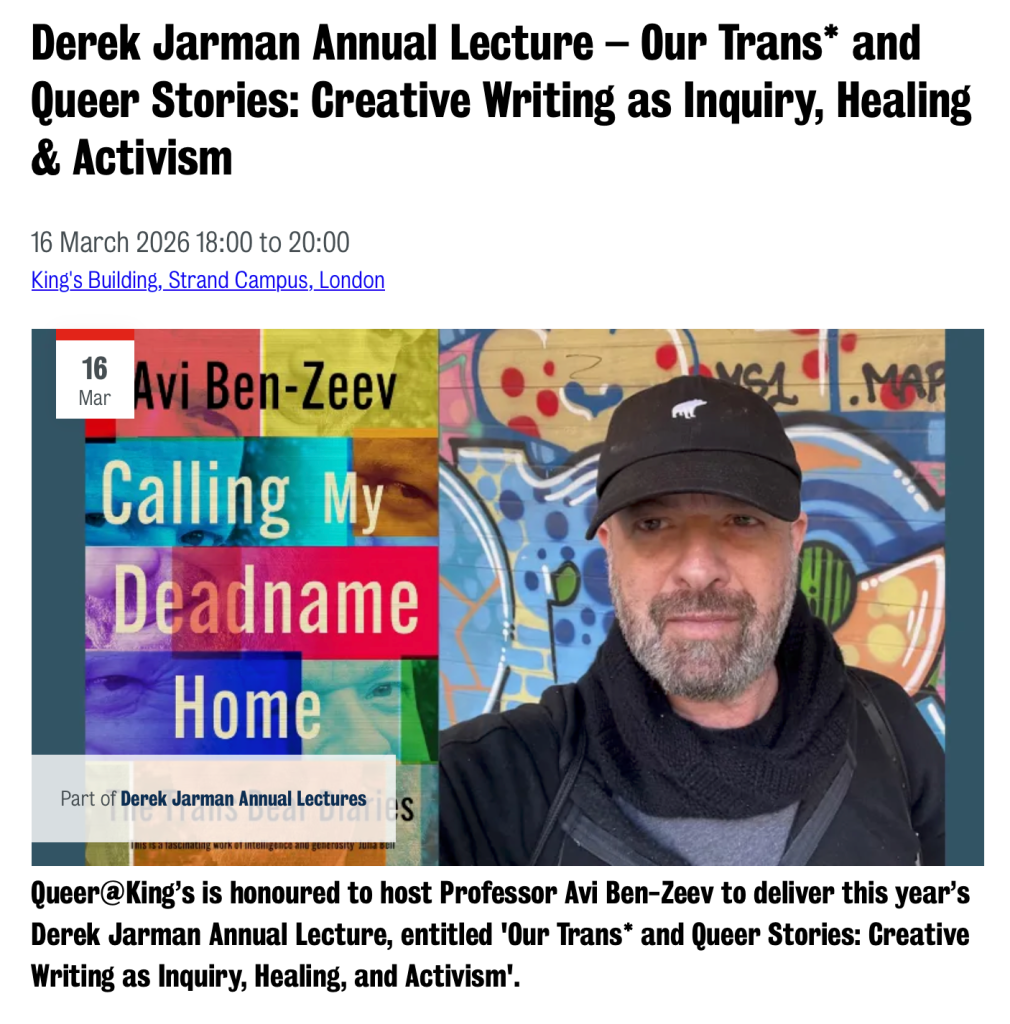
The blurby bit
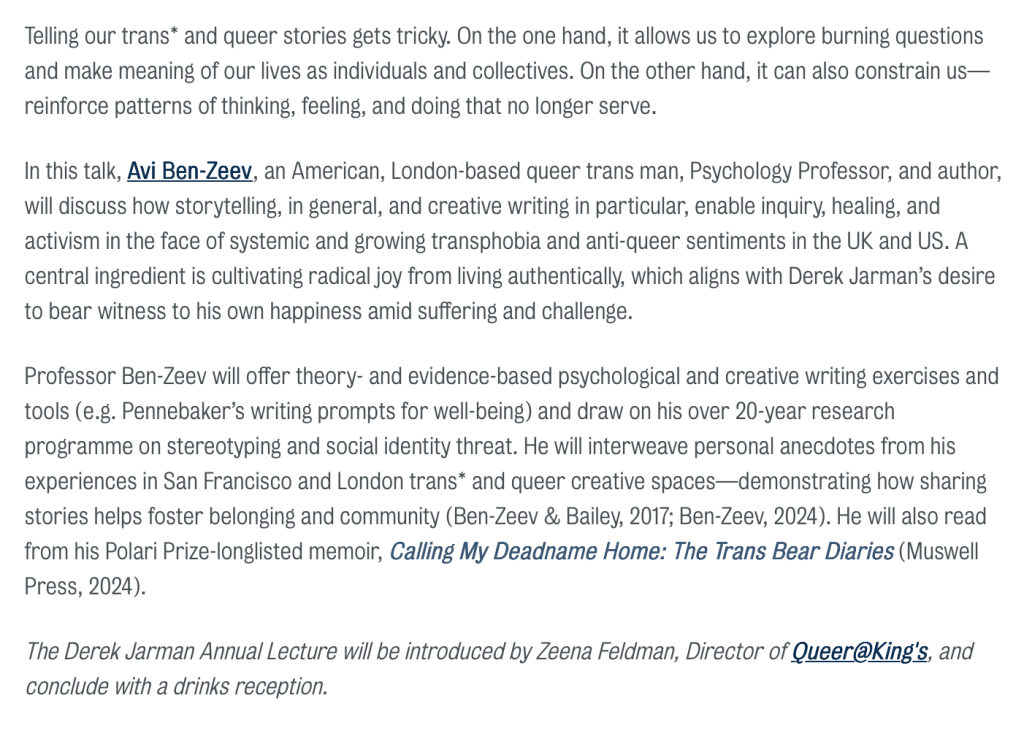
On the Derek Jarman lecture series
The Derek Jarman lecture is Queer@Kings flagship event and captures the politics of what they aim to do at the University, said Zeena Feldman the group’s director, and was conceived to celebrate Derek Jarman’s many contributions to queer theory, art and activism. It is King’s College, of course, who will be running the NHS puberty blocker trial for children referred for gender dysphoria.
Feldman alleged the annual event was endorsed by the Jarman Estate. I could find nothing to support this assertion but did find out that King’s has the right to use Jarman’s name as per standard academic practice with regards to alumni. The point of the lecture was the opportunity to promote queer and trans studies within academia, since most institutions ‘fail’ to do so and to ‘rejoice in the non-normative’, which, as we all know, the academy rarely does nowadays. Pfft.
The lecture wasn’t knowledge for knowledge’s sake, it was also political. Feldman believes the LGBTQIA+ community are sexual and gender outlaws and its politics should be to ‘challenge and resist, care and repair’, but also to express ‘rage and hope.’ Feldman acknowledged this was a lot to expect of any speaker but felt sure Avi Ben-Zeev was up to the task.
As an aside, I couldn’t find any compelling evidence that Jarman would have supported ‘queer’ politics as it is today, or that he was particularly influenced by queer theory, but who knows? The only thing of note which did turn up – if Paedo Tatchell can be believed, of course – is that Jarman apparently claimed to have ‘enjoyed sex’ aged 9.
Creative writing as inquiry, healing and activism
Transitions
Avi Ben-Zeev began the lecture by showing photographs of her family, quipping that the photo of her as a toddler, showed her in her first drag queen outfit, as it was a pink onsey.
Transitions come in many forms, which even plebs could understand. People often didn’t know that Ben-Zeev was trans and assumed that her ‘sex-change’ was the biggest transformation she had undergone. She didn’t agree. Her move from her birth place of Israel (she says she grew up in a small right wing town) to becoming a Pro-Palestinian activist outside of it, was a much bigger shift.
Another transition: education. In third grade (around 8-9 years) she failed arithmetic and was ‘kicked out of choir.’ School was bleak because all the kids knew that they faced conscription into the Israeli Defence Force soon after. Ben-Zeev claims she did not serve and instead got a PhD in cognitive psychology from Yale.
Ben-Zeev had the amazing insight that ‘getting old is a kind of transition.’ This, along with graduating, was the third type of transition she had experienced. She was also leaving behind psychology as an academic and moving towards creative writing and downward financial mobility. Her memoir, Calling My Deadname Home, covered the first ten years of her transition (I blogged about its launch).
Talking about trans and queer stories
Ben-Zeev put up a slide of the odious Alok Vaid-Menon, praising his fashion sense, and that Alok’s unique take was that ‘gender itself is a story’ and that there as many ways to be a woman, as there is to be a man. But also non-binary. ‘Trans, queer,’ and, with a pregnant pause, added, ‘Daddy,’ and then giggled.
Derek Jarman’s view of labels
So Derek Jarman did get a mention. I did wonder. Ben-Zeev claims she has been very affected by Jarman’s view of labels and conjured up a quote on screen (which I later ascertained from Grok was probably from Jarman’s 1992 memoir).
These names: gay, queer, homosexual are limiting. I would love to finish with them. We’re going to have to decide which terms to use and where we use them. For me to use the word ‘queer’ is a liberation; it was a word that frightened me, but no longer.
Derek Jarman, 1992
Ben-Zeev took the contradictory position that labels were both limiting and liberating. Her friend, Libro, who had come along to the lecture, talked about the poem what she wrote for her ‘grandkid’, so that they knew how to refer to her, since she was neither grandad nor grandmother (i.e. she identified as non-binary), so was asking that the child call her ‘grand-dandy’ instead.
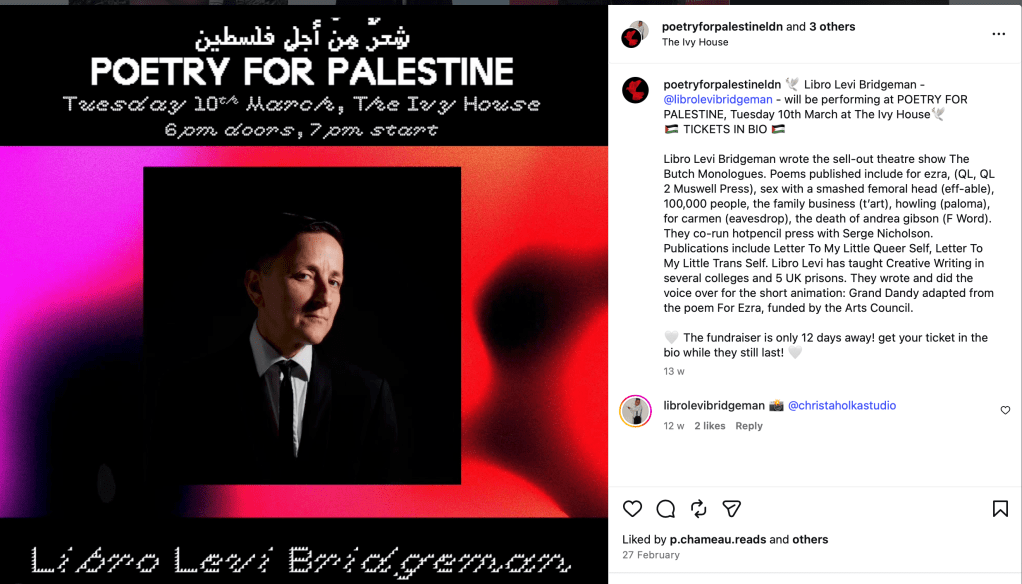
We were now almost fifteen minutes in and Ben-Zeev had just gotten over the preamble and ready to talk about what she’d come to talk about; the powerful transformative effects of creative writing. It was a tool to help you understand how you fitted into the world. There were scary forces at play, conniving against the happiness of trans and queer people.
‘Story making is a conscious act of speaking ourselves into being.’
This is what trans and queer people had to do, said Ben-Zeev, adding that any allies in the room were very welcome as well and didn’t have to ‘out’ themselves, – which isn’t othering at all, is it? So much for solidarity and seeing the commonalities between all people. And it especially didn’t make sense, given she had opened by pointing out that transformation was a universal experience, and had hinted that ‘gender’ change was as pedestrian as any other.
It was the desire to ‘speak oneself into being’ which led her to co-edit an anthology called Trans Homo – which comprised the sex stories of ‘trans- and cis-gay queer men’. As part of the project a group of ‘trans men’ (aka trans-identified females, many likely only interested in the same) were invited to talk about what it was like for them to be part of gay male communities. What did it mean to be a ‘gay trans man’? Back in 2017, this issue wasn’t being discussed much and the point was to generate ‘more stories’ with the ultimate aim that TIFs could be incorporated into gay male communities. Ben-Zeev tantalising told us of the stories she had heard at cocktail parties about the assumptions gay men had and assured us it was ‘very cool interesting stuff.’ Right. Like blocking all the TIFs on Grindr, I am reliably informed.
Inevitably, despite her upfront claim that her gender transition wasn’t the biggest transition of her life, she talked about her so-called previous self – Talia – and her bravery on the matter of using the name publicly and that this character (who is her) had been ‘killed off’ (which is language incongruent with a transition narrative in any case).
How do we create the stories we tell ourselves? (i.e. a fancy way of lying)
A lesser aspect of this, which wasn’t spoken about so much, what do we do with stories about our stories? Namely, how do we take ourselves out of a rut? Ben-Zeev appears to think that by discarding the stories, which also presumably include facts we don’t like about ourselves, we can simply carve ourselves a new reality. Calling it so, will make it real. For her, this was ‘becoming authentic.’
Cognitive psychology showed that there were two systems of thinking: system 1 (reactive) and system 2 (intentional). Trans and queer people, if they wanted to talk themselves into being, needed to rely on system 2, rather than reacting to instinct and intuition which could ‘hijack’ us. Creative writing could help with this. For Ben-Zeev, system 1 was all cliches, system 2 had nuance (meaningless adjectives to attach to these made-up categories, to say the very least).
‘Trans people are divine*,’ was a popular slogan in San Francisco, said Ben-Zeev, but one that she didn’t quite agree with, preferring the messiness of human reality, rather than the romanticisation. Also giving someone undeserved labels didn’t keep them smart and perhaps even made them afraid of intellectual challenges? We needed to be very cautious about this.
*According to Grok, the phrase was “gifted to the world” in the context of The Black Trans Prayer Book, vis a vis J. Mase III (a poet, performer, and educator) and Lady Dane Figueroa Edidi (a performer, writer, and ritualist), – natch).
What happens when you have a misalignment between system 1 and system 2? For example, what if Ben-Zeev had just accepted her trans body as it is and celebrated it? Most of time, however, there was dysphoria. She explained to us that the discrepancy between the two systems resulted in shame as a direct consequence of telling herself her story. There should space for dysphoria. Or something like that. She was making about as much sense as an astrologer at this point.
What helps?
Ben-Zeev prior to extolling the benefits of creative writing, recounted how she had experienced a terrible microaggression whilst attending for a gynaecological exam. Apparently the nurse who performed the exam had commiserated with her that she must have ‘suffered so much’ and ‘couldn’t tell’ she was female from her outward appearance. Ben-Zeev had dealt with it as the pro she now is in these situations, remarking she thought it was funny and that ‘the look on her face was funny.’ Nice, huh?
So what could help (ostensibly gender dysphoria) was doing twenty minutes per day of creative writing, which could help with depression, immune function, fewer doctor visits, self-esteem and it was also a form of activism. All of this backed up by ‘research’, obviously. And that’s how her lecture finished.
Q&A
How did Ben-Zeev come up with the idea of the lecture? Was it discussed first with Queer@King’s?
Yes, there had been discussions between herself and Feldman. Ben-Zeev bought up the August 2025 boycott of the Polari Prize for having included John Boyne’s book Earth on the longlist, not that she mentioned his name or the book, referring him to only as a ‘cis gay man’ turned ‘terf’. Dozens of authors had withdrawn from the Polari Prize longlist, demanding Boyne’s removal (‘people wanted him gone, I definitely wanted him gone,’ said Ben Zeev), thereby trashing the competition. This was all because Boyne had previously expressed support for J.K. Rowling (his having written My Brother’s Name is Jessica is no get out clause, obviously).
So, the conversation had been; how do we reckon with transphobia/terfs within the queer community? She had wanted to talk about creative writing and psychology.
Could you elaborate on border crossings?
Ben-Zeev talked about the issues facing trans people in the US, particularly migrants, who had travelled there (illegally) and now might be ‘imprisoned’, sent back and might not get their cross sex hormones. In her own personal history, her grandmother had lived on the Poland-Russia border and had come home one day to see her father hung from a tree following a pogrom. Then later, as her grandmother was an orphan, she was transported to ‘Palestine’ by a non-Jewish Russian; Ben-Zeev argued that her emigration was not zionism. Interestingly, Ben-Zeev’s definition of right wing schooling was being taught ‘everyone hates us and wants to kills us’ and that this was on the basis of race, not religion (which is exactly the criteria that anti-semites use, so not sure what her beef with this was). Ben-Zeev also opined that she and her fellow Israeli students had been forced to watch Nazi documentary footage and felt unable to stay in Israel due to the mismatch between the – as described – ‘right wing education’ versus the ‘genocide of the Palestinian people.’
Where is the true self? In system 1 or system 2?
Asked a man doing a PhD project related to queer immigrants in the US.
Ben-Zeev said the difference was between us telling our stories and who we are. In order to tell our stories we had to tap into system 2, but that didn’t mean system 1 (automatic) wasn’t alive and kicking. The messiness of human beings was really in system 2 though. Or summink. I really don’t know.
On academic language.
Ben-Zeev gave an all-over-the-place answer. Yes, in certain circumstances it was necessary but it also wasn’t accessible language and left people behind, was about the nub of it. Creative writing could help. Sometimes.
On feeling seen.
Yes, she did feel seen. Particularly by the people in her creative writing groups, some of whom were in the room and she invited one to speak, who then burbled some nonsense about trust and seeing the best and worst of people whilst sharing intimacy. Ben-Zeev said it was about holding space and being held. Then someone else said it was about being real with each other but that it wasn’t therapy because they were really looking at the words and then went on to list a load of things to make clear it was (some sort of quasi) therapy, like admitting ‘I’m a bit scared’. Making yourself vulnerable in front of other people was an extraordinary thing to do and you can do it too! At her group run every Thursday at Birkbeck. Please, no thank you.
(The real draw of these groups, of course, is the friendships which are formed – people seek community – and will tolerate a heaps of bullshit to get at it.)
How do we do this work in the service of collective transformation?
At the end, Feldman naturally complimented Ben-Zeev on the content of her talk. Creative writing was a form of resistance, a way of overcoming problems and demanding recognition but she wanted to know how could it be politicised (even further). Ben-Zeev gave the example of Sweet Sundays, which is held in Hackney once a month, whereby some hipsters read (no doubt their own terrible) poetry together and then go off to feed homeless people (hopefully with actual food, rather than their empty words). Open mic events were also great. Offer more spaces for this in universities, said Ben-Zeev, pointedly turning it back to Feldman. Ben-Zeev wanted grant money to run workshops specifically for trans-identified people (and no doubt she’ll get it (or someone will)).
Afterwards was a proper buffet with alcoholic drinks served, and, given the alacrity with which some marched towards the function room, one suspects this may be why it was so well attended.
Thank you for reading! Sign up to my blog by going to the bottom of the page.
Please share on other forums if you liked it, as I only do Twitter.


You must be logged in to post a comment.