
Event held by Lambeth Libraries
The blurby bit
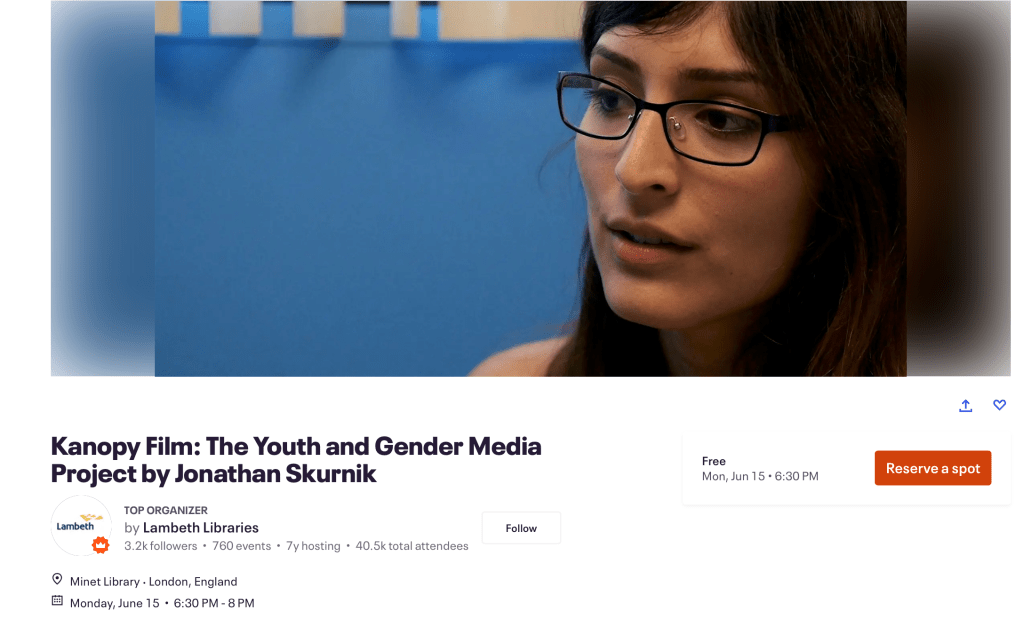
Learn what life is like for transgender teens with these two documentaries from award-winning filmmaker and media activist Jonathan Skurnik, followed by a discussion and Q&A with Jonathan.
As part of our Kanopy Film Screenings we’ll be showing two film shorts from The Youth and Gender Media Project: I’m Just Anneke (2010, 11min English subtitles) and Becoming Johanna: The Journey of a Transgender Teen (2016, 26min English subtitles).
From the Eventbrite listing
Introduction
Lambeth Libraries have made the documentary shorts of The Youth and Gender Media Project, an initiative founded by filmmaker Jonathan Skurnik, free to view for library members and invited him to talk on the topic. Skurnik started the project because he wanted children who didn’t conform to ‘gender roles’ to feel valued, the upshot of which is that he was probably the first filmmaker to spread uncritical information about medical and surgical transition for children across North America. He made four films on this subject, as part of the Youth and Gender Media Project, over a ten year period, starting in 2010.
The event was held in the same week that it was announced that the UK puberty blocking trial (The Pathways Trial), which arose as a result of Cass, and is to be run by researchers from King’s College, had set the minimum age for participation at 11 years for females and 12 years for males.
(This specified age raises another point in the Medicines and Healthcare Products Regulatory Agency recommendation regarding the risk of sterilisation if a child proceeds from blockers to hormones. A girl of this age [11 years] is likely to be at Tanner stage 2 of puberty. For children at this stage, discussions about fertility preservation are meaningless as there is no fertility to preserve. Is it explained to girls at this stage of puberty that to retain any chance of fertility she will have to come off blockers at the end of the trial and wait for puberty to resume until she reaches Tanner stage 4 and starts menstruation? Imagine a 13 yr-old girl taking all this in).
Pathways trial to go ahead despite safety concerns, Blog post from Transgender Trend, 21 June 2026
The films
I’m Just Anneke
You can click here to see a trailer for the 11 minute documentary on Anneke, a 12 year old girl put on puberty blockers, living in Vancouver, Canada. Released in 2010, it is therefore well before the start of the trans madness (i.e. the 2015 Tipping Point). Although Anneke supposedly doesn’t know if she wants to be a boy or a girl, the words ‘non-binary’ are not used once, rather ‘gender fluid’. I don’t recall anyone using they/them pronouns in the short and, in the official blurb for this piece still, Anneke is referred to as she/her. The title jars with the theme, Anneke is anything but just herself. If she was, there wouldn’t be a film to be made.
Beginning with whimsical music, we enter slowly into the world of Anneke, an obese girl into ice hockey, who has a ‘socially conscious’ mom and dad. She is playing on an ice hockey team with other girls, liking to be referred to as ‘the guy’, but is very clear in herself that she is a girl. The story from the mother is familiar and predictable – Anneke reportedly was unhappy with clothing choices presented to her and depressed, expressing suicidal ideation aged around the age of 4/5.
Crucially we see Anneke in the doctor’s office being teed up to start on puberty blockers. The male prescribing doctor wisecracks about making sure ‘things are turned off, and that your oestrogen level is zero.’ Cut to Anneke – as talking head – she isn’t sure whether she should ‘go and trans, or stay where I am,’ and acknowledges she is ‘a tomboy.’ We see Anneke receive her first shot (interestingly an ally in the screening room recoiled in horror, leading me to initially suspect a fellow terf) and the mom pops back up to helpfully confirm that Anneke doesn’t really have any firm friends due to the ‘gender stuff.’ Mom has told Anneke that ‘you don’t have to be a boy, you don’t have to be a girl.’ Naturally, when Anneke responds to such charges, she is evasive, uncertain and embarrassed by the topic. Discussion of the really triggering issues with regards to female puberty, like breast development and menses, are avoided and one suspects that Anneke’s obesity is linked. Mom and dad make warm fuzzy comments about wanting nothing but happiness for Anneke but there are no critical off-camera prompts asking them to consider alternatives, e.g. that Anneke may regret not going through puberty, that the drugs may have deleterious long term effects, or even the most obvious – adolescence is a universally unpleasant experience.
Q&A on Anneke
Skurnik explained that at the time that he started making I’m Just Anneke, it was difficult to get funding due to ‘transphobia’ but that since then there had been thousands of films on the topic. He was, however, one of the first to document the phenomenon of children receiving puberty blocking medications. He was still in touch with Anneke, who he now referred to as they/them and reported that she had struggled with drug addiction (marijuana), is still living with her parents (or else did do for quite a while), gave up hockey, got really depressed and has only part-time jobs. Other than that she was ‘doing well’ (as can be expected, I suppose). Anneke went onto take testosterone after coming off puberty blockers, but on the plus side, given she had never gone through puberty, she never had to have any (presumably ‘top’) surgery. Anneke had had the opportunity, however, to become an activist. Namely, one who went up and down the schools of North America, shilling the little fable Skurnik had made about her.
Responding as to why he had been inspired to make the film, Skurnik said that in 2009 he had started to read articles about the phenomenon of trans kids, didn’t have any judgements about it but was curious. Curious enough to make a film. So he made contact with the only trans youth advocacy group which existed at that time, the founder of which had just published a book on how to be ally*. Skurnik read the book and meet with them and attended their very first convention for families and it was at that convention that Skurnik had interviewed and filmed Anneke.
*According to Grok, this is most likely to be Gender Spectrum (originally Gender Spectrum Education and Training) and the activist Stephanie Brill (a lesbian), who wrote the book The Transgender Child, a handbook on how to affirm. Grok also pulled up information that Gender Spectrum did hold conferences for families in 2009 and 2010.
The thing which had fascinated him so much, was his own shared experience of being othered when he was growing up, having enjoyed the company of his sister very much and playing with her dolls. His parents had been supportive and had bought him his own doll’s house. He felt an affinity with these children because he had been bullied at school for being a ‘sissy’ (and it struck me I hadn’t heard that word in forever) and wanted to help create a world in which children could be free to be whatever they wanted to be.
To be fair to Skurnik, very little was known about these drugs back in 2010 and hearing a doctor say they simply put a pause on puberty is persuasive. What is less understandable, however, is that we are now sixteen years later and literally no one involved in trans activism is prepared to admit that medicalisation of youths may be a mistake. In fact, Skurnik opined that transphobia was worse now than it had been.
Becoming Johanna
You can click here to see the trailer about Johanna, previously Jonathan, a feminine homosexual boy put on the rail road that is gender affirming care. This is a later film, released post-Tipping Point in 2016. It begins with Johanna, not yet 16, talking about when he was ‘young’ and we quickly learn that when he told his mother that he was gay, she emphatically tells us that she told him he wasn’t. There is zero exploration of the mother’s rejection, either with Johanna directly, the mum or between them both. What is clear though is that the relationship is under a lot of strain and there are various adults in Johanna’s life who are prepared to exploit that weakness, including a trans activist group made up of trans-identified males (TransLatin@ Coalition, notably Bamby Salcedo), who encourage Johanna and his peers to take part in runway model shows, a foster family who unquestioningly embrace his gender identity and appear to have zero interest in reuniting him with his mom and an utterly creepy middle aged lesbian teacher at school, who comments that she is able to give Johanna access to the parts of the community he requires (by this she clearly means the burgeoning T-part and not a coming out group to support young gay men). This aspect of adult intervention is particularly concerning, as it is clear that Johanna’s mom is not rich and probably not educated to a high level. It is fair to say the mother is pretty much demonised and given no further right of reply once she is out of the picture. This is not responsible film-making.
If memory serves me correctly Johanna Olson, a notorious prescriber of puberty blockers based in Los Angeles, appears in the film (or else in the one about Anneke). One person who definitely does appear though is Marci Bowers, the trans-identified male surgeon notorious for performing sex reassignment surgery and influential WPATH member). Bowers tells a clearly entranced Johanna that, as he does not have a supportive family, he is going against all the odds, but then reassuringly boasts that he has done over one thousand of these operations. Johanna talks about how he is comfortable at the hospital (where the gender identity clinic is) because it is a place where he can be around other teens who are like him.
There is also a section where Johanna talks about how he used the girls bathroom at school and got in trouble with the police for that. His mother was called to the school and Johanna was charged, if I recall correctly.
Given that both films were very much the first in the genre of children-find-their-true-selves-whilst-self-destructing-, it’s very interesting indeed how little the genre has diversified since then. Or at all. Or how much alike they are to adult stories of discovery. It’s the same fucking story over and over and over again.
Q&A on Johanna
It sounded like Johanna has fared better than Anneke. Skurnik told us that he and Johanna became really close friends post-production as they toured the United States with the film, doing Q&As. After three months of public speaking Johanna got the hang of it and had a mini career as a public speaker and educator and got paid well to do so. One weekend they did screenings and discussions for all the private schools in Maryland and at one of these discussions the students asked to speak with Johanna alone, with no adults in the room, which Johanna was happy to do. Skurnik had a separate conversation with the adults in another room. The point of all this, said Skurnik, was to ‘build an ally muscle’ and be ‘an adult ally for young people.’ He realised that a lot of the adults did not fully understand these concepts back then and that this was the point of the project. We learnt Johanna went to Austin, Texas, and started a career as a pole dancer. He also did a brief stint working for the latino trans activist organisation who put him on the runway.
(While researching for this piece, I learnt that Skurnik met Johanna during a stint of volunteering with the transgender youth unit at Children’s Hospital of Los Angeles, according to this article.)
With regards to Johanna’s mother, they still haven’t made up, with Skurnik candidly admitting that the mother was accepting of the transgender identity but a lot less keen on the rude back chat Johanna exhibited towards her. (And didn’t comment on the fact that the mom could not accept his homosexuality.) Johanna is still in contact with one of his ‘surrogate’ mothers though. Finally though Skurnik did admit that Johanna had had a similar struggle to Anneke, in figuring how to be in the world.
Skurnik told us that after he gave up on the idea of making a feature length documentary, he honed in on making a documentary for middle schoolers (Anneke), one for high schoolers (Johanna), one called Creating Gender Inclusive Schools for teachers and administrators, and The Family Journey, which was for parents and siblings. Skurnik says the films are still shown all over North America as part of official training. He spent twelve years running the project.
To fund the four films he raised $120,000 himself and had some help from various foundations (including the notorious Arcus Foundation, PFLAG, the Jewish Federation of Greater Los Angeles, the Fledging Fund, Awesome Without Borders, H. van Amerigen Foundation and Gender Spectrum). No public funding contributed to the production. However, after the films were finished Skurnik received $250,000 of public money for community engagement and he hired full time staff for a year to help lead discussions in schools all over southern California. This also enabled the project to carry out some statistical analysis of what effect the films were having on audience attitudes.
The final message Skurnik wanted to impart though was that binary ideas about gender were oppressive ‘regardless of where you were on the gender spectrum’ and thus it was in the best interests of everybody to embrace all gender-identities and -expressions. I thought it a really interesting place to finish – no progressive person wants to put people into boxes, nor children to feel uncomfortable in themselves – but how did that end up translating into the promotion of medications which permanently stunt the growth of sexual organs?
Thank you for reading! Sign up to my blog by going to the bottom of the page.
Please share on other forums if you liked it, as I only do Twitter.


You must be logged in to post a comment.