
On the door they gave out trans-themed fiddlers and ear plugs, in case you were of a nervous disposition.
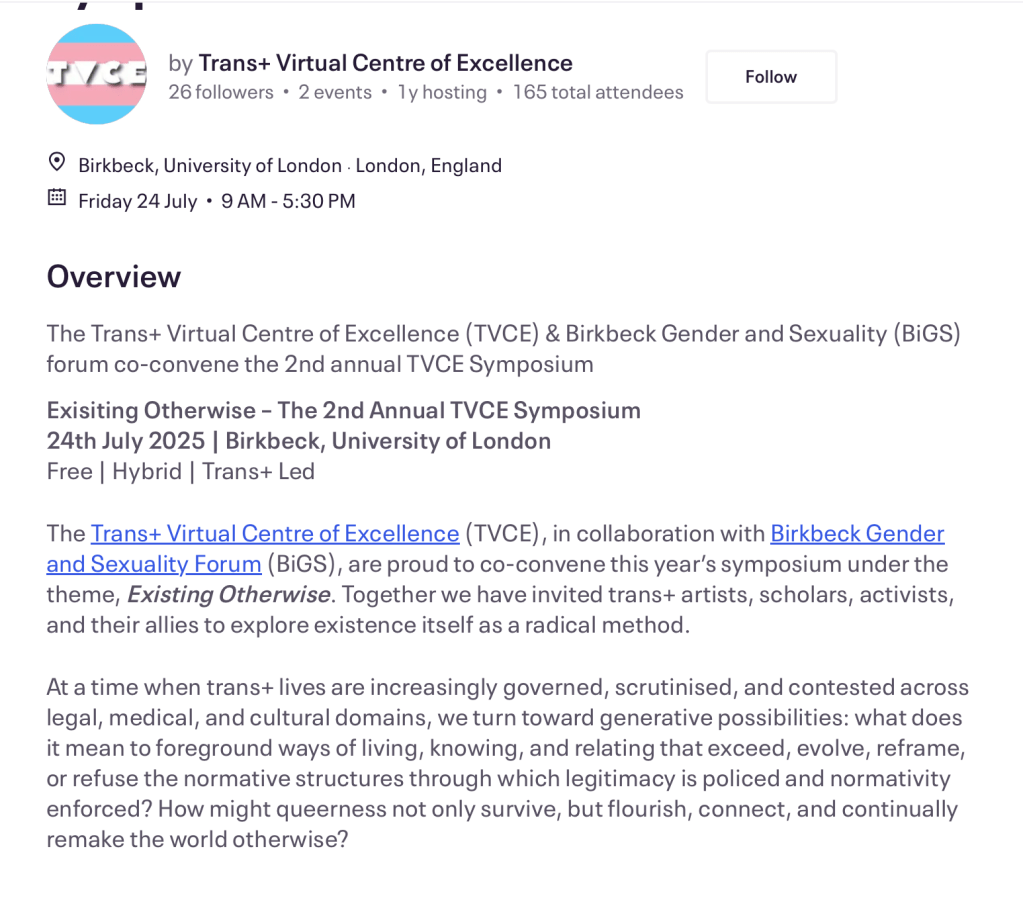
The agenda
As regular tweeps know, we never shy away, having said that, even we couldn’t help being a bit rabbits-in-headlights when facing down the agenda for the Trans+ Virtual Centre of Excellence ‘Existing Otherwise’, published on Bluesky.
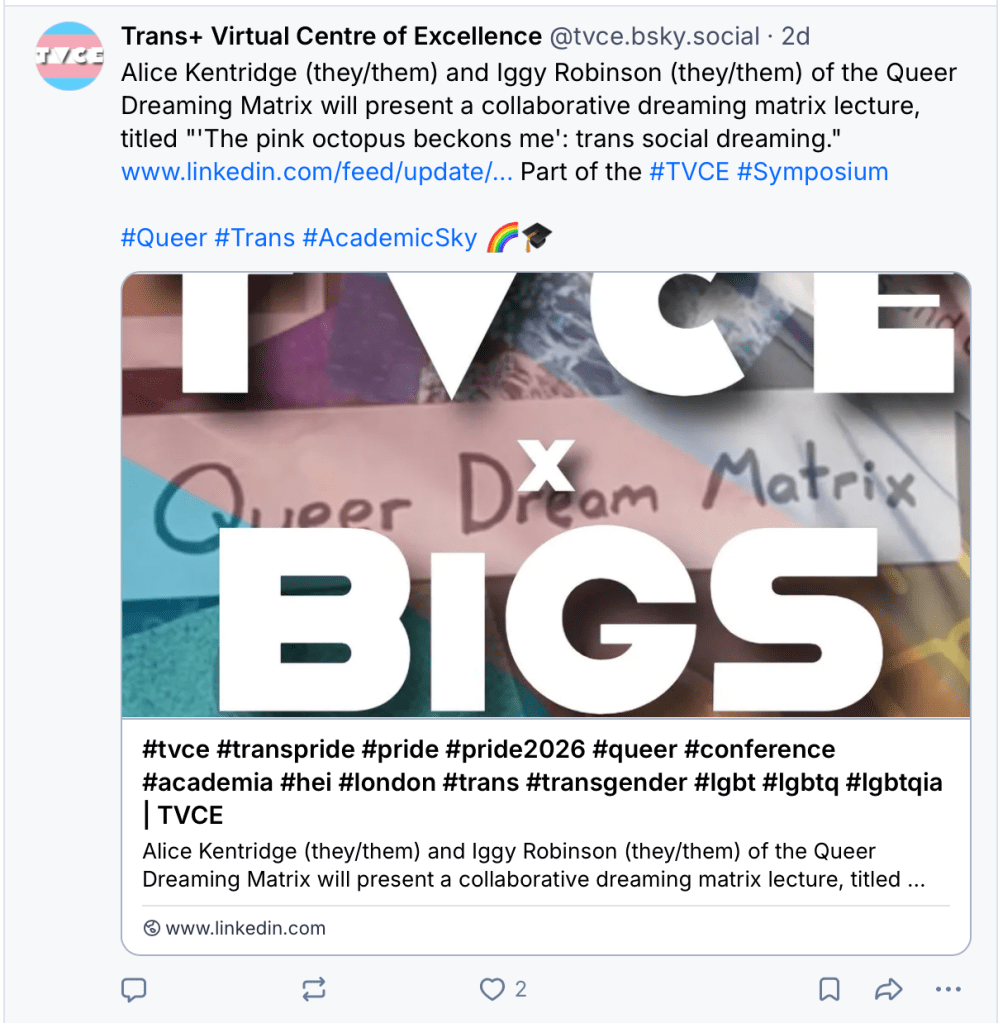
Items were as follows:
- a Meditation titled “We Are Here.”
- a Creative Collage Workshop, titled “Remapping Masculinity.”
- a collaborative dreaming matrix lecture, titled “‘The pink octopus beckons me’: trans social dreaming.”
- a session titled “Acknowledging realities, and imagining alternatives: What does a good life look like to you?”
- an echo paper titled “Reclaiming the Monster: Transgender Horror and Individual Legibility”
- a Fragmented Paper titled “The Border Begins Here”
- a Fragmented Paper titled “Inhabitable Inbetweens: Non-Binary Images Across Media”
- a Ritual of Refusal titled “Held Interval: An Embodied Listening Session”
- Geoffa Fells (they/them) presents a 4 Scene Play titled “An Earthenware Mug, a 1942 Bomb Crater, an Industrially Reinforced Piano, and Geoff queer Music Therapy”
- a Transmission titled “Disruptions from Elsewhere”
- a Conversational Paper “DIY HRT and Liberated Futures”
- an Ephemeral Manifesto titled “The Manifesto and Flashmob of Resistance” (presented by Amanda Kamanda)
- a #LongTable titled “The Binary Trap: Imagining Intersex and Non-Binary Recognition Beyond the Limits of Current UK Law”
- an FRAGMENTED PAPER titled “McNally, Desire and Knowledge”
- an Ephemeral Manifesto titled “Our Trans* and Nonbinary Stories”
- a TRANSMISSION titled “Who is the legitimate subject of trans research? Or, if you’d asked me that summer what a hospital was…”
- a DISTRIBUTED ACTION titled “to hold is to be held: the work of untying”
- Breathing. Being. Bound: experiences of a nonbinary, transmasculine, white-passing, working-class sculptor in the face of oppression
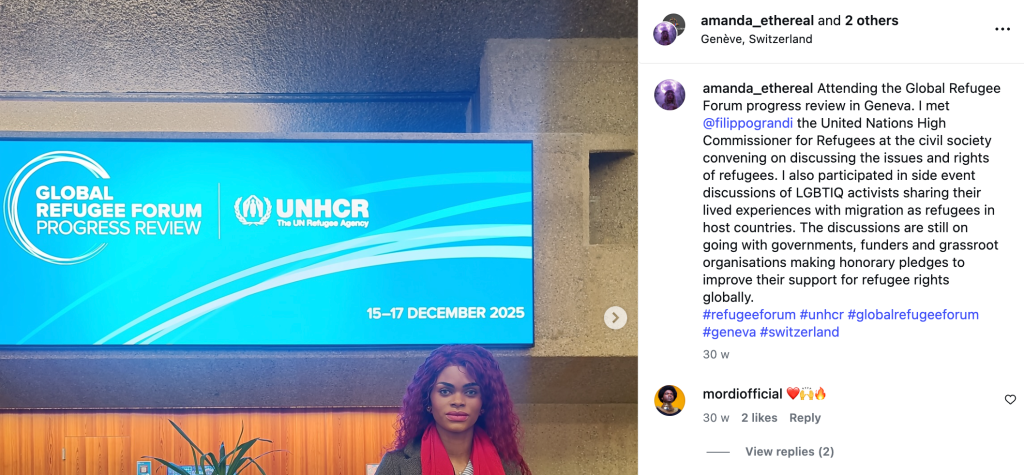
Nothing screams out hormone abuse more than this. And this isn’t even the exhaustive list. Though our interest was piqued by mention of the pink octopus and Amanda Kamanda (who turned out to be a trans-identified male, who held the 2022 title for Miss Trans Uganda and appears to straightforwardly be a homosexual male). Predictably, in the pronoun credits, there was an over-abundance of they/thems, not to mention a faer, a siya, and a they/he/it to boot.
The event was hosted by the Birkbeck Research Institute for gender and sexuality, thus most of the presenters were academics, with a good number of third sector trans activists thrown in for good measure, otherwise university students.
Morning sessions
DIY HRT and Liberated Futures

One of the medical issues caused by cross sex hormones is that it fucks up the vocal chords. Fact. Especially female vocal chords, because, as the muscles thicken in response to testosterone, hoarseness is induced, often with a ‘cold’ throat feeling. We say all this because it’s happened several times now at events where trans-identified females (TIFs) on testosterone have been leery/unable to project and so we believe it was the case at this roundtable.
Around sixteen people attended, the majority TIFs of the non-binary variety. Musa Sharples (he/they) ran the session. Sort of. She had written a paper (not shared with us at the table, so perhaps she was going to write it) on how doing ‘DIY HRT’ could lead to ‘harm reduction’. Access to information was the main barrier, but also the internet. (Erm, who doesn’t have the internet these days?) Interestingly, it was felt that the price of blackmarket drugs was not a barrier. (Have a look at a popular blackmarket website and see if you agree, seems extortionate to us.)
Of course, the discussion made as much sense as a box of jumping frogs, but interesting, nonetheless, for the contrived ignorance. For example, it was stated that doctors knew less than patients, and the words ‘clinically violent’ were uttered. Knowledge-sharing with other (non-medically trained) drug abusers was the way to go. Putting your hormone doses into a spreadsheet and then recording how you felt was effective management (but would clearly not tell you if you were producing too many red blood cells). On the other hand, it was also pointed out that it was possible to misinterpret results and that chronic use of these drugs affected the data produced by Gender Identity Clinics (GICs), since no (or at least no reliable) tracking was possible. If people were going to pursue the DIY route, how did we expect things to improve in the GICs? (Was the only sensible point raised, which no one tried to form an answer to, not even the questioner.)
The main trend among TIFs, as we read it currently, is to medically ‘transition’ to non-binary. Of course, this is a nonsensical aim, which a GP is unlikely to understand, hence such women will tell GPs that they want to become male in order to access exogenous testosterone. It was opined that ‘cis’ men access (abuse) anabolic steroids for muscle-building. Reading the reviews from male bodybuilders could be very instructive in choosing the correct blackmarket testosterone product, apparently. We gained the impression that people believed anabolic steroid abuse for body builders was legal, whereas ‘DIY HRT’ wasn’t (to clarify, possession for personal abuse is not a criminal offence, it only becomes an offence when ‘production’ is involved). In any case, trans activism’s response to this legal minefield has been to publish self-help guides regardless, with The Love Tank’s puberty blocker guide cited and who are currently working on a ‘DIY Road Map’ (see below). Advice should be framed as ‘if you’re going to do it anyway, this is what you need to know’, which would be fine, if you really were told what you need to know.
As trans people oft opine, ‘cis’ people use HRT, so why can’t they? With the example of oestrogen for peri-menopausal symptoms given (though we can quite agree that the use of this drug is bordering on faddish as this point). Also women of colour have difficulty accessing HRT, thus an activist present had organised a meeting of the same to meet and discuss their medical problems with a group of trans-identified males. Tower Hamlets, of course.
As per usual for these discussions, there was zero mention of the serious side effects of exogenous hormones, which does include multiple organ failure, bone thinning and serious psychological harms (e.g. the anti-androgen agent cyproterone is known to cause depression/mood swings), let alone all of this is being risked without the support of a competent health professional. Rather, there was a rejoicing in ‘community’ and the natural progression from user to ‘distributor’ (mem: this is where the illegality lies), which probably mainly involves passing on your gear from wherever, made up of whatever, to whoever (but probably mostly to friends and acquaintances, which is nice). The legal and ethical implications of such behaviour was far from anyone’s mind, ‘beauty’, however, did get a mention.
Precarious Lives: Telling Trans Elders Stories with Zoe Playdon
About sixteen people (mostly students) attended but there were also attendees online.
Zoe Playdon, who is now in his 70s, and was P in the P v S and Cornwall County Council case, began by describing his appearance. He told us that he was responsible for setting up a parliamentary committee on ‘gender identity’ in 1994 alongside Lynne Jones (in fact it was a Parliamentary Forum on Transsexualism, which later went onto influence the Gender Recognition Act (2004)). Everything had been going absolutely fine until 2019 and Maria Miller’s (remember her?) ill-fated attempt to implement ‘self-ID’.
Playdon opined that there weren’t many trans elders left from his generation (‘we don’t seem to make old bones’) and that back in the day (1970-1996), it was ‘assimilate or die’, claiming that if you didn’t assimilate (one assumes he meant ‘pass’) then you were likely to be killed and the police unlikely to investigate your murder. Playdon and friends are currently working on a project to gather up the important stories of trans elders, but rather than tell us what their stories were, he wanted to know what we wanted to know. His second question pertained to how to talk about trans elders’ stories, when all of the language was from a cis-het perspective influenced by a colonial narrative. Should new terms be created? With that, we were split into groups and Playdon collected the responses after. Unsurprisingly, the kids took the ‘assimilate or die’ to heart. One rather large loud chap pointedly wanted to know what it was like ‘to lez out as a transsexual woman in the seventies’.
Trans people were subject to ‘violent framing’, said Playdon, and talked to us about Richard von Krafft-Ebing’s Psychopathia Sexualis (1886)* and cited case 129 as a case of transgenderism. Playdon triumphantly explained that medicine didn’t really understand the aetiology of anything, giving the example that medicine could describe what happens when you give someone general anaesthetic, but it couldn’t explain how general anaesthetic works (a rather nitpicking point, we thought, given the huge amount of research and specialism in anaesthetics), thus doctors relied on the patient narrative. Case 129 was to become the stereotype of a trans woman, said Playdon, as ‘she’ was ‘pretty, obedient, quiet and modest’ and gave a little ironic laugh (understandable, since no troon has really ever been like that). The case was so persuasive, it became the way trans women could legitimise their identities.
* According to Mr Grok, Psychopathia Sexualis was widely read and a publishing success in the late 19th and early 20th centuries, far beyond its original medical/forensic audience. It began as a relatively modest clinical-forensic study aimed primarily at doctors and jurists. To my mind, Case 129 appears to be a straightforward case of a feminine homosexual male in denial.
Playdon moved onto Roberta Cowell. Cowell, Playdon wanted to point out, wasn’t prepared to do needlework (he was a racing car driver, an incredibly dangerous occupation at the time). In 1951 Cowell was allowed to change his birth certificate to record that he was female after he underwent castration. Then he wanged on about the case of Ewan Forbes (possibly a man with a DSD condition, or possibly a woman pretending to be a man, there really is no definitive answer on this, according to Mr Grok) and commented that the Steinach procedure (a one-sided vasectomy) and other fads ‘did really work’ before contradicting himself that ‘they were all placebo effect’. Playdon also stated that primogeniture law was still ‘alive and well’ and that there were still ‘titles and estates that can only be inherited’ by a male relative, and whilst this is true for certain peerages and titles, it is not true for property, which must be divided equally among sons and daughters if the parent dies intestate. Playdon told us that the Forbes case induced a constitutional crisis, as it threatened the Crown (Forbes bought his/her case in the late 60s, when Elizabeth II had already been on the throne for about 15 years, clearly Playdon was confident that no one in the room knew the dates). Playdon went on: Everyone was sworn to secrecy on the Forbes case, such was the threat from trans men.
Next slide: the formation of what was to become WPATH, a conference held in 1969, in which the sexologists John Money and Richard Green took over NHS services for trans people (?). The Corbett vs Corbett case cemented the idea that it was a mental illness. Had April Ashley corrected his birth certificate, things could have been so different. There were medical tests on Ashley’s vagina, which came back ‘just like everybody else’s, it was a vagina,’ Playdon told us (Mr Grok, however, said that Ashley was probably only the 8th or 9th patient to have ever had a vaginoplasty).
More potted history: April Ashley’s solicitor was probably a chaser, trans women were routinely raped in prison, they were given secret codes on their driving licences, and also given special letters which excused them from arrest if the police caught them publicly cross-dressing (both of which suggest special treatment). Special mention also goes to a Judy Cousins, former soldier who ‘transitioned’ aged 53, who set up SHAFT (Self-Help Association For Transsexuals, one suspects the acronym came first). Please do click here to see a rare photo of Judy looking radiant.
In 1984, children’s gender services were set up at St George’s Hospital, which eventually transferred to the Tavistock, but things really took off though in 1992 when Press 4 Change was formed (by two TIFs). And then, of course, Playdon’s 1996 legal case.
The most interesting thing that Playdon revealed though, was that upon Alice Purnell’s death (Purnell being the man who set up the Beaumont Society, a secret society for heterosexual male cross dressers), he was one of two people tasked with clearing Purnell’s house. More interesting still, we could not find a date of death for Alice Purnell, only that he passed in 2024. You would think there would be at least a single obituary, for such a towering figure in the world of transvestism/transsexualism, which went onto become trans activism proper, but Mr Google and Mr Grok both drew blanks.
Playdon handed us all two leaflets that the Beaumont Trust produced (the Society became a registered charity) likely published in July 2006, according to the leaflet information (not shown). One was on Transvestites/Crossdressers – subtitled: ‘A discussion of some of the issues concerning Transvestites or Crossdressers’. (One sense’s a frisson in writer’s itemising clothing in the paragraph ‘Is it a fetish?’, no?)
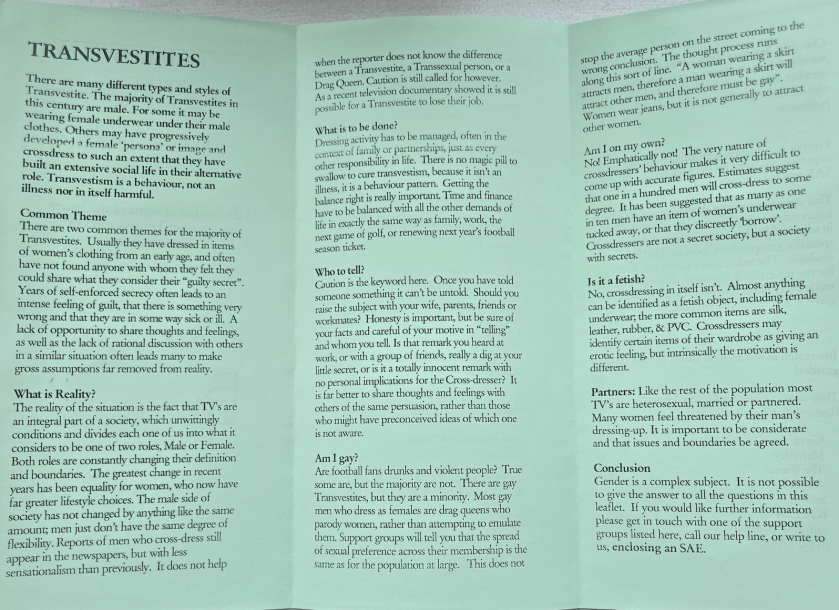
The other was on Transsexualism, ‘A look at some of the issues concerning Transsexual people’.
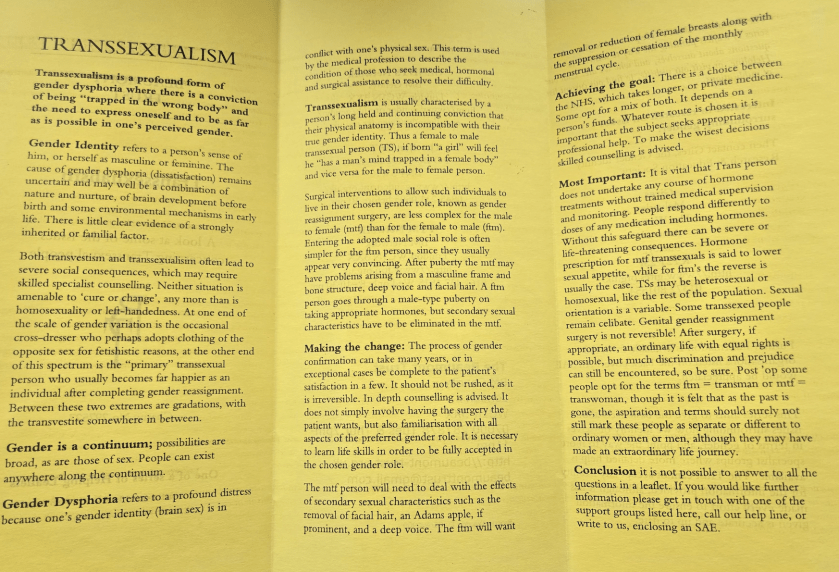
Playdon thought the leaflets gave an interesting insight into ‘taxonomy’, ‘categorisation’ and ‘hegemony and self-subordination, that we necessarily subjected ourselves to’. The main job back then, reflected Playdon, was to ‘survive’, which meant ‘co-operating with the enemy’.
One student wanted to know if it was true that Roberta Cowell had sought out medical treatment from Michael Dillon and Playdon confirmed it was (Dillon, a trans-identified female, is believed to have performed an orchidectomy on Cowell, she was only a ship’s surgeon and thus not qualified to carry out the procedure).
Playdon felt one of the big challenges going forward for trans activism, was to learn to lose and that when you lose the other side has to expose themselves. The thing was to assess how they took you down, to think again and to go back fighting. Everything had been going fine until 2019.
Afternoon sessions
The last session we attended was one of the artsy ones. It doesn’t feel fair to name the young woman who ran the session, despite the fact she was a proper (as in paid) trans activist, as she didn’t have a clue what she was talking about. The discussion was entirely unremarkable with zero scholarship and no persuasive parallels made between culture and trans, either as it really is, or even how it is perceived by insiders. However, it was notable that there was a real shared paranoia about state interference in trans lives. One young woman spoke boastfully about making ‘cis’ people feel uncomfortable and a bit of a discussion was had around whether people cared or not what other people thought of them (Dear Reader, they did really). The spectre of white colonialism was invoked and women, who were probably lesbians, spoke with sadness at the cruel fate handed to ‘trans women.’ It was pathetic but also fervently religious, as it was agreed refuge could only be found in other trans people, whilst vehemently rejecting the labelling function of language. Chronic.
Not a speck, a plank
The culture and history of trans is littered with behaviour, which, in other contexts, would be regarded by believers as odd, immoral and dangerous. This is the plank in the eye that is trans. The other issue here is academia. At the time of writing, there is an ongoing furore about the alleged plagiarism of Jason Arday (who even The Guardian has savaged). It turns out that Arday is an inveterate liar and/or fantasist, but he does have to be regarded as a symptom of the problem that the academy has created for itself, rather than the cause. And if you don’t believe us, we invite you to read again through the (not exhaustive) agenda list at top …
Thank you for reading! Sign up to my blog by going to the bottom of the page.
Please share on other forums if you liked it, as I only do Twitter.


One comment
Comments are closed.