
They had me at ‘shrinking opportunities.’
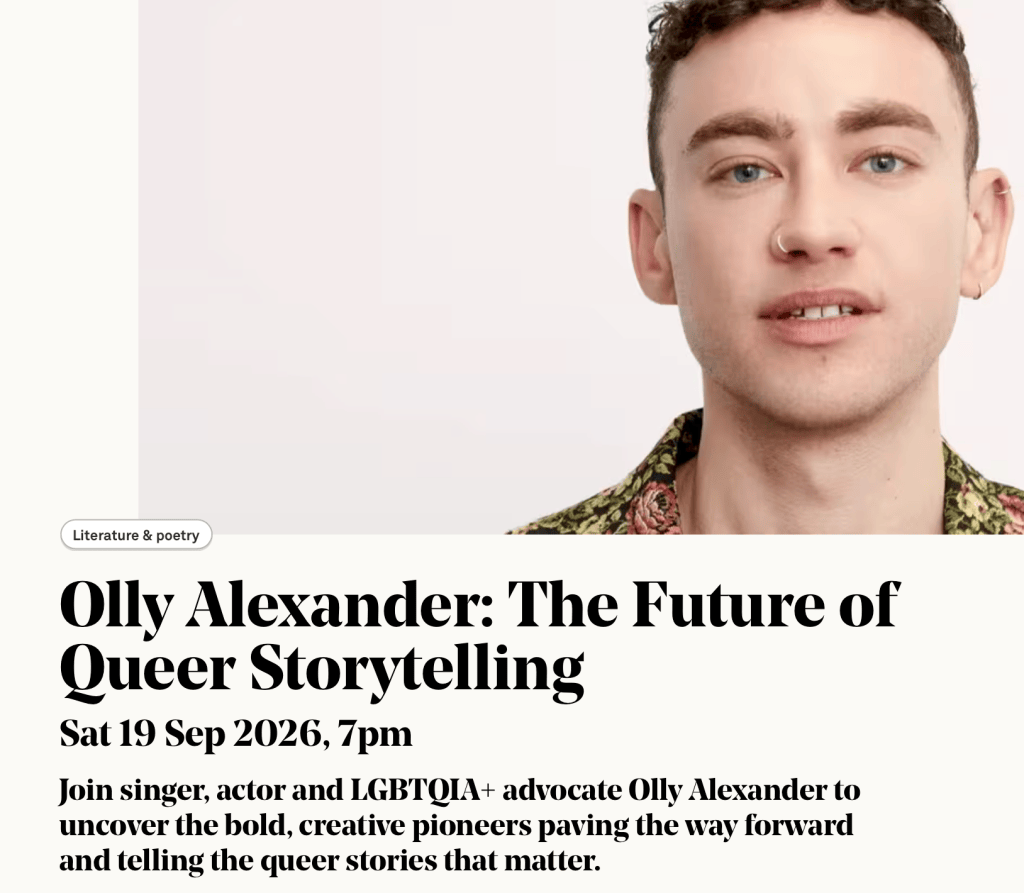
The blurby bit
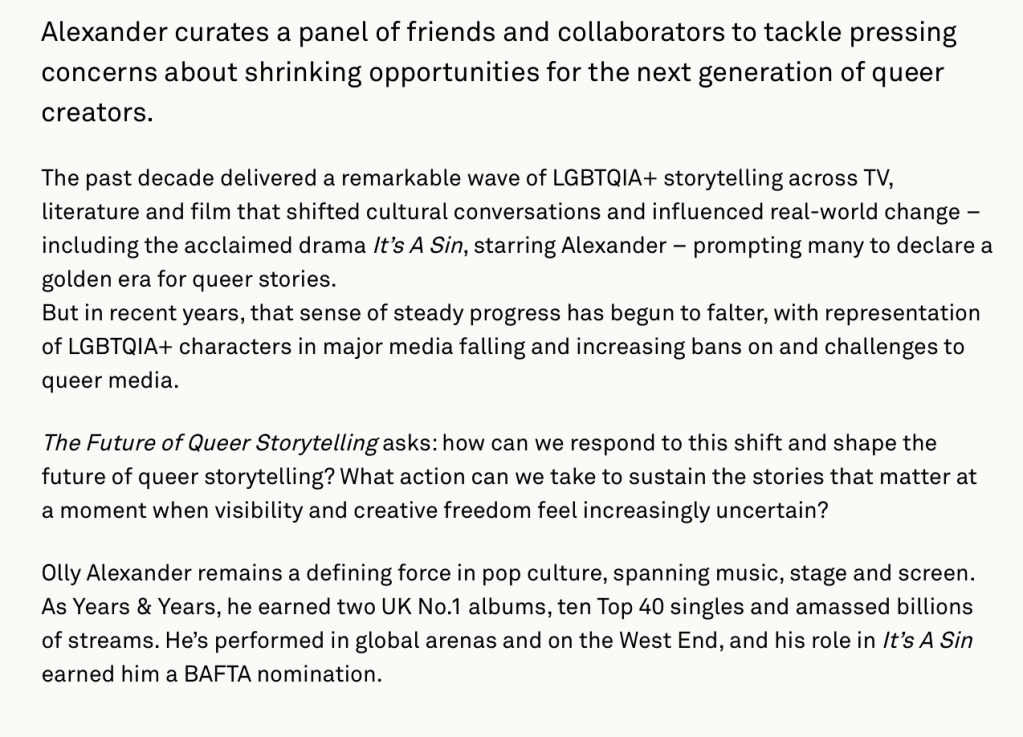
‘Shrinking opportunities.’ Pfft!
In London at least, over the last few years, we have seen the opening of King’s Head theatre which only platforms LGBT/queer art, the opening of a further branch of Soho Theatre in Walthamstow (heavy on the queer), a second queer bookshop opened in Dalston, and institutions like the Southbank, Barbican, the ICA, Somerset House, etc, relentlessly falling over themselves to promote the lives of ‘queer’ people. So, you might be wondering: Where exactly is the shrinkage happening?
Belated panel announcement
The gravitas sitting alongside irrelevant pop tart Olly Alexander, were writer, film-maker and performer Amrou Al-Kadhi (non-binary git); actor and writer Jade Anouka (who?); and writer Juno Dawson (consolation prize prick) and they didn’t disappoint.
Scintillating discussion
I should start by saying that Olly Alexander sounded utterly amazed with himself as host, asking meandering questions which sounded like they were only just occurring to him. God knows what was on his clipboard. Doodles? His shopping list? Worse still, no one ever defined what ‘queer’ meant to them, therefore one could (and did) assume they were meaning it in its loosest sense, i.e. being plain old non-normative.
Below is how Stonewall UK defines the word ‘queer’ at the current time (September 2026), not that they are the arbiter on anything these days, including within the alphabet bag movement, but note that it includes the (as yet undefined) + sign:
A term used by those wanting to reject specific labels of sexual orientation and/or gender identity. It can also be a way of rejecting the perceived norms of the LGBTQ+ community (such as racism, sizeism, and ableism).
The term was historically used a slur, and is still viewed as such by some LGBT people. However, others have reclaimed and now embrace the term.
Source: https://www.stonewall.org.uk/resources/list-lgbtq-terms
In other words, ‘queer’ is a free-for-all, anyone can identify into it, and it doesn’t necessarily exclude cisgenhets.
What is your favourite piece queer storytelling?
Juno Dawson was naturally invited to go first and he told us Queer as Folk taught him about rimming. Phnarr. But then decided to change his answer to Ru Paul’s Drag Race, the global franchise reality TV show, in which he has learnt about many diverse stories, such as contestants identifying as non-binary. Dawson, hopeful that someone powerful from Channel 4 was in the room, thought they should definitely acquire it. However, if the drag-queen-obsessed BBC thinks it’s too expensive, it seems unlikely Channel 4 will shell out for this stale cack, but Lies isn’t going to place bets.
Dawson then asserted that it was Eurotrash which made him queer. That’s Eurotrash, the late night 90s comedy show, which featured mostly smutty stories, or if they weren’t, managed to make them sound that way, so not exactly storytelling in the classical sense. I also think Dawson doesn’t quite recall Eurotrash for what it was, as it was quite zealous in its piss-taking of ‘queer’ people.
Amrou Al-Kadhi went high-brow, citing Pedro Almodovar and his film All About My Mother, which apparently features ‘drag queens fucking nuns’, which makes it ‘queer’ (suppose it does). Amrou also ‘loves’ the The Skin I live In but didn’t want to explain the plot because he didn’t want to get ‘cancelled’ (because it’s about a ‘young man who was kidnapped and forced to undergo a surgical sex change by a vengeful doctor,’ as summarised by Mr Google). We were ten minutes in, and the one example of actual storytelling given so far, couldn’t be mentioned because of the censorious nature of queer politics. Slow clap.
Jade Anouka chose Orange is the New Black, a TV drama series set in a women’s prison. Anouka liked it because she had never seen black queer women loving each other before, commenting that ‘if you put women together, they’re gonna love each other.’ (Yeah, that well documented prison phenomenon.)
Olly Alexander chose My Own Private Idaho, which was ‘super nourishing’. (Apparently the film ends with one of the gay hustler characters deciding to return to polite society, and a woman, thus rejecting the other gay character, who then dies of a broken heart.)
GLAAD had reported a year on year decrease in LGBTQ+ characters appearing in shows and films on network television and major streaming platforms. [Several paragraphs later.] How do you feel about queer representation in media?
First of all, I don’t know what Olly was talking about because GLAAD had reported a 4% increase in LGBTQ+ characters, and that’s according to their own statement on the matter, even though they desperately try to spin it as a negative.
Again, Dawson answered first. He had come out as transgender around 2015 – the Trans Tipping Point – and had been ‘a stupid naive bitch’ for believing it was going to be a good thing (the Tipping Point that is, not for cutting his nose off to spite his face). The real problem was that cis straight people had all the power and trans people had none. The former, of course, don’t know any real trans people, so when a Dawson script turns up on one of their cishetpatriarchal desks’, they were unable to understand the positive representation of trans people contained therein, and preferred a scenario whereby Dawson stole someone’s husband (which he does do, by the way, tee-hee). Trans representation was important in the media because most people were never going to know a real trans person in real life, as they are such a tiny weeny group, just one percent of the population in fact.
Al-Kadhi claimed that trends in drama had returned to predominantly white casts and that in America he had had two shows which had been greenlit but were both cancelled after the October 7th. He also complained that no one wanted to show his dramas about queer Arabs and that people were concerned about dramas which depicted Arabs killing people (fancy that!). White friends were allowed to write whatever they wanted, he opined, whereas he had to show Arabs behaving as well as possible and thus not allowed to show that they had any moral complexity. Ditto for queer characters. (Of course, Al-Kadhi forgot to mention the support he received from Film 4 and the BFI to produce Layla, a story about that rarest of all creatures, a non-binary Palestinian drag queen.)
Why aren’t queer dramas popular?
Was the question that Alexander probably wanted to ask (I think). Dawson admitted he had written for Doctor Who, for both Jodie Whittaker (the female one) and Ncuti Gatwa (the out gay black one), and apparently does not understand that fans hated both incarnations because they were shit. Or that he bore any responsibility for the series tanking.
Al-Kadhi had decided to firmly keep to his ooh-look-at-me-being-all-controversial and told us that audiences didn’t like being patronised and wanted good stories over anything else (he may as well have just slapped Dawson across the face). For example, he gets on very well with his 75 year old Reform-supporting racist neighbour (so racist, she’s happy to rub shoulders with him) who was trying to set him up with a (dog) groomer (hee-haw). Commissioners these days were too scared to show moral contradiction. These were the notes he gets all the time (forgetting, of course, that if he was really facing a barrier, he wouldn’t be getting notes from commissioners full stop).
Anouka felt the media told whatever stories they wanted about queer people, she, however, wanted queer stories ‘about our differences’ so that other people would learn ‘the truth about the differences’. Naturally she did forget to mention exactly what those differences were, but did know that the Daily Mail could be beaten in this way.
The panel seemed to have a fundamental misunderstanding that journalistic reporting was ‘bad storytelling’ and that ‘good storytelling’ was people saying what they want about their lives (and taking that at face value) and that there didn’t have to be anything more imaginative than that.
Main challenges.
Anouka said in the theatre world she kept on coming up against the excuse that there was enough already. Al-Kadhi said the trojan horse way of getting stories told about queer Arabs was to write a part for a hot white guy. Dawson wrote a novel about a trans character without even saying it was a trans character until halfway through (in other words, it was a story with a twist). Apropos of nothing, Dawson announced he would ‘rather eat sick’ than talk about J.K. Rowling, proving that wasn’t really true. Naturally, the audience laughed at this extraordinary witticism. There was a difference between being an artist and an opinion columnist, opined Al-Kadhi (who has written opinion columns, according to Grok, in the following: Attitude, The Guardian, Independent, i-D, Dazed, Gay Times, amongst others).
Here is one of Al-Kadhi’s opinion pieces, in which he claims to have been ‘transphobically’ abused on a bus. The details are so cringe, but it was 2018, so he got away with it. I’m not sure even The Guardian would be so wide-eyed now.
The driver stayed quiet, removing neither me nor the perpetrator, and so things escalated. The offender yelled that if his “kids were there”, he’d “fuck me up to keep them safe”; he became alarmingly enraged, and I feared for my safety. Because his “kids weren’t there this time”, he decided not to pulverise me. Perhaps he thinks I should have been grateful.
Source: https://www.theguardian.com/commentisfree/2018/jul/18/transphobically-abused-bus-passengers-did-nothing, Published Wednesday 18 July 2018
Positive about the future?
Okay, this is the important bit, the whole point of us assembling in the hallowed space of the Purcell Room, Queen Elizabeth Hall, Southbank Centre, on a Saturday evening at 7.00pm. What did the panel think? (Mem: We were there to discuss the ‘shrinking opportunities’ for queer storytelling.)
Well, Anouka said female actresses nowadays were allowed to audition doing male parts in Shakespeare plays (this, apparently, had never been allowed before) and that the woke kids of today would be the commissioners of tomorrow. She thought the future was bright.
Al-Kadhi thought that audiences had an appetite for quality but didn’t really have anything to say which spoke to the actual theme.
Dawson said the success of Obsession (I’m not clear how the film would meet the criteria for being ‘queer’), had been the most successful film of 2026 so far, proved that the audience was there.
Alexander said that there was a time when queer popstars dominated the conversation and still did (running off a load of names including Billie Eilish and Sam Smith but could have legitimately added many more, like Lady Gaga), and who were also super successful.
Question and Answer with audience
Questions to the panel had to be emailed in advance. No roving mics allowed since Julia Long dared ask the public intellectual, Judith Butler, what a woman was.
What are the panel’s views on TV programmes, like It’s a Boy/Girl and Ru Paul Drag Race being cancelled and the current climate on social media and public debate and opinions, what chance do the transgender community have?
It was a very concerning when even a global brand, like Drag Race, wasn’t safe, said Dawson. He had had lots of conversations with supportive commissioners, who were trying so hard to tell trans stories but there was no consensus about what those stories should be. Trans creatives didn’t want to do dead sex workers, sad stories about surgery or body dysmorphia. Of course, the BBC had aired What It Feels Like For A Girl (based on trans activist Paris Lees’ memoir, first broadcast in 2025), which hadn’t just featured one trans/non-binary character, but several. Another example from Dawson: Jules (played by Hunter Schafer) from Euphoria was a trans character, who just happened to be horrid.
Do you think the future of queer storytelling is about having queer characters become ordinary within mainstream stories or should queer creators continue to challenge what mainstream storytelling is, until it is normal?
Question doesn’t make any sense, so makes sense it was chosen.
Al-Kadhi, however, thought it was ‘interesting’ and blathered on again about all the commissioners he’s in touch with and that being a queer Arab is hard. Dawson loved the sexually explicit film Pillion (which depicts a BDSM relationship between two men) and also thought It Gets Worse, a comedy series commissioned by Channel 4 and about to be premiered at the London Film Festival (and incidentally directed by an woman of Arab descent) was good. The trailer shows the therapist character spitting in the mouth of his much younger client during their first sesh.
Alexander forgot what he was going to say. Then he remembered, there had been an enormously successful novel this year – Fruit Fly – about the dating app Grindr. (Being the absolute dickhead that he is, he gave away the plot twist.)
What emerging queer creatives should we be paying attention to?
Alexander said Joel Silver, writer of Fruit Fly, after having embarrassed himself. Anouka nominated trans writer/director Charlie Josephine, who had made an impact in theatre. Al-Kadhi wanted to promote a short film called Telly XXX (a Google search inevitably only bought up hardcore porn) made by a Arab filmmaker, about a man who liked to have sex with his TV. Dawson nominated fellow doll Torrey Peters for his writing of the awful ‘quintet’ Stag Dance, which came out last year to much fanfare (including a talk at the Southbank).
Who turns up for these things?
I mean, apart from me (obviously) and the poor terf I dragged along (him falling up the stairs the entertainment highlight). We discussed and it’s people who just want a night out in central London, have a few craft beers whilst visiting the Southbank street food market (tick) and switch off for a few hours, and let a narrative, that they’re already really comfortable with, wash over them. Like most podcast consumption, in fact. This would explain why they were satisfied by the ludicrous and contradictory conversation, but even they must have been left slightly puzzled by the patent lack of shrinking opportunities?
Thank you for reading! Sign up to my blog by going to the bottom of the page.
Please share on other forums if you liked it, as I only do Twitter.

