
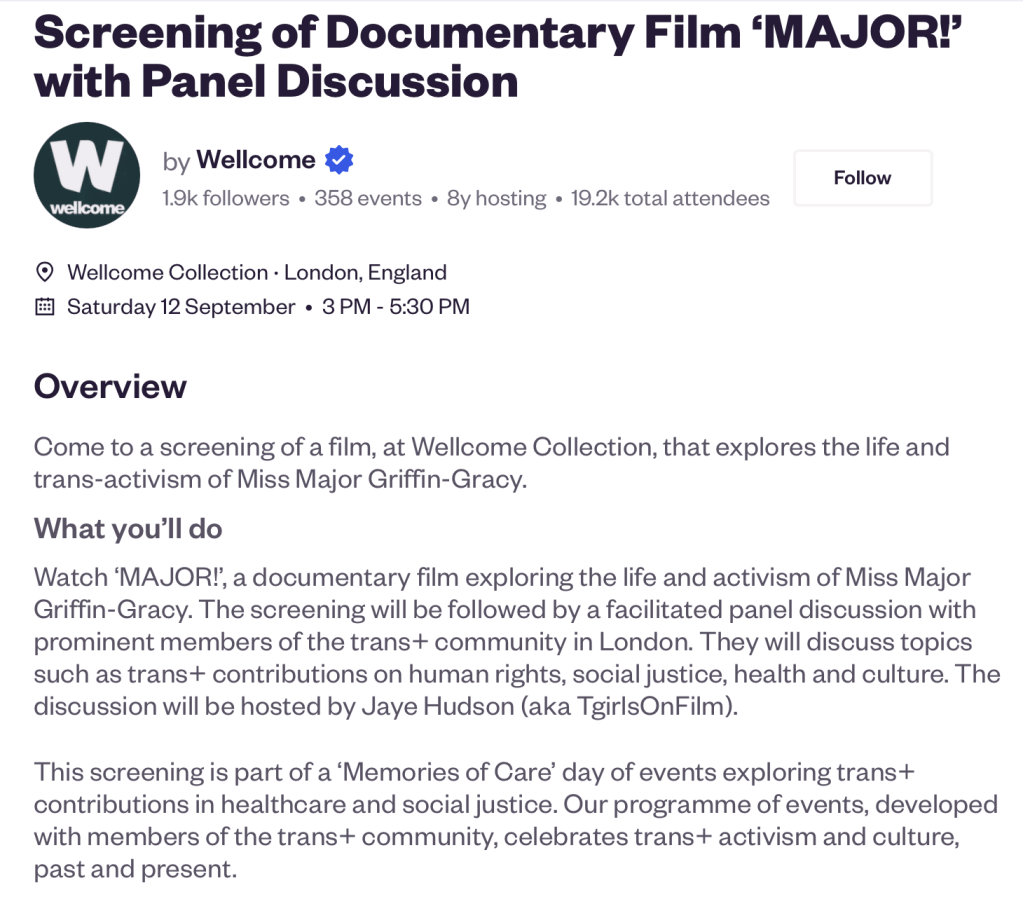
Screening hosted by the Wellcome Collection.
The blurby bit
Introduction
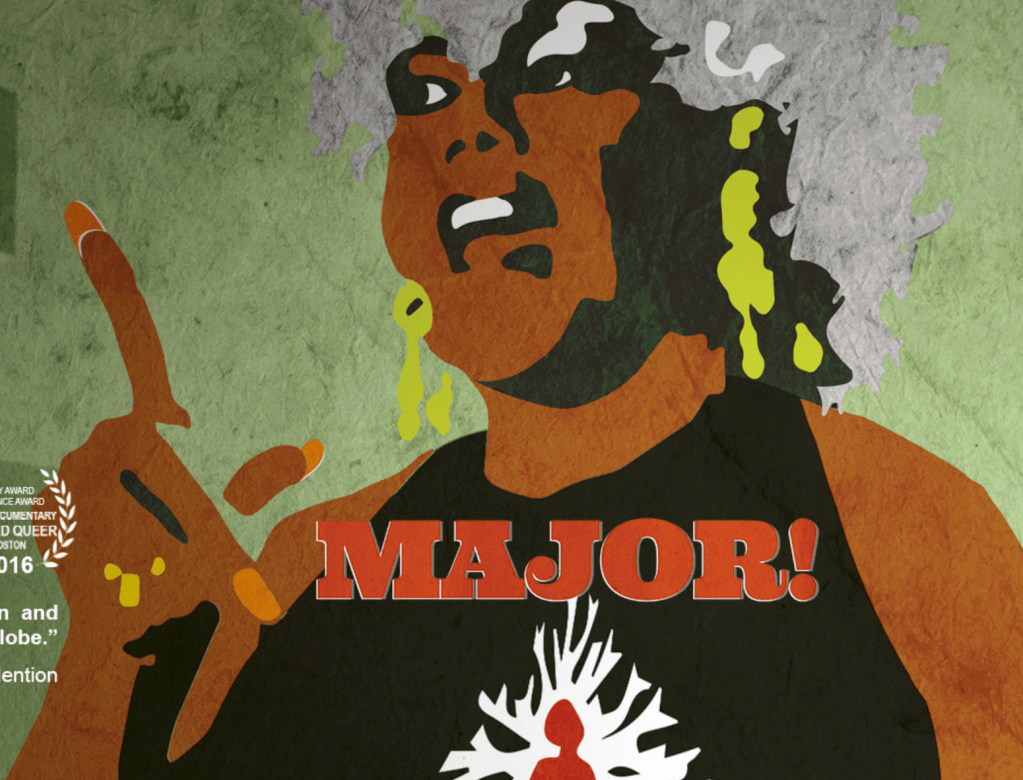
Released in 2015, i.e. the Trans Tipping Point, Major! is an interesting documentary about the life of Miss Major Griffin-Gracy, a former drag queen based in San Francisco. Crucial to this documentary is Major’s role as supposed mother-figure to a sprawling set of much younger, mostly African American, trans-identified males. Clearly, Major is a charismatic character, given the size of the flock and the (?genuine) affection with which he is regarded. I, however, never warmed to his onscreen presence, which believe it not, is genuinely quite unusual for me, as I do normally like my subjects.
I have written about the panel discussion in a separate blog, to be published at a later date. The panel included Olivia Campbell Cavendish (Trans Legal Clinic/Garden Court Chambers) and Dr Kamilla Kamaruddin (clinical lead for the East of England Gender Service).
Film review
Format
Major! is divided into sections titled things like ‘history’, ‘love’, ‘activism’, etc, each of which is illustrated by overly long saccharine doo-do-do-do-doo musical inserts and cute animations, making it feel as if it is aimed at children (or else the mentally subnormal). Wellcome advised that attendees be at least 14 years old and I couldn’t find a BBFC classification, but it seems likely (according to its website), that Major! has done the rounds at schools and campuses across north America and the UK. That being said, there is nothing particularly offensive in it, aside from some half-truths.
One thing the camera doesn’t shy away from though, is showing Major and ‘daughters’ in raw ‘brick’ form, so it’s really noticeable when a ‘doll’ or two pops up. It’s quite incredible how unattractive the bricks are though, including Major himself, his slurred speech hard to understand, partly due to his missing several teeth. I suspect if the film had been made today, a lot of the bricks wouldn’t have made the final edit, and Major himself would have been glammed up for the entirety, the most powerful lights available trained on his mug.
At the end Janet Mock turns up (who is so 2015, it’s painful), to testify that Major has been an inspiration to him his whole life, in front of an adoring crowd, even though it’s clear from the filmed conversation that it is the first time the pair have met.
In the closing moment, one by one, each of the ‘daughters’ tells us: “I’m still fucking here”, the ever present reminder that they don’t all make it, you know.
On Miss Major’s personal life
Major’s organisation is the Transgender Gender-Variant Intersex Justice Project* (TGIJP) based in San Francisco and appears to be how he recruits ‘daughters’ to his cause via a penpal system to inmates. These are trans-identified males, who, like him, have been through the prison system and affected by drugs, prostitution, family issues, etc. His special ability is to make them feel they are not abandoned, providing food and a sort of halfway house once they are ejected onto the streets. Understandably these men are fiercely loyal and, if allowed, reward him with ‘mama’ and they might perhaps earn the honorific ‘daughter.’ But it isn’t just men who are in awe of ‘mama’, there is also the inevitable gaggle of lesbians/trans-identified females, one of whom is Beck Witt**, Major’s long term partner, who is at least 30 (but probably 40) years his junior and on testosterone. Another friend loved Major so much that he gave him his kidney. Despite Major having to take immunosuppressants to stop the gifted organ rejecting, it seems he still stayed on the exogenous oestrogen. It’s amazing he lived as long as he did with such chronic health conditions and drug use.
*The ‘About’ page states that it was ‘founded in 2004 with the help of a Soros Justice Fellowship from the Open Society Institute.’
**Major and Beck Witt had a child together in 2021, several years after the documentary’s release. This appears to confirm that Major never had the snip. It is also likely that Major was older than 79 years stated in the article. Both parents are cross sex hormone users.
Most of Major’s relationships had been with men, with his only other heterosexual relationship resulting in the birth of a son. The baby mother testified that he had been a great father, even to the extent that when the relationship broke up, she was happy to leave her son in his full-time care. We see the son, who is effusive, affectionate and extremely complimentary about ‘dad’ (it’s interesting that his only real child is allowed to refer to him as such). On the day of filming, it was the first time in 23 years that Major and his ex-girlfriend had been in the same room together, so clearly she hadn’t been entirely at ease with his behaviour.
Major died in October 2025 and was probably born in 1941 (he declined to confirm the exact year). Major’s laughs re-telling of his mother’s fainting fit when he once flashed his moobs at her. His cross-dressing began with the wearing of her clothes. He laughs about this, but does appear to be dimly aware of the impropriety.
His sister committed suicide when she was 26 but beyond feeling she must have really meant it, no insights are offered as to why (I wondered if nicking her clothes had contributed). Neither his mother or sister supported or understood his ‘transition’, which, by implication, means this must have happened early on his life (I’m thinking around 1970) when crossdressing in public was still a criminal offence in many states.
Prison politics
The black lesbian feminist Angela Davis features, praising Major and explicitly endorses the placement of trans-identified males into prison estates supposedly restricted for females. Davis is a fully fledged prison abolitionist too, as is Major’s TGIJP, of course. Although it is clear that this is her first meeting with Major and had just turned up for the filmed event regarding his organisation, the entire film is peppered with her witterings, as if she was omnipresent in his life, like his ‘daughters’. It is an important endorsement though, when you consider this film has been rolled out as an educational toolkit in schools, and dispenses a narrative that black trans-identified males in prison are systematically raped and tortured (obviously no facts are presented, just the various anecdotes from Major’s errant ‘daughters’). Furthermore, using terminology like gender-variant makes the entire issue much larger than it necessarily is, yet the issues the ex-cons discuss are ones which are common to all prisoners. Placement in solitary confinement for their own protection is defined as abuse, which is extraordinary when you consider the number of vulnerable inmates needing protection.
It is also claimed that being held in solitary confinement disqualifies one from early release or educational opportunities, both of which Grok says is unlikely if the solitary confinement was not given as a disciplinary. As I am always saying, it’s up to the filmmaker to check facts and they never do and this was one of the more easy ones that could have been double-checked.
Other factoids
As you’d expect, the whole myth about Stonewall being led by ‘trans women’ is repeated. Major refers to himself as the ‘last black girl alive’ from that event (no photographic or other documentary evidence provided and the only source I could find which supported this assertion were his own words published by the New York Times as part of his obituary).
Another rather questionable story arises from one of the ‘daughters’, who alleges that he was subject to repeated rape by (an unspecified number of) deputies for ‘several months’. He bought a case against (one of?) the deputies, which ended up being settled out of court, and one of the conditions of his settlement was implementing transgender sensitivity training inside of the jailhouse. That’s how it’s done, folx!
Conclusion
This isn’t the first time I have seen Major! offered as a free screening at an important institution and I would like to draw attention to the fact that it was screened as part of the Wellcome’s pledge to ‘celebrate’ trans activism with specific reference to healthcare. Which makes Major! a strange choice as it didn’t really have anything to say about ‘gender affirming healthcare’, despite the fact that we learn, via ‘in memory of’ subtitles, that a number of the bricks succumbed to various health complications post-production. The filmmaker, of course, made no attempt to investigate whether these early and untimely deaths had anything to do with cross sex hormone abuse …
Thank you for reading! Sign up to my blog by going to the bottom of the page.
Please share on other forums if you liked it, as I only do Twitter.

