
The usual narcissistic bollocks, one comes to expect of these people.
The blurby bit
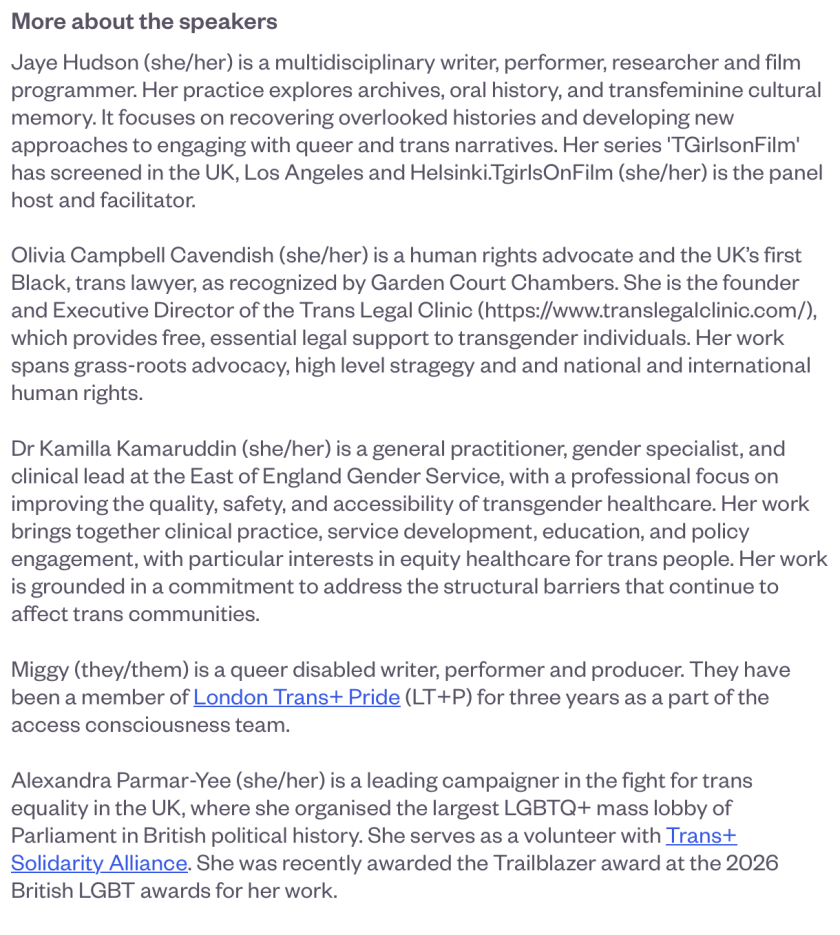
The panel discussion
Reactions to the documentary
I have written a separate review of the documentary film Major! which had been screened prior to the panel discussion and didn’t particularly deal with the issue of ‘gender affirming care’ at all, so a rather strange choice for a discussion focussing on the same.
Olivia Campbell Cavendish, spoke first. He is a trans-identified male, whose only real connection to Garden Court Chambers is the fact that his organisation – the Trans Legal Clinic – has instructed them. Pathetic really. Anyway, he was struck by the fact that Miss Major Griffin-Gracy had said trans people were the only people you could still bash, whereas queer bashing, for example, was no longer acceptable. The violence was non-stop.
The others variously commented that the documentary had given them warm fuzzy feelings and that Major was an amazing trans person of colour, despite being part of a demographic most likely to be killed. Additionally, trans people weren’t just being killed by abusers, but by the healthcare system (this in reference to the large number of bricks in the documentary who appeared to have succumbed to complications with their gender affirming healthcare).
Trans healthcare in the UK
Dr Kamilla Kamaruddin*, who currently leads the East of England Gender Service, was asked his thoughts. Kamaruddin reflected that in Malaysia there was no access to trans healthcare whatsoever** and the reason why he came to the UK in the 90s. When he arrived, access was restricted but not impossible, and he faced a complete lack of awareness from fellow health professionals. He didn’t even know how to reach out for help and found that colleagues treated the subject as a big joke. At that point he had not ‘transitioned’ yet, however. When he found the courage to do so, he went to his GP and asked for a referral to the gender clinic so that he could start on cross sex hormones. Before that though he had to have a mandatory consult with a psychiatrist to confirm that he ‘did not have a mental illness’. Kamaruddin told us this, managing to still sound as if he was surprised by this so many years later. (It is still the case one needs a confirmed diagnosis of gender dysphoria to access cross sex hormones on the NHS.) ‘You can see me, I do not have a mental illness,’ Kamaruddin giggled. From what he said I gathered that he delayed his full social transition by a significant period until he gained his British passport.
*By the by Maya Forstater was questioned by the police for reporting on Kamaruddin’s public comment that he could do: “more intimate examinations that they did not let me do when I was a male GP”.
**Interestingly, Mx Grok threw up this fact: A 1982 National Fatwa Council ruling declared sex reassignment surgery haram (forbidden) for Muslims (with a limited exception for intersex conditions). This has shaped policy: public doctors cannot prescribe hormones specifically for gender transition.
Kamaruddin finally did ‘transition’ fully, including at work, and began working as a ‘female doctor’, which meant he faced a few problems with the GMC (General Medical Council) who had wanted him to have a Gender Recognition Certificate (GRC) before performing his duties. However, Kamaruddin had asked: ‘How can I get a Gender Recognition Certificate if you don’t allow me first to perform as a female doctor?’ Kamaruddin states that he ‘wasn’t angry’ but ‘sued the GMC’ and won. (Mx Grok found no evidence for this supposed legal case and I can see zero reason for keeping such an important win secret.) At the time Kamaruddin was told by colleagues he was probably the first person to have sued the GMC and won; if he had known that, he said, he would have sued for more. The audience tittered.
Things were ‘slightly better’ now, he told us, as there were 7 gender identity clinics in the UK (two in London, one in Nottingham, Sheffield and Newcastle, etc) and there were also regional services, which were GP-led (Cambridge, Manchester and London). The Levy Review (which arose from the Cass Report) had looked at adult gender dysphoria services and recommended more primary care involvement, which meant easier access. However, there were still barriers to access and there were still very powerful people who don’t like trans people in the NHS, said Kamaruddin.
What forms of care can trans people perform to help each other?
Miggy went with ‘feeding each other’, this could be through community meals but also checking in with someone to check that they were eating, since a lot of people have a lot of things on their brain and that the smaller parts of looking after yourself, like eating, got missed. She had witnessed friends physically feeding each other*. This was soft and lovely.
Alexandra Parmar-Yee said the power to ‘yap’. It had kept him going and he thought it mutually beneficial.
*Fact: People in the UK fraudulently access Personal Independence Payments by claiming difficulties with activities of daily living, which includes ‘preparing food’, ‘taking nutrition’ and ‘communicating verbally’).
Kamaruddin had patients who came to him to express fear about going outside, the reality was though a lot of people loved and supported trans people and these outnumbered the haters. Reach out to trans support groups and you will experience the feeling of being the majority.
What has kept Campbell Cavendish going during a terrifying year of trans rights being undermined globally, was that the trans community had something the nasty gender crits will never have. Which was care. The trans movement was built on love (hah!). He could go to any city in the world and find instant love and care from the trans people residing therein and receive the type of care that Miggy had described. Nasty gender crits will never have that. Therefore, there was no need to be afraid. Foremost in his mind was to help his sisters and siblings (the latter being a secondary consideration, natch). Hatred is like fire and burns everything in its path, therefore the gender crit movement couldn’t last very long. Love, care, kindness is everlasting. This was why trans activism would succeed.
What work do you do which people might not know about?
The first thing Campbell Cavendish learnt about the law was that it was literally like a BBC drama no one wanted to watch, i.e. white men running around (a comment he did not go on to explain). Law also used archaic Latin phrases (or ‘funny lawyer words’ if you’re Campbell Cavendish) which he found hard to understand. For example: ‘Actus non facit reum nisi mens sit rea’. He thought this meant ‘to act alone does not make a man guilty, it also requires a guilty mind’, when it actually means ‘an act does not make a person guilty unless the mind is also guilty’. He was in the right ballpark, I suppose, and is only running a legal advice clinic!* This is free to access and runs the whole gamut of trans issues: access to healthcare, gender recognition, employment discrimination, housing and homelessness, etc. It is, according to him, the only ‘direct access’ organisation which exists just for trans people in the country. Individuals could also self-refer and be assigned a case worker and access to solicitors, barristers, etc. (There presumably are some limits to what they agree to take on, but Campbell Cavendish was keen to make it appear otherwise.)
*According to Grok, The Trans Legal Clinic is primarily funded through a combination of charitable grants, public donations, and crowdfunding. It operates as a registered charity under the name Trans Legal Foundation (charity number 1209517). Main funding sources are grants from trusts and foundations, including **The Three Guineas Trust (which provided the majority, including significant multi-year awards such as £445,000 for core running costs (2025–2028), £225,000 for premises costs, and smaller grants for IT equipment and unrestricted support. Total from this funder exceeds £690,000 across several grants).
**In turn the The Three Guineas Trust stated aim is ‘to support the autonomy, safety and civil rights of autistic, neurodivergent, Disabled, trans and non-binary people,’ and are mainly funded by supermarket dynasty, the Sainsbury Family Charitable Trusts (SFCT) with Clare Sainsbury a Trustee.
Examples of the kinds of cases TLC do, include visiting a police station to demand that police officers take a crime report from a trans person who has been physically attacked, or liaising with peoples’ GPs to tell them that ‘it is absolutely not appropriate to refuse provide somebody care because you’re not competent.’ Like, we wouldn’t tolerate it if a GP said: ‘I can’t care for you because I don’t know how to treat broken arms,’ said Campbell Cavendish smartly. When Campbell Cavendish comes across an area of law he isn’t familiar with, what do you think he does? He becomes familiar with that area of law (or we could say: ‘Ignorantia juris non excusat,’ to confuse the little blighter, though he preferred ‘I open a fucking book’).
Campbell Cavendish wanted to give us a stark example of the trans broken arm complex. Currently the TLC was supporting the mother of a trans-identified male – ‘Joelle’ – who died in 2023, after multiple visits to A&Es, he was refused access to care because of a combination of ‘medicalised transphobia and misogyny’ and told his symptoms were due to exogenous hormones. Finally, he called his mum, explaining he was in a lot of pain, and the mum travelled down to London, with the intention of nursing him at home. However, during the journey his pain became so severe he had to be taken to hospital. Tests were run and it was discovered he had a very serious form of cancer but was told it was ‘highly treatable.’ After receiving the diagnosis, he was admitted to a general ward to await commencement of chemotherapy. He waited on the ward for several days without anything happening but on the thirteenth he was wheeled to the chemo ward, where staff took one look at him before turning him away. This lead to the patient telling his consultant that he didn’t care if he went on a male ward to receive chemotherapy, he just wanted treatment. Within six hours of this declaration the patient finally received a bed where he could receive chemotherapy. Twenty-four hours later though, he died. The TLC was going to be doing a lot of campaigning and fundraising around this case to ‘help mum get justice for her daughter’.
Joelle’s abdominal tumour measured 98cm. Her normal weight was 8 stone. The wrong ward also meant being in the care of people who had no experience or understanding of the likely rapid deterioration of someone with aggressive lymphoma, and did not take appropriate steps to protect or care for her as her condition deteriorated in a way that is textbook expected for this lymphoma over less than 16 days.
Source: https://www.translegalclinic.com/justice-for-joelle (still says 98cm as of 1 November, so appears not to be a typo)
For the record, I asked Mx Grok, and it is anatomically impossible for a 98cm tumour to sit within the abdomen, ‘since an adult torso length (roughly shoulder-to-hip or xiphoid-to-pubis) is typically well under this length, and the peritoneal/retroperitoneal cavity is constrained by the diaphragm, pelvis, spine, and abdominal wall.’ It is possible that his cancer was extremely aggressive and literally doubling up overnight (Mx Grok says its possible and an oncologist also confirmed this with me) and I believe this a likely scenario, in which case surely exogenous oestrogen accelerated the spread? There is definitely some missing information, one of which is probably that chemotherapy was never going play a role for someone who had such aggressively advanced disease.
GPs and hormone prescriptions
Kamaruddin was pissed about the fact that there were hundreds of GPs refusing to prescribe hormones, even ignoring letters telling them it was their ‘moral duty’. He urged us, that if we came across this situation, we should make a complaint to the ICB (the Integrated Care Board, which commissions primary care and community care and has statutory powers). The more complaints, the more likely NHS England would be to do something about it. That was his plea. But please don’t mention that the suggestion came from him if you did write a letter.
The trans activist mass lobby earlier in the week
Parmer-Yee had helped organise the lobby event held on 9 September 2026, in which (according to Mx Grok) almost 1,000 trans people and allies signed up to personally to lobby their MPs on the issue of EHRC’s single sex guidance. Mr Menno also attended and took video – see here.
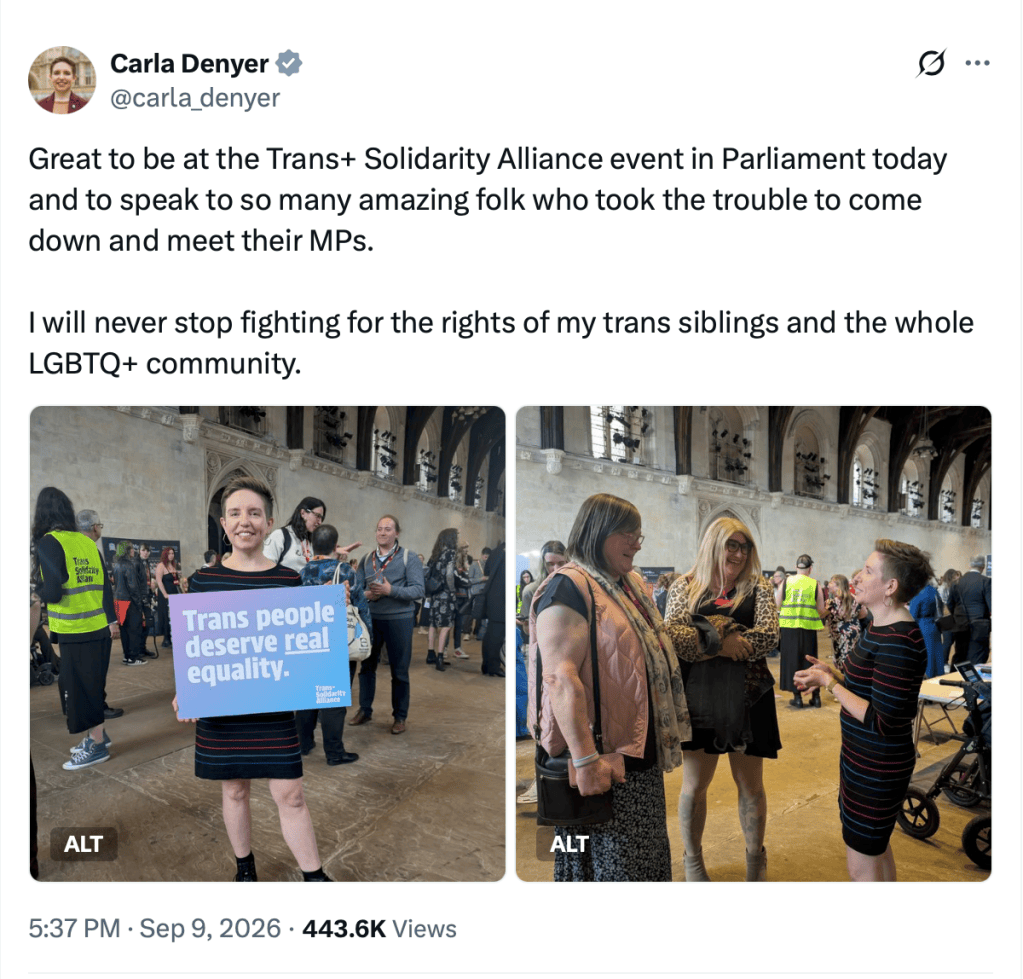
The event was to remind MPs ‘that we’re still fucking here,’ said Parmer Yee eloquently. The event was educating people on how to lobby, skills which they could take into their communities.
Using white people
When liaising with certain stakeholders, the TLC employ the tactic of using a white member of the team where they believe certain people will respond better to a white face, including organisations within the LGBTQ+ movement. They were excellent at sniffing out racism (but not challenging it, it seems, given they rely on such a ploy).
Question and Answer session
There was just ten minutes left for audience questions. Someone stood up who had known Major personally and said she considered him to be her ‘grand-ma-ma’ and other personal tidbits she knew about him. Show off. There was no real question but that didn’t stop Campbell Cavendish opining the difficulties of being a trans person of colour with multiple marginalisations. ‘I love the gays, I really do,’ said he, but he was sick of the white ones, who behaved like a ‘harem’, ‘whooping’ and ‘cheering’ him. My god, he could not stop talking (you can predict about what – global violence, systemic discrimination, looking fabulous in the face of evil, etc). So much, in fact, there was no time left for any questions. Hurrah!
An aside
On the day of this screening and panel discussion, there was also supposed to be a talk given by an Eliott Rose on trans healthcare. Please note the Wellcome Collection’s explicit endorsement below, which uses the phrase ‘celebrates trans+ activism’.
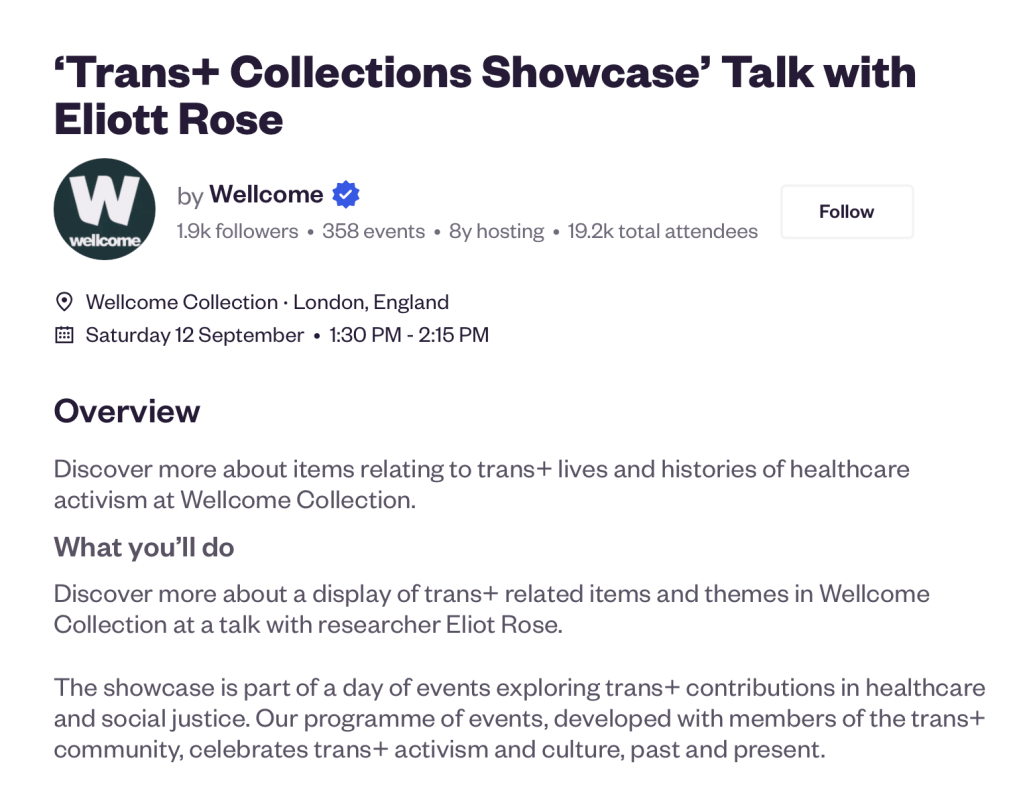
However, the event was cancelled about a week before – no reason given, but I include the blurb below since it’s quite interesting that ‘Eliott Rose’ had been allowed anywhere near the Royal College of Paediatrics and Child Health, let alone in healthcare policy.
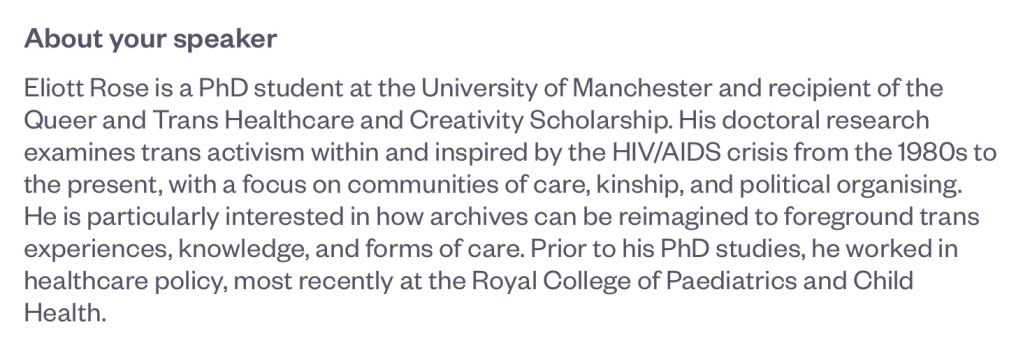
Not only was the lecture cancelled but also the display itself, I think, as I tried to enter but was told I couldn’t because a workshop was going on (must have been by private invitation only). I peered through the crack in the door to see people lying on the floor. All very mysterious. Were the objects so objectionable, that even the transhumanist hell, which is the Wellcome Collection, chickened out? We’ll never know.
Conclusion
So, as I said up top, it was the usual narcissistic bollocks, one comes to expect of these people. I have run out of energy (almost) to repeat the usual points – why does no one mention the consequences of surgeries and medications gone wrong? Why are so many of these quite powerful trans activists so bloody thick? Why do powerful institutions continue to throw money at these outfits? Etc, and so on. One has just enough steam to eke out our usual cry: Chronic.
Thank you for reading! Sign up to my blog by going to the bottom of the page.
Please share on other forums if you liked it, as I only do Twitter.


I don’t think it was Kamaruddin that had Maya F questioned by the police – ISTR that one of the reasons the police didn’t take it further was that the “victim” had not complained (or even replied when they tried to contact him, I think). It was one of the vexatious-complainant mob – “Lynsay Watson” or someone – that did the reporting to the police?
LikeLike
Thank you, that’s an important correction.
LikeLike