
Yes, it was very, um.
*Literally pronounced ‘I’d a hobbit’.
The report – Tower Hamlets Transgender Needs Assessment
Tower Hamlets Council, notorious for its alleged-corruption, -sectarianism, -nepotism and proven electoral fraud (Lutfur Rahman is still mayor), commissioned this transgender needs assessment report from The Love Tank CIC.
You can read the report here.
The role of elop
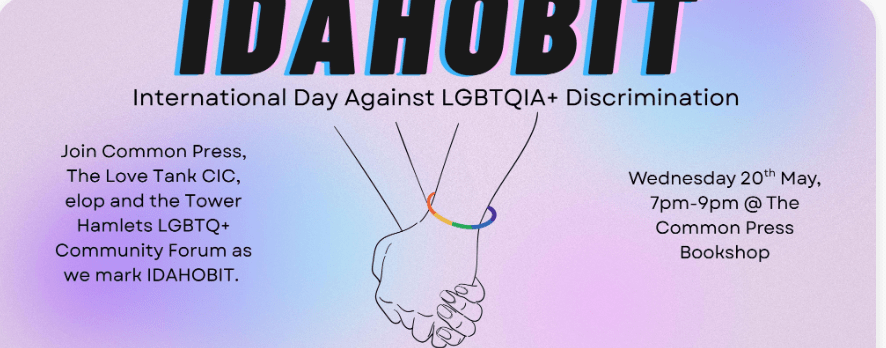
Mark, who works for elop (East London Out Project), introduced the speaker. Mark’s role at elop is as a community and events worker, which includes facilitating for the Tower Hamlets LGBT+ community forum (one suspects this facilitation is just nominal, as there is a neglected website and not much else). IDAHOBIT is celebrated to commemorate the day that homosexuality was declassified as a mental disease by the WHO in 1990, Mark told us. The UK used to rank No. 1 as the safest country for LGBT+ people, but now it ranked 22nd due to the Supreme Court ruling, the government’s failure to ban conversion therapy, scarcity of healthcare for trans youths (we were all given a copy of The Love Tank’s Little Back Pocket Guide to Puberty-Suppressing Hormones, apropros of nothing*) and the poor treatment of LGBTQ+ persons seeking asylum. Amidst the scarcity and isolation, there was a plus side: the community constructed safe spaces where chosen family could be found. These homes were sacred, welcoming and transcended borders. ‘We are worthy of so much care,’ said Mark.
*Also authored by Dr Kylo Thomas.
The academic
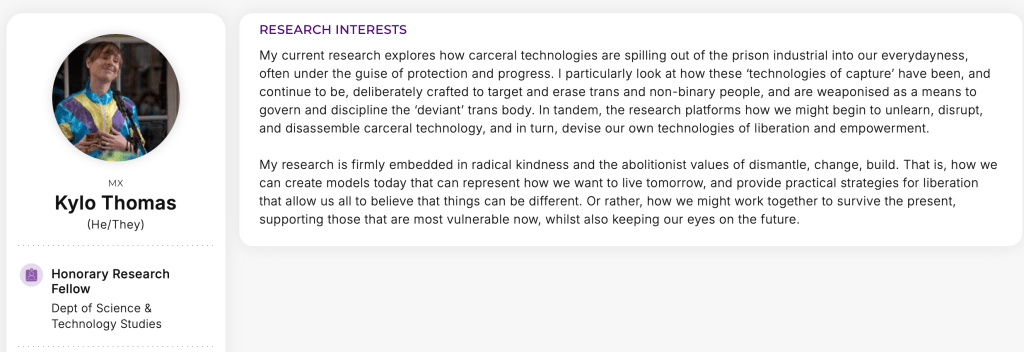
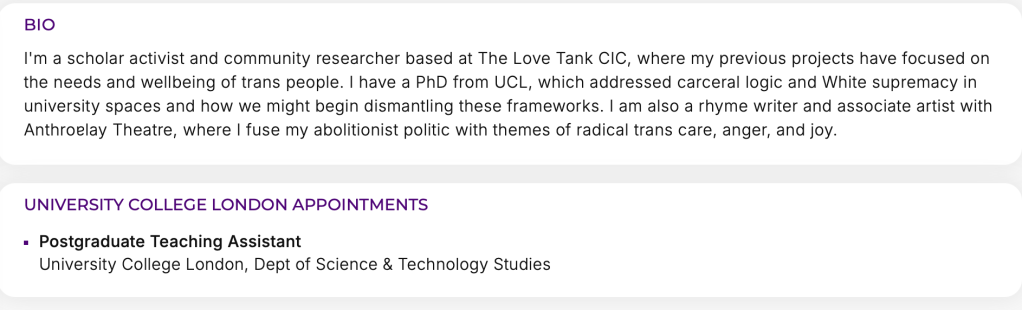
Dr Kylo Thomas (he/they), what wrote the report, is an Honorary Research Fellow at UCL in the Department of Science and Technology Studies. ‘Dr’ Thomas is a trans-identified female, who had a smattering of facial hair fashioned into – what might have been – a moustache. She started by stressing that she was an abolitionist and, as such, saw all official institutions as ‘carceral’, and thus fighting for ‘liberation for all’.
Research methodology
The qualitative research which underpinned the report was carried out from November 2024 to January 2025, thus prior to the Supreme Court Judgment in April 2025. The ‘research’ consisted of holding three dinner parties at The Love Tank’s offices (local restaurants could not provide accessible or gender neutral toilets). Interestingly, dinner parties were held in line with gender identifications, one being for ‘trans women and transfemme people’ (4 attendees), one for ‘trans men and transmasculine people’ (6 attendees) and one for non-binary identified people (12 attendees), meaning the groups were (potentially, at least) male, female and mixed sex. How very binary. The dinner party method was considered ideal as it was ‘anti-extractive’. Plus, it was the perfect place for Dr Thomas to find new pals. The report includes a photograph of the ‘inviting’ dinner party space, which the Dr was clearly enamoured with, given she pointed it out at least twice. Of course, the food served was vegan and ‘bought from local takeaways’. Despite all this, there was an ‘acknowledgment’ that ‘no space is truly safe’. Quite.
Participants could live, work or socialise in Tower Hamlets to contribute to the council’s ‘needs assessment’, meaning, if you’ve ever bought a matcha latte on Brick Lane, your opinion was as good as any. There were 25 research participants in total, 22 of whom attended a dinner party, with three additional interviewees outside of that setting. Sixty-eight percent identified as non-white and 80 percent as disabled (aka ‘neurodivergent’).
Thomas told us that the design of the study was inspired by ‘black feminist qualitative research design’ and ‘black feminist kitchen table practice’ both of which appear to boil down to ‘telling porkies whilst eating’. Participants also got a notebook and pen to write down their earth-shattering reflections and/or drawings in the post-prandial phase.
As the research was conducted prior to the Supreme Court Judgment it could not include the horrors unleashed onto the community as a result of the clarification, therefore, everything that the report says about how bad things are, you can put a multiplier on that by at least eleventy percent. Orwite?!
Fake facts
Thomas told us that trans people make up one percent of the UK population and that there had been very little research published on the ‘intersectional needs of trans people’, despite the over abundance on the same.
I guess I’m an immigrant, so sometimes I don’t feel safe, and I don’t know what I should ask for?
Real quote from the report, made by ‘Isabella’, on accessing hormones, who is unclear of their immigration status
Health and healthcare
As per all reports on all things trans, we learned that trans people had to teach their GPs about trans healthcare, including ‘how to read blood tests’ (this predictably involves the trans person demanding the GP ignore raised liver function tests and the like). Worse still, some GPs refused to do bridging prescriptions or monitoring blood tests, and this had gotten worse since the Cass Report. GPs also refused to offer support to patients who were self-medicating with hormones bought off the internet. There was a wait of ten years to be seen in a Gender Identity Clinic. Trans people who had the intersection of being people of colour or migrants were considered ‘complex cases’, meaning they were less likely to be treated and more likely to become ‘D-I-Yers’. Even people who were being seen within a GIC service, received such poor care, that they too were forced into sourcing hormones off the internet, thus self-medication had become to be seen as a more reliable and empowering route to ‘healthcare’, despite its obvious risks.
I literally was gentle parenting a GP through how they can read liver function on our blood tests, and that it’s not difficult. I’m sure they taught you that at med school. We shouldn’t have to rely on the same guy in that massive WhatsApp group to interpret our blood tests. But then they’ll be like, well, that wasn’t my specialism.
Real quote from the report, made by ‘Dominic’, a white transmasc in his 30s.
Suicide card
Participants were keen to point out that there were high rates self-harm and suicide due to transphobia and how society treated them. Many were too scared (remember, all 25 of them) to even enter such services, for fear of misgendering and pathologisation. They might also have to access single sex care/spaces.
Housing and houselessness
‘Houselessness’ is a new one on me. Presumably, due to the lack homelessness on behalf of the participants, a new term had been thought-up. They all knew housing precarity or someone in the state of houselessness. They were often overlooked for housing because there was a perception that trans peoples’ lives were just about gender affirming care and pronouns. Because of the poor standard of housing, number of rogue landlords, etc, trans people were often pushed out of housing in Tower Hamlets, thus the Tower Hamlets community as a whole was losing out of the special sparkles trans people bring. Imagine how important this is to a borough which is roughly 35 percent Bangladeshi, a significant number of whom do not speak English, nor engage outside of their milieu.
Dr Thomas used quotes from the participants to prop up the assertions about ‘houselessness’, rather than hard data, obviously.
So many of the trans sex workers I meet are finding it difficult to find housing for being trans and find it even harder to find housing for being a sex worker. But then, like having this complex relationship where will I live live and where will I work. Then many trans people end up living together and sex working from home.
Real quote from the report, made by ‘Vix’, on houselessness, and who may or may not live in Tower Hamlets
Employment and economic inclusion
There’s another new-fangled phrase for you – ‘economic inclusion’. We weren’t told what it meant. Obviously there are staggeringly high rates of transphobia in Tower Hamlets, including bullying and harassment from LGBTQ+ colleagues. Indeed, hostility was even worse from the alphabet mafia (I suspect they meant difficult lesbians) and curiously no mention whatsoever of discrimination from Bangladeshi muslims at all. Transphobia manifests even in creative and cultural workplaces. Gender awareness training alone could not solve this problem.
I went into work, into a restaurant, and I said to the head chef, it was a kitchen. I was like, oh by the way I’m non-binary. I use these pronouns. And he’s like, oh no don’t worry your secret’s safe with me, and I was like, that wasn’t what I was saying. What the hell?
Real quote from the report, made by ‘Andy’, a white transmasc in their 20s, ‘forced back into the closet by colleagues’, who may or may not work in Tower Hamlets (or a kitchen, for that matter)
‘Experiences of misgendering and isolation,’ left some participants so physically unwell, they were forced to quit their jobs, rendering them suicidal. The same person, who tried to ‘self-advocate’ with their employer, was labelled ‘aggressive’. It was discovered, during the course of the research, that human resources is useless and only ever acts upon behalf of the organisation. Wasn’t it only ever thus?
Finally, the constant experience of microaggressions, resulted in ‘exhaustive additional emotional labour, which in turn leads to burn out, as trans people had to work ten times harder to prove themselves, whilst defending their identity.’
Over 40 percent of the participants had had to rely on benefits (Universal Credit or Personal Independence Payments). Participants found that Job Centres were hostile places (Wasn’t it only ever thus?), which ‘refused to accept deed polls’* (which would be illegal and actionable). Erasure of your name from bureaucratic systems resulted in an erasure from society entirely.
*The further detail on this in the report (page 35) erroneously states that ‘all that is needed [to change your name] is an unenrolled deed poll’ (citing Trans Actual as a source). In fact, institutions require a deed poll plus proof of identity, meaning that Job Centres, and all other institutions, have the right (and responsibility) to ask to see your passport (either in your previous or new name). Doh!
When trans people were employed, it was often as a diversity tick box exercise! This was particularly bad for trans people of colour, who also experienced racialised tokenism (not to mention the ones who were also disabled).
Leisure and recreation
You’d think Dr Thomas might boast of the swanky dive bars, where hipsters eek out their fantasy of being cock-ker-knees (roughly one-quarter of Tower Hamlets is white, one wonders what the social-economic class breakdown is), but instead claimed available spaces were ‘trans community-led’. Like ‘barbecues, warm suppers, harm reduction hubs, sex-worker led spaces, saunas, needle exchanges, etc.’ Dr Thomas had come to the conclusion that the ‘state does not […] serve us, so it is safer to exist outside of it.’ I think I’d still stick to one of the many (state-run, natch) cocktail bars on Roman Road, if I could.
Of note, there was often fear of violence from venue security staff (Wasn’t it only ever thus?), particularly from ‘gendered pat-downs’ (oo-er). Only ‘queer-led’ security services, such as Safe Only, could be trusted (hint-hint).
Conclusion
Dr Thomas moved onto summarise the conclusion of the report, i.e. everything was weally weally bad and she was going to scweam and scweam until she was sick, i.e. trans people were pushed to the margins in all areas of life and this status quo could confidently be replicated across all other geographical areas. Everywhere. Happily, this meant that the recommendations of the report, –do-everything-necessary-to-fulfill-our-every-demand-, could also be safely recommended to every council across this green and pleasant land. Genius.
Question and Answer session
One of Dr Thomas’s colleagues from The Love Tank, a gay man who had he/they pronouns, led the Q&A. He worked in ‘bridging the gap in traditional healthcare settings’ by providing sexual health advice, particularly on the drug PrEP.
The dinner parties, again
‘How was the extractive process for you?,’ was his first leading question. Dr Thomas repeated all her blurb about the community dinner parties and how fun they were but it was particularly joyous because so many of them experienced ‘housing precarity’. The colleague then revealed that he was involved in one of the dinners, describing it as ‘beautiful’ to see people managing to discuss things whilst eating and told us a ‘decompression space’ was also provided. The dinner party guests need not to tell anyone they were going to decompress, thus could access the space in secret (or else pretend they’d had a really difficult shit).
Intersections, again
The focus of the media narrative was on healthcare and getting pronouns right, when in fact housing and houselessness was just as, if not more, important.
Back to the dinner parties
‘But what was it really like?,’ asked the colleague again, who had just said he was present for one. ‘It was so gorgeous, you know,’ Dr Thomas revealed. Hard issues were discussed but there was also banter and playfulness. And she certainly made some friends out of it, so it was a win-win. ‘Twas a sacred space.
In terms of food, there was a range. The first dinner was Palestinian food from a local Palestinian restaurant. Then there was Thai and tapas. It was all vegan. Some people bought food in. If they were to do it all again, she would have a final dinner party in which all three groups were merged together.
As for advertising the research opportunity, this was done on Instagram, and Dr Thomas’s colleague boasted of the massive traction their account has. But it was also word of mouth. Which is interesting isn’t it, when just a paltry 22 people turned up for a free fucking meal in (basically) central London?
The age range was from aged 18, and, interestingly, at least one of whom had been involved with Trans Kids Deserve Better. The oldest was aged 50 (that will be the AGP then). Dr Thomas admitted it was a challenge recruiting older members of the community.
What has been the response of Tower Hamlets council to the report they commissioned?
The report was completed in June 2025, the Council read it and then were like ‘oh, shit, what have we done?.’ Pretty much sums it up. The Love Tank had been petitioning Tower Hamlets to take it seriously ever since, serially listing it for council scrutiny and then finally having to utilise the Council’s corporate equality board, who has fobbed them off, citing bureaucratic technicalities (in other words, the ultimate ‘that would be an ecumenical matter’ coverall excuse).
On the plus side though, trans groups across the UK, and in Europe, had been in touch to use the wonky dinner party research for their own ends. Prior to this research, the evidence didn’t exist and now it does, for all to use, whether it be another council, institution or the academy. Like Dr Thomas had told the council’s equality board, it wasn’t possible to bring down every institution in a day, however, it was possible to find accomplices and allies in those spaces and likened it to finding a doctor who was prepared to do a blood test for your self-bought cross sex hormones.
This work is very challenging, what do you do to take care of yourself?
‘It’s really fucking hard,’ admitted Dr Thomas, because of the level of trauma within the community, suddenly forgetting the fun she’d had at the dinner parties, making new pals and eating locally prepared Palestinian food.
Post script
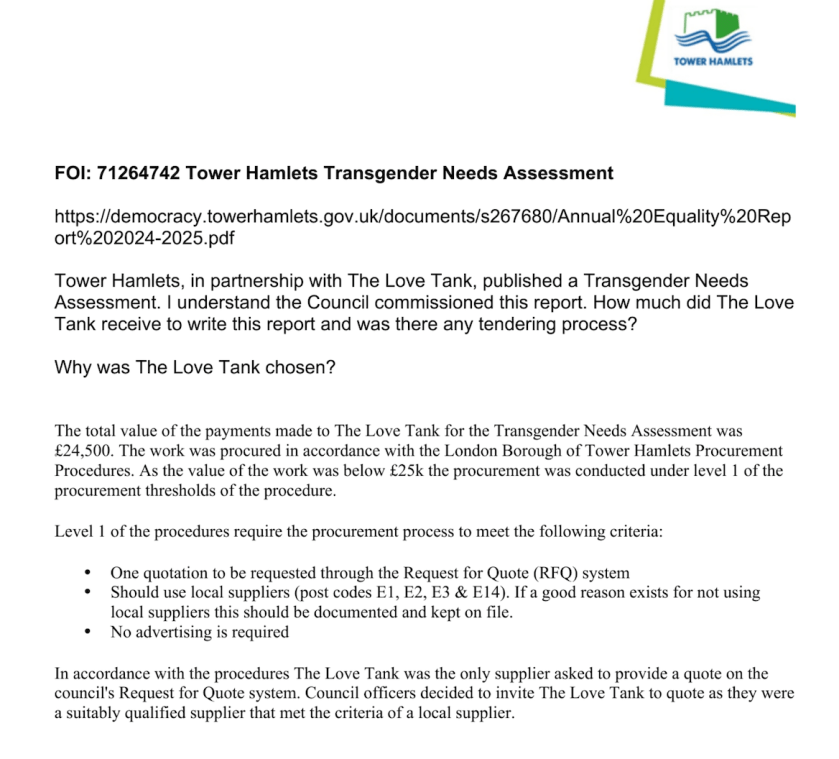
An FOI to Tower Hamlets revealed that, because the payment to The Love Tank had fallen just under £25,000, there had been no tendering process. How very queer! Sorry, I mean convenient.
Thank you for reading! Sign up to my blog by going to the bottom of the page.
Please share on other forums if you liked it, as I only do Twitter.


Great update, difficult lesbians indeed 😆. How very worthy to have vegan Palestinian food in their sacred space. Sounds a real fun space – not.
LikeLiked by 1 person